How to Make Your Home Safer for Elderly Parents: Window Security Guide
If you are an adult child worrying about an aging parent living alone, window security is one of the most overlooked and most impactful upgrades you can make during your next visit. Seniors are disproportionately targeted by burglars, and the windows in a home your parent has lived in for decades are probably protected by nothing more than the same flimsy locks that were installed when the house was built. This guide gives you a practical, step-by-step plan to assess your parent's window vulnerabilities, choose the right products, install them yourself in an afternoon, and train your parent and their caregivers on emergency egress.
You do not need to be a contractor. You do not need special tools. You need a cordless drill, a tape measure, a level, and one Saturday afternoon. By the time you drive home, your parent's home will have professional-grade physical security on every window -- security that works 24 hours a day without batteries, subscriptions, internet, or any action required from your parent.
Step 1: Assess Your Parent's Home -- The Window Security Walkthrough
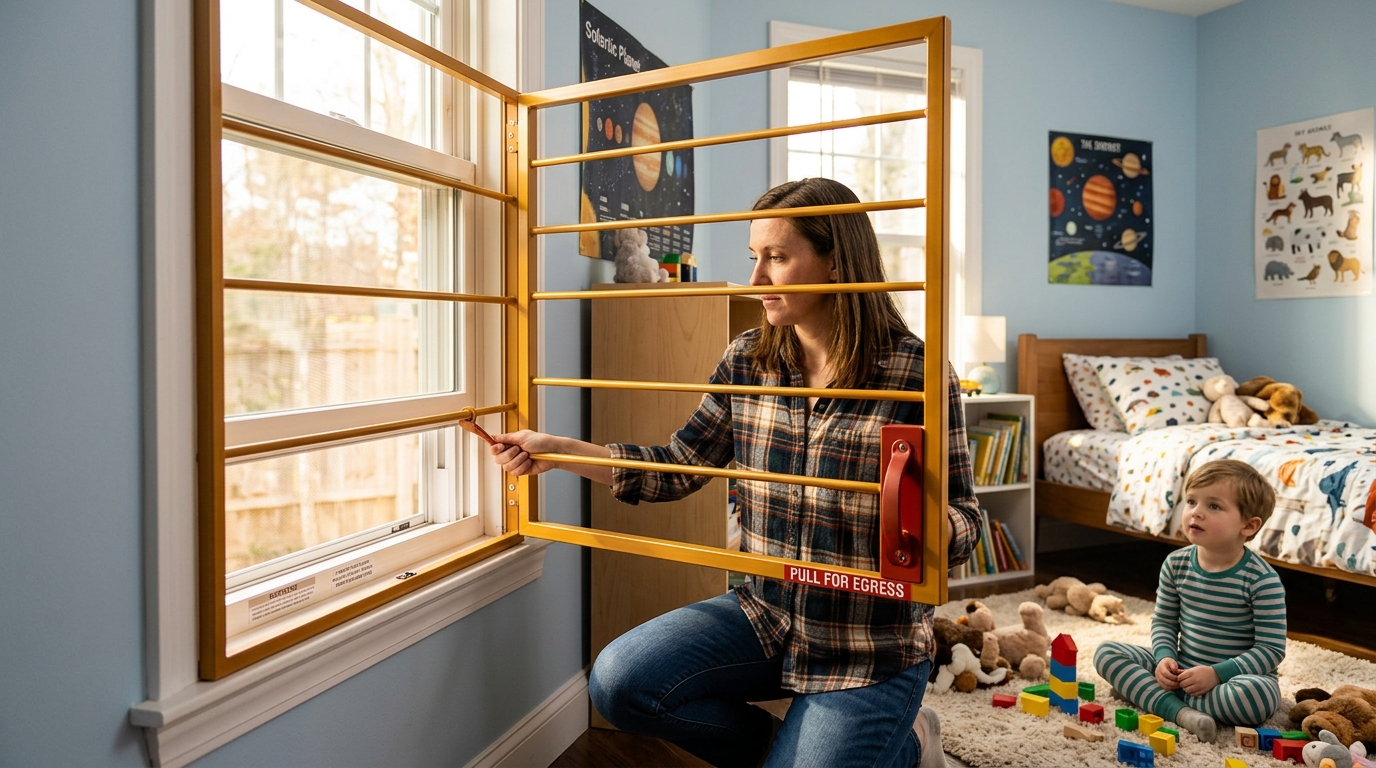
Before you buy anything, walk every room of your parent's home with a critical eye toward window security. Most adult children are surprised by what they find -- windows that do not lock properly, screens that a toddler could push out, and entire rooms with zero security beyond a pane of glass.
The Assessment Checklist
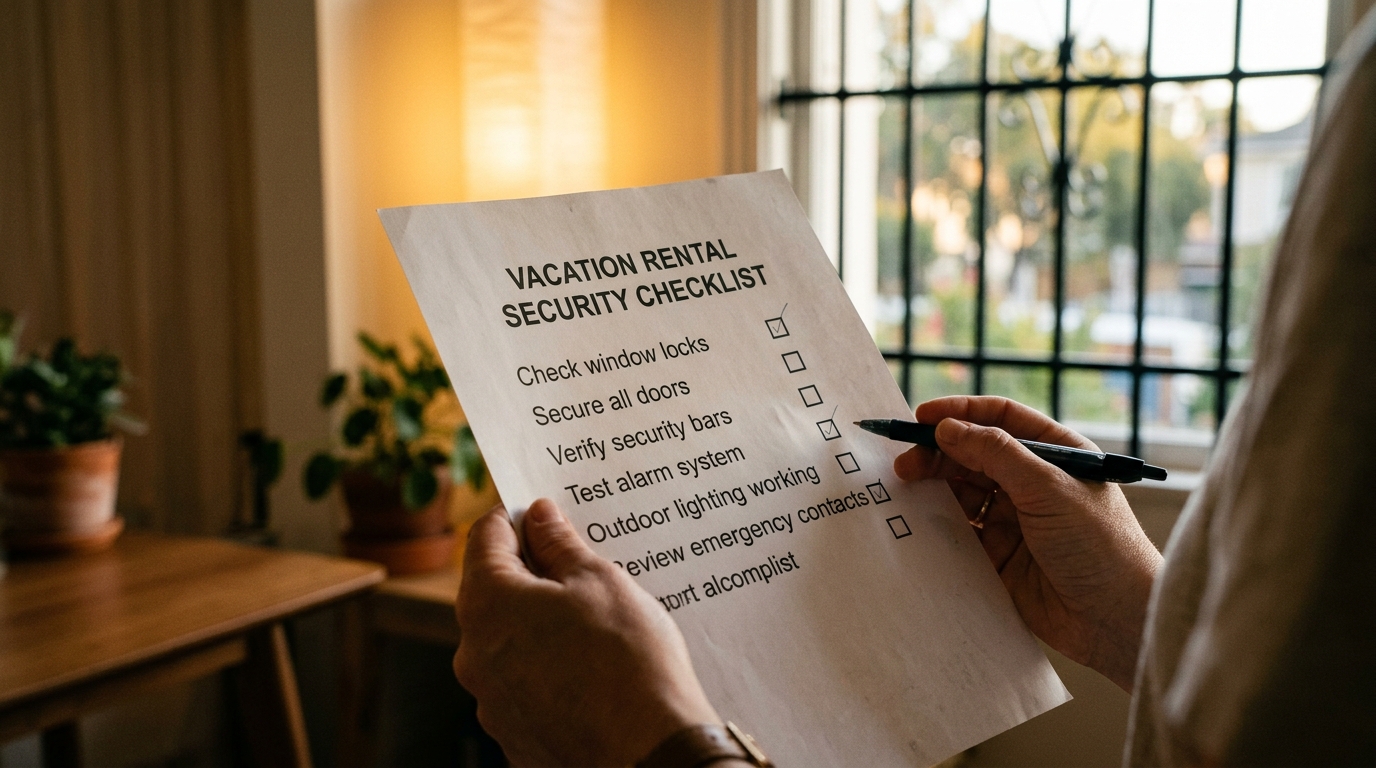
Print this checklist or save it on your phone. Go room by room and note every issue.
| Check | What to Look For | Risk Level |
|---|---|---|
| Window lock function | Does every window lock engage and hold? Test by pushing on the sash after locking. | High if any lock fails |
| Ground-floor accessibility | Can someone reach a ground-floor window from outside without a ladder? | High for all ground-floor windows |
| Visibility from street | Are any windows concealed by landscaping, fences, or structure from street view? | High -- concealed windows are primary targets |
| Window type and age | Single-pane, double-hung, casement, sliding? Age of hardware? | Moderate -- older hardware is weaker |
| Bedroom identification | Which rooms are used for sleeping? Include any room your parent naps in. | Critical -- bedrooms require egress bars |
| Sliding glass doors | Is there a sliding glass door? Is it secured beyond the standard latch? | High -- sliding doors are easy to force |
| Basement windows | Are basement windows accessible from outside? Are they secured? | High -- most common burglary entry point |
| Furniture near windows | Is furniture positioned where your parent might lean against a window? | Moderate -- fall risk for unsteady seniors |
| Approach path from bed to window | Can your parent reach the bedroom window without obstacles? Is the path clear of tripping hazards? | Critical for fire egress |
| Exterior lighting | Are windows lit at night? Motion lights present? | Moderate -- darkness enables burglary |
What Most Adult Children Discover
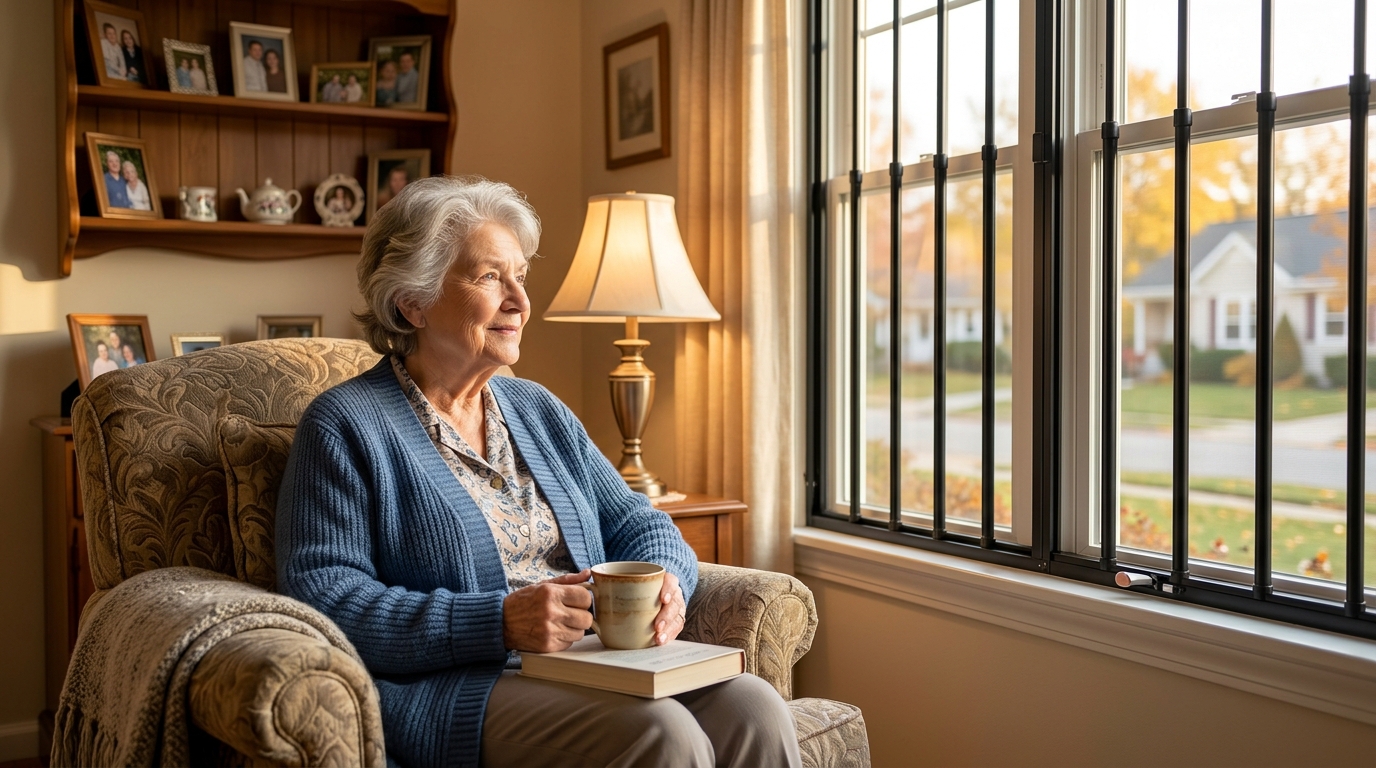
After this walkthrough, the typical finding is that the parent's home has multiple ground-floor windows with outdated locks, zero physical barriers on any window, concealed windows on the side or back of the house, and a sliding glass door with nothing more than a standard latch. The good news: all of this can be addressed in a single afternoon with the right products.
Step 2: Create a Window-by-Window Security Plan
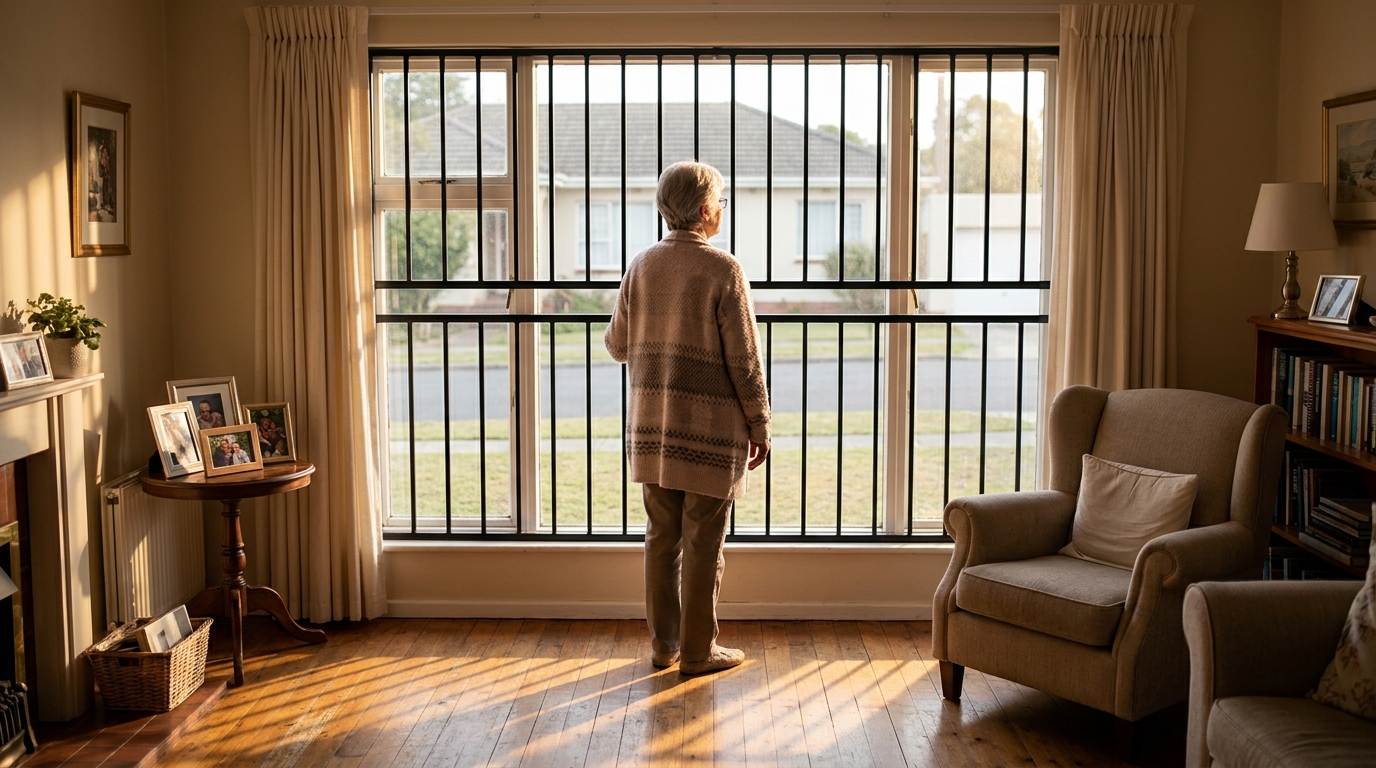
Using your assessment, create a simple spreadsheet or list that maps every window in the house to the right product. Here is a template:
| Room | Window Count | Sleeping Room? | Floor Level | Product | Priority |
|---|---|---|---|---|---|
| Master bedroom | 2 | Yes | Ground | Model A/EXIT | 1 |
| Guest bedroom | 1 | Yes (or nap room) | Ground | Model A/EXIT | 1 |
| Living room | 3 | No | Ground | Model A | 2 |
| Kitchen | 1 | No | Ground | Model A | 3 |
| Bathroom | 1 | No | Ground | Model A | 3 |
| Sliding glass door | 1 (2 modules) | No | Ground | Model A (modular) | 2 |
The rule is simple: if your parent sleeps in the room, it gets Model A/EXIT. Every other window gets Model A. No exceptions. The fire code requires quick-release egress on bedroom windows, and this is the one area where there is zero room for compromise. For a detailed look at legal requirements, see the state-by-state legality guide.
Budget-Constrained Approach
If budget is a concern, prioritize in this order:
- All bedroom windows -- Model A/EXIT (~$92 each) -- non-negotiable for fire safety
- Concealed ground-floor windows -- Model A (~$90 each) -- highest burglary risk
- Sliding glass door -- Model A modular (~$180) -- large, easy-to-force opening
- Remaining ground-floor windows -- Model A (~$90 each) -- complete the perimeter
- Basement windows -- Model A (~$90 each) -- if applicable
Even if you can only afford the bedroom windows today, do those first. They cover the highest personal-safety risk (fire egress) and the highest burglary vulnerability (bedrooms contain valuables and are occupied when the senior is most defenseless).
Step 3: Choose the Right Products for Each Window
For elderly parents, product selection must prioritize ease of use above all other factors. The SWB Model A/EXIT (~$92) is specifically designed with a lever-style quick-release mechanism that operates with a palm push -- no grip strength, no fine motor skills, no keys required. This is critical for seniors with arthritis, visual impairment, or cognitive decline.
Measuring Windows
Before ordering, measure each window opening:
- Measure the inside width at three points: top, middle, bottom. Use the smallest measurement.
- Measure the inside height at three points: left, center, right. Use the smallest measurement.
- The Model A's telescopic adjustment handles standard residential windows without custom sizing.
For sliding glass doors, measure the total opening width and plan for 2-3 Model A modules that stack side by side. For full measurement instructions, see our installation guide.
Step 4: Installation Day -- What to Bring and What to Expect
Tools Required
- Cordless drill with driver bits (including the anti-tamper security bit included with SWB bars)
- Tape measure
- Level (a 12-inch torpedo level is sufficient)
- Pencil for marking
- Safety glasses
- Step stool (if any windows are at height)
- Silicone lubricant spray (for the quick-release mechanisms after installation)
Time Estimate
| Task | Time |
|---|---|
| Unbox and organize bars | 15 minutes |
| Extend and lock telescopic bars to width | 2 minutes per bar |
| Install each bar (frame mount) | 15-20 minutes per window |
| Test all quick-release mechanisms | 2 minutes per window |
| Train your parent on egress | 20-30 minutes |
| Clean up | 15 minutes |
| Total for 10-window home | 3.5-4.5 hours |
For detailed time estimates by mount type, see our installation time guide.
Installation Steps (Frame Mount)
- Extend the telescopic bar to match your window width measurement. Lock the set screw firmly.
- Position the bar inside the window opening. Check level. Mark pilot hole positions through the bracket holes with a pencil.
- Pre-drill pilot holes at each marked position. Use a drill bit one size smaller than the mounting screws.
- Reposition the bar and align with pilot holes.
- Drive anti-tamper fasteners through brackets into the frame. Tighten until the bar is snug with zero movement.
- Test rigidity -- push, pull, and attempt to rattle the bar. It should be completely solid.
- For Model A/EXIT: operate the quick-release mechanism to confirm it functions smoothly. Apply a light coat of silicone lubricant to the pivot points.
Tips for Working in a Senior's Home
- Work one room at a time to minimize disruption to your parent's routine.
- Clean as you go -- seniors are more sensitive to construction mess than younger homeowners.
- Explain what you are doing as you work. This reduces anxiety and helps your parent feel included rather than imposed upon.
- Leave all packaging and debris bagged and removed before you leave. Do not add to your parent's trash burden.
Step 5: Train Your Parent on Emergency Egress
This step is as important as the installation itself. A quick-release mechanism that your parent cannot operate in an emergency provides zero fire safety benefit.
Training Protocol
- Show and tell: Stand at the bedroom window with your parent. Point to the release mechanism. Explain: "If there is ever a fire and you cannot get to the door, push this lever and the bars swing open. Then open the window and climb out or call for help."
- Guided practice: Have your parent operate the release while you watch. Coach them through the motion. Do this at least twice on each bedroom window.
- Eyes-closed practice: Have your parent close their eyes (simulating smoke or darkness) and locate the release mechanism by touch. Then operate it. This builds the muscle memory that will matter during a real emergency.
- Full sequence practice: Have your parent practice the complete sequence: locate release, push lever, swing bars open, open the window. They do not need to climb out -- just go through the steps to the open window.
- Written reminder: Post a large-print instruction card near each bedroom window: "FIRE ESCAPE: Push lever on window bars. Bars swing open. Open window. Exit or call for help."
Addressing Resistance
Some seniors find emergency drills anxiety-inducing. Reassure your parent that the bars make the home safer overall and that knowing how the release works is just like knowing where the fire extinguisher is -- preparation, not panic. Keep the training calm, patient, and encouraging.
Step 6: Establish Caregiver Protocols
If your parent has a home health aide, visiting nurse, or regular caregiver, that person needs the same training you gave your parent. Create a simple one-page instruction sheet that covers:
- Location of every barred window in the home
- Which windows have quick-release (bedroom windows)
- How to operate the release (with a simple diagram or photo)
- Emergency procedure: release bars, open window, assist the senior out, call 911
- Your contact information as the family member responsible for the home
Give this sheet to every new caregiver on their first day. Ask them to practice the release on at least one window during their first shift. This one-minute training could save your parent's life.
Step 7: Integrate with Medical Alert and Alarm Systems
Window bars work independently of any electronic system, which is one of their greatest strengths for seniors. But they are even more effective when integrated into a broader safety plan.
Medical Alert (PERS) Integration
If your parent wears a medical alert pendant or wristband, the window bars complement it perfectly. The alert button summons help for medical emergencies; the bars prevent criminal intrusion. Together, they cover the two primary safety risks for seniors living alone.
Smoke Alarm Coordination
Upgrade to interconnected smoke alarms if your parent's home still has standalone units. Interconnected alarms trigger throughout the house when any single alarm detects smoke, giving your parent maximum warning time to wake up, reach the window, and operate the quick-release if the door exit is blocked. Modern interconnected alarms cost $25-$40 each and can be installed during the same visit as the window bars.
Optional: Smart Home Monitoring
For tech-comfortable families, a smart home hub with door/window sensors can alert adult children when windows are opened at unusual hours. This adds a digital monitoring layer on top of the physical barrier provided by window bars. However, this is strictly optional -- the bars provide full protection without any smart home technology.
Step 8: Set Up a Maintenance Schedule
Window bars are virtually maintenance-free, but a brief twice-yearly check ensures everything stays in peak condition for decades.
Every 6 Months (Spring and Fall)
- Test every quick-release mechanism. The lever should move smoothly with minimal force. If any resistance is felt, apply silicone lubricant.
- Check mounting hardware. Attempt to rattle each bar. If any movement is detected, tighten the fasteners.
- Inspect the finish. Look for chips, scratches, or rust spots on the powder coat. Touch up minor damage with matching paint to prevent corrosion.
- Verify clear approach paths. Has furniture been moved closer to windows? Has medical equipment been positioned in a way that blocks the egress path?
- Re-train if needed. Ask your parent to demonstrate the quick-release. If they hesitate or cannot remember the motion, practice again until it is automatic.
This entire check takes 15 minutes for a full house. Add it to your regular visit routine and it becomes second nature.
Frequently Asked Questions
How much does it cost to secure an elderly parent's home with window bars?
A typical single-story senior home with 8-10 windows costs approximately $800-$1,000 to fully equip with SWB window bars. Bedroom windows use the Model A/EXIT (~$92 each) for fire egress compliance, and all other windows use the Model A (~$90 each). This is a one-time investment with no monthly fees. DIY frame-mount installation requires only a cordless drill and takes 15-20 minutes per window, so there is no professional installation cost unless you prefer to hire help.
Can I install window bars at my parent's house in one day?
Yes. Frame-mount installation on a 10-window home takes approximately 3.5 to 4.5 hours including unpacking, measuring, installing, testing, training your parent, and cleaning up. A single person can complete the entire project in one Saturday afternoon. If you bring a helper, you can finish in 2-3 hours. Masonry-mount installation takes longer (30-45 minutes per window) but is only necessary for brick or concrete walls.
Will my parent be able to escape a fire with window bars installed?
Yes, as long as bedroom windows have egress-compliant bars like the SWB Model A/EXIT. The quick-release lever operates with a simple palm push that requires no keys, tools, or significant grip strength. The bars swing fully open to provide the 5.7 square feet of clear egress opening required by the IBC and NFPA fire codes. Practice the release with your parent at least twice during installation and again every six months to maintain muscle memory.
Do window bars work if my parent has dementia?
Window bars provide excellent security for seniors with dementia because they work passively -- they do not require the senior to remember to lock anything. The bars also prevent window-exit wandering, which is a documented risk for people with moderate to advanced dementia. For fire egress, the quick-release mechanism on the Model A/EXIT requires a deliberate lever push that a confused person is unlikely to perform accidentally. However, in households with a dementia patient, a caregiver who is trained to operate the release should always be present or on immediate call.
What if my parent rents their home -- can I still install window bars?
You should get landlord permission before drilling into window frames or walls. Many landlords will approve window bar installation because it improves property security and potentially reduces their insurance premiums. Frame-mount installation leaves minimal holes that are easily patched if the bars are removed later. If the landlord refuses permission, tension-fit options exist, though screwed connections are more secure. In some jurisdictions, landlords are required to provide security measures for elderly or vulnerable tenants upon request. Contact your local housing authority if the landlord is uncooperative.
Make It Happen This Weekend
You have the checklist. You have the product recommendations. You have the installation timeline. The only thing standing between your parent's current vulnerability and professional-grade window security is a Saturday afternoon and a cordless drill.
Order this week. Install this weekend. Sleep better knowing your parent is safer.
- Window Security Bars for Seniors -- Full buyer's guide for aging in place
- Model A/EXIT -- Quick-release egress | Senior-friendly | ~$92
- Model A -- Telescopic + Modular | Non-bedroom windows | ~$90
- Child Safety Window Bars -- If grandchildren also visit
- Pricing Guide -- Full cost breakdown by home type