Decorative Window Security Bars: Modern Designs That Actually Look Good
Window security bars have a reputation problem. For decades, the phrase conjured images of grim, institutional-looking iron grates that screamed "high-crime neighborhood" louder than any alarm system. But that era is over. Today's decorative window security bars combine serious protection with designs that genuinely enhance a home's appearance — and many homeowners are surprised to learn that the right bars can actually increase curb appeal rather than diminish it.
This guide covers everything you need to know about choosing window security bars that look as good as they perform. From sleek minimalist profiles to custom color options and HOA-friendly designs, you'll learn how modern engineering has transformed an ugly necessity into an architectural feature worth showing off.
How Decorative Window Bars Have Evolved
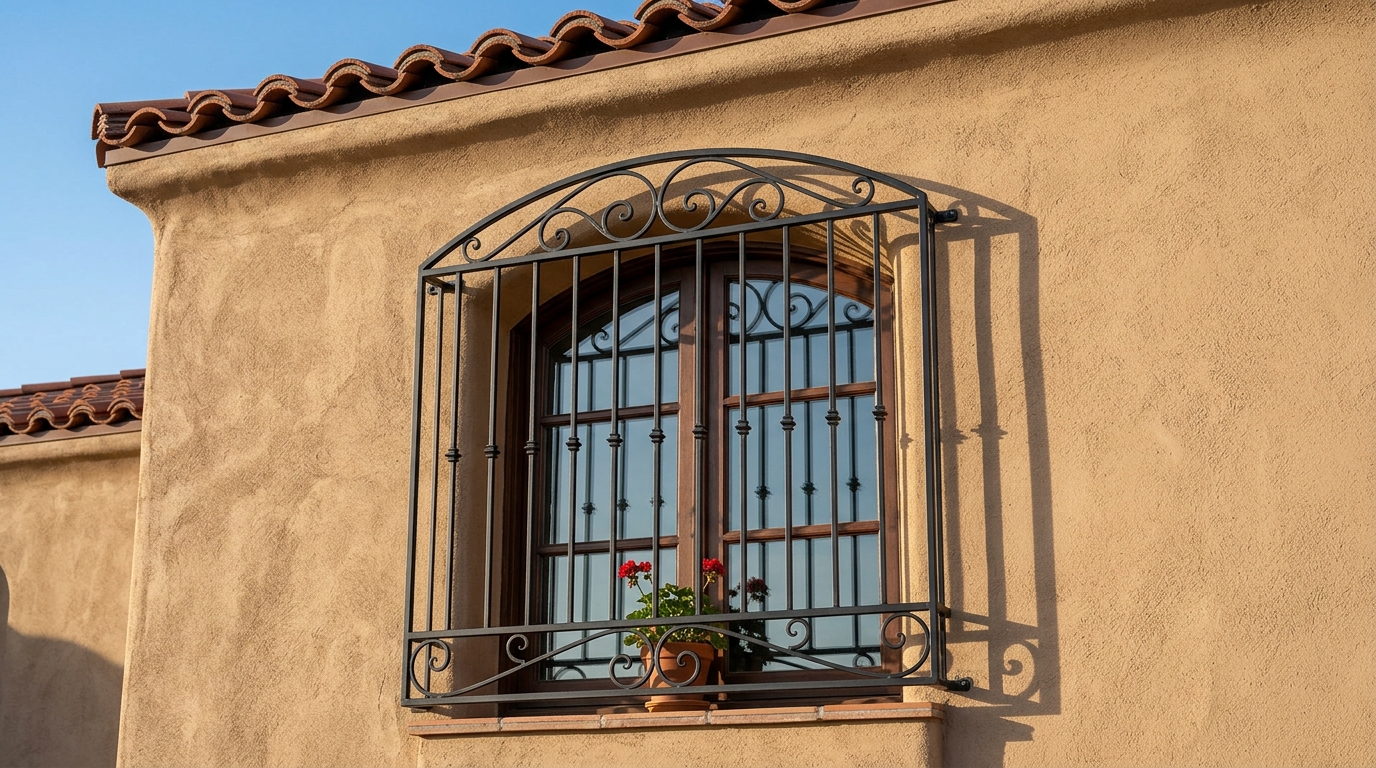
The history of window security bars in America is essentially a story about function slowly learning to coexist with form. The earliest residential window bars — common in cities like New York, Chicago, and Philadelphia from the 1960s through the 1990s — were purely utilitarian. Fabricated from raw steel or iron, they were welded in simple grid patterns, painted black (if painted at all), and bolted permanently into masonry. They worked, but they looked terrible.
Several forces drove the evolution toward decorative designs:
- HOA regulations — As homeowner associations gained power in the 1990s and 2000s, blanket bans on "ugly" security features forced manufacturers to rethink design.
- Property value awareness — Homeowners realized that prison-style bars could decrease perceived property value, creating demand for aesthetically neutral or positive options.
- Powder-coating technology — Modern powder-coat finishes opened the door to virtually unlimited color matching, allowing bars to blend with any exterior palette.
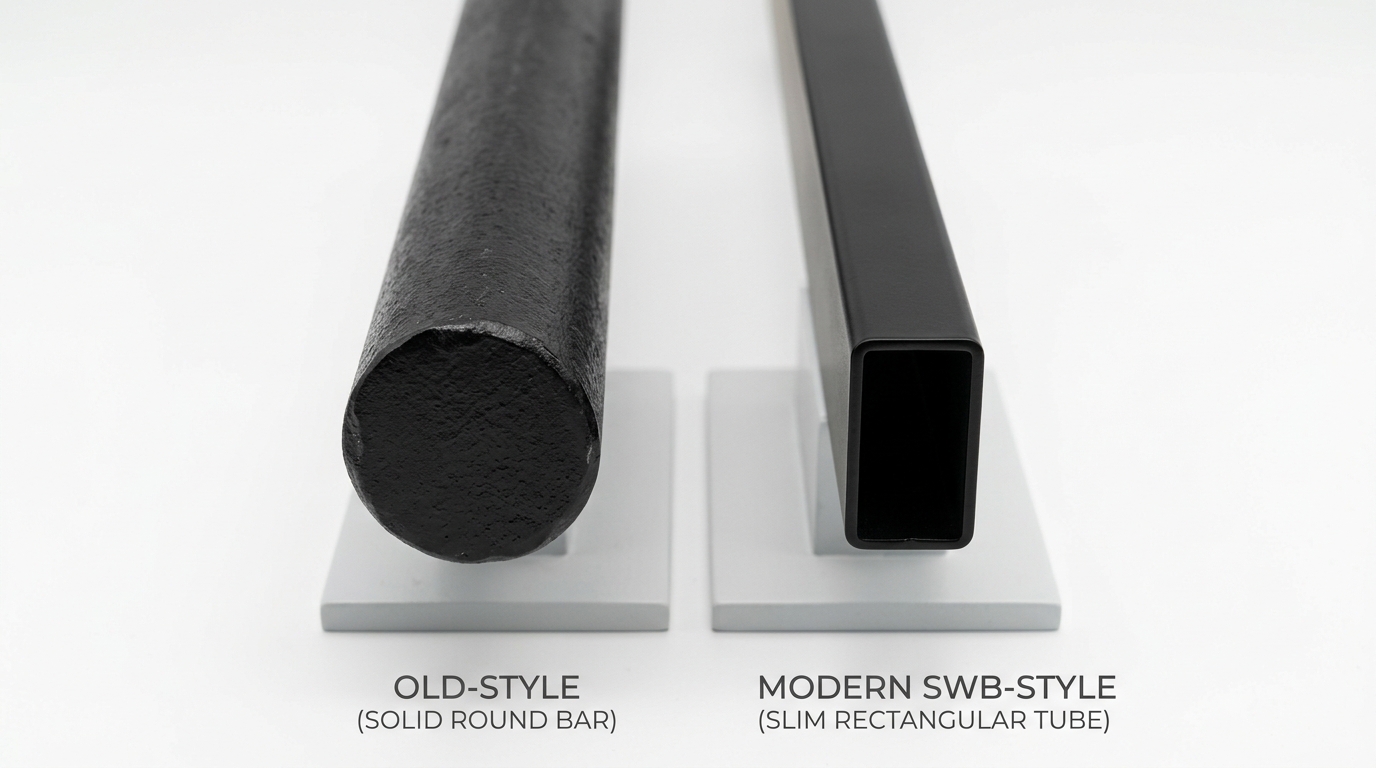
- Modular and telescopic engineering — Designs like SWB's Model A replaced crude fixed-width bars with clean, adjustable profiles that look intentional rather than retrofitted.
- Minimalist architecture trends — The broader cultural shift toward clean lines and minimal ornamentation created a market for security bars that look like design features.
Today, decorative window security bars occupy a range from ornate scrollwork patterns that echo Mediterranean or colonial architecture to ultra-clean linear profiles that suit modern and contemporary homes. The key advancement is that homeowners no longer have to choose between security and appearance. You can have both.
Modern Design Styles and Profiles
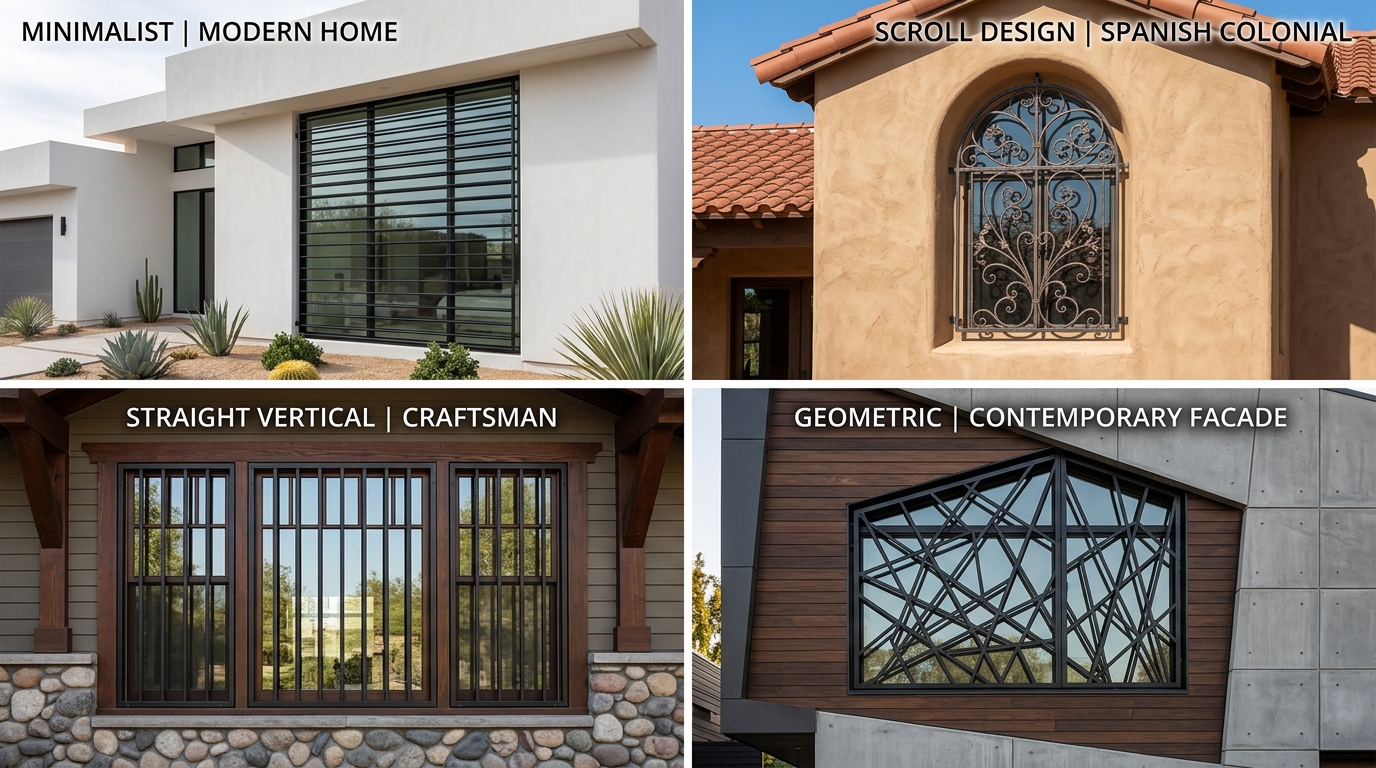
Decorative window bars fall into several distinct design families. Understanding these categories helps you match bars to your home's architectural style.
Minimalist / Linear
The fastest-growing category. These bars feature simple vertical or horizontal lines with consistent spacing, no scrollwork, and slim profiles. They look deliberate — more like architectural mullions than security barriers. SWB's Model A exemplifies this style with its clean telescopic design that integrates visually with the window frame rather than sitting in front of it like an afterthought.
Contemporary Geometric
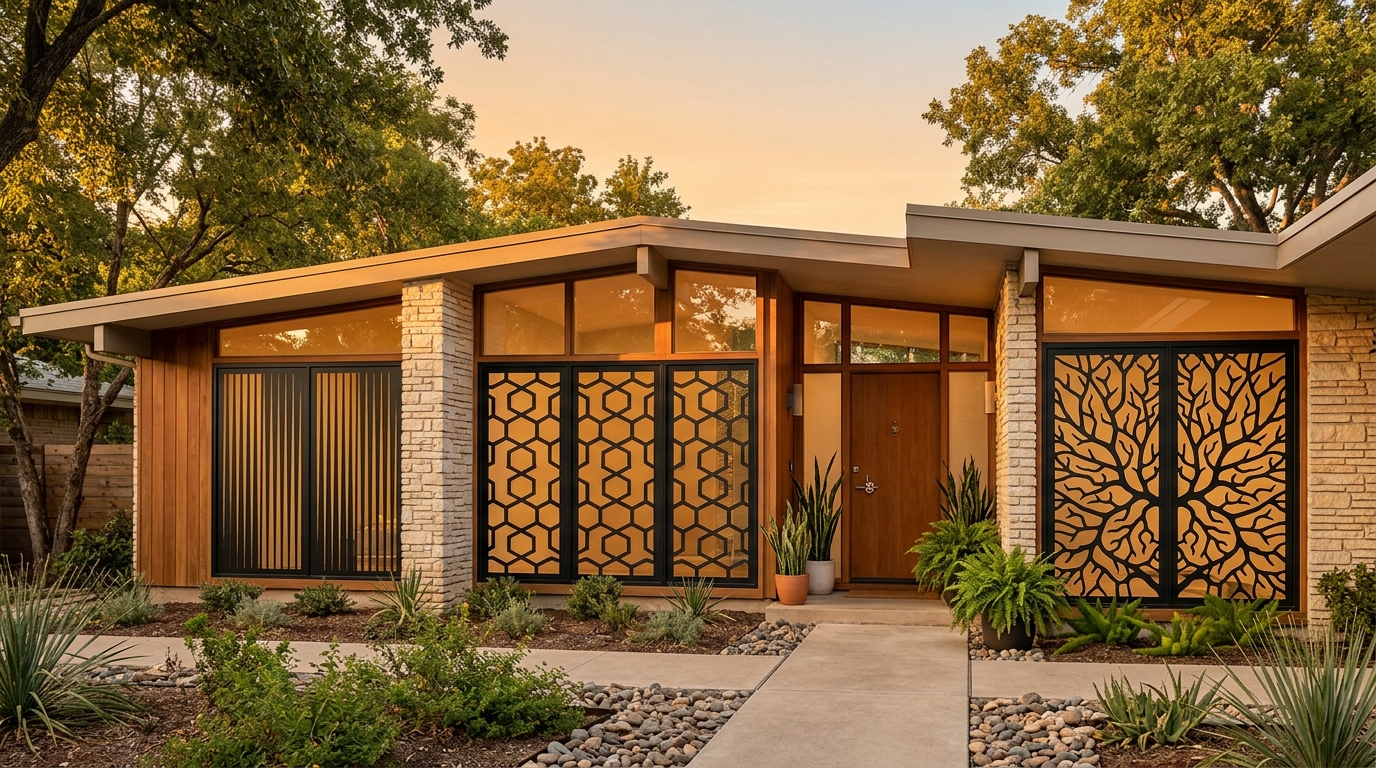
Rectangular, diamond, or staggered patterns that add visual interest without ornate detail. These work well on mid-century modern homes, ranch-style houses, and contemporary builds. The geometry creates a design element that reads as intentional architectural detail.
Traditional Scrollwork
Curved ironwork patterns — S-curves, scrolls, fleur-de-lis motifs — that suit colonial, Mediterranean, Spanish Revival, Tudor, and Victorian architecture. When matched to the home's existing metalwork (railings, gates, light fixtures), these bars enhance rather than detract from architectural character.
Industrial / Loft
Raw steel or blackened-steel aesthetic bars with visible welds and heavy gauge construction. These work on converted warehouses, loft apartments, and industrial-chic homes where the bar's function becomes part of the design language. SWB's Model B, designed for masonry mounting, carries this industrial-strength aesthetic naturally.
Invisible / Low-Profile
The newest category. Bars engineered to be as visually unobtrusive as possible — narrow profiles, matching frame colors, interior mounting that hides them from street view. For homeowners who want security without any visible change to their home's exterior, interior-mounted bars are the ultimate solution.
Color Options and Powder-Coat Finishes
Color is arguably the single biggest factor in whether window bars enhance or harm your home's appearance. The old default — flat black — works on some homes but looks jarring on others. Modern powder-coating technology has changed the game entirely.
How Powder Coating Works
Unlike liquid paint, powder coating applies a dry powder electrostatically, then cures it under heat to form a skin that's far more durable than conventional paint. The result is a finish that resists chipping, scratching, fading, and corrosion for years without maintenance. SWB bars come standard with powder-coated finishes.
Popular Color Choices
- Black — Still the most popular. Works universally, especially on white, gray, brick, and stone exteriors. Creates a clean contrast.
- White — Ideal for white or light-colored homes. Virtually disappears against white trim. Very popular in coastal and farmhouse styles.
- Bronze / Dark Brown — Blends with earth-tone exteriors, brick homes, and wood accents. Less contrast than black, more warmth.
- Custom match — Many manufacturers can match bars to your exact window frame color, siding, or trim paint. This is the ultimate way to make bars disappear visually.
The Color Matching Strategy
The golden rule of decorative window bar color selection: match the bars to whatever they sit closest to. If bars mount inside the frame, match the frame color. If they mount on the wall face, match the siding or trim. When bars match their immediate surroundings, the eye registers them as part of the architecture rather than an addition.
Architectural Integration: Making Bars Part of the Design
The difference between bars that look like a security add-on and bars that look like they belong comes down to integration. Here's how to make window security bars feel like a deliberate design choice.
Match Existing Metalwork
Look at your home's existing metal features — porch railings, stair balusters, gate hardware, light fixtures, house numbers. When window bars echo the same style, weight, and finish as these elements, they read as part of a cohesive design language rather than a one-off security measure.
Respect the Architecture
Scrollwork on a minimalist modern home looks as wrong as industrial bars on a Victorian. Choose bar designs that honor your home's architectural period and design intent. When in doubt, go simpler — clean linear bars work on nearly every architectural style.
Use Interior Mounting
Mounting bars on the interior rather than the exterior eliminates the street-facing visual impact entirely. From outside, windows look completely normal. From inside, the bars provide full protection. This approach is especially popular in HOA-controlled neighborhoods.
Frame Mount for Clean Lines
SWB's Model A frame mount system installs inside the window frame itself, creating a flush, integrated look with no visible brackets or mounting hardware on the wall face. Compare this to traditional wall-mount installations where brackets and anchors are visible, and the difference in perceived quality is significant.
Consider Partial Coverage
Not every window needs bars. Ground-floor windows facing streets or alleys are the priority. Upper-floor windows, windows facing fenced backyards, and windows above garages are lower risk. Strategic placement looks more intentional than covering every window on the house.
HOA-Friendly Window Bar Options
Homeowner associations are one of the biggest obstacles to window security bar installation, but they don't have to be a dealbreaker. The key is understanding what HOAs actually object to and choosing products that address those objections proactively.
Why HOAs Restrict Window Bars
Most HOA restrictions on window bars stem from three concerns:
- Aesthetic consistency — HOAs want the neighborhood to maintain a uniform, attractive appearance
- Property value protection — The perception (often outdated) that bars signal a high-crime area and depress values
- Architectural control — Boards want approval authority over anything that changes a home's exterior appearance
Notice what's not on that list: security. HOA boards rarely argue that homeowners shouldn't protect their homes. They argue about how it's done. This distinction is your leverage.
Features That Pass HOA Review
- Powder-coated finish matching the home's trim or frame color — Bars that blend visually are harder to object to
- Interior mounting — If bars aren't visible from the street, most HOA rules don't apply
- Clean, minimalist profiles — No ornate scrollwork that could be deemed inconsistent with the neighborhood
- Frame-mount installation — No visible hardware on the building exterior
- Documented fire safety compliance — Showing that bars meet egress codes demonstrates responsible installation
For a detailed walkthrough of the HOA approval process, see our companion guide: How to Get Your HOA to Approve Window Security Bars.
How the Right Bars Boost Curb Appeal
It sounds counterintuitive, but well-chosen decorative window bars can actually improve a home's curb appeal. Here's how:
Visual Depth and Dimension
Windows are flat surfaces. Bars add a layer of depth and shadow that creates visual interest, much like shutters, flower boxes, or decorative trim. This layering effect is a fundamental principle of architectural design.
Signal of Investment
High-quality decorative bars communicate that the homeowner has invested in the property. Like a well-maintained fence or a professional landscape, quality security features suggest pride of ownership. The key word is "quality" — choosing the right bars makes the difference between communicating investment and communicating fear.
Consistency and Character
When bars match the home's metalwork vocabulary — same finish as the gate, same profile as the railing — they add to the home's overall character rather than detracting from it. Think of Spanish colonial homes with ornate ironwork: the window grilles are as much a part of the style as the clay tile roof.
Neighborhood Context Matters
In neighborhoods where window bars are common (many urban areas, historic districts), the presence of bars is neutral or positive. In neighborhoods where bars are rare, the impact depends entirely on the product quality and how well the installation is executed. This is where choosing decorative options over utilitarian ones makes a measurable difference.
Materials: Steel, Wrought Iron, and Aluminum Compared
The material you choose affects appearance, strength, durability, and price. Here's an honest comparison.
| Material | Strength | Weight | Corrosion Resistance | Decorative Potential | Price Range |
|---|---|---|---|---|---|
| Powder-Coated Steel | Excellent | Heavy | Very Good (with coating) | High (smooth, uniform finish) | $$ |
| Wrought Iron | Good | Very Heavy | Moderate (needs maintenance) | Very High (hand-forged details) | $$$$ |
| Aluminum | Low | Light | Excellent | Moderate | $$ |
| Stainless Steel | Excellent | Heavy | Excellent | Moderate (industrial look) | $$$ |
The practical choice for most homeowners: Powder-coated steel delivers the best combination of strength, appearance, and value. SWB's Model A and Model B both use powder-coated steel specifically because it offers commercial-grade security with a finish that looks clean for years without repainting.
Wrought iron is beautiful but expensive and maintenance-heavy. Aluminum looks decorative but offers minimal actual security — most burglars can bend aluminum bars with basic tools. Stainless steel works in commercial settings but has a clinical look that feels cold on residential properties.
Residential vs. Commercial Decorative Bars
The decorative priorities differ significantly between homes and commercial buildings.
Residential Priorities
- Curb appeal and neighbor perception
- HOA compliance
- Color matching to existing architecture
- Low-profile installation (frame mount preferred)
- Fire safety and egress compliance for bedrooms
- Renter-friendly removability for apartments
For homes, SWB's Model A is the go-to choice. Its telescopic design adjusts to fit standard window widths, the frame-mount option requires no drilling, and the powder-coated finish comes in black or white with custom color options available. At roughly $90 per window, it's the most cost-effective decorative option on the market.
Commercial Priorities
- Maximum strength and pry resistance
- Professional appearance that doesn't deter customers
- Compliance with ADA and commercial building codes
- Permanent installation that can't be tampered with
- Durability in high-traffic environments
For commercial properties, especially those with brick, concrete, or block walls, SWB's Model B provides heavy-gauge steel construction with masonry-specific anchoring. The clean, professional profile doesn't scream "security" to customers while still providing commercial-grade protection. It's a favorite for retail storefronts and professional offices in ground-floor spaces.
How to Choose Decorative Bars for Your Home
Follow this step-by-step process to select decorative window bars that protect your home and enhance its appearance.
Step 1: Assess Your Windows
Measure each window you want to protect. Note the frame material (wood, vinyl, aluminum), the wall material around the frame (siding, brick, stucco), and whether the window is a designated egress point (typically bedrooms).
Step 2: Identify Your Architectural Style
Match your bar design to your home's architecture. Modern homes get linear profiles. Traditional homes can handle more ornate options. When in doubt, minimalist is always safe.
Step 3: Choose Your Mounting Method
Frame mount is cleaner-looking and doesn't require drilling into walls. Wall mount is stronger and necessary for certain situations. For most residential applications, frame mount delivers the best visual result.
Step 4: Select Your Color
Match bars to the closest surrounding material. Frame mount = match the frame. Wall mount = match the trim or siding. Custom color matching is worth the small premium for homes where curb appeal is a priority.
Step 5: Check Local Requirements
Verify egress requirements for bedrooms. Check HOA rules. Review any local building codes that apply. Most jurisdictions allow window bars as long as bedrooms have operable egress — which is exactly what SWB's Model A/EXIT provides.
Step 6: Budget Realistically
A typical home needs bars on 4-8 ground-floor windows. At roughly $90-92 per window with SWB models, the total investment is $360-$736 — less than most alarm system installation fees and with no monthly monitoring cost. See our full pricing guide for detailed budgeting.
SWB Model A and Model B: Decorative Security Done Right
SWB designed its product line with the understanding that security and appearance are not opposing forces. Here's how each model addresses the decorative question.
Model A: The Residential Favorite
The Model A is built on a telescopic, modular platform that creates a clean, uniform appearance across all window sizes. Key decorative advantages:
- Telescopic adjustment means no awkward gaps or asymmetric spacing — every window gets a proportionally balanced look
- Frame mount option sits inside the window frame for a flush, integrated appearance
- Powder-coated steel in black or white, with custom color available
- Modular stacking for wide windows maintains consistent spacing across multi-unit installations
- No visible mounting hardware with frame installation — the bars look built-in
Model B: The Professional Standard
The Model B brings commercial-grade strength with a design profile clean enough for customer-facing businesses. Key decorative advantages:
- Heavy-gauge steel with uniform spacing that looks engineered, not improvised
- Professional powder-coated finish that maintains appearance in high-traffic environments
- Masonry-specific mounting that sits flush against brick and concrete without clumsy brackets
- Clean lines that communicate security without creating a fortress impression
Installation Options: Frame Mount vs. Wall Mount
Your mounting choice has a direct impact on how decorative the final result looks.
Frame Mount (Model A)
Frame mount installs bars inside the window frame using compression or screw-in brackets. The result is bars that appear to be part of the window itself. From the street, frame-mounted bars create minimal visual disruption because they occupy space the eye already expects to see filled by the window.
This is the preferred installation for homeowners who prioritize aesthetics, renters who need removable solutions, and any property subject to HOA review. The 15-minute DIY installation means no contractor is needed.
Wall Mount (Model A and Model B)
Wall mount attaches bars to the wall face surrounding the window using screws and anchors (masonry anchors for Model B). The bars sit in front of the window rather than inside it. This provides maximum security but is more visually prominent.
The decorative key to wall-mount installations: use the same color as the wall surface, ensure brackets are symmetrically placed, and keep the installation tight to the wall with minimal gap. A well-executed wall mount with color-matched bars can look surprisingly good, especially on brick where the masonry anchors are virtually invisible.
Frequently Asked Questions
Do decorative window security bars provide the same protection as standard bars?
Yes. Decorative window security bars made from powder-coated steel provide identical protection to plain bars. The steel gauge, weld quality, and mounting strength determine security performance — not the visual design. SWB bars use the same commercial-grade steel in all models. The decorative aspect comes from finish, profile design, and color, none of which compromise structural integrity.
What color window bars are least noticeable?
Bars that match the window frame color are least noticeable. White bars on white frames virtually disappear. Black bars on dark frames blend seamlessly. For maximum invisibility, choose interior-mounted bars — they're completely hidden from street view. If matching exactly isn't possible, darker colors are generally less conspicuous than lighter ones because they recede visually.
Will my HOA approve decorative window bars?
Many HOAs approve decorative window bars, especially interior-mounted or color-matched frame-mounted options. The key is submitting a formal proposal with product photos, color samples, and installation details before installation. Some states (including Texas and California) have laws limiting HOA ability to prohibit security devices. Check your CC&Rs and consult your board before purchasing.
How much do decorative window security bars cost compared to standard bars?
Modern decorative bars cost about the same as standard bars. SWB's Model A runs approximately $90 per window and includes a powder-coated decorative finish standard. Custom wrought iron decorative bars from local fabricators can cost $150-$500+ per window. The biggest cost difference is between mass-manufactured bars (like SWB) and custom one-off fabrication, not between decorative and plain styles.
Can I paint window security bars a custom color?
You can paint over powder-coated bars, but factory powder coating is more durable than field-applied paint. If you need a specific color, request a custom powder coat color at the time of purchase or choose a white or black base that's close to your desired shade. If painting in the field, use a high-quality exterior metal primer followed by exterior enamel for best results.
Do decorative window bars work on all window types?
Decorative bars work on virtually all standard window types including single-hung, double-hung, sliding, casement, and picture windows. SWB's telescopic Model A adjusts to fit most residential window widths. Unusual shapes like arched or circular windows may require custom fabrication. For vinyl windows, frame-mount options work without modification in most cases.
Are there window bars that don't look like prison bars?
Absolutely. Modern window bars have evolved far beyond the prison-bar look. Clean-profile bars like SWB's Model A resemble architectural mullions more than security bars. Interior-mounted bars are invisible from outside. Color-matched bars blend with the window. The "prison look" came from old-style raw iron grids — today's powder-coated, architecturally designed bars look nothing like that.
Do decorative window bars affect home resale value?
The impact depends on the product quality, installation quality, and neighborhood context. Cheap, ugly bars can hurt value. High-quality decorative bars that match the architecture are neutral to slightly positive, especially in neighborhoods where ground-floor security is a common concern. Removable frame-mount bars (like SWB Model A) can be taken down before listing if preferred. Read our full analysis on window bars and property value.
What is the most popular decorative window bar design?
Clean, minimalist vertical-bar designs are currently the most popular decorative style. They suit the widest range of architectural styles, are the easiest to get HOA approval for, and have the most neutral visual impact. Scrollwork and ornate designs are popular in specific architectural contexts (Mediterranean, colonial, Victorian) but represent a smaller share of overall sales.
Can decorative window bars be installed without drilling?
Yes. SWB's Model A offers a frame-mount installation that requires no drilling into walls. The bars mount inside the window frame using adjustable brackets. This makes installation a 15-minute DIY project, makes bars fully removable (great for renters), and leaves no holes or damage to the building. It's also the cleanest-looking installation method since no external hardware is visible.
The Bottom Line: Security That Looks Like It Belongs
The era of choosing between security and curb appeal is over. Modern decorative window security bars — especially engineered products like SWB's Model A and Model B — deliver commercial-grade protection in designs that enhance rather than diminish your home's appearance. Whether you're navigating HOA requirements, protecting property value, or simply refusing to settle for an ugly solution, decorative bars give you everything you need.
The key principles: match the color to your architecture, choose a profile that fits your home's style, opt for frame mount when possible for the cleanest look, and invest in powder-coated steel for a finish that lasts. Do those four things, and your neighbors will be asking where you got your bars — not whether you need them.