How to Install Window Bars Without Drilling Holes: The Complete Renter's Guide
Learn how to install window bars without drilling holes. Step-by-step guide for renters & apartments. No damage, no lease violations. Shop SWB today.
SWB: High-caliber Security Window Bars experts. We bring the most advanced protection within your reach, explained clearly. If you're a renter wondering how to install window bars without drilling holes, you're not alone — and you're asking exactly the right question. According to the FBI Uniform Crime Report, approximately 6.7 million burglaries occur across the United States every year, with nearly 60% of break-ins happening through ground-floor windows and doors. Apartment renters are among the most vulnerable, yet most assume that adding window security bars means drilling into walls, voiding a lease agreement, or losing a security deposit. That assumption is flat-out wrong. Modern telescopic and tension-mounted window bars — like those engineered by Security Window Bars (SWB) — require zero permanent fasteners, zero damage to walls or window frames, and zero calls to your landlord for permission. This guide walks you through every step of the process: choosing the right no-drill bar system, measuring your windows correctly, installing bars safely in under 20 minutes, and staying compliant with US building codes and egress requirements. Whether you rent in Chicago, Los Angeles, Houston, or New York City, this is the definitive renter's installation guide you've been searching for.
The National Crime Victimization Survey consistently identifies renters as disproportionately affected by property crime compared to homeowners. Ground-floor un…
Why Renters Need Window Security Bars — and Why Drilling Is Not the Answer
According to the US Census Bureau's 2023 data, there are 44.1 million apartment renters in the United States. The overwhelming majority of those renters live under lease agreements that explicitly prohibit permanent structural modifications — and drilling anchor holes into walls or window frames absolutely qualifies as a permanent structural modification. Beyond lease violations, unauthorized drilling can result in the forfeiture of your security deposit, eviction proceedings in extreme cases, and genuine structural damage to older building materials like plaster or brick that are common in cities like New York, Chicago, and Philadelphia. Yet the security need is undeniable. Ground-floor apartments are statistically the most targeted units in any residential building. A burglar testing window resistance for under 60 seconds will move on to an easier target — and a visible set of steel window bars is one of the most proven deterrents in residential security. The solution that bridges the gap between security and rental compliance is a no-drill, tension-mounted or fully telescopic window bar system. These systems use the window frame itself — the existing structural element — as the anchor point. No holes. No damage. And when moving day comes, the bars come out in minutes and go right back in your next apartment. Understanding how to install window bars without drilling holes is not a workaround; it is the smartest, most practical approach to urban renter security in 2025.
The Cost of Doing Nothing: Burglary Risk for Ground-Floor Renters
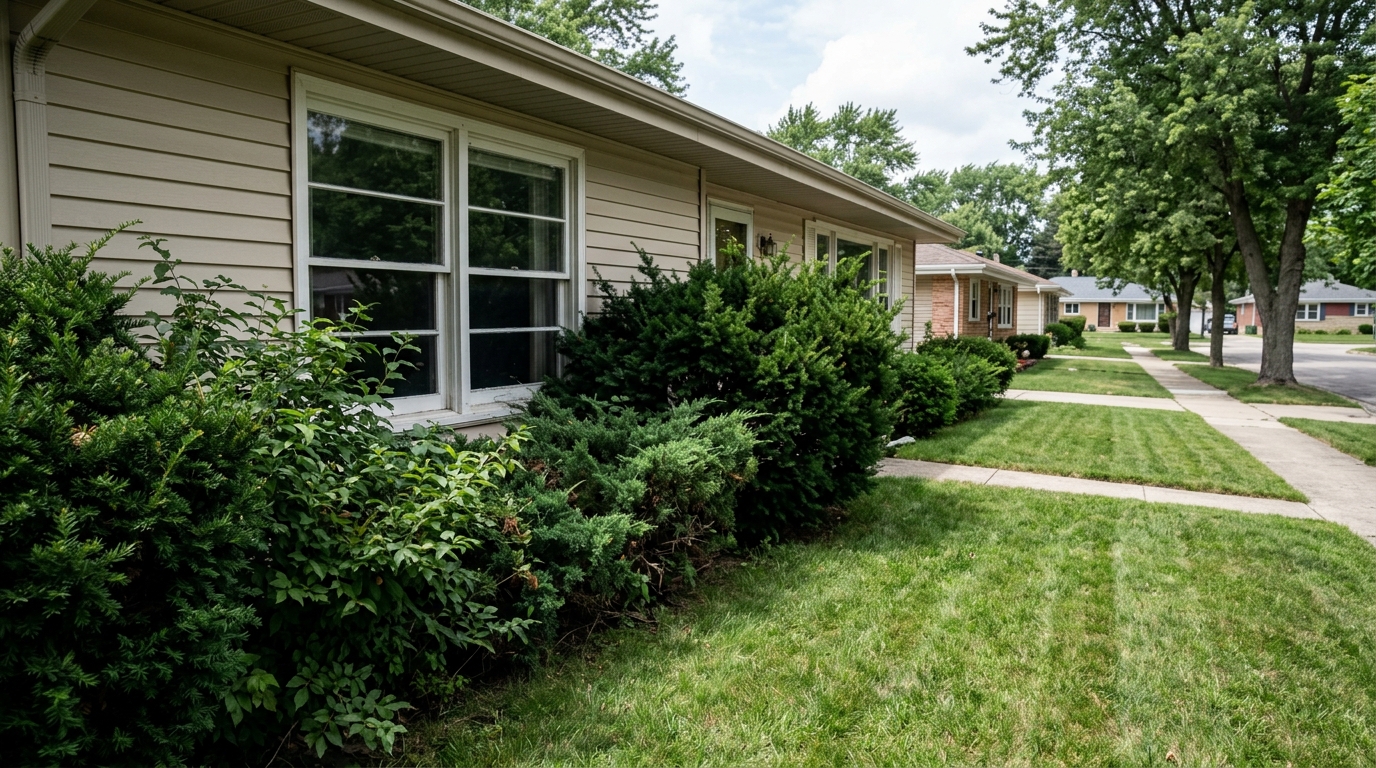
The National Crime Victimization Survey consistently identifies renters as disproportionately affected by property crime compared to homeowners. Ground-floor units — particularly those with windows facing alleys, parking lots, or poorly lit side streets — represent the path of least resistance for opportunistic burglars. Cities with the highest residential burglary rates in the US include Memphis, TN; Detroit, MI; Albuquerque, NM; and St. Louis, MO, according to FBI UCR data. In these markets, the average burglary results in approximately $2,661 in property losses (FBI, 2022). A set of steel window bars costs less than $100. The math is not complicated. Beyond property theft, the psychological impact of a home break-in on victims — including heightened anxiety, disrupted sleep, and long-term feelings of vulnerability — is well-documented by the Bureau of Justice Statistics. Installing window bars is not paranoia; it is rational, evidence-based home protection.
Lease Agreements and Window Bar Restrictions: What You Need to Know
Most standard US residential lease agreements include a clause that prohibits tenants from making alterations, modifications, or improvements to the property without prior written consent from the landlord. Drilling screw anchors into window frames or surrounding drywall constitutes exactly that kind of alteration. However, the critical distinction in most lease language is the word 'permanent.' Tension-mounted and telescopic window bars that apply outward pressure against the existing window frame — without penetrating any surface — are functionally equivalent to a tension shower curtain rod. They are removable, leave no marks, and restore the window to its original condition upon removal. Before installing any security device, renters should review their specific lease language and, when in doubt, send a quick written note to their landlord describing the no-drill system. In the vast majority of cases, landlords have no objection — and many actually appreciate tenants taking proactive security measures that protect the property as well as themselves.
Understanding No-Drill Window Bar Systems: How They Actually Work
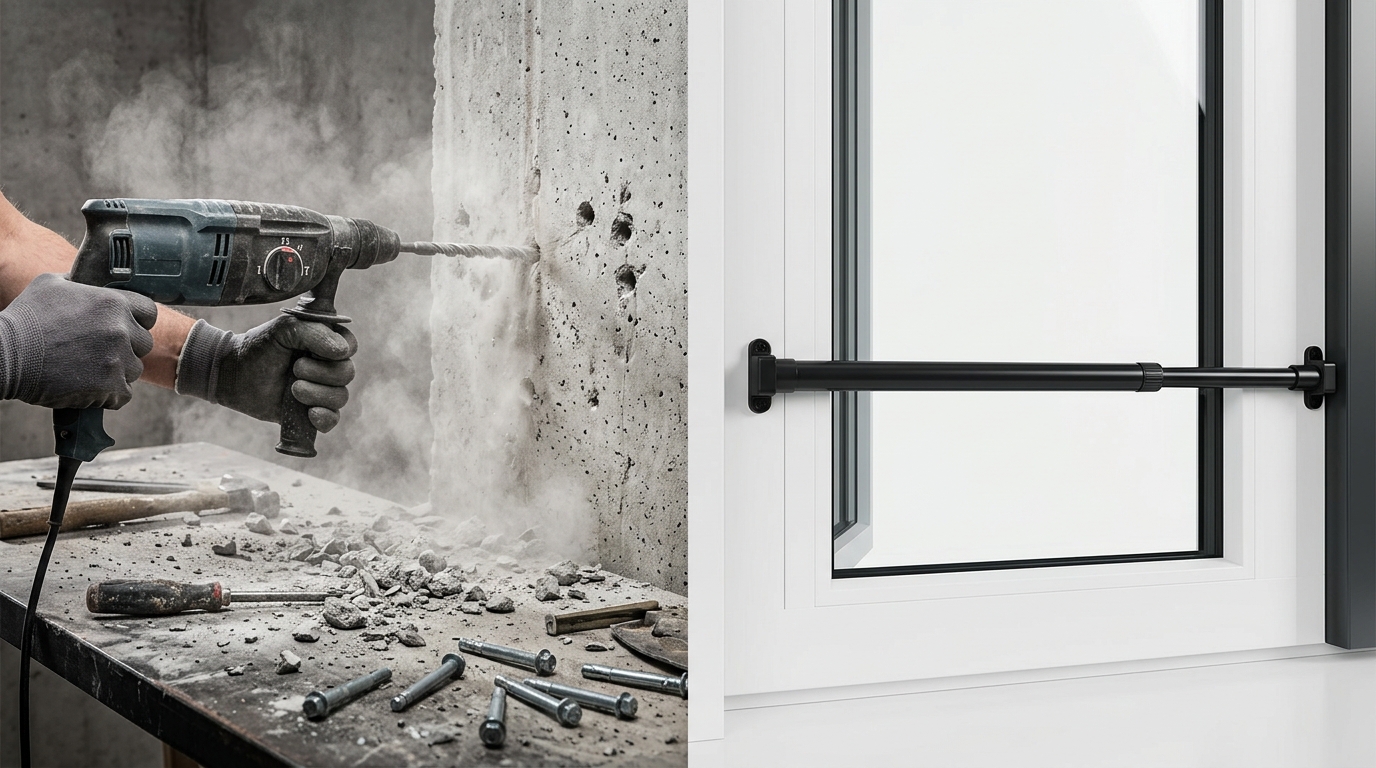
Before you can properly learn how to install window bars without drilling holes, you need to understand the mechanical principle that makes it possible. Traditional permanently installed window bars are welded or bolted to anchor points embedded in the wall surrounding the window — the window frame itself plays no structural role in holding them. A no-drill telescopic system works on an entirely different principle: outward spring tension. The bar extends telescopically — meaning it can be lengthened — until its end caps press firmly against the interior side walls of the window frame. As the extension mechanism is locked, the bar exerts continuous lateral pressure against both sides of the frame simultaneously. This is the same principle used in tension rods for shower curtains and room dividers, but executed in heavy-gauge steel with load ratings engineered for security, not just support. The friction generated by the end caps against the window frame creates a surprisingly powerful grip. A properly installed SWB Model A telescopic bar, for example, resists horizontal force equivalent to the kind of impact a burglar would apply when attempting to push or pry a window open from the outside. Multiple bars installed in a vertical stack across a single window multiply that resistance significantly. The window frame itself — typically made of wood, vinyl, aluminum, or fiberglass — acts as the structural anchor. This is why measuring your window correctly before installation is so critical, which we cover in detail in the next section.
Telescopic Bars vs. Tension-Mounted Bars: What's the Difference?
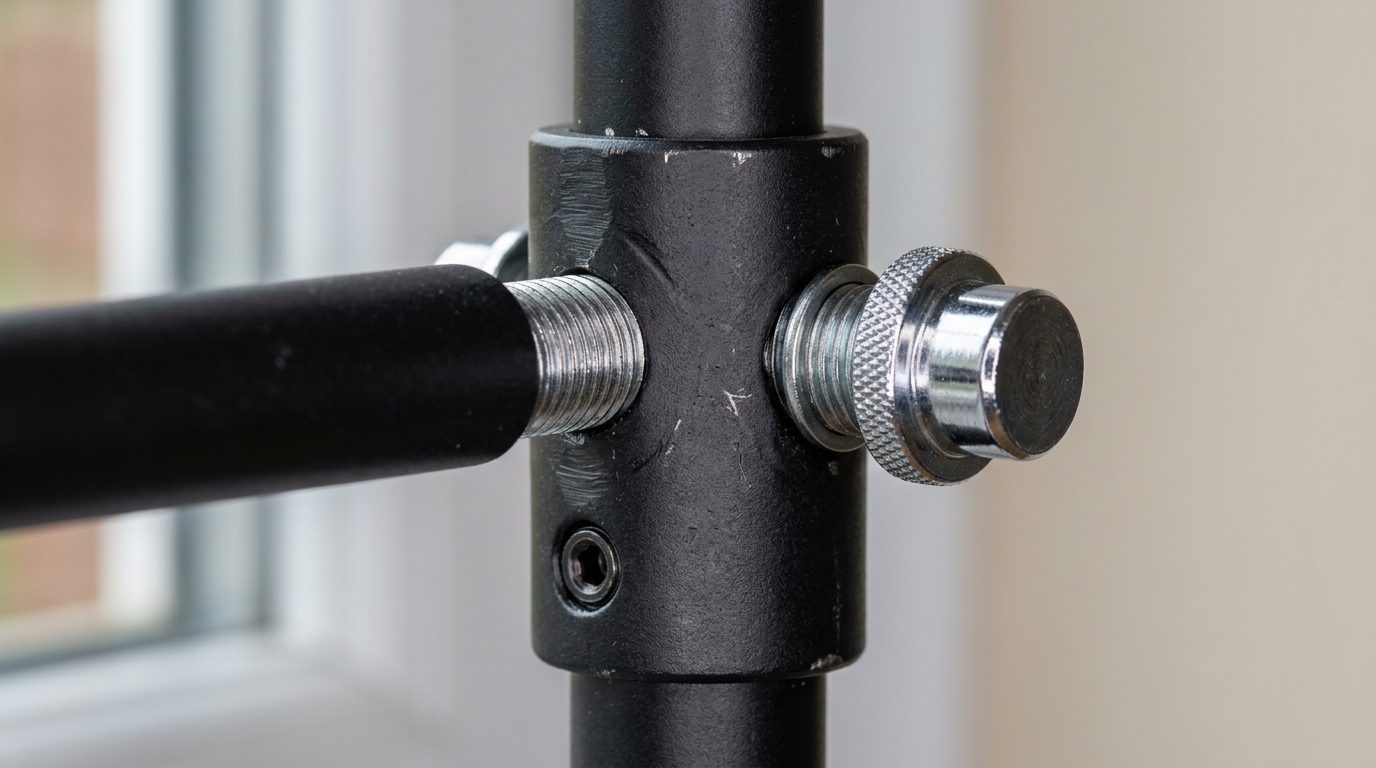
The terms 'telescopic' and 'tension-mounted' are often used interchangeably, but there is a meaningful technical distinction. A telescopic window bar extends in length via a sliding inner tube or threaded rod mechanism — similar in concept to a telescoping antenna. Once extended to the desired width, a locking mechanism (typically a set screw or friction lock) holds the extended length in place. The outward pressure on the frame is maintained by the locking tension of the extension. The SWB Model A is a prime example of this design. A pure tension-mounted system, by contrast, typically uses a strong spring mechanism that continuously pushes outward regardless of any locking mechanism. Both approaches achieve the no-drill goal, but telescopic systems generally offer greater structural rigidity, more precise size adjustment, and better security performance because the extension is mechanically locked rather than just spring-loaded. For security applications — as opposed to decorative or child-safety applications — telescopic steel systems are the clear choice.
Weight Ratings, Steel Gauge, and What Actually Stops a Burglar
Not all no-drill window bars are created equal. Consumer-grade tension rods sold at home improvement stores are manufactured from thin-wall aluminum or light steel tubing — perfectly adequate for hanging curtains, completely inadequate for resisting a determined forced entry attempt. When evaluating a no-drill window security bar, the key specifications to examine are: (1) steel gauge — lower numbers mean thicker, stronger steel; (2) end cap material and grip surface — rubber or textured polymer caps grip window frame surfaces far better than smooth plastic; (3) extension lock mechanism — a threaded bolt lock is more secure than a simple friction fit; and (4) maximum and minimum width range — bars that fit your window precisely will always outperform bars installed at the edge of their adjustment range. SWB's telescopic bars are manufactured from heavy-gauge steel and are engineered to fit standard US window widths of 22 to 36 inches — covering the vast majority of apartment and residential windows across all 50 states.
Step-by-Step: How to Measure Your Window for a No-Drill Bar Installation
Accurate measurement is the single most important factor in a successful no-drill window bar installation. An improperly measured bar — either too short to create adequate tension or so long it cannot extend to fit — will fail to provide meaningful security. Fortunately, the measurement process is straightforward and requires nothing more than a standard tape measure and two minutes of your time. This section walks you through the exact process, window type by window type, so your installation is dialed in before you unbox your bars. Proper measurement also ensures you select the correct SWB model for your specific window dimensions, which is critical for both security performance and building code compliance.
Measuring Single-Hung and Double-Hung Windows
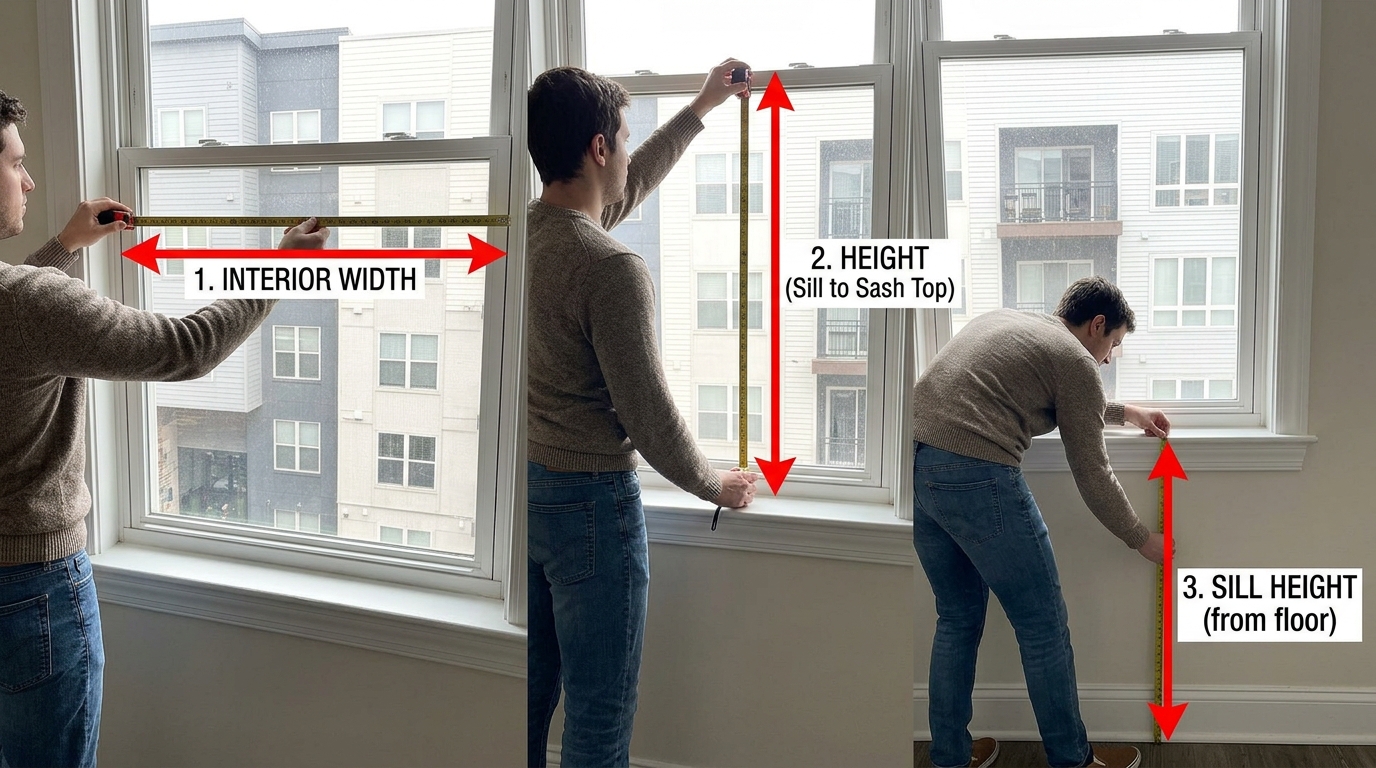
Single-hung and double-hung windows are by far the most common window types in American residential buildings — particularly in the apartment stock of cities like New York, Boston, Chicago, and Atlanta. To measure correctly: open the window to its intended operating position, then measure the interior width of the window frame at the point where you intend to install each bar. Measure at three points — top of the intended bar position, middle, and bottom — because window frames are rarely perfectly square, especially in older buildings. Use the smallest of your three measurements as your working width. This ensures your bar will fit without needing to force it. For a standard 30-inch wide double-hung window, for example, you would select the SWB Model A, which accommodates widths from 22 to 36 inches. Note: measure the interior frame width — the distance between the side jambs — not the exterior window opening or the glass pane width.
Measuring Casement, Sliding, and Basement Windows
Casement windows (hinged on the side, swinging outward) and sliding windows present slightly different measurement scenarios. For a casement window, measure the full interior frame width with the window in the closed position — the bar will be installed with the window closed, so the full frame width is your working measurement. For horizontal sliding windows, the bar needs to span the full frame interior width at each horizontal bar position, as with a standard window. Basement windows, which are often smaller and set in thick concrete or masonry walls, require extra attention. The interior width is measured between the inner edges of the masonry or frame — not the full opening. Basement windows are a critical security vulnerability: according to security industry data, they are disproportionately targeted in residential burglaries because they are low-visibility access points. If you live in a basement apartment in cities like Philadelphia or Detroit, window bar installation is not optional — it is essential.
How Many Bars Do You Need Per Window?
The number of bars required per window depends on the window's height and the security level you need. As a general rule, bars should be spaced no more than 5 inches apart vertically to prevent an intruder from reaching through and manipulating a lock or gaining a grip. For a standard 36-inch tall double-hung window, this means installing approximately 5 to 6 bars. For a smaller 24-inch basement window, 3 to 4 bars may suffice. However, if you are installing bars in a bedroom or any sleeping area, you must also account for egress compliance — the ability to exit the window in a fire emergency. This is where the SWB Model A/EXIT becomes critically important, and we cover egress requirements in a dedicated section below. For a complete breakdown of installation configurations for every window type and size, visit the SWB Window Bar Installation Guide at https://www.securitywb.com/installation/.
The Tools You Need — and What You Can Skip When There's No Drilling
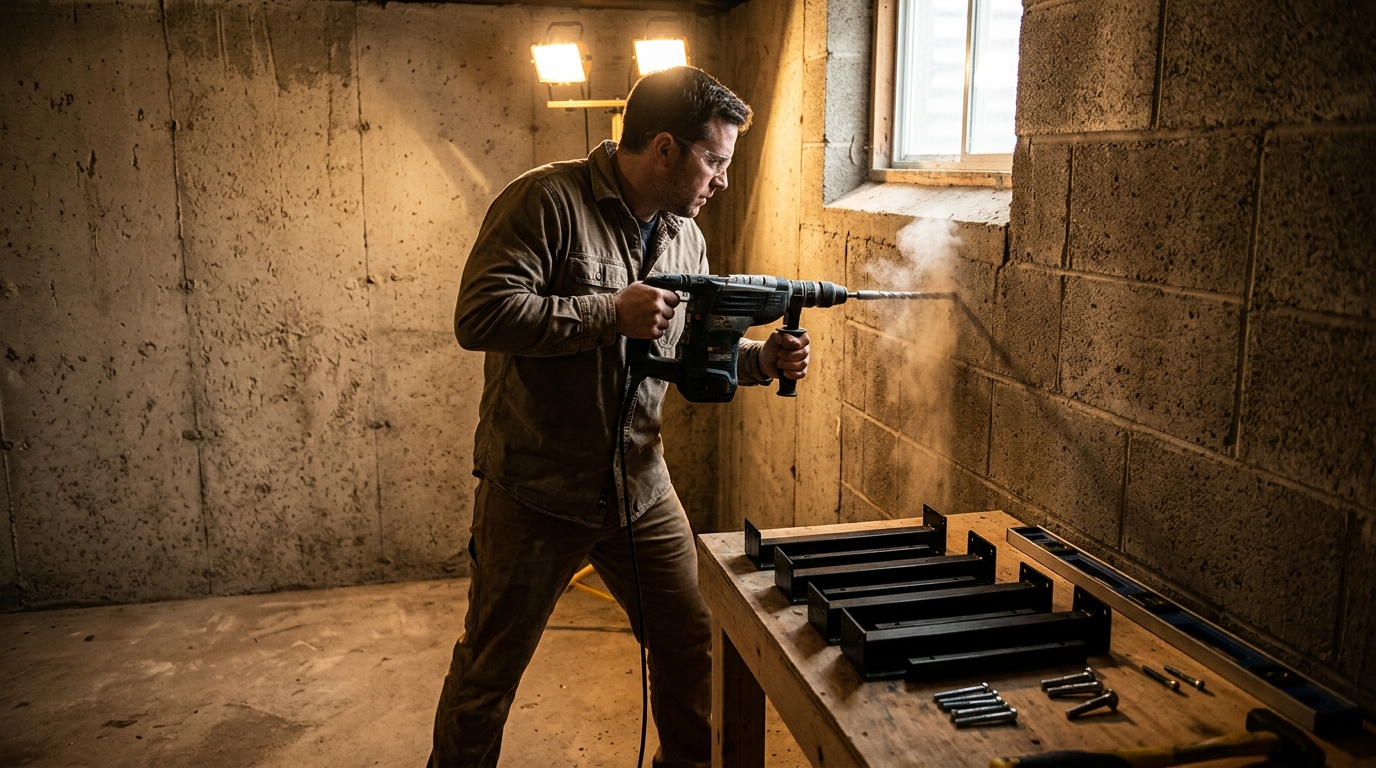
One of the most appealing aspects of learning how to install window bars without drilling holes is the dramatic simplification of the tool requirement list. A traditional professionally installed window bar system requires a hammer drill, masonry or wood drill bits, anchor bolts, a level, stud finder, safety glasses, and often a second person to hold bars in position during installation. The total tool investment can exceed $200 if you don't already own the equipment — on top of the $600 to $1,800 professional installation cost cited by the National Association of Home Builders. A no-drill telescopic bar installation from SWB requires almost none of that. Here is the complete honest tool list for a no-drill installation.
The Minimal Tool List for No-Drill Window Bar Installation
To install SWB telescopic window bars without drilling, you will need: (1) A standard tape measure — for the window measurements described in the previous section. (2) A pencil or painter's tape — for marking your desired bar positions on the window frame before installation. (3) A level — a small 9-inch bubble level is ideal for ensuring each bar is installed perfectly horizontal. A crooked bar not only looks unprofessional, it also distributes tension unevenly across the end caps, reducing holding power. (4) A hex key or Allen wrench — most telescopic bar locking mechanisms use a hex bolt to secure the extension; the appropriate size is typically included with SWB bars. That's it. No power tools. No drilling. No dust. No damage. The entire installation for a single window — including measuring, positioning, and locking three to five bars — takes approximately 15 to 20 minutes from start to finish. This is the installation experience that SWB has engineered specifically for the American renter market.
Optional Additions That Improve Grip Without Damaging Surfaces
While no-drill bars are designed to work without any surface preparation, there are a few optional enhancements that can improve grip and stability without causing any damage. First, foam or rubber grip tape — the same type used for tool handles or athletic grips — can be applied to the end caps of your bars to increase friction against the window frame surface. This is particularly useful on smooth vinyl or painted aluminum frames where metal-on-surface contact may slip under sustained pressure. This tape is completely removable and leaves no residue. Second, self-adhesive rubber bumpers (available at any hardware store for under $5) can be placed at the contact points where bar end caps press against the window frame interior, acting as non-slip pads. Third, if your window frame has a slight inward taper — common in older wood-framed windows — small wooden shim wedges cut to fit can stabilize bars that might otherwise shift. None of these additions require drilling, adhesives that damage surfaces, or any permanent modification.
Step-by-Step Installation: How to Install Window Bars Without Drilling Holes
Now that you've measured your windows and gathered your minimal tool set, it's time to walk through the actual installation process step by step. This process applies directly to the SWB Model A Telescopic Window Bar and covers the most common installation scenario: a standard single-hung or double-hung residential window in an apartment or ground-floor home. The entire process should take no more than 20 minutes per window. For a comprehensive visual walkthrough and model-specific instructions, refer to the SWB Window Bar Installation Guide at https://www.securitywb.com/installation/. If you're interested in a broader overview of the full range of installation methods, our complete guide on How to Install Window Security Bars covers additional scenarios including permanent and semi-permanent systems.
Phase 1: Prepare the Window Frame and Mark Bar Positions
Step 1: Clean the interior surfaces of your window frame side jambs — the vertical surfaces where your bar end caps will press. Use a damp cloth to remove any dust, paint chips, or debris. Clean contact surfaces maximize friction and holding power. Step 2: With your window in the desired operating position (fully closed for maximum security; partially open if you want ventilation while maintaining security), use a pencil or small strip of painter's tape to mark the vertical positions where each bar will be installed. Remember: bars should be spaced no more than 5 inches apart. Step 3: Using your level, draw or tape a horizontal reference line at each bar position. This ensures each bar installs perfectly level — critical for even tension distribution across both end caps. Step 4: Double-check your width measurement one final time at each marked position. Window frames in older buildings can vary in width by as much as half an inch from top to bottom.
Phase 2: Extend, Position, and Lock Each Bar
Step 5: Collapse the telescopic bar to its shortest position and hold it horizontally against your first reference mark inside the window frame. Step 6: Slowly extend the inner tube of the bar outward — pushing it toward one side jamb — until the end caps make firm contact with both interior frame surfaces simultaneously. You should feel clear resistance as both caps engage the frame. Step 7: Do not over-extend. The goal is firm, snug contact — not a forced fit that bows the frame. If you feel significant resistance before the bar is fully horizontal, the bar may be slightly too long for that position, or the frame may be slightly narrower at that height. Adjust accordingly. Step 8: Once the bar is positioned with level, even contact on both sides, tighten the locking hex bolt firmly using the included Allen wrench. This prevents the bar from collapsing inward under pressure. Step 9: Give the installed bar a firm push toward the exterior of the window — this simulates the direction of force a burglar would apply. The bar should feel solid and completely immovable. Step 10: Repeat for each bar position. For a standard 36-inch window, complete this process for all 5 to 6 bars.
Phase 3: Test, Inspect, and Document the Installation
Once all bars are installed, conduct a systematic inspection of the completed installation. Test each bar individually with firm outward and downward pressure. Every bar should feel equally solid — if one feels looser than the others, it may not be making full contact on both sides, or its locking bolt may need tightening. Photograph the completed installation from multiple angles. This documentation serves two purposes: it provides a visual record proving that your installation is non-destructive (protecting your security deposit), and it documents your security measures for renter's insurance purposes. Many US renter's insurance providers — including State Farm, Allstate, and Lemonade — factor in physical security measures when assessing claims and may offer premium discounts for documented security installations. Finally, test your window's ability to open and close normally if you've left it in a partially open position with bars installed. The bars should not prevent normal window operation in the position you've chosen.
Egress Compliance: Fire Safety Rules Every Renter Must Know Before Installing Window Bars
This is perhaps the most important section in this entire guide — and the one most commonly skipped by DIY installers. Under the International Building Code (IBC), the National Fire Protection Association's NFPA 101 Life Safety Code, and the International Residential Code (IRC), windows in sleeping areas — bedrooms — must provide an emergency egress opening. This means that in a fire emergency, occupants must be able to fully open the window and escape through it. Window bars installed in a bedroom that prevent this emergency exit are not just a safety risk — they are a code violation that can expose a landlord to significant legal liability and, more critically, can cost you your life. According to the National Fire Protection Association (NFPA), home fires cause approximately 2,500 civilian deaths annually in the United States, with a significant portion of fatalities occurring when occupants cannot escape through windows. Installing window bars in bedrooms requires an egress-compliant bar system — specifically, one with a quick-release mechanism that can be operated from the inside without tools or a key, in the dark, under stress.
What the IRC and IBC Actually Require for Egress Windows
The International Residential Code (IRC), Section R310, specifies minimum requirements for emergency escape and rescue openings. Every sleeping room must have at least one operable window or exterior door that provides a minimum net clear opening of 5.7 square feet (or 5.0 square feet for ground-floor windows), with a minimum height of 24 inches and a minimum width of 20 inches. The sill height of the egress opening cannot be more than 44 inches above the finished floor. Most importantly for window bar installations, any bars, grilles, or screens covering this egress opening must be releasable or removable from the inside without the use of a key, tool, or special knowledge or effort. This is a non-negotiable code requirement across all jurisdictions that have adopted the IRC — which includes the vast majority of US states and municipalities. Bars that require a key, Allen wrench, or any tool to remove do NOT meet egress requirements in sleeping areas.
The SWB Model A/EXIT: Egress-Compliant No-Drill Window Bars
The SWB Model A/EXIT was engineered specifically to address this critical compliance gap. It combines the full telescopic, no-drill installation system of the Model A with a patented quick-release egress mechanism that allows the bar to be removed instantly from the inside — with no tools, no key, and no special knowledge — in full compliance with IBC, NFPA 101, and IRC emergency egress requirements. For any renter or homeowner installing bars in a bedroom or sleeping area, the Model A/EXIT is not an upgrade — it is the only legally and ethically acceptable choice. The Model A/EXIT is available at https://www.securitywb.com/model-a-exit/ and ships via Amazon FBA for fast delivery to all 50 states. If you are installing bars in living rooms, kitchens, basements used for storage, or any non-sleeping area, the standard Model A Telescopic bars at https://www.securitywb.com/model-a/ are appropriate and fully compliant. Never install non-egress bars in a room where anyone sleeps — not even temporarily.
Product Selection Guide: Choosing the Right SWB No-Drill Bar for Your Window
Security Window Bars offers three distinct models, each engineered for a specific installation scenario and security need. Understanding which product is right for your specific situation — window type, room type, rental vs. ownership status, and security objectives — is the key to a successful installation that delivers genuine protection without complication. All three models ship from Amazon FBA warehouses, meaning renters in New York City, Los Angeles, Houston, Chicago, Phoenix, and every other US metropolitan area can receive their order within one to two business days. The price difference between models is intentionally minimal — ranging from $90 to $92 — because SWB's philosophy is that life safety should not be cost-prohibitive.
SWB Model A — The Standard for Renter No-Drill Security
The SWB Model A Telescopic Window Bar at $90 is the flagship no-drill solution for renters and apartment dwellers. Manufactured from heavy-gauge steel with a matte black powder-coat finish, the Model A adjusts to fit windows from 22 to 36 inches wide — covering virtually every standard US residential window size. Installation requires no drilling, no adhesives, and no permanent modification of any surface. The matte black finish is intentionally designed to complement modern apartment aesthetics — these bars look intentional and stylish rather than institutional. The Model A installs in 15 to 20 minutes and removes just as quickly when it's time to move. It is the ideal solution for ground-floor apartment windows, basement windows, living room windows, and any non-sleeping area where maximum adjustability and renter-friendliness are the priority. Shop the Model A at https://www.securitywb.com/model-a/.
SWB Model A/EXIT — For Bedrooms and Sleeping Areas
As detailed in the egress compliance section, the SWB Model A/EXIT at $92 is the mandatory choice for any window in a sleeping area. The additional $2 over the standard Model A represents one of the most cost-effective safety upgrades available to American renters. The quick-release egress mechanism operates with a single intuitive motion — no tools, no key, operable in complete darkness — meeting the full requirements of IBC, NFPA 101, and IRC Section R310. The Model A/EXIT is also fully telescopic and requires no drilling, making it equally renter-friendly as the standard Model A. For families with children, the Model A/EXIT also serves a dual purpose: it prevents children from opening windows and falling, while maintaining an adult-operable emergency exit function. This makes it particularly valuable for parents in high-rise apartments across cities like New York, Chicago, and San Francisco.
SWB Model B — For Homeowners Ready for Permanent Installation
The SWB Model B Wall-Mount Window Bar at $91 is the solution for homeowners — not renters — who want the maximum security of a permanently anchored bar system. The Model B uses heavy-gauge steel with a powder-coated black finish and is designed for fixed wall-mount installation with anchor bolts into the window frame surround or adjacent wall. This is the appropriate solution for ground-floor windows in owned homes, commercial storefronts, garages, and retail properties where permanent installation is acceptable and desirable. The Model B is not a no-drill system and is not recommended for renters. However, for homeowners who have read this guide and are now considering whether a permanent or no-drill system better suits their needs, the Model B represents an extremely cost-effective alternative to professional installation, which averages $600 to $1,800 per window according to HomeAdvisor national cost data. Learn more about the Model B at https://www.securitywb.com/model-b/.
Common Mistakes to Avoid When Installing No-Drill Window Bars
Even the best-engineered no-drill window bar system can underperform if installed incorrectly. After helping thousands of renters and homeowners across the USA achieve proper window security, the SWB team has identified the most common installation errors — and how to avoid every one of them. Avoiding these mistakes is the difference between a bar installation that genuinely stops a burglar and one that fails at the first serious test. The good news: every mistake on this list is entirely preventable with the information in this guide.
Mistake 1: Installing Bars in a Window Without Checking Egress Requirements
The most dangerous mistake a DIY installer can make is placing non-egress bars in a bedroom window. As covered in the egress compliance section, this is a building code violation under the IRC and NFPA 101, and it is a potentially fatal mistake in a fire emergency. Before installing any window bar in any room, ask yourself: does anyone sleep in this room? If the answer is yes — even occasionally, as in a room that doubles as a guest room — you must use an egress-compliant bar with a tool-free quick-release mechanism. The SWB Model A/EXIT is that product. Do not rationalize that you'll deal with it in an emergency. The NFPA's research shows that residential fires can become unsurvivable within two to three minutes of ignition in modern homes with synthetic furnishings. You will not have time to find a key or fumble with a tool.
Mistake 2: Incorrect Measurement Leading to Improper Tension
The second most common installation error is measuring the glass pane or the exterior window opening rather than the interior frame width. Telescopic bars must span the interior jamb-to-jamb width — the distance between the interior side surfaces of the window frame. Measuring the glass gives you a number that is several inches narrower than the actual installation width, leading to a bar that cannot achieve proper tension. Measuring the exterior opening gives you a number that may be wider than the interior frame, leading to a bar that physically cannot fit. Always measure the interior frame width at the exact height where each bar will be installed, take three measurements (top, middle, bottom of the bar's intended position), and use the smallest measurement as your working number. When in doubt, remeasure. A bar that is installed at the wrong width — either too loose or forced into a space too small — will not provide adequate security.
Mistake 3: Spacing Bars More Than 5 Inches Apart
Many first-time installers underestimate the importance of bar spacing. Installing only two or three bars across a large window to save time or money leaves gaps large enough for an intruder to reach through, manipulate a window lock, or even squeeze through in the case of a particularly large gap and a slender individual. The 5-inch maximum spacing rule is derived from the same principle applied to prison bar spacing and commercial security grille standards — it prevents arm entry and makes the window effectively impassable. For child fall prevention, the relevant US standard (referenced by NYC Local Law 57 and ASTM F2090) specifies a maximum 4-inch opening, which is even more stringent. If you are installing window bars for child safety in addition to security — a common need in New York City buildings with children under 10 — reduce your bar spacing to no more than 4 inches to meet the applicable standard.
🏆 Conclusion
Learning how to install window bars without drilling holes is one of the most practical, cost-effective security investments any American renter can make in 2025. With approximately 44.1 million renters across the United States — millions of them living in ground-floor or basement units in cities with elevated crime rates — the gap between security need and actionable solution has never been more costly. Traditional permanently installed bars mean lease violations, security deposit losses, and landlord disputes. But a properly installed set of SWB telescopic window bars delivers the same steel-strength deterrence as welded bars, in 20 minutes, with no damage to your apartment, and full compliance with your lease agreement. The key principles from this guide: measure interior frame width accurately, space bars no more than 5 inches apart, always use the egress-compliant Model A/EXIT in sleeping areas, and test every installed bar for solid immovable tension before calling the job done. Security Window Bars has engineered every product in the SWB lineup specifically for the reality of the American rental market — renter-friendly, code-compliant, and genuinely effective. Don't leave your family's safety to chance. The average US burglary takes less than 10 minutes. Your window bar installation takes 20 minutes and costs less than $100. The choice is straightforward.
Security Window Bars · USA
Secure Your Home Today
Protect your home today — no drilling, no damage, no excuses. Shop Security Window Bars on Amazon for fast 1-2 day delivery to all 50 states: /buy-now/. Or explore all three SWB models and find the perfect fit for your windows at https://www.securitywb.com/contact/ — our security specialists are ready to help you choose.
Shop on Amazon →Frequently Asked Questions
In the vast majority of cases, no. Standard US residential lease agreements prohibit permanent structural modifications — and no-drill telescopic window bars do not qualify as permanent. These bars apply tension to the existing window frame without penetrating any surface, leaving no holes, marks, or damage. They are functionally equivalent to a tension shower rod. However, you should review your specific lease language and, when in doubt, send your landlord a written note describing the no-drill system. Most landlords welcome tenants who take proactive, non-destructive security measures. Document your installation with photographs before and after to protect your security deposit.
Measure the interior width of your window frame — the distance between the inner surfaces of the side jambs — at the height where you plan to install each bar. Take three measurements at different heights (top, middle, bottom of your intended bar position) and use the smallest measurement as your working width. The SWB Model A and Model A/EXIT both fit windows from 22 to 36 inches wide, which covers the vast majority of standard US residential window sizes. If your window measures within that range at every bar position, the SWB telescopic bars will fit correctly and install securely without drilling.
Yes — but you must use an egress-compliant bar system. The International Residential Code (IRC) Section R310 and NFPA 101 Life Safety Code require that window bars in sleeping areas can be released from the inside without a key, tool, or special knowledge in a fire emergency. Installing standard non-egress bars in a bedroom is a building code violation and a serious fire safety risk. The SWB Model A/EXIT is specifically engineered for bedroom installation — it combines the fully telescopic, no-drill design of the standard Model A with a patented quick-release egress mechanism that meets IBC, NFPA 101, and IRC requirements. At $92, it is the only responsible choice for any sleeping area.
As a general rule, bars should be spaced no more than 5 inches apart vertically to prevent an intruder from reaching through the opening. For a standard 36-inch tall double-hung window, this means approximately 5 to 6 bars. For a smaller basement window around 24 inches tall, 3 to 4 bars are typically sufficient. For windows in homes with children, consider reducing spacing to 4 inches or less to meet child fall prevention standards referenced by NYC Local Law 57 and ASTM F2090. Always prioritize complete vertical coverage of the window — partial bar installations that leave large gaps at the top or bottom of the window offer significantly reduced security.
High-quality telescopic steel window bars — like the SWB Model A — provide security performance that is genuinely comparable to permanently welded systems for the most common burglary threat scenario: an opportunistic intruder attempting to force a window open quickly and quietly. The critical variables are steel gauge (heavier is stronger), end cap grip quality, and proper installation tension. A correctly installed SWB telescopic bar resists the horizontal outward force that a burglar would realistically apply. The primary advantage of welded bars is resistance to sustained, heavy-impact forced entry — a threat profile that represents a very small fraction of residential burglaries. For the overwhelming majority of renters in US urban areas, properly installed telescopic bars provide fully adequate security.
It depends on which model you choose. Standard SWB Model A bars installed in non-sleeping areas (living rooms, kitchens, storage basements) require the tightening hex bolt to be loosened before removal — this is intentional, as it prevents easy removal by an intruder from the outside. These bars are not designed for rapid emergency removal and should never be installed in sleeping areas for that reason. The SWB Model A/EXIT, however, incorporates a patented quick-release mechanism designed specifically for emergency egress. It can be fully released from the inside in seconds with no tools, no key, and no special training — meeting all IBC, NFPA 101, and IRC requirements for bedroom window bar installation.
In New York City, Local Law 57 (codified in the NYC Administrative Code, Section 27-2043.1) requires that building owners install window guards in apartments where a child 10 years of age or younger resides. The law applies to all windows in the apartment (except windows giving access to fire escapes) when the building owner has been notified of a child's presence through the annual window guard notice. Tenants may also request window guards even without children in the household — the landlord is obligated to install them. The bars must prevent a 5-inch sphere from passing through any opening. If you are a NYC renter with children under 10, window guards are a legal requirement — not just a safety recommendation.
SWB window bars are available directly through Amazon USA — searching for 'SecurityWindowBars' or through the SWB Amazon storefront — with Amazon FBA fulfillment providing 1 to 2 day delivery to all 50 states, including Alaska and Hawaii. This makes SWB bars accessible to renters in every US metro area, from New York City and Los Angeles to Chicago, Houston, Phoenix, and smaller markets alike. You can also order directly through securitywb.com, where you'll find detailed product specifications, installation guides, and the ability to contact SWB security specialists for personalized guidance on which model is right for your specific window and security needs.