Storefront Window Security Bars: Protect Your Retail Business in 2026
Storefront security bars are the single most effective physical deterrent against smash-and-grab theft, after-hours break-ins, and opportunistic vandalism targeting retail shops, restaurants, and street-level commercial spaces in 2026. If you operate a business with ground-floor windows facing a sidewalk, parking lot, or alley, those windows are your biggest liability. One brick through a plate glass window gives a thief unrestricted access to your merchandise, registers, and equipment in seconds. No alarm, no camera, and no insurance policy stops the break-in itself. Steel bars do.
This guide is written specifically for retail storefronts, small businesses, and street-level commercial spaces — the shops, boutiques, salons, restaurants, pharmacies, and service businesses that line Main Streets and strip malls across America. We cover the exact products, mounting methods, costs, fire code requirements, and ROI calculations you need to make the right purchasing decision for your specific storefront. By the end, you will know exactly how many bars you need, what they cost, how to install them, and why the math makes this the smartest security investment available to a small business owner today.
Why Storefronts Are Targeted: The Anatomy of Retail Break-Ins
Retail storefronts sit at the intersection of two factors that attract criminal activity: high-value merchandise visible from the street and large glass surfaces that take seconds to breach. A typical storefront window is 4 to 8 feet wide, made of single-pane tempered or annealed glass, and positioned at sidewalk level where anyone walking or driving by can case the interior during business hours.
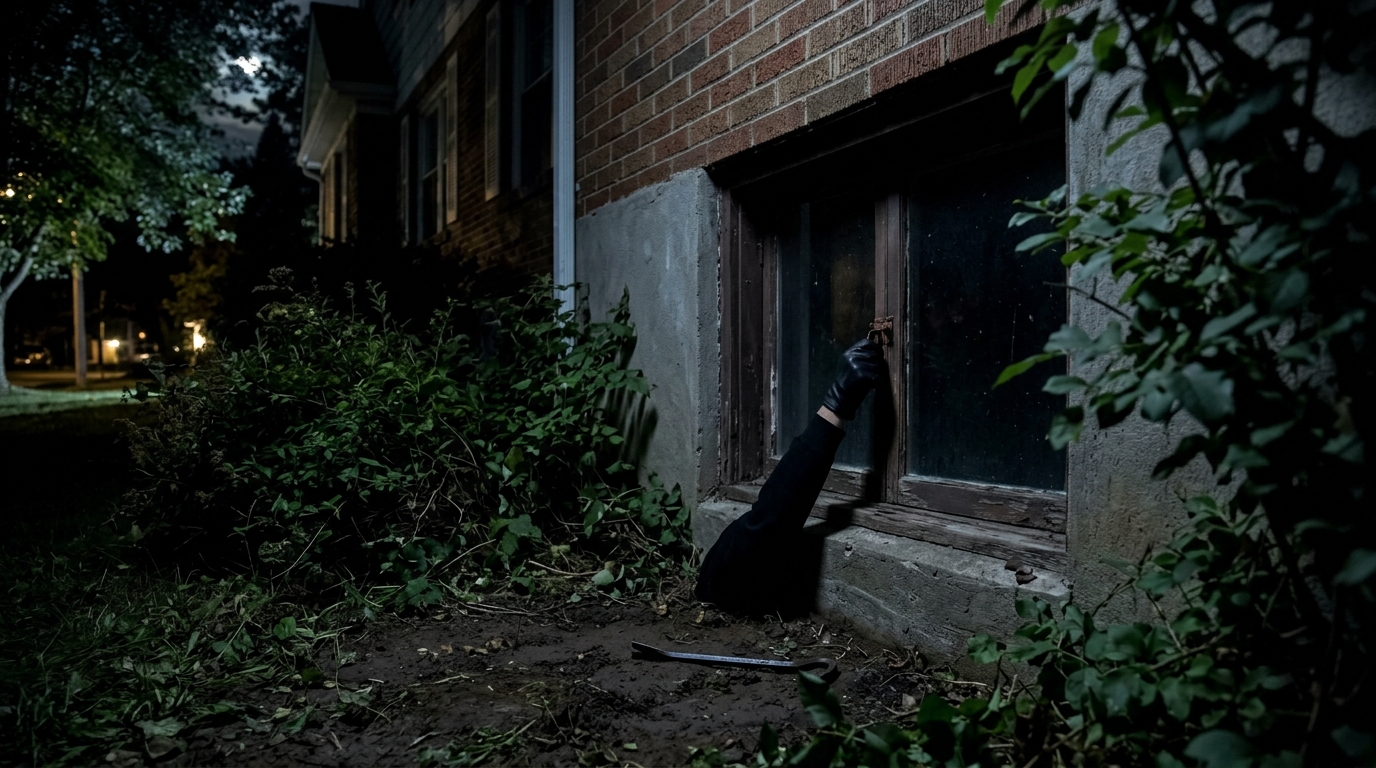
The modern smash-and-grab attack follows a predictable pattern. Criminals drive to the storefront after closing time — or in some cities, during broad daylight. One person throws a heavy object through the window (a brick, a spark plug fragment, a hammer). The group enters through the opening, grabs whatever they can carry in 30 to 90 seconds, and leaves before police can respond. The entire event is over before the alarm company finishes the verification call.
The Numbers Behind Retail Break-Ins
Data from the National Retail Federation and FBI Uniform Crime Reports paints a clear picture of the scale:
- Property crime costs US retailers tens of billions annually when combining theft, vandalism, and business interruption
- Smash-and-grab incidents have increased significantly in major metropolitan areas since 2020, with organized retail crime rings targeting multiple stores in coordinated attacks
- Average response time for police to a commercial alarm call ranges from 7 to 15 minutes in most jurisdictions — an eternity when the break-in takes 60 seconds
- Insurance deductibles for small retail businesses typically range from $1,000 to $5,000 — meaning the business owner absorbs the first several thousand dollars of every loss
- Business interruption following a break-in — boarding up the window, filing the police report, dealing with insurance, replacing inventory — costs the average small retailer 2 to 5 business days of reduced or zero revenue
Why Electronic Security Fails Storefronts
Most retail owners invest in alarm systems and security cameras as their primary defense. These tools have genuine value for evidence collection and deterring amateur criminals, but they share a fundamental limitation: they document the crime; they do not prevent it.
An alarm siren sounds after the glass is broken. A camera records the intruder's face (often masked) after they enter. A monitoring service calls the police after the signal is received. Every link in that chain adds seconds to the response, and the criminal needs fewer than 60 seconds to empty a display case and vanish.
Storefront security bars work on a completely different principle. They do not detect, record, or respond to a break-in. They prevent it. Steel bars across the storefront glass mean that breaking the glass accomplishes nothing — the intruder still cannot enter. The opening between bars is too narrow for a person or even an arm to pass through. The bars themselves resist cutting, prying, and bending forces that no human can generate with hand tools in a time frame that makes the crime worthwhile.
This is why experienced security consultants recommend layering: cameras and alarms for detection and evidence, plus physical barriers like security bars for actual prevention. For a broader look at physical security layering strategies, see our Ultimate Burglar Bars Guide.
How Storefront Security Bars Work
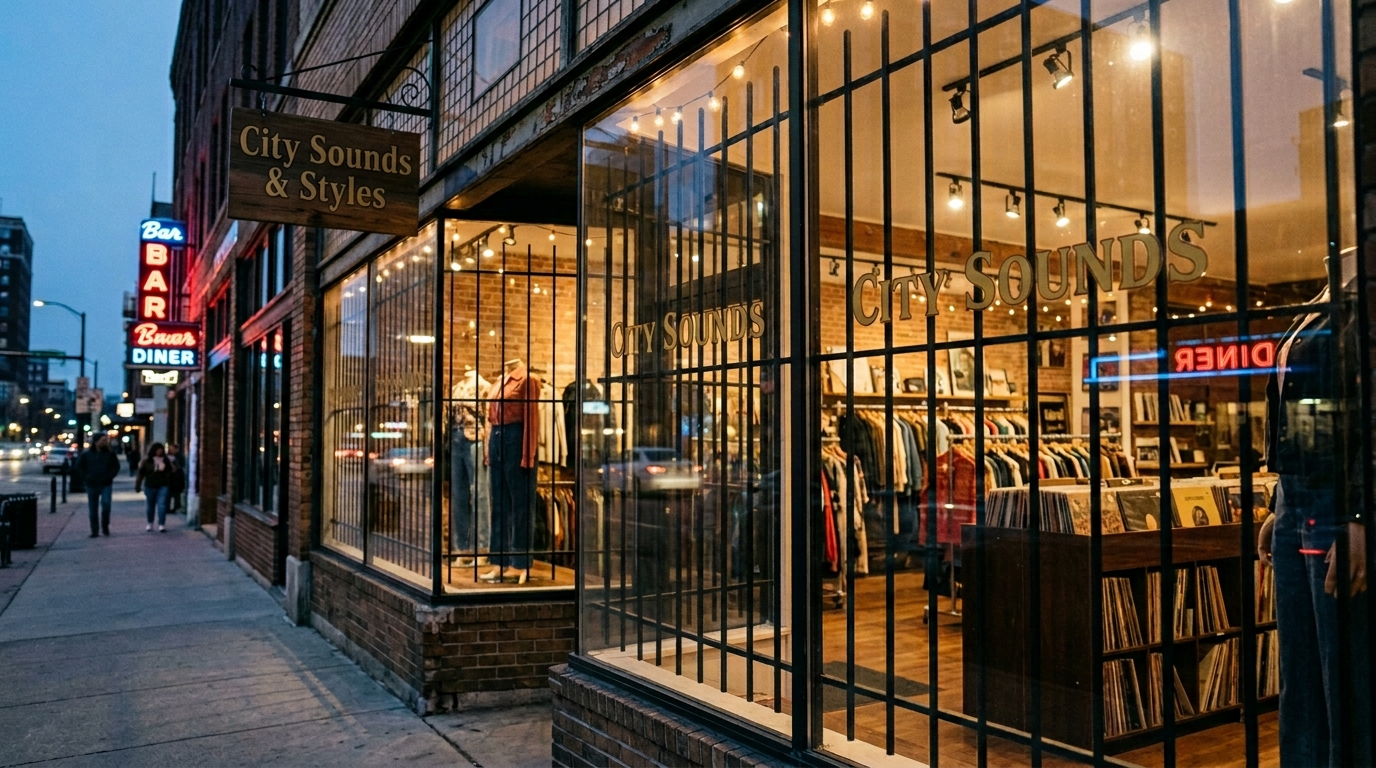
Storefront security bars are vertical steel bars mounted across the glass surface of a retail storefront window or door. They are anchored to the building's frame, wall, or masonry surround at the top and bottom of the glass area. The bars are spaced closely enough (typically 4 inches or less apart) that a person cannot pass between them, and the steel gauge is heavy enough that cutting through a bar with portable tools takes significant time and creates obvious noise.
The Physics of Deterrence
The security value of storefront bars comes from three physical principles working together:
- Penetration resistance. Even after the glass is broken, the steel bars remain in place. The intruder faces a wall of steel that requires industrial cutting tools (angle grinder, reciprocating saw with metal blade, or oxy-fuel torch) to defeat. These tools are loud, conspicuous, throw sparks, and take minutes per bar.
- Time multiplication. Every second a criminal spends attempting to breach the bars is a second closer to police arrival. Security professionals call this "delay time" — the gap between breach attempt and entry. An unbarred window offers zero delay. A barred window offers 5 to 15+ minutes of delay depending on bar gauge and mounting method.
- Visual deterrence. Bars are visible before the criminal commits to the attack. An experienced thief surveilling a strip mall will skip the barred storefront and target the unbarred one three doors down. This displacement effect protects barred businesses even when the criminal is determined — they simply choose an easier target.
What Security Bars Do NOT Do
Transparency matters. Security bars do not:
- Prevent the glass from being broken (the glass will still shatter if struck)
- Stop daytime shoplifting through the front door during business hours
- Protect against cyberattacks, point-of-sale skimming, or employee theft
- Replace the need for insurance (always maintain your commercial property policy)
- Guarantee zero break-ins (a sufficiently determined attacker with unlimited time and industrial tools can defeat any physical barrier)
What they do is make your storefront a hard target instead of a soft one — and in the real world of retail crime, that distinction is the difference between getting hit and getting skipped.
Types of Storefront Security Bars: Which One Fits Your Shop
Not every storefront is built the same way, and the right security bar depends on your building's construction, your window dimensions, and your aesthetic requirements. Here is a breakdown of the three main categories relevant to retail storefronts.
1. Telescopic Adjustable Bars (Frame Mount)
Telescopic bars adjust to fit a range of window widths using an internal sliding mechanism. They mount to the window frame (wood, vinyl, aluminum, or steel) using lag screws or security fasteners. This is the most versatile option for retail storefronts because window widths vary enormously between buildings, and telescopic adjustment eliminates the need for custom fabrication.
Best for: Retail shops in wood-frame or metal-frame buildings, strip mall storefronts with standard window frames, restaurants with framed window openings, and any storefront where the windows have a defined frame structure to anchor into.
Recommended product: SWB Model A (~$90) — telescopic + modular, powder-coated steel, 15-minute DIY install per unit.
2. Masonry-Mount Fixed Bars
Masonry-mount bars anchor directly into brick, concrete block, stone, or poured concrete using expansion anchors or chemical anchors. The bars do not rely on a window frame at all — they bond to the structural masonry of the building itself. This creates the strongest possible mounting because the failure point is the masonry material, not a frame fastener.
Best for: Retail storefronts in brick buildings (downtown districts, historic Main Streets), concrete block commercial buildings, and any storefront where the windows are set directly into masonry walls without a prominent frame.
Recommended product: SWB Model B (~$91) — wall mount masonry only, heavy-gauge steel, commercial-grade forced-entry resistance.
3. Modular Multi-Unit Systems
Large storefront windows — the 6-foot, 8-foot, or 10-foot plate glass expanses common in retail strip malls — exceed the coverage width of any single bar unit. Modular systems use multiple bar units connected side by side to create a continuous barrier across any width. The SWB Model A's modular stacking capability makes it the default choice for wide storefront applications.
Best for: Large plate glass storefronts, floor-to-ceiling display windows, multi-panel storefront glass systems, and any opening wider than a single bar unit can cover.
4. Rolling Security Grilles (For Comparison)
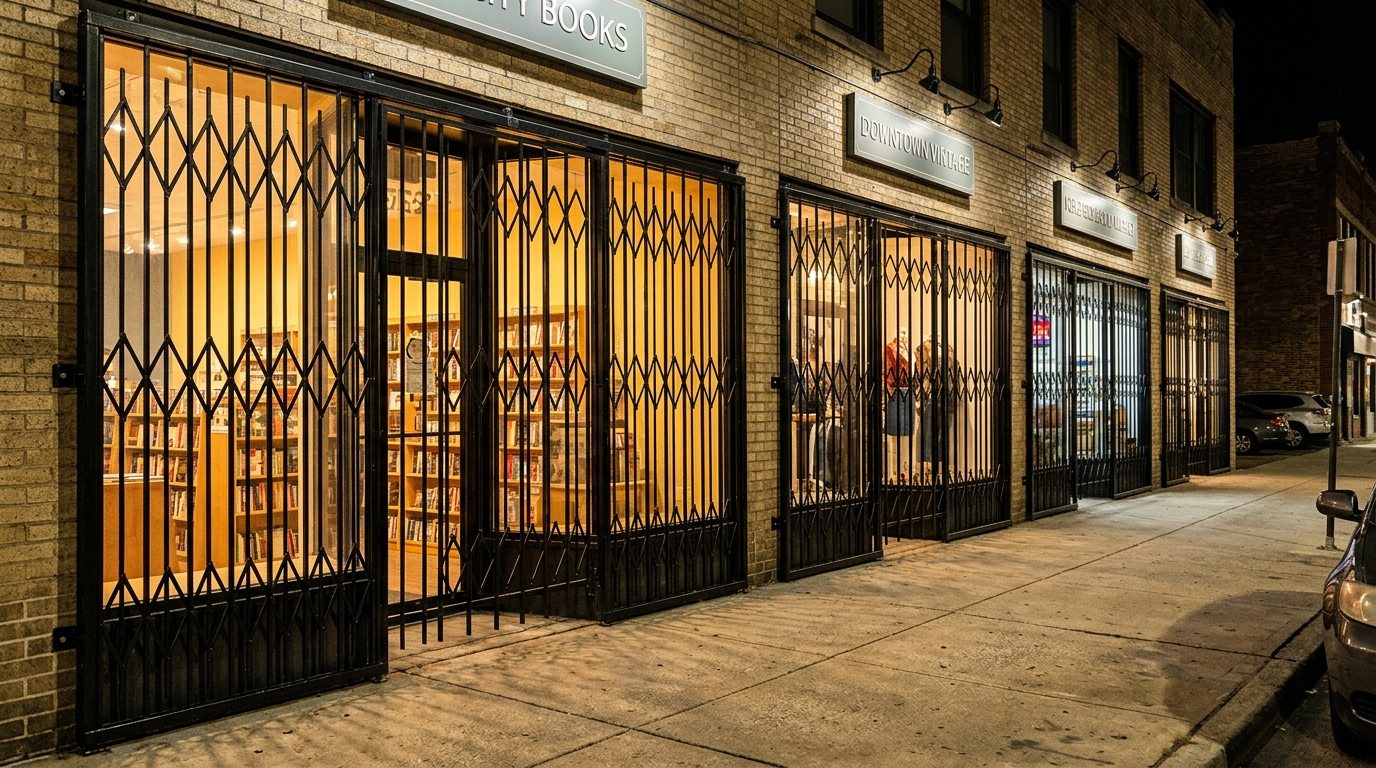
Rolling grilles are the traditional storefront security solution — the accordion-style metal gates that pull across the storefront and lock in place. They remain a viable option, but they have significant disadvantages compared to fixed security bars:
| Feature | Fixed Security Bars | Rolling Security Grilles |
|---|---|---|
| Cost per linear foot | $15-$25 | $50-$150 |
| Daily operation required | None (permanent installation) | Must be opened/closed daily |
| Mechanical failure risk | None (no moving parts) | Track jams, motor failure, lock seizure |
| Aesthetics during business hours | Clean vertical lines, always visible | Stored overhead or to the side when open |
| Maintenance required | None | Annual lubrication, track cleaning, lock service |
| Lifespan | 20-30 years | 10-15 years before mechanical issues |
| Employee dependence | None | Someone must close the grille nightly |
| Defeat method | Requires cutting through steel bars | Padlock can be cut; grille can be pried from track |
| Insurance discount eligibility | Yes | Yes |
Fixed security bars win on cost, maintenance, reliability, and daily operational simplicity. Rolling grilles win on aesthetics for businesses that want a completely unobstructed window during business hours. For most small retail operations, fixed bars offer far better value.
SWB Model A vs. Model B for Storefront Applications
Choosing between the Model A and Model B comes down to one question: what is the material surrounding your storefront windows?
Choose the SWB Model A When:
- Your storefront windows have wood, vinyl, aluminum, or steel frames
- You are in a strip mall or shopping center with standard framed window openings
- You need to cover a wide storefront using modular multi-unit stacking
- You want DIY installation capability (no specialty tools beyond a cordless drill)
- You rent the space and need a reversible installation that does not permanently alter the building's masonry
- Your windows are non-standard widths and require telescopic adjustment
The Model A at approximately $90 per unit delivers the widest range of storefront coverage options. Its telescopic mechanism handles every common retail window width, and its modular stacking connects multiple units for plate glass storefronts of any size. Frame mount installation takes about 15 minutes per unit with anti-tamper security fasteners.
Choose the SWB Model B When:
- Your storefront windows are set directly into brick, concrete block, or stone walls
- You own the building and want a permanent, structural-grade installation
- You are in a downtown brick building, historic district, or older commercial structure
- You need maximum forced-entry resistance for a high-crime area
- Your windows have minimal or no frame — just glass set into masonry
The Model B at approximately $91 per unit is purpose-built for masonry applications. Its heavy-gauge steel construction and expansion anchor system create a bond with the building's structural material that is functionally permanent. Removing a properly installed Model B requires demolishing the surrounding masonry.
Side-by-Side Comparison for Storefronts
| Specification | SWB Model A | SWB Model B |
|---|---|---|
| Price per unit | ~$90 | ~$91 |
| Mounting surface | Frame or wall (wood, vinyl, aluminum, steel) | Masonry only (brick, concrete, stone) |
| Telescopic adjustment | Yes | No |
| Modular stacking | Yes — connect units for wide storefronts | No — fixed-width units |
| DIY installation | Yes (15 min per unit, cordless drill) | Rotary hammer drill required |
| Best storefront type | Strip malls, framed openings, rentals | Brick buildings, downtown, permanent installs |
| Reversible installation | Yes — remove screws, patch holes | No — expansion anchors are permanent |
| Steel gauge | Standard commercial | Heavy gauge commercial |
| Powder coat finish | Yes (black/white) | Yes (black/white) |
| Anti-tamper hardware | Included | Included |
Storefront Security Bars by Business Type
Different retail businesses have different window configurations, threat profiles, and aesthetic requirements. Here is how storefront security bars apply to the most common retail categories.
Boutiques and Specialty Retail
Small boutiques — clothing stores, gift shops, jewelry stores, electronics retailers — typically have 1 to 3 display windows ranging from 4 to 8 feet wide, plus a glass entry door. The primary threat is smash-and-grab targeting high-value display merchandise.
Recommended setup: 2-3 Model A units per window (modular stack for wide displays), plus 1 unit covering the glass door panel. Total investment for a typical 2-window boutique: 5-7 units at $450-$630.
Priority windows: The display window facing the street is the primary target. If budget is limited, bar this window first and add the entry door glass second.
Restaurants and Cafes
Restaurants present large glass frontage — often floor-to-ceiling windows spanning 15 to 25 feet of linear footage. The primary threats are after-hours break-ins targeting the register, liquor stock, and kitchen equipment, plus vandalism.
Recommended setup: Model A modular systems for framed glass or Model B for masonry surrounds. A 20-foot storefront typically requires 6-8 bar units. Total investment: $540-$728.
Priority windows: Focus on the windows closest to the register and bar area first. Side and rear windows facing alleys or parking lots are high-priority because they offer concealment.
Pharmacies and Medical Supply
Pharmacies are high-value targets for organized theft rings and individuals seeking controlled substances. Many municipalities now require or strongly recommend physical security measures for licensed pharmacies.
Recommended setup: Complete perimeter coverage — every ground-floor window and glass door panel. Model B for masonry buildings, Model A for strip mall locations. Combine with interior-mounted bars on the pharmacy dispensing area for dual-layer protection.
Liquor Stores and Convenience Stores
Among the most frequently targeted retail categories for smash-and-grab attacks. Large plate glass windows filled with visible product, combined with late-night or 24-hour operating hours that make pre-attack surveillance easy.
Recommended setup: Full storefront coverage with the heaviest-gauge option your building supports. Model B on masonry, Model A modular stacks on framed openings. Budget for complete window coverage — partial coverage just shifts the attack to the unbarred window.
Salons, Barbershops, and Service Businesses
Lower-value merchandise but expensive equipment (salon chairs, styling tools, electronics) and the register make these businesses viable targets. Glass frontage is typically moderate — 2 to 3 windows.
Recommended setup: 2-4 Model A units covering the primary display windows. Total investment: $180-$360. The low cost makes this an easy decision for most service business owners.
Pawn Shops and High-Value Retailers
Businesses with consistently high-value visible merchandise — pawn shops, electronics retailers, jewelry stores, gun shops — face the highest break-in risk and should treat storefront security bars as a non-negotiable operating expense.
Recommended setup: Complete perimeter coverage with Model B where masonry allows. Combine exterior bars with interior security bars for dual-layer protection on display windows. Consider the Model A/EXIT for any window that serves as a secondary egress point per fire code.
How to Measure Your Storefront for Security Bars
Accurate measurement is the foundation of a successful storefront security bar installation. Retail windows come in far more varied dimensions than residential windows, so the standard three-point measurement method becomes even more important.
Step-by-Step Storefront Measurement
- Measure each window opening individually. Do not assume all windows in your storefront are the same width. Even in the same building, window openings can vary by 1/2 inch to 2 inches due to construction tolerances.
- Measure the inside width at three points: top of the glass area, middle, and bottom. Record the smallest measurement.
- Measure the inside height at three points: left side, center, and right side. Record the smallest measurement.
- Identify the mounting surface. Is it wood frame, metal frame, brick, concrete block, or stone? This determines whether you need Model A (frame mount) or Model B (masonry mount).
- Note any obstructions. Window signage hardware, awning brackets, alarm sensors, or decorative elements near the window edges that could interfere with bar mounting brackets.
- Calculate the number of units. For wide plate glass windows, divide the total width by the single-unit maximum coverage width to determine how many modular units you need.
- Photograph each window with a tape measure visible for reference when ordering.
For the complete measurement methodology with detailed instructions, see our window measurement guide.
Common Storefront Window Dimensions
| Storefront Type | Typical Window Width | Typical Height | Model A Units Needed |
|---|---|---|---|
| Small boutique window | 3-4 ft | 4-5 ft | 1-2 |
| Standard retail display | 5-6 ft | 5-6 ft | 2-3 |
| Large plate glass | 8-10 ft | 6-8 ft | 3-4 |
| Floor-to-ceiling panel | 4-6 ft per panel | 8-10 ft | 2-3 per panel |
| Glass entry door | 3 ft | 7 ft | 1-2 |
| Sidelight panel | 1-1.5 ft | 6-7 ft | 1 |
Installation Methods: Frame Mount vs. Masonry Mount
The installation method depends entirely on your building's construction. There is no universal "best" method — the right one is determined by what your storefront is made of.
Frame Mount Installation (Model A)
Frame mount installation anchors the security bars to the window frame surrounding the glass. This works on wood, vinyl, aluminum, and steel frames — the materials found in strip mall storefronts, newer commercial buildings, and metal-frame commercial construction.
Installation process:
- Position the Model A bar in the window opening and extend the telescopic mechanism to fit
- Level the bar using a bubble level
- Mark mounting bracket holes through the pre-drilled locations
- Pre-drill pilot holes into the frame
- Drive anti-tamper security screws through the brackets into the frame
- Verify the bar is rigid with zero lateral movement
- Repeat for each unit in the modular stack
Time: 15 minutes per unit. A 3-unit modular installation covering a 6-foot window takes approximately 45 minutes total.
Tools required: Cordless drill/driver, level, tape measure, pencil. No specialty tools.
Masonry Mount Installation (Model B)
Masonry mount installation anchors the bars directly into the brick, concrete block, or stone surrounding the window opening. This is the standard for older commercial buildings, downtown brick storefronts, and any building where the windows are set into masonry walls without a prominent frame.
Installation process:
- Position the Model B bar against the masonry surface
- Level and mark the anchor locations through pre-drilled bracket holes
- Drill anchor holes using a rotary hammer drill with the specified masonry bit
- Set expansion anchors flush with the masonry surface
- Mount the bar and torque fasteners to specification
- Verify anchor pull-out resistance with firm outward pressure
Time: 30-45 minutes per unit. A 3-unit installation takes approximately 90 minutes to 2 hours.
Tools required: Rotary hammer drill (SDS-Plus), masonry drill bits, torque wrench, level, tape measure. If you do not own a rotary hammer drill, rent one from a hardware store for approximately $50/day or hire a local handyman for the installation.
For a comparison of frame mount and masonry mount applications for residential properties, see our guide on installing window bars on brick and masonry walls.
Interior vs. Exterior Mounting Position
Both the Model A and Model B can be mounted on the interior or exterior side of the window. Each position has trade-offs for storefront applications:
| Factor | Interior Mount | Exterior Mount |
|---|---|---|
| Visual deterrence | Less visible from street (behind glass) | Highly visible — maximum deterrence |
| Aesthetic impact | Lower — bars are behind glass, less prominent | Higher — bars are the first thing people see |
| Weather exposure | None — fully protected | Full exposure (powder coat protects the steel) |
| Tamper access | Inaccessible from outside (behind locked glass) | Accessible from outside (anti-tamper hardware critical) |
| Installation access | From inside the shop | From the sidewalk (may need permit for scaffolding on public sidewalk) |
| Glass breakage protection | Glass can still be broken; bars prevent entry | Bars shield glass from direct impact |
Most retail owners prefer exterior mounting for maximum visual deterrence. The message to potential criminals is unmistakable: this storefront is protected. Interior mounting is the better choice when aesthetics are the top priority and the neighborhood crime level is moderate rather than high.
Fire Code, ADA, and Building Permit Requirements
Commercial storefront security bars must comply with three regulatory frameworks: fire code, ADA accessibility standards, and local building permit requirements. Getting this right is non-negotiable — violations can result in fines, forced removal, and liability exposure.
Fire Code Compliance (IBC / NFPA)
Under the International Building Code (IBC) Section 1010 and NFPA 101 (Life Safety Code), all means of egress in commercial occupancies must remain operable from the interior without keys, tools, or special knowledge. For storefront applications, this means:
- Bars on windows do not affect egress as long as the windows are not designated emergency exits. Most storefront windows are not egress windows — the entry door serves as the primary and secondary egress route.
- Bars on or adjacent to doors must not obstruct the door from opening. Bars mounted on the glass panel of a door or on adjacent sidelights are compliant because they do not affect the door mechanism.
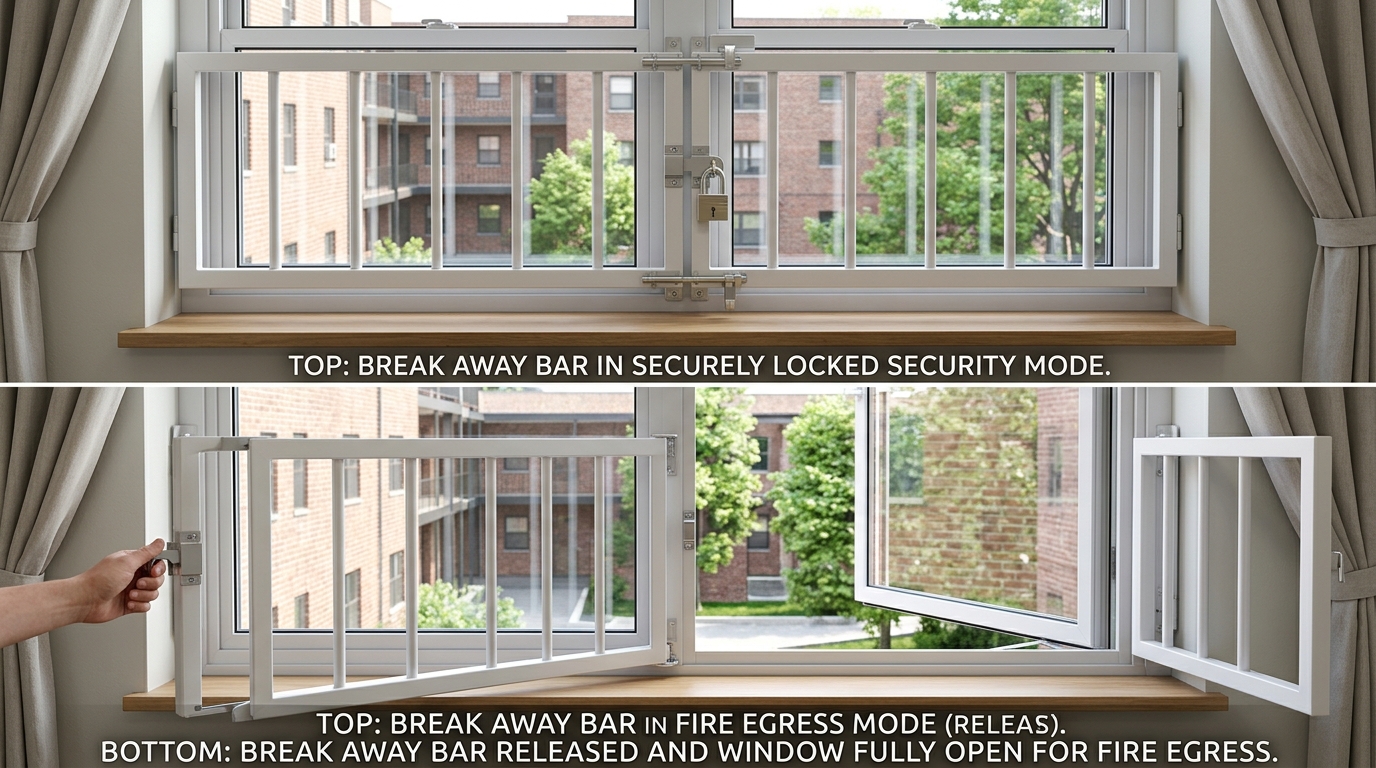
- If any window IS a designated emergency exit (uncommon in storefronts but possible), bars must include a quick-release mechanism operable from inside. The SWB Model A/EXIT (~$92) is specifically designed for this scenario, with IBC/NFPA/OSHA compliant quick-release hardware.
For a detailed breakdown of window bar fire code requirements, see our guide on window bar legality by state.
ADA Accessibility
The Americans with Disabilities Act (ADA) requires commercial establishments to maintain accessible entry. For security bar installations, the key ADA requirement is:
- Bars cannot reduce the clear opening width of any accessible entry door below 32 inches (measured with the door open 90 degrees).
- Bars on windows adjacent to entry doors must not protrude into the accessible route along the sidewalk. Exterior-mounted bars that extend more than 4 inches from the building face into a public sidewalk may violate ADA route requirements.
In practice, this means mounting bars on the glass surface or flush with the building face rather than on extended brackets that protrude outward.
Building Permits
Permit requirements for storefront security bars vary by jurisdiction. Some cities require permits for any exterior modification to a commercial building. Others exempt security devices from permit requirements entirely. A few guidelines:
- Always check with your local building department before installing. A 5-minute phone call can save you from a code violation and forced removal.
- Historic districts often have additional design review requirements that may restrict or specify the appearance of exterior-mounted security bars.
- Landlord approval — if you lease the space, get written approval from the property owner before installing. This is especially important for masonry-mount bars, which are permanent.
Cost Analysis: What Storefront Security Bars Actually Cost
Let us build specific cost scenarios for the most common storefront configurations. These numbers use SWB Model A at ~$90/unit and Model B at ~$91/unit.
Small Storefront (1-2 windows + door)
| Component | Units | Product Cost |
|---|---|---|
| Main display window (5 ft wide) | 2 x Model A | $180 |
| Glass entry door panel | 1 x Model A | $90 |
| Side window (3 ft wide) | 1 x Model A | $90 |
| Total product cost (DIY install) | 4 units | $360 |
| Professional installation | 4 units x $75 | $300 |
| Total with pro install | $660 |
Medium Storefront (3-4 windows + door)
| Component | Units | Product Cost |
|---|---|---|
| 2 display windows (6 ft each) | 4-6 x Model A | $360-$540 |
| Glass entry door | 1 x Model A | $90 |
| 2 side/rear windows | 2 x Model A | $180 |
| Total product cost (DIY) | 7-9 units | $630-$810 |
| Professional installation | 7-9 units x $75 | $525-$675 |
| Total with pro install | $1,155-$1,485 |
Large Storefront (5+ windows, brick building)
| Component | Units | Product Cost |
|---|---|---|
| 3 large display windows (8 ft each) | 9-12 x Model B | $819-$1,092 |
| Glass entry door + sidelights | 3 x Model B | $273 |
| Rear entry door window | 1 x Model B | $91 |
| Total product cost | 13-16 units | $1,183-$1,456 |
| Professional masonry installation | 13-16 units x $125 | $1,625-$2,000 |
| Total with pro install | $2,808-$3,456 |
ROI Calculation: Security Bars vs. Other Retail Security Options
The return on investment for storefront security bars becomes obvious when you compare them against every other security option available to a small retail business.
One-Time Cost vs. Recurring Security Expenses
| Security Measure | Year 1 Cost | Annual Recurring | 5-Year Total | Prevents Entry? |
|---|---|---|---|---|
| Security bars (medium storefront, DIY) | $630-$810 | $0 | $630-$810 | Yes |
| Commercial alarm system | $500-$1,500 install | $600-$1,200/yr monitoring | $2,900-$6,300 | No |
| Security camera system (8 cameras) | $1,500-$4,000 | $200-$600/yr cloud storage | $2,300-$6,400 | No |
| Security guard (after-hours, 6 hrs/night) | $31,200-$47,000 | $31,200-$47,000 | $156,000-$235,000 | Depends |
| Rolling security grille | $2,000-$8,000 | $200-$500 maintenance | $2,800-$10,000 | Yes |
| Security window film | $500-$2,000 | $0 (replace every 10 yrs) | $500-$2,000 | Partially (delays, doesn't prevent) |
Security bars are the only option under $1,000 that physically prevents entry. And they have zero recurring costs. Every other option that actually prevents entry (rolling grilles, security guards) costs significantly more in both upfront investment and ongoing expenses.
Break-Even Analysis
Consider the economics of a single prevented break-in:
- Average retail break-in loss: several thousand dollars in merchandise, register cash, and property damage
- Insurance deductible: $1,000-$5,000 (the amount YOU pay before insurance covers anything)
- Emergency board-up and glass replacement: $500-$2,000 for commercial plate glass
- Business interruption: 2-5 days at reduced revenue while dealing with aftermath
- Insurance premium increase: commercial property claims often trigger 10-20% premium increases at renewal
A single prevented break-in covers the cost of barring your entire storefront multiple times over. The bars pay for themselves the first night they deter an attempted entry.
Insurance Premium Discounts
Many commercial property insurers offer premium discounts for visible physical security measures. Security bars may qualify you for a discount of 5-15% on your property/casualty premium. Contact your insurance broker and ask specifically about security bar credits — some carriers have specific line items for this. Over five years, the discount alone can offset a significant portion of the bar installation cost. For more on how window bars affect property value and insurance, see our cost analysis guide.
Interior vs. Exterior Mounting for Retail Storefronts
This decision affects both the security effectiveness and the customer-facing appearance of your storefront. Both positions provide the same physical security — the steel bars are equally effective whether mounted inside or outside the glass. The differences are in deterrence visibility, weather exposure, and aesthetic impact.
Exterior Mount: Maximum Deterrence
Exterior-mounted bars are visible from the sidewalk and street, sending an unmistakable signal to potential criminals. This is the traditional commercial security bar mounting position and the one most associated with serious storefront protection.
Advantages:
- Maximum visual deterrence — criminals can see the bars from a distance
- Protects the glass surface from direct impact (bars absorb the initial blow)
- Easy to inspect from outside for damage or tampering
Disadvantages:
- More visible to customers — can create a "high crime area" perception
- Exposed to weather (powder coat finish protects the steel, but exterior installations see more wear over decades)
- Accessible to tampering from outside (anti-tamper hardware is essential)
- May require permit for protrusion into public sidewalk space
Interior Mount: Discrete Protection
Interior-mounted bars sit behind the glass, visible but less prominent. They provide identical physical protection while presenting a cleaner exterior appearance.
Advantages:
- Cleaner exterior appearance — bars are behind glass and less visually dominant
- Protected from weather and vandalism (behind locked glass)
- Inaccessible to tampering from outside
- No sidewalk encroachment issues
Disadvantages:
- Slightly less deterrent effect — bars are less visible at night and from a distance
- Glass can still be broken (bars prevent entry but not glass breakage)
- Installation requires access from inside during business hours or after-hours scheduling
Our Recommendation
For high-crime areas and high-value merchandise: exterior mount. The visual deterrence outweighs the aesthetic impact. Your customers already know the neighborhood; visible security bars may actually increase their confidence in your store's safety.
For moderate-crime areas and aesthetic-sensitive businesses: interior mount. The protection is identical, and the cleaner exterior preserves your storefront's visual appeal for walk-in traffic.
Aesthetics and Product Visibility: Bars That Don't Scare Customers
The most common objection retail owners raise about storefront security bars is appearance. "Won't bars make my store look like a prison?" The answer is no — but only if you choose the right product and installation approach.
Modern Bar Design vs. Old-School Burglar Bars
The ornamental wrought-iron bars with scrollwork and decorative curlicues that characterized 1980s and 1990s storefront security are a product of a previous era. Modern security bars like the SWB Model A and Model B feature clean, vertical-line profiles with professional powder-coated finishes. The visual effect is more "architectural element" than "security device."
Black bars on a dark-framed storefront are nearly invisible from across the street. White bars on light-colored buildings blend into the facade. The key is matching the bar finish color to the building's existing color palette rather than choosing a contrasting color that draws attention.
Maintaining Product Visibility
Retail display visibility through security bars depends on bar spacing and the viewing angle. With standard bar spacing (approximately 4 inches), customers can clearly see display merchandise through the bars. The bars occupy a small fraction of the total glass area, and the human eye naturally focuses on the merchandise behind them rather than the bars themselves.
Tips for maximizing display visibility through security bars:
- Light the display area generously. Well-lit merchandise behind bars reads as "secure and valuable," not "blocked."
- Position display items between bar locations so each item is fully visible through an unobstructed gap.
- Use black bars — black recedes visually and creates the least visual obstruction.
- Keep bars clean. Dust, cobwebs, or peeling paint on bars draws attention to them.
Customer Perception: The Data Tells a Different Story
Retail owners worry that security bars signal "dangerous neighborhood" to customers. Research into consumer behavior suggests the opposite in many cases. In areas with visible crime or known theft problems, customers report feeling safer entering stores with visible security measures. The bars communicate that the owner takes security seriously — which means the store is actively monitored, well-maintained, and invested in long-term operation.
The stores that suffer perception problems are the ones with rusty, damaged, or poorly maintained bars from decades ago. Modern, clean, professional-grade bars in good condition read as "serious business" rather than "high crime."
7 Mistakes Retail Owners Make with Storefront Security Bars
After working with hundreds of retail and commercial property owners, these are the errors we see most frequently. Avoiding them will save you money, time, and frustration.
Mistake #1: Barring the Front Windows but Ignoring the Rear
Criminals case a building before attacking it. If the front windows have bars but the rear windows or back door glass do not, the break-in simply moves to the rear. Complete perimeter coverage is the goal. Partial coverage just redirects the attack point.
Mistake #2: Choosing the Cheapest Bars Available
Generic bars from budget retailers use thin-gauge steel (sometimes aluminum) and standard Phillips-head screws. A determined thief can pry these off the building or cut through the bars with a bolt cutter in minutes. The price difference between a $25 generic bar and a $90 SWB Model A is $65 — and that $65 buys 20+ years of actual security versus a false sense of protection.
Mistake #3: Using Standard Screws Instead of Anti-Tamper Hardware
This applies to exterior-mounted bars specifically. Standard Phillips-head or hex-head screws can be removed with a cordless drill in seconds. Anti-tamper security fasteners (one-way screws, security Torx, shear-head bolts) require specialty tools that criminals do not carry. SWB products include anti-tamper hardware; use it.
Mistake #4: Forgetting About the Entry Door Glass
Most retail entry doors have glass panels — half-light, three-quarter-light, or full glass. Breaking the door glass provides the same entry access as breaking a window. Bar the door glass just as you would any other window opening.
Mistake #5: Not Checking Permit Requirements
Installing bars without required permits can result in code violation fines and forced removal. A 5-minute call to your local building department prevents this entirely. In historic districts, exterior modifications often require design review board approval.
Mistake #6: Installing Bars That Block Emergency Egress
Bars must never be installed across a designated emergency exit. If your storefront has a window designated as an emergency exit (check your building's fire safety plan), that window requires bars with a quick-release mechanism. The SWB Model A/EXIT meets this requirement.
Mistake #7: Waiting Until After a Break-In to Install Bars
The most expensive security bar is the one you buy the day after a break-in — because you are now also paying for the broken glass, stolen merchandise, business interruption, and insurance deductible. Every night your storefront is unbarred is a night you are gambling with your business. The math is simple: $360-$810 protects your entire storefront for the next 20-30 years. Install them now.
Frequently Asked Questions About Storefront Security Bars
What are storefront security bars and how do they work?
Storefront security bars are vertical steel bars mounted across the glass surfaces of retail shop windows and door panels. They anchor to the building's window frame or masonry surround at the top and bottom, creating a steel barrier that prevents entry even if the glass is broken. The bars are spaced approximately 4 inches apart so a person cannot fit between them, and the steel gauge resists cutting with portable tools. Products like the SWB Model A provide telescopic adjustment to fit any window width, while the SWB Model B mounts directly into brick and concrete for maximum commercial-grade protection.
How much do storefront security bars cost for a small retail store?
A small retail storefront with 1-2 display windows and a glass entry door typically requires 4-6 security bar units. At approximately $90 per unit for the SWB Model A, the total product cost for a small store runs $360-$540 with DIY installation. Professional installation adds $50-$75 per unit. A medium storefront with 3-4 windows runs $630-$810 for products. These are one-time costs with zero recurring fees and a 20-30 year lifespan, making security bars the most cost-effective physical security option available to retail businesses.
Do storefront security bars deter smash-and-grab theft?
Yes. Storefront security bars deter smash-and-grab theft through two mechanisms. First, visual deterrence: criminals surveilling potential targets will skip barred storefronts in favor of unbarred ones because bars signal a harder target. Second, physical prevention: even if a criminal breaks the glass, the steel bars prevent anyone from entering the store or reaching merchandise through the opening. The combination of deterrence and prevention makes security bars the most effective single countermeasure against smash-and-grab attacks on retail storefronts.
Are storefront security bars legal for retail businesses?
Storefront security bars are legal in all 50 states for retail businesses, subject to local building permit requirements and fire code compliance. Bars must not obstruct any designated emergency exit or reduce the clear width of an accessible entry door below 32 inches per ADA requirements. Some jurisdictions require permits for exterior modifications to commercial buildings, and historic districts may have design review requirements. Always check with your local building department before installing. If a window serves as a fire exit, use bars with a quick-release mechanism like the SWB Model A/EXIT to maintain fire code compliance.
Can I install storefront security bars myself or do I need a professional?
Frame-mount security bars like the SWB Model A can be installed by any business owner with a cordless drill, level, and tape measure. Installation takes approximately 15 minutes per unit. No cutting, welding, or specialty tools are required. Masonry-mount bars like the SWB Model B require a rotary hammer drill to set expansion anchors in brick or concrete, which takes 30-45 minutes per unit. If you are not comfortable with masonry drilling, hire a local handyman or contractor for the installation — labor typically runs $75-$150 per unit for masonry work.
Will security bars hurt my store's curb appeal and drive away customers?
Modern security bars with clean vertical-line profiles and professional powder-coated finishes have minimal aesthetic impact. Black bars on dark-framed storefronts are nearly invisible from across the street. Consumer behavior research suggests that in areas with known crime concerns, customers actually feel safer entering stores with visible security measures. The bars that damage curb appeal are rusty, damaged, or outdated ornamental bars from decades ago. Modern products like the SWB Model A and Model B present a professional appearance that reads as an architectural element rather than a security device.
Do storefront security bars qualify for insurance premium discounts?
Many commercial property insurance carriers offer premium discounts of 5-15% for visible physical security measures, and security bars often qualify. The discount amount varies by carrier, location, and your current policy terms. Contact your insurance broker and ask specifically about security bar credits. Some carriers have specific line items for physical barrier installations. Over a 5-year policy period, the accumulated discount can offset a meaningful portion of the original bar installation cost, effectively making the bars partially free in the long run.
What is the difference between security bars and rolling security grilles for storefronts?
Fixed security bars are permanently mounted and require no daily operation, maintenance, or employee action. They cost $15-$25 per linear foot, have no moving parts to fail, and last 20-30 years. Rolling security grilles are accordion-style gates that must be opened and closed daily, cost $50-$150 per linear foot, require annual maintenance, and have mechanical components that can fail. Grilles offer the advantage of a completely clear window during business hours, while fixed bars are always visible. For most small retail operations, fixed bars provide superior value due to lower cost, zero maintenance, and no dependence on employee compliance.
Should I mount storefront security bars on the interior or exterior?
Exterior mounting provides maximum visual deterrence because criminals can see the bars from the street. Interior mounting provides a cleaner exterior appearance and protects the bars from weather and tampering. Both positions provide identical physical security. For high-crime areas and businesses with high-value visible merchandise, exterior mounting is recommended for its deterrence effect. For moderate-crime areas and aesthetic-sensitive businesses like boutiques or salons, interior mounting preserves curb appeal while delivering the same protection. Anti-tamper hardware is essential for exterior installations.
How many security bar units do I need for my storefront?
The number of units depends on your window dimensions. Measure each window's inside width and divide by the single-unit maximum coverage width of your chosen bar. A standard 5-foot retail display window typically needs 2 units. A large 8-foot plate glass window needs 3-4 units using the SWB Model A's modular stacking system. A glass entry door panel needs 1-2 units. A complete small storefront (2 display windows + 1 door) typically requires 4-6 units. A medium storefront (3-4 windows + door) requires 7-9 units. Measure every window individually — do not assume they are all the same width.
Final Recommendation: Your Storefront Security Action Plan
After analyzing every available option for retail storefront security, here is the specific, actionable plan we recommend for every small business owner with street-level glass.
Step 1: Assess Your Storefront
Walk the perimeter of your building and identify every glass surface — front display windows, entry door glass panels, sidelights, side windows, rear windows, and any other glass that a person could break and enter through. Count them and measure them.
Step 2: Identify Your Mounting Surface
Determine whether your windows are surrounded by frame material (wood, vinyl, aluminum, steel) or masonry (brick, concrete, stone). This tells you whether you need the SWB Model A (frame mount, ~$90) or the SWB Model B (masonry mount, ~$91).
Step 3: Calculate Your Unit Count
Use the measurement method above to determine how many bar units cover each window. Add them up for your total order. Round up if you are between sizes — it is better to have slight overlap than a gap.
Step 4: Check Permits and Landlord Approval
Call your local building department (5-minute phone call). If you lease, get written approval from the property owner. If you are in a historic district, check with the design review board.
Step 5: Install
Frame mount bars take 15 minutes per unit with a cordless drill. Masonry mount bars take 30-45 minutes per unit with a rotary hammer drill. A typical small storefront can be fully barred in a single afternoon.
Step 6: Call Your Insurance Broker
Report the installation and ask about physical security premium credits. Document the installation with photos for your insurance file.
The Bottom Line
For $360-$810, you can protect your entire retail storefront from break-ins for the next 20 to 30 years with zero recurring costs. No alarm system, camera system, or security service comes close to this cost-effectiveness. And unlike every electronic option, security bars physically prevent entry — they do not just document it.
Every night your storefront windows are unbarred, you are relying on luck, an alarm siren, and police response time to protect your livelihood. One set of steel bars changes that equation permanently.
Ready to protect your storefront? Explore the SWB product line:
- Model A — Telescopic + Modular | Frame or wall mount | ~$90 | Best for strip malls, framed storefronts, DIY install
- Model B — Heavy-gauge masonry mount | Brick and concrete | ~$91 | Best for downtown brick buildings, permanent commercial installs
- Model A/EXIT — Quick-release egress | IBC/NFPA/OSHA compliant | ~$92 | Required for windows designated as emergency exits