Patio Door Burglar Bars: Steel Security That Stops Forced Entry on Your Most Vulnerable Access Point
Stop forced entry cold with SWB patio door burglar bars. Adjustable steel, no drilling, ships via Amazon USA. Shop now and protect your home today.
SWB: High-caliber Security Window Bars experts. We bring the most advanced protection within your reach, explained clearly. Your patio door is not a feature — it is a liability. According to the FBI's Uniform Crime Report, approximately 6.7 million residential burglaries occur in the United States every year, and law enforcement data consistently identifies sliding glass patio doors as one of the top three most exploited entry points by intruders. Unlike solid wood or metal front doors with deadbolts, standard patio doors rely on flimsy factory latches that can be lifted off their tracks in seconds. Patio door burglar bars are the single most cost-effective physical deterrent you can install to close that vulnerability for good. Whether you own a home in Atlanta, rent a ground-floor apartment in Houston, or manage a portfolio of properties in Los Angeles, the math is simple: a $90 steel bar deployed correctly makes forced entry dramatically harder and slower — and burglars, above all else, hate delay. This guide covers everything you need to know.
Patio door manufacturers install latches that meet minimum residential construction standards, not security standards. The International Building Code (IBC) doe…
Why Patio Doors Are the #1 Burglar Entry Point in American Homes
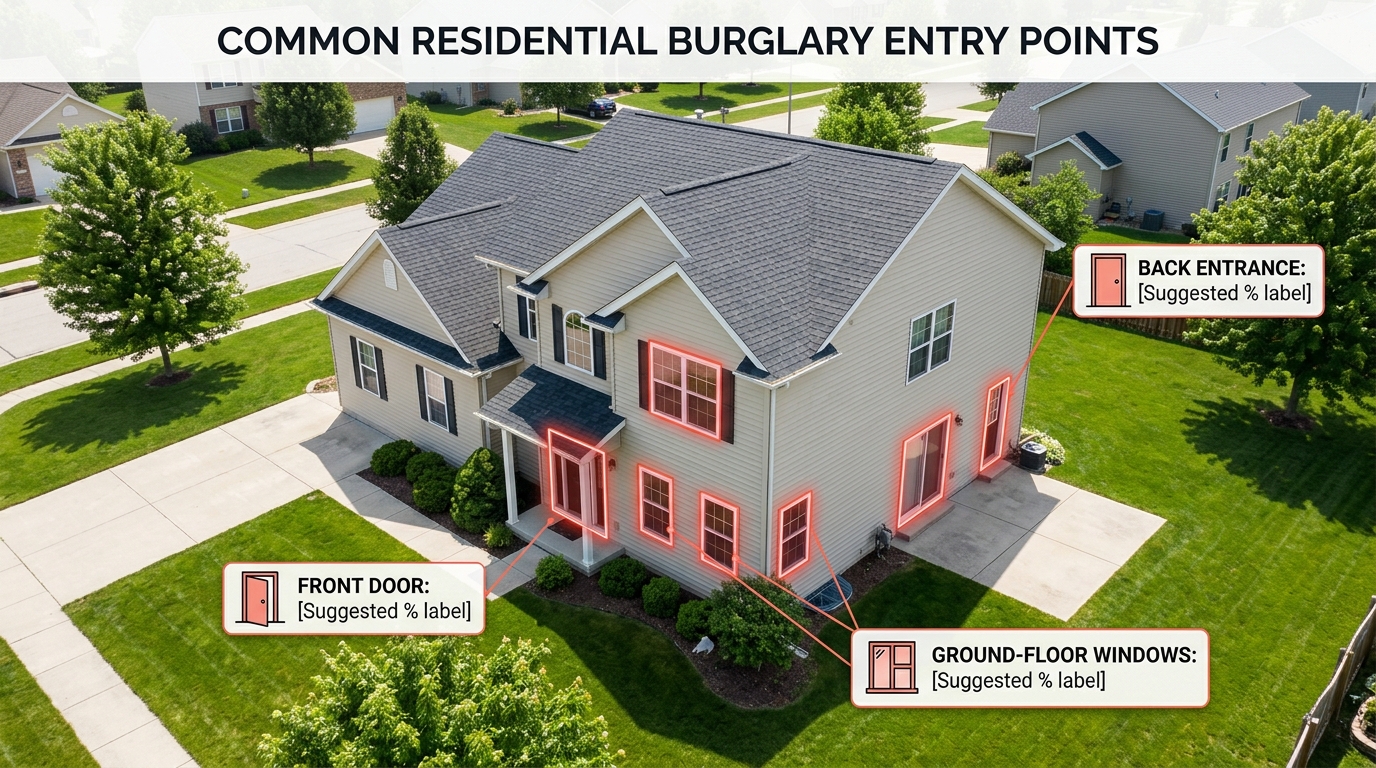
Most American homeowners invest heavily in front-door deadbolts and alarm systems while completely overlooking the sliding glass patio door at the back of the house. That oversight is exactly what experienced burglars count on. According to the Bureau of Justice Statistics, roughly 34% of burglars enter through a front door, but back doors and sliding glass doors collectively account for nearly 22% of all forced entries — and patio-style sliding doors are disproportionately represented in that number because of their structural weakness. A standard sliding patio door is secured by a spring-loaded latch, not a deadbolt. That latch can be defeated in under ten seconds using a flathead screwdriver or by simply lifting the door off its bottom track — no glass breaking required, no noise, no alarm triggered. In neighborhoods across Memphis, Detroit, and Philadelphia, burglary crews specifically target properties with unprotected patio doors precisely because of this known vulnerability. Installing patio door burglar bars eliminates the lift-and-shimmy technique entirely and dramatically increases the time and effort required for forced entry — the two factors that most effectively deter opportunistic burglars.
The Sliding Door Latch Problem: What Factory Hardware Does Not Tell You
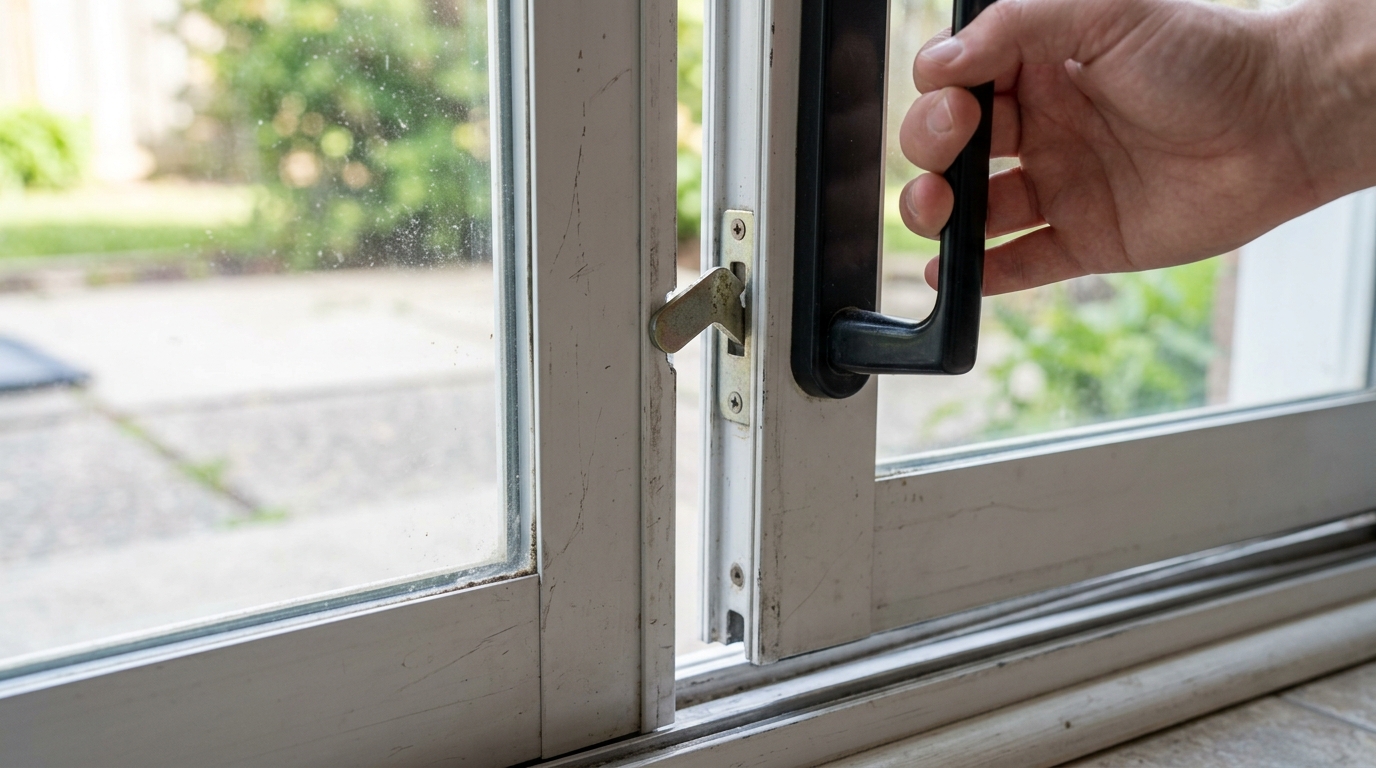
Patio door manufacturers install latches that meet minimum residential construction standards, not security standards. The International Building Code (IBC) does not require sliding doors to include a secondary locking mechanism at the factory level. What you get off the assembly line is a latch designed to keep the door closed against wind pressure — not against a determined adult applying lateral force or vertical lift. A 2021 analysis by the National Crime Prevention Council (NCPC) noted that sliding doors equipped only with their original factory latch were successfully forced in simulated entry tests in under 12 seconds. By contrast, doors with a secondary bar or rod in the track required an average of over 4 minutes to breach — enough time to trigger alarms, alert neighbors, and cause the intruder to abandon the attempt. Patio door burglar bars work by filling the floor track, physically preventing the door from sliding open regardless of latch condition.
Track-Fill Method vs. Bar-Brace Method
There are two primary mechanical approaches to patio door burglar bars. The track-fill method uses an adjustable bar or rod laid flat in the bottom track so the door panel cannot slide. The bar-brace method uses a vertical or angled bar that braces against the door frame, applying resistance to lateral movement. SWB's telescopic bar system is designed to work with the track-fill method — it adjusts to fit your exact door width, sits flush in the track, and requires no drilling or permanent hardware installation.Crime Statistics by City: Where Patio Door Burglaries Are Most Common
The FBI's annual Crime in the United States report identifies the following metro areas as consistently ranking in the top quartile for residential burglary rates: Memphis, TN; Detroit, MI; Milwaukee, WI; Albuquerque, NM; Tulsa, OK; Kansas City, MO; and St. Louis, MO. In these cities, ground-floor residential units with rear patio access experience burglary rates significantly above the national average. However, high-crime cities do not have a monopoly on patio door break-ins. Law enforcement data from suburban Atlanta and Houston also documents high rates of opportunistic patio door burglaries in newer construction neighborhoods where builders install low-grade hardware at scale. The common thread is architectural: any property where a sliding glass door faces a backyard, alley, or shared common area — away from street visibility — is at elevated risk regardless of the neighborhood's overall crime rate. Patio door burglar bars address the structural vulnerability directly, independent of neighborhood context.
How Patio Door Burglar Bars Work: Mechanics, Materials, and Force Resistance
Understanding exactly how patio door burglar bars function at a mechanical level helps you choose the right product and install it correctly. At its core, a security bar for a sliding patio door is a rigid steel or heavy-gauge aluminum rod that occupies the floor track — the channel in which the door panel slides. When the bar is in place, the door panel has zero travel distance. An intruder cannot slide the door open by even a fraction of an inch regardless of what happens to the latch. The physics are straightforward: the force required to overcome a properly installed steel bar in a track is not applied to the latch — it is applied to the entire door frame, the floor anchoring, and the structural wall itself. Defeating a properly installed steel bar without specialized tools is, for practical purposes, impossible in the timeframe a residential burglar operates in. Steel construction is critical here. Hollow aluminum bars sold at big-box retailers can be sheared or bent by a determined attacker. Solid or heavy-gauge steel bars like those used in SWB's system maintain structural integrity under sustained impact force.
Telescopic Design: Why Adjustability Matters for Patio Doors
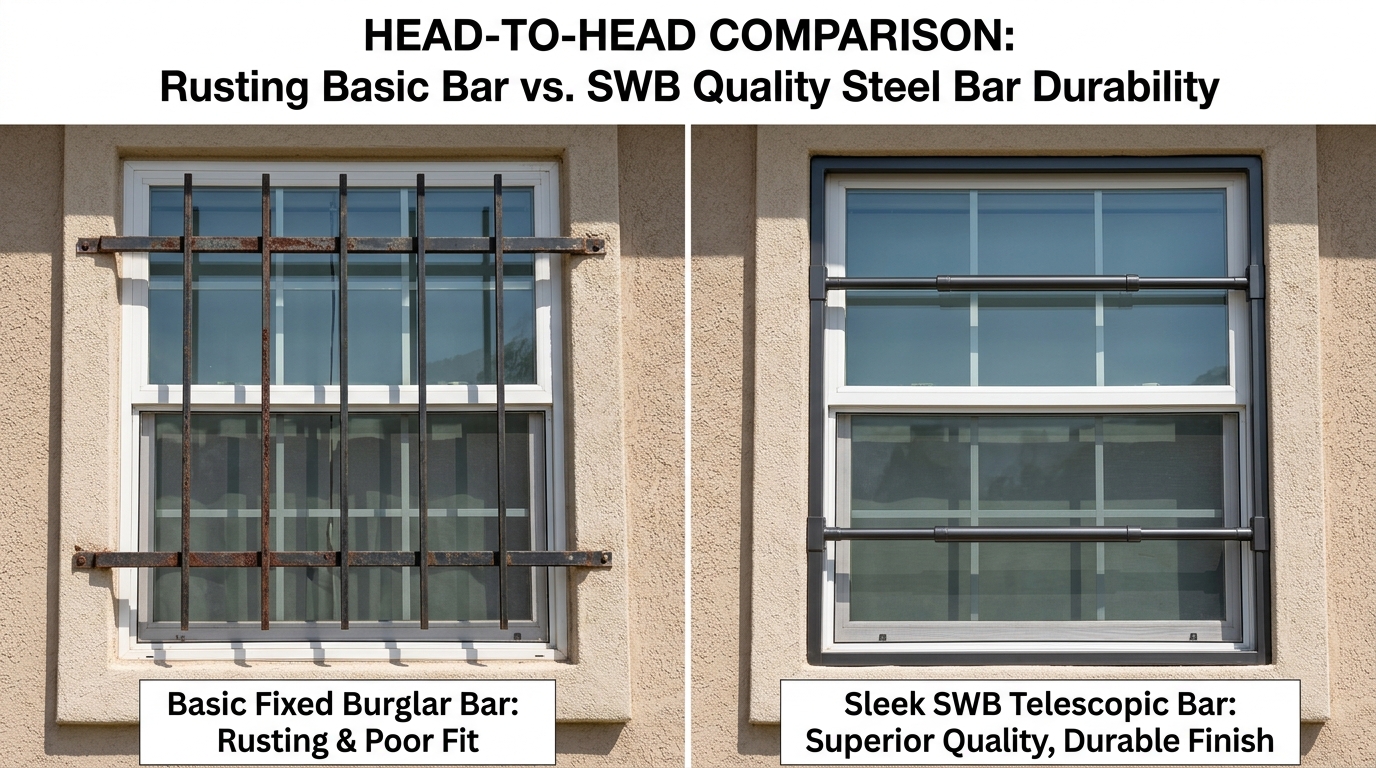
American patio doors are not standardized. Door widths in the US residential market typically range from 60 inches for a standard two-panel configuration to 144 inches for a multi-panel system. Even within standard two-panel doors, the actual track width varies by manufacturer and installation tolerances. A fixed-length bar will either be too short — leaving movement play in the track — or too long — requiring modification. SWB's telescopic bar system solves this problem definitively. The bar extends and locks at the precise width of your door track, with no gap and no slack.
Telescopic Extension Range and Lock Mechanism
SWB's Model A telescopic system covers windows and door track widths from 22 inches to 36 inches in a single unit. The telescoping shaft uses a friction-lock or pin-lock mechanism that holds the bar rigid once set to length — it does not compress under impact. For wider patio door configurations, two bars can be deployed in the same track, end to end, to cover the full span. The installation process takes under 15 minutes: measure your track width, extend the bar to match, and place it in the track. No drilling, no wall anchors, no tools required.Steel vs. Aluminum vs. Wood: Material Comparison for Patio Door Security Bars
The materials market for patio door burglar bars breaks into three categories, and each has meaningfully different performance characteristics. Wood dowel rods are the lowest-cost option and are widely sold at hardware stores for around $5–$10. They are better than nothing, but they can crack under impact, warp in humid climates (common in Florida, Louisiana, and the Gulf Coast), and often do not fit the track snugly enough to prevent lateral door movement. Hollow aluminum bars improve on wood for corrosion resistance but introduce a new failure point: aluminum can be bent or fractured with a hammer blow. Heavy-gauge steel bars — like those in the SWB product line — are the professional-grade choice. Steel's yield strength far exceeds the force that can be manually applied in a patio door forced-entry scenario. The matte black powder-coated finish used by SWB adds corrosion resistance without sacrificing aesthetics. For renters in coastal markets like Miami or Seattle where humidity and salt air degrade materials quickly, the powder-coated steel finish is particularly valuable.
Choosing the Right SWB Model for Your Patio Door
Security Window Bars offers three distinct product models, and understanding the differences is essential for selecting the right patio door burglar bar for your specific situation. The primary considerations are: installation type (permanent vs. removable), egress compliance requirement (critical for doors used as emergency exits), and the physical configuration of your patio door. Each SWB model is built from the same heavy-gauge steel with the same matte black powder-coat finish — the differences are in the mounting system and the egress feature set. At $90–$92, all three models are dramatically more affordable than professional security bar installation, which according to HomeAdvisor national averages ranges from $600 to $1,800 per opening when a contractor is hired.
Model A — Telescopic: Best for Renters and Multi-Use Properties
The SWB Model A is the flagship telescopic bar and the most versatile option for patio door applications. At $90, it deploys in the floor track of any standard sliding patio door without drilling, wall anchors, or permanent hardware. For apartment renters in cities like Chicago, New York, or Los Angeles where lease agreements prohibit structural modifications, Model A is the only professional-grade steel security solution that is fully compliant with no-drill lease clauses. When you move out, the bar removes in seconds and leaves zero evidence of installation — no screw holes, no paint damage, no security deposit disputes. Landlords and AirBnB hosts who rotate tenants also benefit from Model A's portability: deploy it for each tenancy, remove it for showings, and reinstall in minutes. You can explore full specifications for the Model A at the SWB Model A product page.
Model A/EXIT — Egress Compliant: Required When the Patio Door Is an Emergency Exit
If your patio door serves as a designated emergency egress route — common in ground-floor apartments and single-story homes where the front door is the only other exit — you cannot use a standard bar that requires manual removal in an emergency. The SWB Model A/EXIT ($92) is the answer. It features a patented quick-release mechanism that allows the bar to be released from the inside with a single motion, even under stress, in full compliance with the International Building Code (IBC), NFPA 101 Life Safety Code, and OSHA standards. This is not a minor technical detail — it is a life-safety requirement. In a residential fire, the average occupant has less than three minutes to evacuate once smoke is detected at sleeping level, according to the NFPA. A security bar that requires two hands, a specific sequence of movements, or physical strength to remove is a fatal hazard in that scenario. The Model A/EXIT eliminates that risk while maintaining the same steel-strength security as the standard Model A. Review full compliance documentation at the Model A/EXIT product page.
Model B — Wall Mount: Maximum Security for Permanent Installations
For homeowners who own their property and want the maximum possible forced-entry resistance on a patio door, the SWB Model B ($91) is the heavy-gauge wall-mount system. Unlike the track-fill telescopic approach, Model B anchors directly into the structural frame on either side of the door opening, providing a rigid brace that resists not only lateral sliding force but also impact force perpendicular to the door plane. This is the appropriate choice for ground-floor commercial properties, detached garages with patio-style access panels, and owner-occupied homes in high-crime markets where maximum deterrence is the priority. The wall-mount system requires basic drilling and hardware installation — a 30–45 minute job for a competent DIYer with a power drill and level. Full installation instructions are available at the SWB installation guide. The powder-coated black finish matches modern patio door frames and does not look out of place against contemporary home exteriors.
Legal and Building Code Considerations for Patio Door Burglar Bars in the USA
Installing patio door burglar bars in the United States involves navigating a patchwork of federal building codes, local ordinances, and rental housing regulations. Failing to understand these requirements can result in code violations, insurance claim denials, or — most critically — a safety hazard in the event of a fire. The good news is that all three SWB models are designed from the ground up to be compliant with the most stringent US building codes. Here is what you need to know by situation type.
IBC and NFPA 101 Egress Requirements for Sliding Door Security
The International Building Code (IBC) Section 1030 and NFPA 101 Chapter 7 both establish requirements for emergency egress openings in residential occupancies. Any door or window used as a required means of egress must be operable from the inside without the use of a key, tool, or special knowledge. This rule directly governs the type of patio door burglar bar you can install. A bar that cannot be quickly released from the inside without tools is a code violation when installed on an egress door. The SWB Model A/EXIT is specifically engineered to meet this requirement. The quick-release mechanism satisfies both IBC Section 1030.2's requirement for hardware operability and NFPA 101's mandate for unobstructed egress in sleeping areas and occupied rooms.
Sleeping Area Egress: What Counts as an Emergency Exit
Under the International Residential Code (IRC), every sleeping room must have at least one emergency escape and rescue opening. In practice, this means ground-floor bedrooms with patio door access — common in master suite configurations throughout the Sunbelt states — must use egress-compliant hardware. The Model A/EXIT is the appropriate and code-compliant choice for those applications.Renter Rights and Lease Compliance Across Key US States
For the 44.1 million apartment renters in the United States (US Census Bureau, 2023), the most pressing question about patio door burglar bars is often not code compliance — it is lease compliance. The majority of residential leases in states including California, New York, Texas, Illinois, and Florida prohibit tenants from making structural modifications to the unit without written landlord consent. Drilling holes for wall-mount bar hardware typically triggers this restriction. SWB's telescopic Model A is specifically designed to address this constraint: it requires no drilling, leaves no permanent marks, and can be removed in seconds. New York City's Local Law 57 requires landlords to install window guards in units where children under 10 reside, but patio doors fall under a separate security framework — and NYC's housing court has consistently held that tenants may install non-permanent security devices at their own expense. California Civil Code Section 1941.2 similarly permits tenants to install non-permanent security improvements. For specific state guidance, consult the SWB contact page or your local tenant rights organization.
Installation Guide: Setting Up Patio Door Burglar Bars Correctly
Incorrect installation is the single most common reason security bars fail to provide their rated protection level. A telescopic bar that is too short leaves movement play in the track. A wall-mount bar installed into drywall rather than structural framing pulls out under impact. This section walks through the correct installation procedure for both SWB systems so your patio door burglar bar delivers its full protection value from day one. For a comprehensive step-by-step visual guide, visit the SWB Window Bar Installation Guide.
Step-by-Step: Installing Model A Telescopic Bar in a Patio Door Track
Installing the SWB Model A telescopic bar in a sliding patio door track takes under 15 minutes and requires no tools beyond a tape measure. Step 1: Open the patio door fully and measure the interior width of the floor track from one end stop to the other. Note this measurement precisely — you want the bar to fill the full track width with no slack. Step 2: Extend the Model A telescopic shaft to match your measured width. Use the lock mechanism to fix the bar at that length. Step 3: Place the bar flat in the floor track behind the closed door panel. The bar should sit snugly against both end stops with no lateral movement. Step 4: Attempt to slide the door from the outside (with a helper) to verify zero travel. If the door moves at all, extend the bar slightly until all slack is eliminated. Step 5: For dual-panel patio doors where both panels slide, use two bars — one in each panel's track section. Total installation time for a standard two-panel patio door: 10–15 minutes. The bar can be removed in under 5 seconds by lifting it out of the track — critical for quick egress if you are using Model A on a non-egress door.
Step-by-Step: Installing Model B Wall-Mount Bar for Maximum Patio Door Security
The SWB Model B wall-mount installation provides the highest level of forced-entry resistance but requires basic DIY skills and a power drill. Step 1: Identify the structural framing members (studs or masonry) on both sides of the patio door opening using a stud finder. Wall anchors in drywall alone are insufficient — the bar must anchor into structural material. Step 2: Hold the Model B mounting brackets in position at the desired height (typically 36–42 inches from the floor, which is optimal for lateral force resistance) and mark anchor hole locations. Step 3: Pre-drill pilot holes into the identified studs or masonry. Step 4: Secure the mounting brackets using the hardware provided. Torque fasteners to manufacturer specification — do not over-tighten into wood framing. Step 5: Attach the bar to the mounted brackets and verify that it is level and rigid. Test by applying lateral pressure to the door — there should be zero movement. Total installation time: 30–45 minutes.
Common Installation Mistakes to Avoid
The most frequent installation errors are: anchoring into drywall rather than studs (results in pull-out under impact), setting the telescopic bar too short (allows door travel), and installing at an incorrect height that allows the door panel to be lifted over the bar. Avoid all three by measuring twice, using a stud finder, and placing the bar flush with the bottom of the door panel.Patio Door Burglar Bars vs. Other Patio Door Security Methods
The residential security market offers several alternatives to physical burglar bars for patio door protection. Smart locks, glass break sensors, security films, and door alarm pins are all marketed as security solutions. This section provides an honest, data-based comparison so you can make an informed decision — not a marketing-driven one. The short version: layered security is always best, but physical barriers are the only method that stops a determined intruder before entry. Every other method detects or alerts after the entry attempt has already begun.
Physical Bars vs. Smart Locks: Why Algorithms Don't Stop Forced Entry
Smart locks — whether Wi-Fi, Bluetooth, or Z-Wave enabled — are authentication upgrades, not physical security upgrades. A smart lock replaces the key with a code or app, but it does not reinforce the door frame, the track, or the glass. A patio door with a $300 smart lock and no physical bar is still defeated in seconds by lifting the door panel off its track — the smart lock plays no role in that attack vector. Patio door burglar bars, by contrast, operate entirely at the physical layer. They do not require power, a Wi-Fi connection, a subscription, or a smartphone. They cannot be hacked, spoofed, or disabled remotely. In grid-down scenarios — power outages, network outages, or infrastructure failures — a steel bar in the track is fully functional. For households in hurricane-prone states like Florida, Texas, and Louisiana, where power outages during peak storm season are common, this physical reliability is a critical advantage.
Physical Bars vs. Security Film and Glass Break Sensors
Security window film and glass break sensors address a specific attack mode: glass breaking. These products have genuine value for that specific scenario. However, experienced burglars avoid breaking glass because of noise — the lift-off-track technique used on sliding patio doors generates almost no sound, renders glass break sensors irrelevant, and defeats security film entirely (the glass never breaks). Door alarm pins and track-mounted vibration sensors detect when the door is opened or impacted but do not prevent the entry itself — they alert, they do not block. A SWB patio door burglar bar prevents entry. An alarm informs you that entry is occurring. For comprehensive patio door protection, the optimal layered approach is: SWB steel bar in the track (blocks forced entry) + glass break sensor (detects glass attack as backup) + motion-activated exterior light (deters approach). The bar is the foundation layer — and at $90, it is the most cost-effective foundation available. Explore the full SWB product lineup at securitywb.com to find the right model for your door configuration.
Buying Patio Door Burglar Bars: Where to Shop, What to Expect, and How to Get Fast Delivery
The SWB product line is available through two primary channels in the United States: Amazon USA (via the SecurityWindowBars seller storefront) and direct through securitywb.com. Both channels offer the full three-model product range. Amazon FBA fulfillment means orders ship from US-based warehouses — not from overseas — with Prime-eligible delivery timelines to all 50 states. For buyers in high-density urban markets like New York, Los Angeles, Chicago, and Houston, Prime delivery typically means the bar arrives within 1–2 business days of ordering. For rural addresses and less-served markets, standard delivery windows apply but remain significantly faster than ordering custom fabricated bars or scheduling a contractor visit for professional installation.
Price Comparison: SWB vs. Professional Installation vs. Big-Box Alternatives
Professional window and door security bar installation in the United States costs between $600 and $1,800 per opening when you factor in materials, labor, and contractor markup, according to HomeAdvisor cost data. That figure assumes welded or permanently mounted steel bars — the same steel strength that SWB delivers for $90–$92. Big-box retailer offerings (Home Depot, Lowe's) typically stock hollow aluminum or low-gauge steel bars in the $15–$40 range — products that deliver a fraction of the physical resistance of heavy-gauge steel. The SWB price point of $90–$92 is the intersection of professional-grade steel construction and DIY-accessible pricing. For property investors managing multiple units in cities like Atlanta, Memphis, or Detroit, the math is compelling: equipping 10 patio doors with SWB bars costs under $1,000 total versus $6,000–$18,000 for professional installation across the same portfolio.
Amazon vs. Direct Purchase: Which Channel Is Right for You?
Buying through Amazon USA is the fastest path to delivery for most US buyers. The SecurityWindowBars Amazon storefront includes Prime shipping, Amazon's A-to-z Guarantee, and straightforward return processing. For buyers who prefer direct-brand purchasing, comparing models, reading full technical specifications, or placing bulk orders for property portfolios, securitywb.com offers direct access to all three models with detailed product documentation. Both channels price identically — there is no premium for buying direct. First-time buyers who want to verify specifications before purchasing can review the complete model comparison at securitywb.com/model-a/ or proceed directly to purchase at Amazon USA. Both channels ship to all 50 states including Alaska and Hawaii.
🏆 Conclusion
Patio doors are the residential security gap that the home improvement industry consistently underestimates and that experienced burglars consistently exploit. The data is unambiguous: sliding glass patio doors equipped only with factory latches can be forced open in under 15 seconds without breaking glass, without triggering standard alarms, and without specialized tools. Installing patio door burglar bars from Security Window Bars eliminates that vulnerability at the physical layer — the only layer that actually stops entry rather than detecting or recording it after the fact. At $90–$92 per unit, SWB delivers heavy-gauge steel construction, telescopic adjustability, and egress-compliant options that match the performance of professionally installed systems at roughly 5–10% of the cost. Whether you are a renter in Chicago who cannot drill, a homeowner in Atlanta securing a master suite patio door, or a property manager fortifying a 20-unit portfolio in Houston, the SWB telescopic system deploys in minutes, ships fast via Amazon across all 50 states, and provides the permanent-installation strength without permanent-installation damage. Protect your patio door today — before it becomes someone else's entry point.
Security Window Bars · USA
Secure Your Home Today
Ready to secure your patio door with professional-grade steel? Security Window Bars ships fast across the USA via Amazon FBA. Shop Patio Door Burglar Bars on Amazon → | Model A Telescopic (No Drilling) → | Model A/EXIT Egress Compliant → | Model B Wall-Mount (Maximum Security) →
Shop on Amazon →Frequently Asked Questions
SWB's telescopic Model A adjusts from 22 to 36 inches, covering the most common American patio door track widths for standard two-panel configurations. For wider multi-panel doors — which can span 72 to 144 inches — two or more bars can be deployed end-to-end in the same track to achieve full coverage. Before purchasing, measure the interior track width of your specific door from end stop to end stop to confirm fit. If you are unsure which configuration your door requires, the SWB team can provide guidance through the contact page at securitywb.com/contact/.
Yes. The SWB Model A telescopic bar requires absolutely no drilling, no wall anchors, and no permanent hardware of any kind. It sits in the floor track of the sliding patio door and is held in place entirely by its telescopic tension and the track walls. It leaves zero marks when removed and is fully compliant with standard no-modification lease clauses. It is specifically designed for the 44.1 million apartment renters in the US who need professional-grade security without violating their lease agreement.
It depends on whether the patio door is designated as an emergency egress route. If your patio door is one of the required means of egress from a sleeping area or occupied room — which is common in ground-floor apartments and single-story homes — then under IBC Section 1030 and NFPA 101 Life Safety Code, any security device installed must be releasable from the inside without tools or special knowledge. In that case, you must use the SWB Model A/EXIT, which features a patented quick-release mechanism that is fully code compliant. For doors that are not egress routes, Model A or Model B are appropriate.
The lift-off attack on sliding patio doors works by lifting the door panel vertically out of its bottom track, bypassing the latch entirely. A telescopic bar placed in the floor track blocks this technique by eliminating the vertical clearance needed to lift the door out. When the bar fills the track end-to-end, the door panel cannot travel upward enough to clear the track. This is why proper installation — ensuring the bar fills the full track width with no slack — is essential. A bar that is even slightly too short leaves movement play that can allow a skilled intruder to work the door free.
Model A is a telescopic, no-drill bar that sits in the floor track — ideal for renters, temporary installations, and any situation where preserving the wall surface is important. It installs in under 15 minutes without tools. Model B is a heavy-gauge wall-mount bar that anchors into structural framing on both sides of the door opening — ideal for homeowners who want maximum forced-entry resistance and are comfortable with a one-time drill installation. Both are built from the same heavy-gauge steel with the same matte black powder-coat finish. Model A offers more versatility; Model B offers the highest peak resistance.
According to HomeAdvisor national cost data, professional window and door security bar installation ranges from $600 to $1,800 per opening, factoring in materials, labor, and contractor markup. SWB's full product line — including the heavy-gauge steel telescopic and wall-mount systems — is priced at $90 to $92 per unit. For a single patio door, SWB delivers equivalent steel strength at roughly 5–15% of the professional installation cost. For property managers equipping multiple units, the savings scale dramatically — 10 doors secured with SWB cost under $1,000 versus $6,000 to $18,000 with a contractor.
Patio door burglar bars designed for sliding track applications — including SWB Model A — are specifically engineered for sliding-panel doors, not outswing French doors or hinged double doors. French doors and hinged double doors require a different security approach: door bar braces, surface bolt hardware, or deadbolt reinforcement. SWB's wall-mount Model B can be adapted for hinged door applications where the bar acts as a brace between the door and the opposite wall or floor, but this requires a custom configuration assessment. Contact SWB directly at securitywb.com/contact/ to discuss your specific door type.
SWB patio door burglar bars are available through two channels: the SecurityWindowBars storefront on Amazon USA and directly through securitywb.com. Amazon FBA fulfillment ships from US domestic warehouses with Prime-eligible delivery — typically 1 to 2 business days for buyers in major metro areas including New York, Los Angeles, Chicago, Houston, Philadelphia, and Atlanta. Direct purchases through securitywb.com are available for all three models with full product documentation. Both channels serve all 50 US states. Pricing is identical across both channels at $90–$92 depending on model selected.