Window Security for Vacation Homes & Airbnb Properties: Complete Guide
Vacation homes, Airbnb rentals, and seasonal properties are burglarized at dramatically higher rates than occupied primary residences because they sit empty for days, weeks, or months at a time with no one inside to notice a break-in. FBI data shows that unoccupied homes account for a disproportionate share of residential burglaries, and the average loss per vacation home break-in exceeds $3,400 when you factor in stolen property, broken windows, water damage from compromised entry points, and the cost of emergency travel to deal with the aftermath.
Window security bars are the most reliable physical deterrent for properties that cannot rely on someone being home. Unlike alarm systems that need WiFi and power, unlike cameras that need cloud subscriptions and cellular connectivity, and unlike smart locks that need batteries and firmware updates, steel window bars work regardless of whether the electricity is on, the internet is connected, or anyone is watching a monitoring feed. They are mechanical. They are permanent in their protection. And they cost a fraction of what a single break-in would cost you in losses, insurance deductibles, and emotional stress.
This guide covers everything you need to know about securing a vacation home, Airbnb property, VRBO listing, lake house, mountain cabin, beach condo, or any seasonal property with window security bars. We cover why these properties are targeted, which products work best, how to stay fire-code compliant, insurance benefits, the real cost math, and exactly how to protect your property before your next departure.
Why Vacation Homes Are Targeted: The Empty-Property Problem
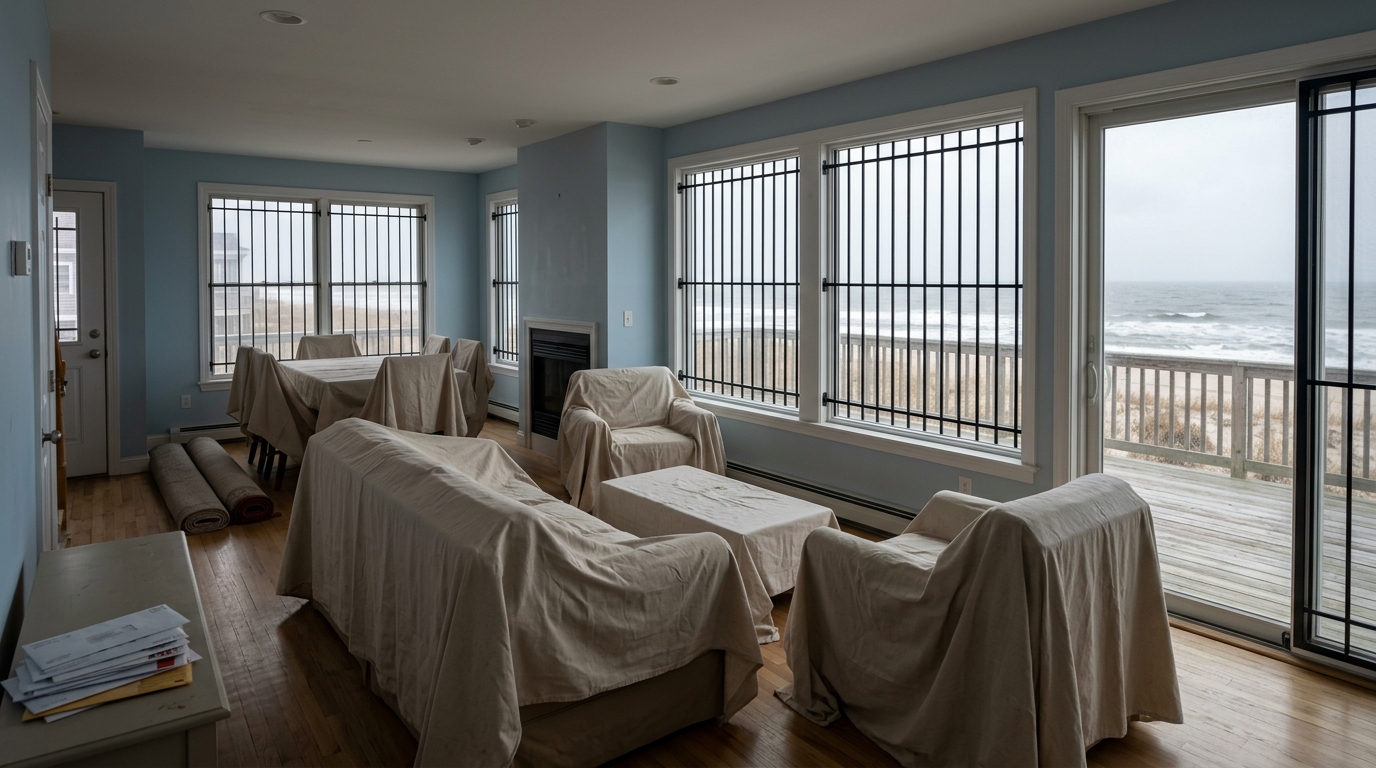
The fundamental security vulnerability of a vacation home is not its locks, its alarm system, or its location. The vulnerability is emptiness. An empty home is a home where no one will hear glass shatter, no one will confront an intruder, no one will call 911 in real time, and no one will notice for days or weeks that anything is wrong.
Burglars who operate in vacation and resort communities understand occupancy patterns. They know which homes go dark after Labor Day. They know which driveways stop having cars in October. They know which mailboxes start overflowing in November. And they know that a broken window at the back of an empty lake house in January will not be discovered until Memorial Day weekend.
How Burglars Identify Empty Vacation Homes
The signals of an unoccupied property are remarkably easy to read from the street:
- No vehicle movement -- the driveway stays empty day after day
- Static lighting -- lights are either always off or always on (timer lights on a fixed 6pm/11pm schedule are obvious)
- Mail and package accumulation -- newspapers pile up, Amazon boxes sit on the porch
- Unmaintained landscaping -- snow stays unshoveled, leaves accumulate, grass grows long
- No interior activity -- curtains never move, no shadows pass windows, no sounds from inside
- Seasonal patterns -- the house was occupied June through August and is now dark every night in September
- Community-wide vacancy -- in snowbird communities, entire blocks go vacant simultaneously, removing natural surveillance
Once a burglar identifies a likely vacant property, the risk calculus tilts heavily in their favor. There is no one inside to resist. There is no one to call for help. The discovery delay gives them hours, days, or months before a police report is filed. And if they enter through a window, the evidence -- a broken pane, a damaged screen -- may be attributed to weather or animals by the first person who notices.
The Occupancy Gap by Property Type
| Property Type | Typical Vacancy Period | Burglary Risk Factor |
|---|---|---|
| Snowbird winter home (AZ, FL, TX) | 5-7 months | Very high -- predictable annual pattern |
| Summer lake house | 7-9 months | Very high -- remote, entire community vacant |
| Mountain cabin | 6-8 months | High -- isolated, limited road access |
| Beach condo (owner use only) | 8-10 months | High -- ground-floor units especially vulnerable |
| Airbnb/VRBO rental | 2-14 days between bookings | Moderate -- public listing reveals address |
| Urban second home | Variable (weekdays, off-weekends) | Moderate -- more natural surveillance from neighbors |
The pattern is clear: the longer the vacancy, the higher the risk. A lake house that sits empty for nine months faces fundamentally different threats than a primary residence where someone sleeps every night. Security solutions designed for occupied homes -- alarm monitoring, smart doorbells, app-controlled cameras -- assume someone is available to respond. Vacation homes need security that works with zero human response.
The Real Cost of a Vacation Home Break-In
The financial damage from a vacation home burglary extends far beyond the value of stolen items. Here is what a typical break-in at an unoccupied property actually costs:
Direct Costs
| Cost Category | Typical Range | Notes |
|---|---|---|
| Stolen property | $1,500-$5,000+ | Electronics, tools, recreational equipment, appliances |
| Window/door repair | $300-$1,200 | Broken glass, damaged frames, forced locks |
| Interior damage | $500-$3,000 | Ransacked rooms, kicked-in interior doors, vandalism |
| Secondary damage (weather/water) | $1,000-$10,000+ | Rain through broken window over weeks/months |
| Insurance deductible | $1,000-$5,000 | Vacation home policies often carry higher deductibles |
| Emergency travel | $500-$2,000 | Last-minute flights/drives to deal with the aftermath |
| Temporary security measures | $200-$500 | Board-up service, emergency lock changes |
| Total direct cost | $5,000-$27,000+ |
Indirect Costs
- Insurance premium increase -- a burglary claim can increase your vacation home insurance premium by 10-25% for 3-5 years
- Lost rental income -- if the property is an Airbnb or VRBO, you lose bookings during repair and may receive negative reviews about security
- Property value impact -- a burglary history can affect resale value, especially if the property is in a community with multiple incidents
- Time and stress -- filing police reports remotely, coordinating repairs from hundreds of miles away, dealing with insurance claims
- Repeat targeting -- once a property is successfully burglarized, it is more likely to be targeted again because the burglar knows the layout and response time
Now compare these costs to prevention. Protecting every window in a typical vacation home with SWB Model A bars costs approximately $900-$1,100 one time, with zero recurring fees and a 20+ year lifespan. The cost of one break-in exceeds the cost of complete window protection by five to twenty times. For a full pricing breakdown, see our window security bars cost and pricing guide.
Physical Barriers vs. Remote Monitoring: What Actually Stops Break-Ins
The vacation home security market is flooded with technology-first solutions: Ring doorbells, Arlo cameras, SimpliSafe alarm systems, August smart locks. These products are excellent for occupied homes where someone can respond in real time. For vacation homes that sit empty for months, they have critical limitations.
Why Technology Alone Fails at Vacant Properties
| Technology | What It Does | Why It Fails at Vacant Properties |
|---|---|---|
| Security cameras | Records footage, sends alerts | Requires WiFi/cellular. Records the crime but does not prevent it. You watch on your phone from 1,000 miles away and can do nothing. |
| Monitored alarm | Detects entry, alerts call center | Requires power and cellular. Response time is 15-45 minutes. Burglar is gone in 5. False alarm fatigue leads to ignored alerts. |
| Smart doorbell | Video of front door, two-way audio | Burglars do not use the front door. Windows and back doors are the entry points. WiFi-dependent. |
| Smart locks | Remote lock/unlock, guest codes | Secures the door only. Windows remain vulnerable. Battery-dependent -- dies after months of vacancy. |
| Motion-sensor lights | Deters with light | Effective deterrent but does not prevent determined entry. Animals trigger them constantly, creating alarm fatigue. |
Why Physical Barriers Work
Steel window bars operate on a fundamentally different principle. They do not detect, alert, record, or notify. They prevent. A burglar standing in front of a window with steel bars cannot enter through that window. Full stop. The bars do not need electricity. They do not need internet. They do not need batteries. They do not need someone monitoring a phone 1,000 miles away. They work at 3am in a power outage in a cabin with no cell signal during a blizzard -- the exact conditions when technology-based security fails completely.
The ideal approach for vacation homes is a layered strategy: physical barriers (window bars) as the foundation, supplemented by technology (cameras, alarms) where infrastructure allows. But if you can only choose one, choose the physical barrier. A camera that records a break-in gives you footage for a police report. A steel bar on the window gives you a window that was never broken.
For a detailed comparison of window security options, see our best window security bars for homes guide.
Best Window Security Bars for Vacation Properties
After evaluating every window bar product on the US market for vacation and seasonal property use, here are our specific recommendations.
Top Pick: SWB Model A (~$90)
The SWB Model A is the best overall choice for vacation home window security. Its telescopic adjustment mechanism fits a wide range of window widths without custom ordering. The frame-mount installation takes approximately 15 minutes per window the first time and under 2 minutes for subsequent installs and removals once the brackets are in place. The powder-coated steel finish handles coastal salt air, mountain freeze-thaw cycles, and southern humidity without the premature rusting that afflicts painted competitors.
Why Model A for vacation homes:
- Telescopic width adjustment -- handles the non-standard window sizes common in vacation properties built across multiple decades
- Removable bracket system -- install bars when you leave, remove when you arrive, no visible trace
- Modular stacking for wide openings -- covers the oversized windows and sliding glass doors that vacation homes are built around
- No power, WiFi, or batteries needed -- works when the property is completely shut down for the off-season
- 20+ year lifespan -- one purchase protects your property for decades
Required for Bedrooms and Rentals: SWB Model A/EXIT (~$92)
The SWB Model A/EXIT is mandatory for bedroom windows at any property where people sleep, and it is especially critical for Airbnb and VRBO rentals. The quick-release mechanism allows the bar to be opened from inside in seconds during a fire or emergency, satisfying IBC, NFPA, and OSHA egress requirements.
Why Model A/EXIT for rentals:
- IBC/NFPA/OSHA compliant -- meets every fire code standard for emergency egress
- Guest safety -- unfamiliar guests can exit through any bedroom window without tools, keys, or prior instruction
- Liability protection -- egress-compliant bars demonstrate reasonable care and protect against negligence claims
- Same removable system -- installs and removes identically to the standard Model A
Recommended Configuration by Property Type
| Property Type | Non-Bedroom Windows | Bedroom Windows | Sliding Doors | Estimated Total |
|---|---|---|---|---|
| 2BR lake house (8 windows, 1 slider) | 5x Model A ($450) | 2x A/EXIT ($184) | 2x Model A ($180) | $814 |
| 3BR mountain cabin (10 windows) | 7x Model A ($630) | 3x A/EXIT ($276) | -- | $906 |
| 3BR beach condo (10 windows, 1 slider) | 5x Model A ($450) | 3x A/EXIT ($276) | 2x Model A ($180) | $906 |
| 4BR Airbnb (12 windows, 2 sliders) | 4x Model A ($360) | 4x A/EXIT ($368) | 4x Model A ($360) | $1,088 |
These are one-time costs with zero recurring fees. Compare to a monitored alarm system at $40-$60/month ($480-$720/year) that cannot physically prevent window entry and may not even function at a remote property without reliable cellular service.
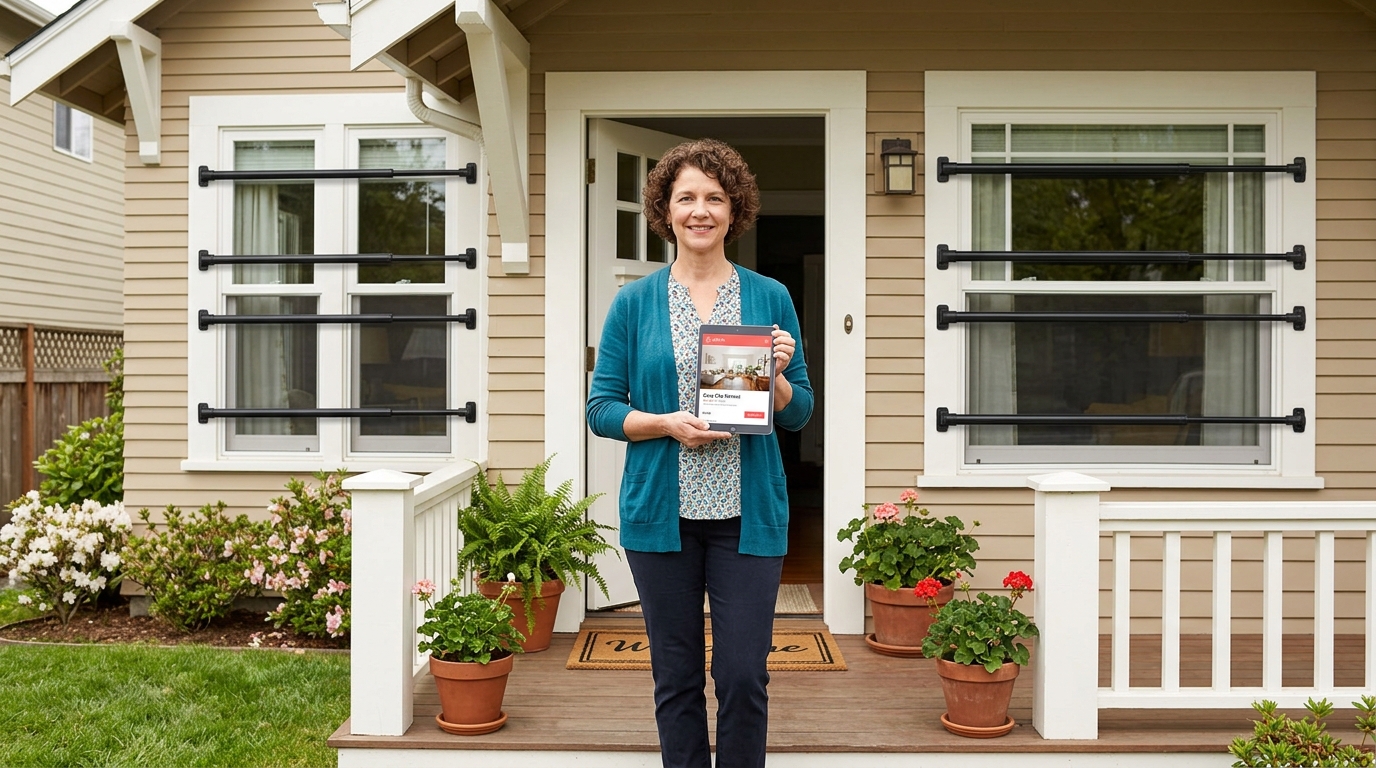
Airbnb and VRBO Host Liability: What You Need to Know
Short-term rental hosts face a specific liability exposure that traditional vacation homeowners do not: you have a legal duty of care to your guests. This means you are responsible for maintaining a property that is reasonably safe, and that includes providing emergency egress from sleeping areas.
The Host Liability Framework
When a guest books your Airbnb or VRBO property, a legal relationship is created that goes beyond a simple rental transaction. You are operating a hospitality business, and you owe your guests:
- A safe environment -- the property must meet building codes, fire codes, and habitability standards
- Functional emergency exits -- every sleeping room must have a clear path to exit, including through windows
- Accurate representation -- if you advertise security features, they must actually work
- Disclosure of hazards -- if windows have bars, guests must be informed about how to open them
Window Bars and Guest Safety
If you install window bars at a short-term rental property, the rules are straightforward:
- Bedroom windows must have quick-release egress bars -- the SWB Model A/EXIT satisfies this requirement
- Post egress instructions inside each bedroom with bars -- a simple card or sticker explaining how to open the bar in an emergency
- Include window bar information in your listing description -- mention that the property has security bars for protection and that all bedroom windows have quick-release mechanisms
- Brief guests at check-in -- demonstrate the quick-release mechanism or include it in your check-in instructions
Between-Booking Security
The most vulnerable period for an Airbnb property is the gap between guest check-out and the next check-in. This is when the property is empty, potentially for days or weeks during the off-season. A practical workflow:
- After guest check-out and turnover cleaning, install Model A bars on all non-bedroom windows
- Model A/EXIT bars on bedroom windows can stay installed permanently since they provide egress
- Before next guest check-in, remove non-bedroom bars for aesthetics
- Store removed bars in a closet or storage area within the property
For more on seasonal and removable bar options specifically designed for this use case, see our removable window bars for seasonal properties guide.
Insurance Requirements and Premium Discounts
Vacation home insurance is a different product than primary residence insurance, and it costs more. Insurers charge higher premiums because unoccupied homes are higher risk -- and they know it. Physical security measures like window bars can reduce your premiums and strengthen your claims position.
How Window Bars Affect Vacation Home Insurance
- Premium discounts of 2-10% are available from many carriers for documented physical security devices, including window bars, on vacation and seasonal properties
- Vacancy clause protection -- most vacation home policies reduce or eliminate coverage after 30-60 days of vacancy. Documented security measures can strengthen your position if you need to file a claim during extended vacancy
- Claim support -- if a break-in occurs through an unbarred entry point (a door, for example), the presence of bars on windows demonstrates that you took reasonable precautions. This matters for claim approval.
- Liability protection -- for rental properties, egress-compliant bars (Model A/EXIT) on bedroom windows demonstrate compliance with safety codes, protecting against negligence claims
What to Document for Your Insurer
- Purchase receipts for all window bar units with product model numbers
- Date-stamped photos of bars installed on every window
- Product specification sheets showing steel grade, powder-coat finish, and mounting method
- Model A/EXIT certification documentation for egress compliance
- A list of all protected windows with their locations in the home
Send this documentation to your insurance agent and ask specifically whether a premium discount applies. If your current carrier does not offer one, shop competitor quotes -- many carriers use physical security measures as an underwriting factor, and the discount may be larger than you expect on a vacation home policy where the base premium is already elevated.
Security by Property Type: Lake Houses, Cabins, Beach Condos, Urbans
Different vacation property environments create different threats and different demands on security products. Here is how to tailor your approach.
Lake Houses and Waterfront Properties
Lake houses face a combination of extended vacancy, remote location, and moisture exposure. Most lake houses are designed around views, which means large windows and sliding glass doors that are security vulnerabilities.
- Priority windows: walkout basement (hidden from road), lakeside ground floor (shielded by the house from street view), sliding glass patio doors
- Product choice: Model A for standard windows, modular Model A stack for sliding doors and picture windows, Model A/EXIT for bedrooms
- Environmental factor: humidity and lake moisture accelerate corrosion. The powder-coated finish on SWB products handles this environment, but annual bracket inspection is recommended.
- Off-season note: many lake communities have dramatically reduced populations October through May, eliminating the natural surveillance of neighbors. Bars are especially important during this period.
Mountain Cabins
Mountain cabins combine isolation with extreme weather. The security challenge is compounded by the fact that law enforcement response times in rural mountain areas can exceed 30 minutes.
- Priority windows: all ground-floor windows (no neighbor visibility to deter break-ins), any windows accessible from decks or porches
- Product choice: Model A across the board, Model A/EXIT for bedrooms
- Environmental factor: freeze-thaw cycles, heavy snow loads, and sub-zero temperatures. Steel and powder coat handle these conditions. No electronics to fail in extreme cold.
- Critical advantage: mountain cabins often lose power and cellular service during winter storms. Steel bars work regardless. An alarm system that cannot call out is a box on the wall.
Beach Condos and Coastal Properties
Coastal properties face salt-air corrosion, which is the primary environmental threat to metal security products. Ground-floor units in condo buildings are the highest-risk configuration because they combine easy access with shared building infrastructure that limits your security options.
- Priority windows: ground-floor windows facing parking lots, alleys, or landscaping that provides concealment
- Product choice: Model A with powder-coat finish for salt-air resistance, Model A/EXIT for bedrooms
- Environmental factor: salt spray destroys painted metal within 1-2 years. Powder coating creates a sealed barrier. Rinse bars with fresh water before seasonal storage to remove salt deposits.
- HOA consideration: many coastal condo communities have exterior modification restrictions. Interior mounting or removable seasonal installation may be required.
Urban Second Homes and Investment Properties
Urban second homes benefit from stronger natural surveillance (pedestrian traffic, neighbors, street lighting) but face higher property crime rates in many metropolitan areas.
- Priority windows: ground-floor windows facing alleys or side streets, basement windows, any windows accessible from fire escapes or adjacent structures
- Product choice: Model A for standard windows, Model A/EXIT for bedrooms. Interior mounting recommended for HOA compliance.
- Environmental factor: urban environments have less corrosion risk but more visibility concerns. Clean-profile powder-coated bars blend with contemporary architecture.
The Seasonal Security Protocol: What to Do Before Every Departure
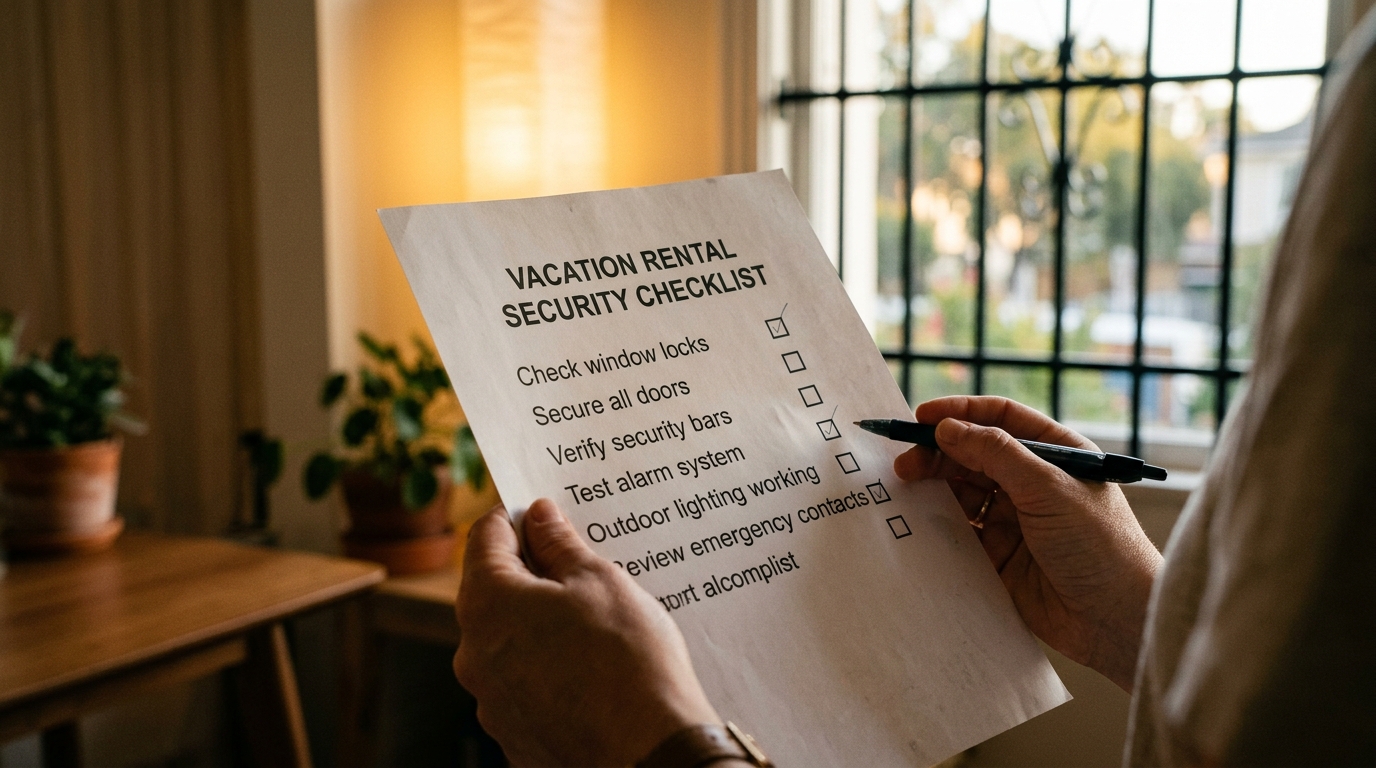
This is the actionable departure checklist for vacation homeowners who want to leave their property protected.
Physical Security (Day of Departure)
- Install window bars on all ground-floor and accessible windows. Model A on non-bedrooms, Model A/EXIT on bedrooms. 1-2 minutes per window if brackets are already in place.
- Install sliding door bars -- modular Model A stack on patio sliders and any glass door panels. Also see our sliding glass door security bar guide for detailed instructions.
- Verify all doors are locked -- deadbolts engaged, sliding door security rods in place, garage door locked and unplugged
- Close and lock all windows -- bars are the primary barrier, but locked windows add a second layer
- Set light timers on randomized schedules in 2-3 rooms to simulate occupancy
Property Management (Week Before Departure)
- Arrange landscape maintenance -- keep the exterior looking occupied. Overgrown yards signal vacancy.
- Hold mail through USPS or arrange for a neighbor/service to collect it
- Notify a trusted neighbor or property manager of your departure dates and provide emergency contact information
- Contact local police vacation check program -- many departments offer periodic drive-by checks for registered vacant homes
- Confirm insurance coverage is active for the vacancy period and check vacancy clause terms
Technology Layer (If Available)
- Verify camera system is operational -- if you have cameras, confirm they are recording and that cloud storage is active
- Test alarm system -- trigger a test alarm and confirm the monitoring center receives it
- Check cellular/WiFi connectivity -- verify the property will maintain internet and cellular service during vacancy
- Set smart home to away mode -- randomize lights, adjust thermostat, enable motion alerts
The physical security layer (steps 1-5) works regardless of whether the technology layer is functional. This is why window bars are the foundation, and technology is the supplement -- not the other way around.
Fire Code Compliance for Vacation Properties
Fire code compliance for window bars comes down to one rule: any window in a room where people sleep must have egress-compliant bars or no bars at all. The SWB Model A/EXIT satisfies IBC and NFPA egress requirements with its quick-release mechanism that opens from inside without tools or keys.
The Vacancy vs. Occupancy Distinction
When your vacation home is completely vacant -- no one is inside -- egress from bedroom windows is not a safety concern because there is no one to escape. During these periods, you can install standard Model A bars on every window for maximum security.
When the property is occupied -- by you, your family, or guests -- bedroom windows must have egress-compliant bars (Model A/EXIT) or no bars at all. Non-bedroom windows can use standard Model A bars during occupancy because residential codes generally require egress only from sleeping rooms.
The Recommended Approach
- Install Model A/EXIT on all bedroom windows permanently -- they provide the same exterior security as standard bars while allowing egress. No need to swap between vacant and occupied periods.
- Install standard Model A on non-bedroom windows during vacancy -- remove them when you return for aesthetic enjoyment and unobstructed views.
- For Airbnb/VRBO properties, treat every sleeping area as a bedroom -- if guests might sleep in a den, family room, or loft, those windows need Model A/EXIT too.
For a comprehensive overview of fire code requirements in every state, see our window bars fire code state-by-state compliance guide.
Cost of Prevention vs. Cost of a Break-In
This is the math that makes the decision obvious.
10-Year Cost Comparison: 3-Bedroom Vacation Home
| Security Strategy | Year 1 | Annual Recurring | 10-Year Total | Prevents Entry? |
|---|---|---|---|---|
| SWB Window Bars (complete) | $906-$1,088 | $0 | $906-$1,088 | Yes |
| Monitored alarm system | $500 + $480 | $480-$720 | $5,300-$7,700 | No (detects only) |
| Camera system + cloud | $600 + $180 | $180-$240 | $2,400-$3,000 | No (records only) |
| Weekly property checks | $1,200 | $1,200 | $12,000 | No (discovers only) |
| One burglary (avg loss) | $5,000-$27,000 | Premium increase 10-25% | $8,000-$35,000+ | N/A |
Window bars cost less in total over 10 years than any other security strategy, and they are the only option that physically prevents window entry. Everything else detects, records, or discovers -- after the damage is done. If you combine window bars ($1,000 one-time) with a basic camera system ($600 + $180/year), your total 10-year cost is approximately $2,800 and you have both prevention and documentation. That is still less than half the cost of a monitoring-only approach.
Combining Bars with Remote Property Management
For vacation homeowners who want the best of both worlds -- physical security plus remote visibility -- here is the recommended technology stack to pair with window bars.
Tier 1: Bars + Basic Camera ($150-$300 one-time)
- SWB window bars on all accessible windows
- One exterior camera covering the primary entry point (front door)
- Local SD card storage (no cloud subscription needed)
- Cellular backup for camera (if WiFi is unreliable)
Tier 2: Bars + Smart Security ($500-$800 one-time + $15-$30/month)
- SWB window bars on all accessible windows
- 2-3 exterior cameras with cloud recording
- Smart lock on primary door (guest code management for rentals)
- Water leak sensor (prevents secondary damage through compromised entry points)
- Temperature monitor (prevents frozen pipe bursts in winter vacation homes)
Tier 3: Bars + Full Monitoring ($1,000-$2,000 one-time + $40-$60/month)
- SWB window bars on all accessible windows
- Professional alarm system with 24/7 monitoring
- Multiple cameras with cloud recording and AI motion detection
- Environmental sensors (water, temperature, smoke)
- Cellular backup for all systems
In every tier, window bars are the foundation. They provide the physical barrier that technology cannot. The technology layers add visibility, documentation, and environmental monitoring -- but none of them stop a burglar from climbing through a window. The bars do.
Installation for Vacation Properties: DIY in One Afternoon
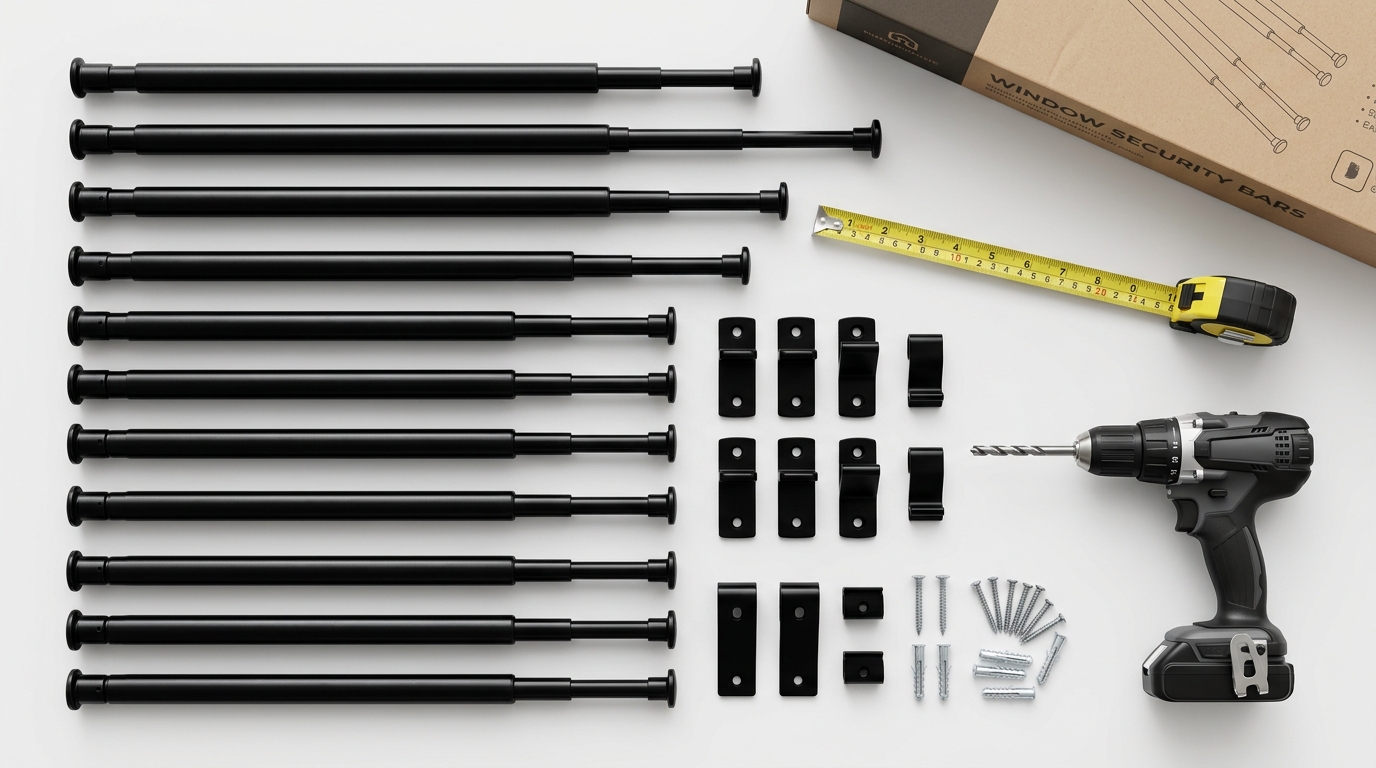
One of the biggest advantages of the SWB Model A for vacation homeowners is the DIY installation. You do not need to hire a contractor, wait for an appointment, or pay installation fees. A cordless drill, a tape measure, and a level are the only tools required.
First-Time Setup
Budget one afternoon (3-5 hours) to install bars on 8-12 windows the first time. This includes measuring, adjusting the telescopic bars, mounting the brackets, and testing each installation. Detailed step-by-step instructions are in our installation time guide and our no-drill installation guide.
Subsequent Installs and Removals
Once the brackets are mounted, installing or removing all bars in a 10-window home takes approximately 15-20 minutes total. This makes the departure protocol practical -- you are not adding hours to your travel day. Snap the bars into the brackets on your way out the door, pop them off when you arrive back.
Frequently Asked Questions
Why are vacation homes burglarized more often than primary residences?
Vacation homes are burglarized more frequently because they sit unoccupied for extended periods -- often weeks or months at a time. This gives burglars zero risk of confrontation, unlimited time to search the property, and a long delay before the crime is discovered. Vacancy patterns at vacation homes are also predictable: snowbird homes empty in spring, lake houses go dark after Labor Day, and Airbnb rentals have visible gaps between bookings. Local criminals learn these patterns and target properties accordingly. The combination of long vacancy, predictable patterns, and delayed discovery makes vacation homes significantly more attractive targets than occupied primary residences.
Do window security bars work without electricity or WiFi?
Yes. Window security bars are completely mechanical -- they are steel bars mounted to the window frame or wall. They require no electricity, no WiFi, no cellular signal, no batteries, and no monitoring service. This makes them the ideal security solution for vacation properties that may lose power during storms, have unreliable internet in remote locations, or sit completely shut down during off-season vacancy. Steel bars work identically at midnight during a blizzard with no power as they do on a sunny afternoon with full connectivity.
What is the best window security bar for an Airbnb property?
The SWB Model A/EXIT (~$92) is the best choice for Airbnb bedroom windows because it provides full security while meeting IBC and NFPA fire egress requirements. The quick-release mechanism allows guests to open the bar from inside during emergencies without tools or keys. For non-bedroom windows at Airbnb properties, the standard SWB Model A (~$90) provides the same physical security at a slightly lower cost. Both models use the removable bracket system that lets you install bars between guest bookings and remove them before check-in.
How much does it cost to secure all windows at a vacation home?
The total cost to secure a typical 3-bedroom vacation home with 10 windows and one sliding glass door is approximately $906 to $1,088. This includes Model A bars at ~$90 each for non-bedroom windows, Model A/EXIT bars at ~$92 each for bedroom windows, and modular Model A units for sliding glass doors. This is a one-time purchase with zero recurring fees and a 20+ year lifespan. By comparison, a monitored alarm system costs $5,300 to $7,700 over the same period, and a single break-in averages $5,000 to $27,000 in total losses.
Can I install window bars at my vacation home by myself?
Yes. The SWB Model A is specifically designed for DIY installation. You need a cordless drill, a tape measure, and a level -- standard tools most homeowners already own. First-time installation takes approximately 15 minutes per window. Budget one afternoon (3-5 hours) to install bars on 8-12 windows. After the initial bracket installation, subsequent installs and removals take only 1-2 minutes per window. No contractor, no specialty tools, no prior experience needed.
Do window bars lower my vacation home insurance premium?
Many insurance carriers offer premium discounts of 2-10% for documented physical security measures on vacation and seasonal properties. Window bars, deadbolts, and alarm systems all qualify. Contact your insurance agent specifically about window bar credits -- not all agents know to offer them proactively. Document your bars with purchase receipts, date-stamped installation photos, and product specifications. Some carriers also offer reduced vacancy clause restrictions for properties with physical security measures in place.
Are window bars legal on Airbnb properties?
Window bars are legal on Airbnb properties in all US states, provided that bedroom windows have egress-compliant bars (like the SWB Model A/EXIT with quick-release mechanism) or no bars at all. Airbnb does not prohibit window bars in its hosting policies. However, you must ensure guest safety by using egress-compliant bars on all sleeping area windows, posting instructions for the quick-release mechanism inside each bedroom, and disclosing the presence of bars in your listing description. Non-compliance with fire egress codes creates liability exposure for hosts.
Will window bars make my vacation home look like a prison?
Modern window security bars look nothing like old-fashioned jail bars. The SWB Model A features a clean, contemporary profile with powder-coated finishes available in black, white, and custom colors that blend with any architectural style. More importantly, for vacation properties using the removable bracket system, the bars are only visible during vacancy periods when no one is there to see them. When you or your guests arrive, the bars come off in minutes and the windows look completely normal. The small mounting brackets are flush-mounted and virtually invisible when bars are removed.
Can I use the same window bars at multiple properties?
Yes. Install mounting brackets at each property and move the bar units between them as needed. The SWB Model A's telescopic adjustment accommodates different window widths, so the same bar can fit windows at different properties even if the sizes vary. This approach works well if you split time between two homes -- protect whichever property is currently vacant by moving the bars. You only need enough brackets for all locations and enough bar units for the property with the most windows.
What happens if a burglar tries to remove window bars?
SWB window bars use anti-tamper security fasteners that cannot be removed with standard tools from the outside. The bracket-and-bar connection is designed to resist prying, pulling, and impact. An attempted forced removal creates significant noise and takes considerable time -- both of which increase the burglar's risk of detection and typically cause them to abandon the attempt. In practical terms, burglars confronted with steel window bars almost universally move on to an easier target rather than attempting removal, which is the primary deterrent value.
Final Verdict and Recommended Setup
If you own a vacation home, seasonal property, Airbnb rental, lake house, mountain cabin, or beach condo, window security bars are the single most cost-effective security investment you can make. They are the only solution that physically prevents window entry, works without electricity or internet, requires zero monthly fees, and lasts 20+ years from a single purchase.
Our recommended setup:
- SWB Model A (~$90) on every non-bedroom window and sliding glass door -- removable bracket system for seasonal install/remove
- SWB Model A/EXIT (~$92) on every bedroom window -- permanent installation for year-round security with fire-code-compliant egress
- Follow the seasonal security protocol for consistent protection every time you leave
- Document everything for your insurance carrier -- photos, receipts, specifications
The cost of complete window protection for a typical vacation home is under $1,100. The cost of a single break-in averages $5,000 to $27,000. The math is not close. Protect your property now, and stop worrying about what might happen while you are away.
Related guides: