How to Get Your HOA to Approve Window Security Bars: Step-by-Step Guide
You want window security bars on your home. Your HOA says no — or you're worried they will. This is one of the most common frustrations homeowners face when trying to secure ground-floor windows, and it stops a lot of people from even trying. But here's what most homeowners don't know: HOA approval for window bars is far more achievable than you think, especially if you approach it strategically.
This guide walks you through every step of the HOA approval process, from reading your CC&Rs to building a proposal that addresses every objection your board is likely to raise. Whether your HOA has explicit rules about window bars or you're dealing with a vague "no exterior modifications" clause, this guide gives you a clear path forward.
Understand Why HOAs Restrict Window Bars
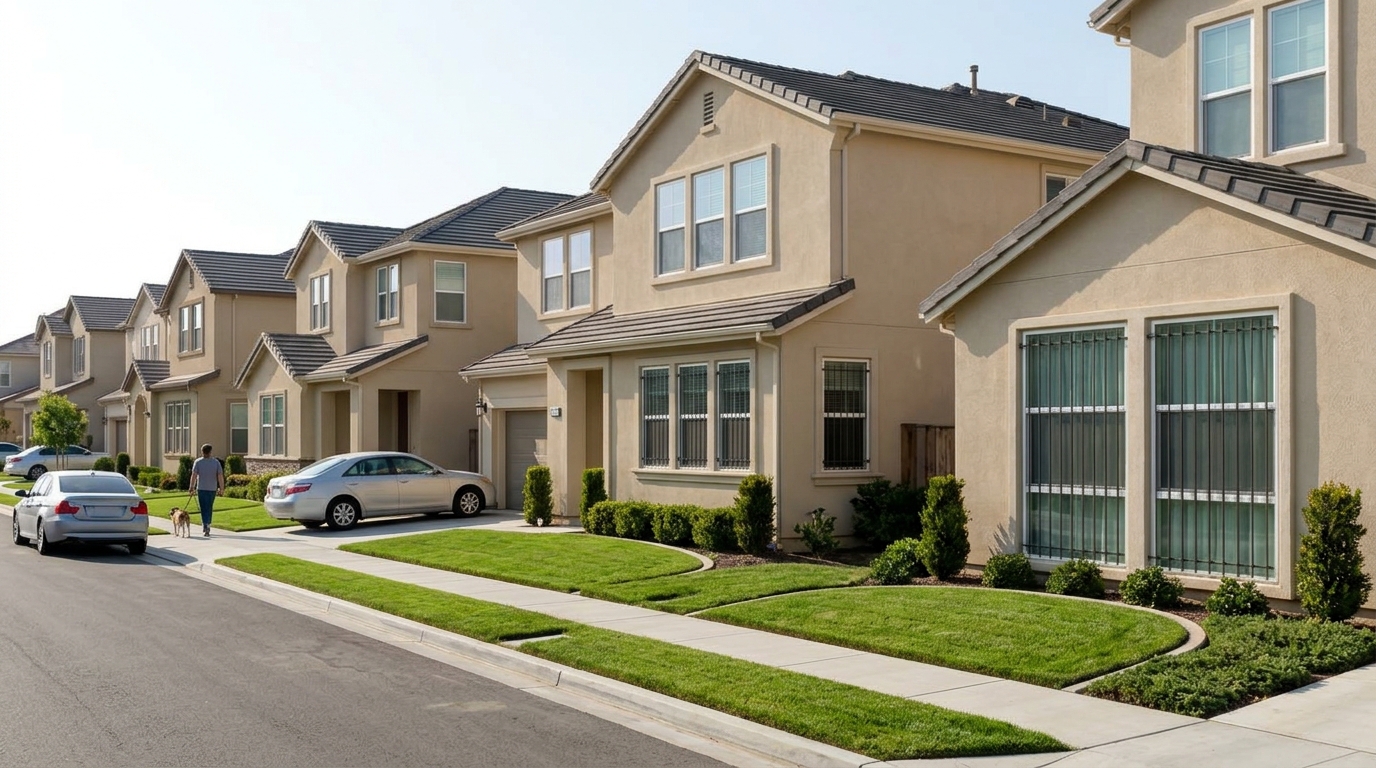
Before you approach your HOA board, you need to understand what you're really up against. HOA objections to window bars almost never come from opposition to home security itself. They come from three specific concerns:
Aesthetic Consistency
HOAs exist primarily to maintain property values through uniform neighborhood appearance. Their core fear is that one homeowner's security bars will look different from every other home, breaking the visual consistency that (they believe) protects values. Your job is to show that your proposed bars maintain that consistency.
The "Crime Signal" Perception
Some board members worry that visible window bars send a message that the neighborhood has a crime problem, which could deter potential buyers. This perception is outdated — modern decorative bars look nothing like the institutional grids people associate with high-crime areas — but you need to address it directly.
Precedent Concern
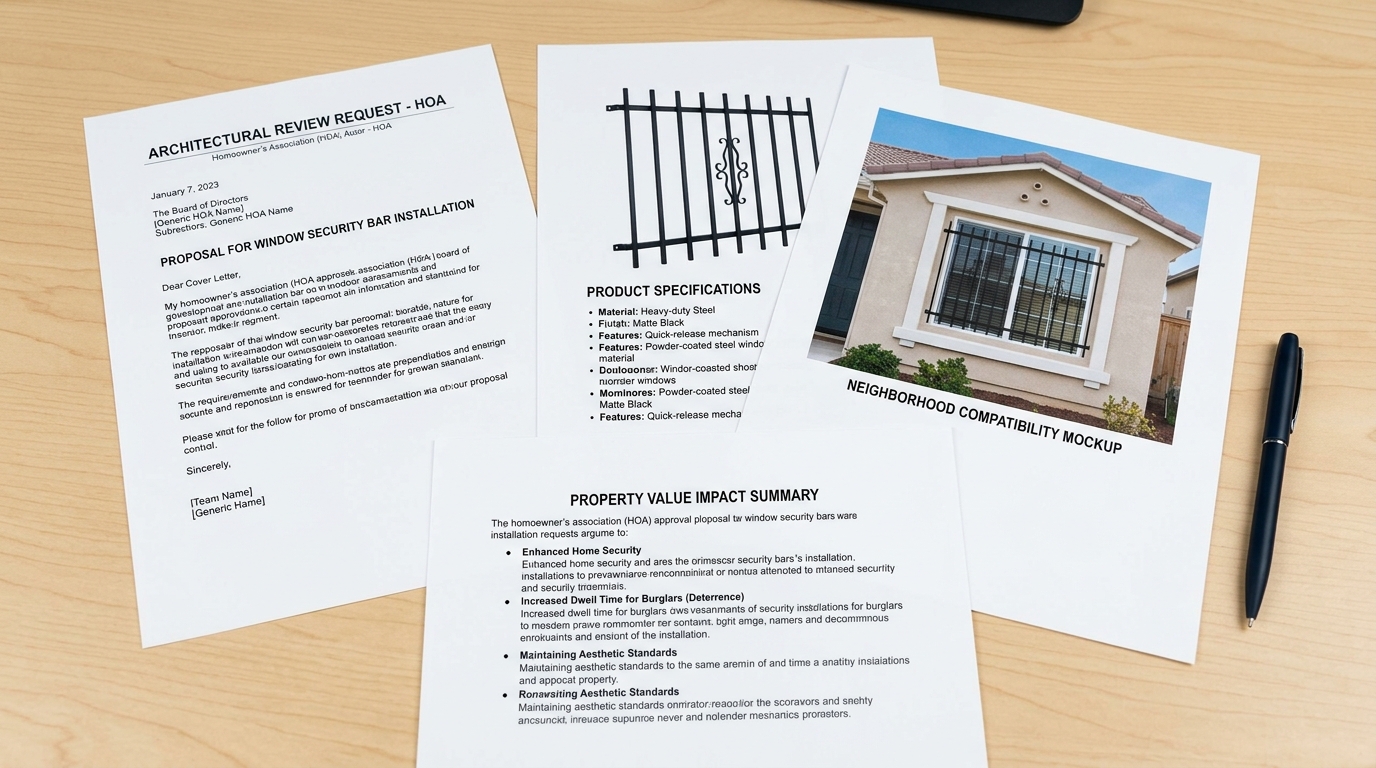
Boards worry that approving your tasteful bars opens the door for the next homeowner to install ugly ones. Your proposal should address this by suggesting the board adopt a standard for approved bar designs, making your request the template rather than the exception.
Read Your CC&Rs Before Anything Else
Your CC&Rs (Covenants, Conditions, and Restrictions) are the legal foundation of what your HOA can and cannot prohibit. Before you do anything else, get your copy and look for these specific sections:
What to Look For
- "Exterior modifications" clause — Most CC&Rs require board approval for changes to a home's exterior appearance. Window bars would fall under this.
- "Security devices" clause — Some CC&Rs have specific language about security cameras, alarms, fences, and bars. Read the exact wording carefully.
- "Architectural review" process — Most HOAs have a defined process for submitting modification requests. Follow it exactly.
- Prohibited items list — Check if window bars are explicitly prohibited or just not mentioned. "Not mentioned" is very different from "prohibited" and gives you more room.
Key Distinction: Explicit Ban vs. General Restriction
If your CC&Rs say "no window bars," you're dealing with an explicit ban that requires either a rule change or a legal challenge. If they say "all exterior modifications require board approval," you're dealing with a process — and processes can be navigated successfully.
Most HOAs fall into the second category. Window bars aren't explicitly prohibited; they just require approval. That's a much easier hill to climb.
Know Your State's Security Device Laws
Here's something many homeowners don't know: several states have laws that limit an HOA's ability to prohibit security devices, including window bars. These laws supersede CC&Rs.
States with Security Device Protections
- Texas — Texas Property Code Section 202.023 prohibits HOAs from restricting owners from installing security devices including window bars, cameras, motion sensors, and perimeter fencing, with some conditions regarding appearance.
- California — Civil Code Section 4735 prevents HOAs from prohibiting security devices. HOAs may require specific design standards but cannot issue blanket bans.
- Florida — Florida Statute 720.304 gives homeowners the right to install security devices and hurricane protections. HOAs can regulate appearance but not prohibit installation.
Even in states without specific statutes, courts have generally sided with homeowners' right to protect their property when the security device doesn't create an actual (not perceived) harm to neighbor property values. Document any crime incidents in your area as part of your case.
Choose an HOA-Friendly Product
The product you choose is 80% of the battle. Show up to a board meeting with photos of industrial-grade raw steel grids, and you'll get denied every time. Show up with photos of SWB's Model A color-matched to your window frames, and you've already addressed most objections before they're raised.
Features That Pass HOA Review
- Clean, minimalist profile — Simple vertical lines with consistent spacing. No scrollwork unless your home's architecture specifically calls for it.
- Color-matched powder coat — Match bars to your window frames or trim. White bars on white frames are virtually invisible.
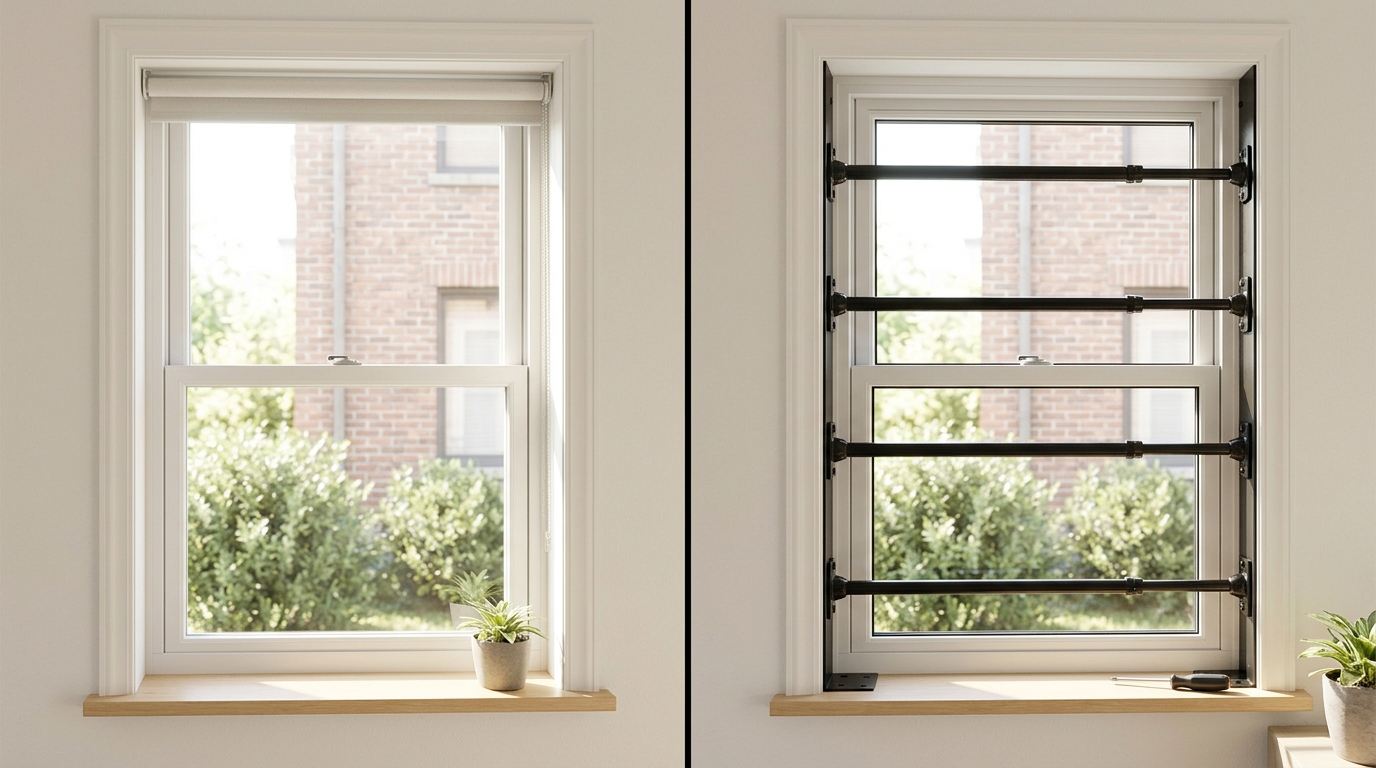
- Frame mount (no visible hardware) — SWB Model A's frame mount sits inside the window frame with no brackets, bolts, or anchors visible on the exterior wall.
- Removable design — Being able to tell the board "these can be removed without any damage to the structure" is a powerful argument.
- Fire code compliance — Mentioning that the bars meet fire safety requirements shows responsible installation and can actually work in your favor.
Why SWB Model A Is Ideal for HOA Situations
The Model A checks every HOA-friendly box: telescopic adjustment for clean proportional spacing, frame-mount for invisible installation, powder-coated finish in black or white, fully removable with no wall damage, and a clean modern design that looks like an architectural feature. At roughly $90 per window, it's also affordable enough that the board can't argue it's a major modification.
Build Your Proposal Package
A formal proposal dramatically increases your approval chances. Here's what to include:
1. Cover Letter
A one-page letter addressed to the architectural review committee or HOA board. State your request clearly: "I am requesting approval to install decorative window security bars on [number] ground-floor windows at [your address]." Keep the tone professional and cooperative.
2. Product Specification Sheet
Include the manufacturer's spec sheet showing materials, dimensions, finish options, and mounting details. For SWB bars, this is available on the product pages.
3. Color and Finish Samples
If possible, provide a physical color sample or high-quality color photos showing how the finish matches your home's trim. Side-by-side comparisons are powerful.
4. Photos: Before and After Mockup
Take a photo of your current windows. Use simple image editing (or even just describe in detail) what the installation will look like. If SWB or another homeowner has installed the same product, use reference photos showing the installed result.
5. Installation Plan
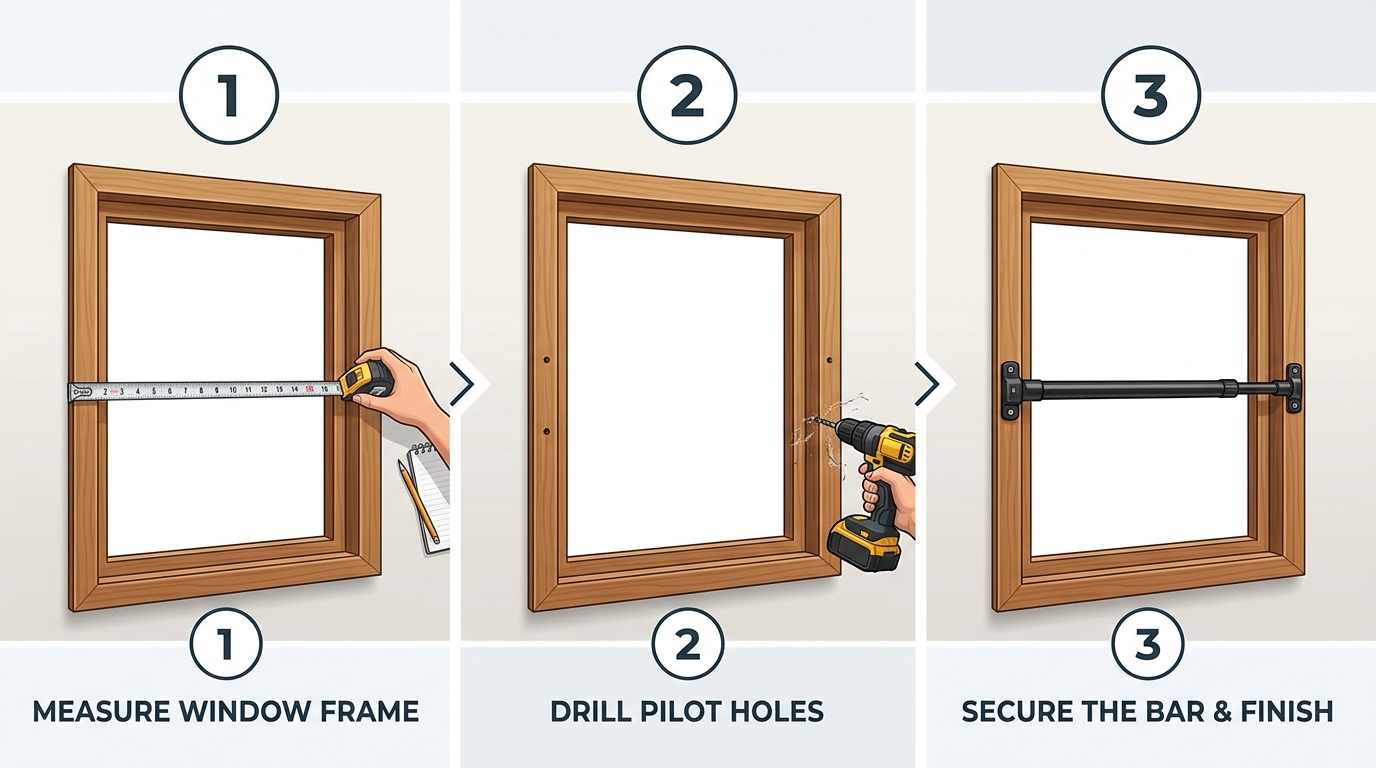
Describe the mounting method (frame mount, no drilling, fully reversible), the number of windows involved, and who will perform the installation (DIY or professional). Emphasize that the installation creates no permanent changes to the building exterior.
6. Security Justification
Include a brief, factual case for why you need the bars. Don't exaggerate or alarm. A simple statement like "ground-floor windows are the most common residential entry point for burglaries, and I want to add a physical deterrent" is sufficient. If there have been break-ins in your neighborhood, mention them factually.
7. Compliance Notes
If you're in Texas, California, Florida, or another state with security device protections, note the relevant statute. This isn't a threat — it's context that helps the board understand their legal position.
Present to the Board: What to Say and What to Avoid
Do Say
- "I want to work with the board to find an approach that maintains the neighborhood's appearance while improving my family's safety."
- "These are modern decorative bars, not the old-fashioned industrial type."
- "The installation is fully reversible — no holes, no permanent changes."
- "The bars are color-matched to my window frames and won't be visible from a normal viewing distance."
- "I'd be happy to have the board approve a design standard that other homeowners can follow."
Don't Say
- Don't describe your neighborhood as dangerous or high-crime — this reinforces the board's value concern.
- Don't threaten legal action in your first interaction — save that as a last resort.
- Don't compare your bars to other homeowners' modifications that were denied — let your request stand on its own merits.
- Don't argue that the rules are unfair — work within the system first.
If Denied: The Appeal Process
Not every first request gets approved. Here's your escalation path:
Step 1: Ask for Specific Reasons in Writing
Request the denial in writing with specific reasons. Vague denials ("it doesn't fit the community") are harder to defend than specific ones ("the color doesn't match"). Specific objections give you specific things to fix.
Step 2: Address Each Objection
If the denial cites appearance, offer a different color or interior mounting. If it cites precedent, propose a design standard. For every objection, prepare a specific solution and resubmit.
Step 3: Gather Neighbor Support
Other homeowners who want security bars — or who support your right to install them — can write letters of support. Board members respond to collective voice more than individual requests.
Step 4: Attend a Board Meeting
If your written appeal is denied, attend the next open board meeting with your proposal materials. Sometimes face-to-face communication resolves what written exchanges cannot.
Step 5: Legal Review (Last Resort)
If all other avenues fail, consult a real estate attorney specializing in HOA law. In states with security device protections, a simple attorney letter citing the relevant statute often resolves the matter. This should be genuinely your last resort — preserving a cooperative relationship with your board is worth more in the long run.
The Interior Mount Workaround
If your HOA proves immovable on exterior modifications, interior-mounted bars may solve the problem entirely. Here's why:
Most HOA CC&Rs only govern the exterior appearance of homes. Interior window bars mount inside the home and are invisible from the street. Since they don't change the exterior appearance at all, they typically fall outside HOA jurisdiction entirely.
SWB's Model A with frame mount works beautifully as an interior installation. The bars sit on the inside face of the window frame, providing full security while keeping the exterior completely unchanged. From outside, your windows look exactly as they did before installation.
This is also the preferred approach in many security scenarios because interior bars are harder for burglars to tamper with (they can't reach the mounting hardware from outside) and they don't advertise the presence of security measures to potential intruders.
Frequently Asked Questions
Can my HOA legally prevent me from installing window security bars?
It depends on your state. In Texas (Property Code 202.023), California (Civil Code 4735), and Florida (Statute 720.304), HOAs cannot prohibit security devices including window bars, though they can regulate appearance. In states without specific statutes, HOAs may have more authority under their CC&Rs, but blanket bans are increasingly challenged in court. Consult a local real estate attorney if your HOA issues an explicit prohibition.
How long does the HOA approval process take for window bars?
Most HOAs are required to respond to architectural modification requests within 30-60 days. Some CC&Rs specify shorter timelines. If your HOA doesn't respond within the stated period, many CC&Rs contain a "deemed approved" clause — check your documents. To speed the process, submit a complete, professional proposal with all required documentation on the first submission.
What if my HOA has no specific rule about window bars?
If your CC&Rs don't mention window bars specifically, the board would likely evaluate your request under the general "exterior modifications" clause. This is actually favorable for you, because the board must apply the same standard they apply to other exterior changes (shutters, awnings, storm doors). Submit a formal request through the architectural review process and emphasize that your bars are less visually impactful than many modifications that are routinely approved.
Do interior window bars require HOA approval?
In most cases, no. HOA jurisdiction typically covers exterior appearance only. Interior modifications that don't change the home's exterior are generally not subject to HOA review. Interior-mounted bars like SWB's Model A with frame mount are invisible from outside and shouldn't require approval. However, always check your specific CC&Rs — a small number of HOAs have unusually broad modification clauses.
What design features make window bars most likely to get HOA approval?
The features most likely to gain approval are: color that matches the window frame or trim, clean minimalist profile without ornate scrollwork, frame-mount installation with no visible hardware, removable design that causes no permanent building changes, and fire code compliance documentation. Products like SWB's Model A are designed with exactly these HOA-friendly features in mind.
Your Next Steps
Getting HOA approval for window security bars is a process, not a gamble. Pull your CC&Rs, check your state's security device laws, choose an HOA-friendly product like SWB's Model A, and build a professional proposal that addresses every likely objection. Most boards will approve a well-presented request for modern, decorative bars that maintain the neighborhood's appearance.
And if the exterior route proves impossible, interior mounting gives you full security with zero HOA friction. Either way, you don't have to choose between protecting your home and living peacefully within your community's rules.