

Do Fire Departments Recommend Window Security Bars?
Fire departments do not oppose window security bars — but they have one absolute requirement: bars on bedroom windows and emergency escape openings must have a quick-release mechanism that opens from inside without tools or keys. When this condition is met, most fire officials view security bars as a legitimate protective measure. When it is not met, fire departments consider non-compliant bars a serious life safety hazard that can trap occupants during fires.
The relationship between fire departments and window security bars is more nuanced than a simple yes or no. This post explains what fire departments actually recommend, why they focus specifically on egress compliance, and how homeowners can satisfy both security and fire safety requirements with the right products.
The Official Fire Department Position on Window Bars
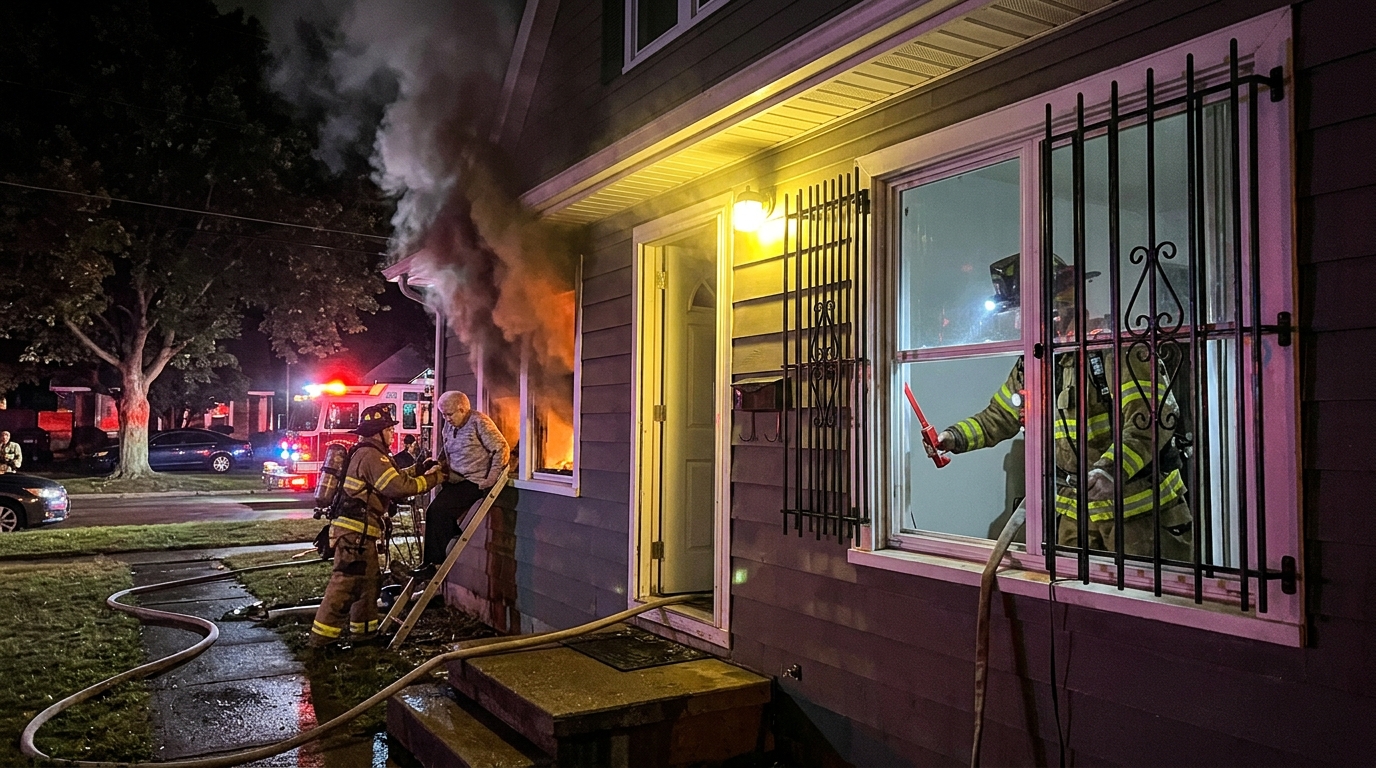
Fire departments across the United States take a consistent position on window security bars: they are acceptable when they comply with fire egress codes, and they are unacceptable when they do not.
The National Fire Protection Association (NFPA) does not ban window bars. The International Building Code (IBC) does not ban window bars. No state fire code bans window bars outright. What every fire code does require is that bars installed on egress-designated windows — specifically bedroom windows and any window in the building's fire safety plan as an emergency exit — must be openable from the inside without tools, keys, or special knowledge.
This position is practical, not ideological. Fire officials recognize that property crime is a real threat and that physical barriers deter break-ins. They also know from experience that non-compliant bars kill people in fires. Their goal is to ensure that security and safety coexist — and with modern quick-release bar designs, they absolutely can.
Why Fire Departments Are Concerned About Window Bars
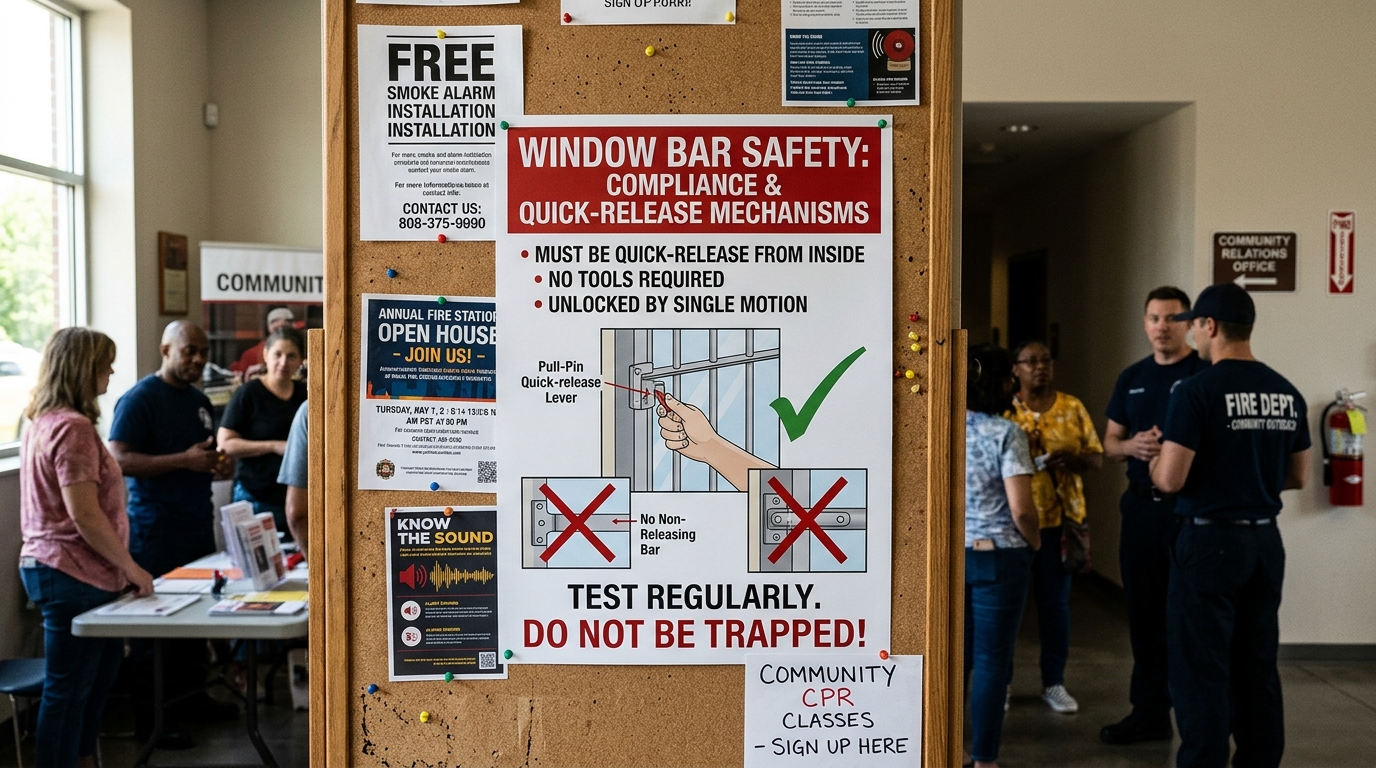
Fire departments have a specific, experience-driven reason for their focus on window bar compliance. Fixed, non-removable bars on bedroom windows create a deadly scenario during a house fire.
The Scenario That Drives Fire Department Policy
A fire breaks out at night. Smoke fills the hallway, blocking the bedroom door route. The occupant goes to the window — the designated secondary escape route — and finds it blocked by steel bars that cannot be opened, removed, or broken. The occupant is trapped. Rescue from outside requires firefighters to either force open a heavily barricaded entry point or cut through the bars — both of which take critical minutes that the occupant may not have.
This is not a theoretical concern. Fire departments have responded to incidents where occupants were unable to escape through barred windows. These cases are the direct reason that egress codes exist in their current form.
What Firefighters See When Responding to Barred Homes

From the firefighter's operational perspective, window bars present specific challenges:
- Ventilation is delayed — firefighters cannot quickly break windows to ventilate smoke if bars are in the way
- Rescue access is restricted — reaching a trapped occupant through a barred window requires cutting tools and additional time
- Hose line entry is blocked — windows serve as secondary entry points for attack hose lines when doors are inaccessible
Quick-release bars solve every one of these problems. When bars can be opened or removed from inside by the occupant (or from outside by a firefighter who can reach the release), the security benefit is retained while the fire safety hazard is eliminated.
What Fire Departments Require for Compliance
The requirements come from two primary code sources, both of which are adopted (with local modifications) by virtually every US jurisdiction:
IBC Section 1030 — Emergency Escape and Rescue Openings
- Every sleeping room must have at least one emergency escape opening
- The opening must be operable from inside without keys, tools, or special knowledge
- Minimum clear opening: 5.7 sq ft (5.0 sq ft for ground-floor windows)
- Minimum clear width: 20 inches
- Minimum clear height: 24 inches
- Maximum sill height: 44 inches above finished floor
- Any device on the window (including bars) that impedes egress and cannot be released without tools violates the code
NFPA 101 — Life Safety Code
- Bars, grilles, and grates on windows must not prevent emergency egress
- Release mechanisms must be operable by the room's occupants without tools or keys
- The release mechanism must function reliably — maintenance is implied
For a detailed state-by-state breakdown of how these codes are adopted and enforced, see our legal guide to window bars.
Window Bars That Meet Fire Department Standards
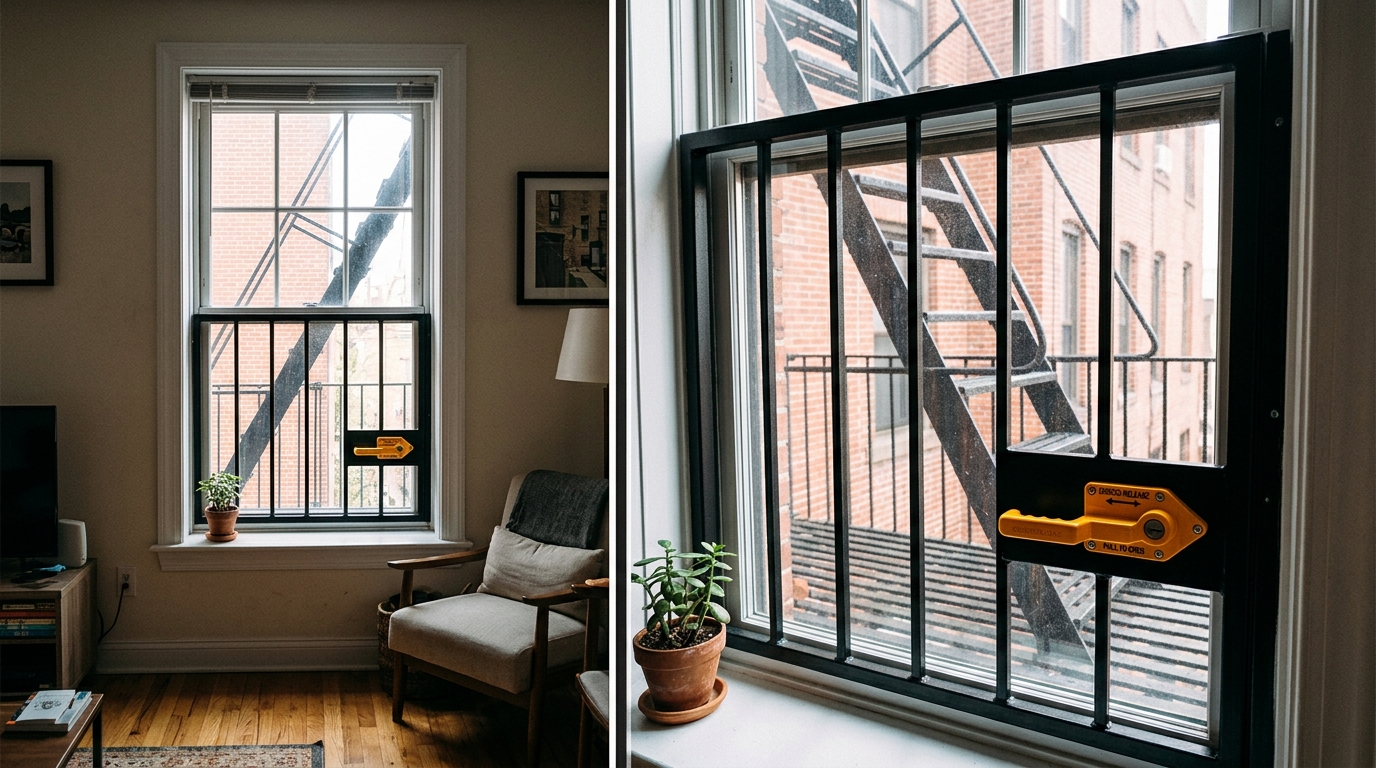
The SWB Model A/EXIT is specifically engineered to meet IBC, NFPA, and OSHA egress requirements. Its interior quick-release lever allows any occupant — including a child — to open the bars in seconds without any tools or keys. From the exterior, the bars appear identical to fixed bars, providing full visual deterrence and physical security.
Key Compliance Features
- Interior lever release — operates with one hand, no tools required
- No key or combination — works with a simple pull or push motion
- Child-operable — the force required is well within the capability of children over age 5
- Tamper-resistant from outside — the release mechanism is accessible only from inside the room
- Full IBC/NFPA/OSHA compliance — meets or exceeds all federal and state egress requirements
- $92 per unit — only $2 more than the standard non-egress Model A
The Firefighter's Perspective: Rescue Operations and Bars
During active fire operations, firefighters approach barred windows differently depending on the bar type:
Quick-Release Bars
If the occupant has already opened the bars from inside, the window is clear for rescue. If the occupant is incapacitated, firefighters can often access the release mechanism through the broken glass or from a ladder position. Quick-release bars are a minor operational challenge, not a significant obstacle.
Fixed Bars Without Release
These require cutting with a rotary saw, reciprocating saw, or hydraulic rescue tool ("Jaws of Life"). This process takes 2-5 minutes per window — an eternity in a structure fire. Fixed bars on occupied rooms are the fire service's primary concern with window security products.
What Firefighters Want Homeowners to Know
- Security bars with quick-release are fine. Firefighters understand property crime concerns and support legitimate security measures.
- Test your release mechanisms annually. A mechanism that worked when installed may seize up after years without use. Apply silicone lubricant and test every release lever at least once a year.
- Make sure every household member knows how to operate the release. In a fire at 3 AM, there is no time to figure it out. Every person sleeping in the home should demonstrate the release mechanism at least once.
- Never install fixed bars on bedroom windows. The security benefit does not justify the life safety risk when compliant alternatives exist at virtually the same price.
How to Have Both Security and Fire Safety
The solution is simple and inexpensive. Here is the recommended approach for any home:
| Window Location | Recommended Product | Cost | Fire Code Status |
|---|---|---|---|
| Bedrooms | Model A/EXIT | ~$92 | Fully compliant |
| Living areas, kitchen, bathroom | Model A (standard) | ~$90 | Compliant (no egress required) |
| Basement (non-egress) | Model A (standard) | ~$90 | Compliant |
| Basement (egress-designated) | Model A/EXIT | ~$92 | Fully compliant |
| Brick/masonry buildings | Model B | ~$91 | Add egress if on bedroom |
Total compliance cost for a typical 3-bedroom home: 3 x Model A/EXIT (bedrooms) + 5 x Model A (other windows) = $276 + $450 = $726. That is full fire code compliance plus full security coverage for less than the cost of one year of alarm monitoring.
For more on product options and pricing, see our 2026 buyer's guide and pricing guide.
Frequently Asked Questions
Are window security bars fire code compliant?
Window security bars are fire code compliant when bars on bedroom windows and emergency escape openings include a quick-release mechanism operable from inside without tools or keys. Standard bars without a release mechanism are compliant on non-egress windows (kitchens, bathrooms, living areas in buildings with adequate exits) but violate fire code when installed on bedroom or egress-designated windows. The SWB Model A/EXIT is specifically designed to meet IBC, NFPA, and OSHA egress requirements at approximately $92 per unit.
Can firefighters cut through window security bars?
Yes, firefighters carry rotary saws, reciprocating saws, and hydraulic rescue tools capable of cutting through steel window bars. However, cutting through bars takes 2-5 minutes per window — time that can mean the difference between life and death in a structure fire. This is precisely why fire codes require quick-release bars on egress windows: to eliminate the need for time-consuming forced removal during rescue operations.
Do I need quick-release bars on every window in my house?
No. Quick-release bars are legally required only on bedroom windows and windows designated as emergency escapes in your building's fire safety plan. Non-bedroom windows in rooms with adequate exit routes (doors leading to hallways or outside) can use standard fixed bars without a release mechanism. However, at only $2 more per unit, many homeowners choose to install egress-compliant bars on all windows for complete peace of mind.
Will my homeowner's insurance cover a fire if I have window bars?
Standard homeowner's insurance covers fire damage regardless of whether you have window bars installed. However, if non-compliant bars (without quick-release) contributed to injury or death during a fire, the insurer could potentially deny liability claims related to the non-compliance. Compliant egress bars eliminate this risk entirely. Some insurers also offer small premium discounts for physical security measures like window bars, making them a net positive for your insurance position.
How often should I test my window bar quick-release mechanism?
Test every quick-release mechanism at least once per year. Apply a small amount of silicone lubricant to the moving parts during each test. The best time is during your annual smoke detector battery replacement — combine both fire safety checks into one routine. If any release mechanism feels stiff, sticky, or fails to operate smoothly on the first attempt, address it immediately. In a fire emergency, you need the release to work perfectly on the first try.