

Window Bar Fire Code Requirements by State: What Your City Actually Requires in 2026
Window bar fire code requirements vary dramatically from state to state, and in many cases from city to city within the same state. If you are installing security bars on windows in your home or rental property, understanding the specific fire code that applies to your jurisdiction is not optional. It is the law. What passes inspection in Houston may fail in Los Angeles. What meets code in Chicago might violate a local ordinance in Miami-Dade County. This guide breaks down the actual fire code requirements for window security bars in every major market across the United States, so you know exactly what your city demands before you drill the first hole.
The core issue is straightforward: security bars on windows that serve as emergency escape routes must include a quick-release mechanism that allows the bars to open from the inside without keys, tools, or special knowledge. But how each state defines "emergency escape," which rooms require egress windows, and what specific hardware satisfies the quick-release requirement all depend on local adoption of model codes, state amendments, and municipal ordinances. This reference guide gives you the state-by-state breakdown you need to stay compliant.
The Federal Baseline: IBC and NFPA Foundations
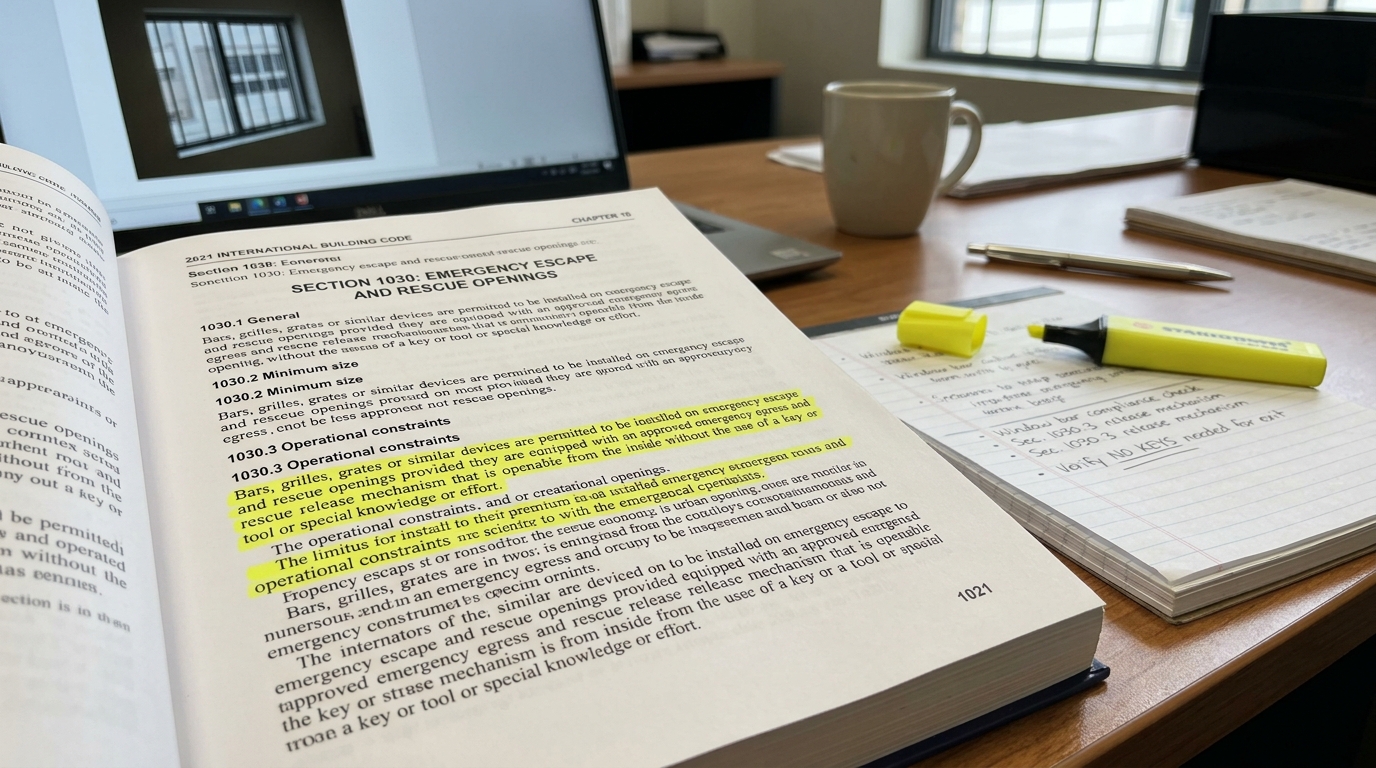
Before diving into individual states, you need to understand the two model codes that form the foundation for nearly every state and local fire code in the country. These are not federal laws themselves, but they serve as the template that states adopt, amend, and enforce.
International Building Code (IBC)
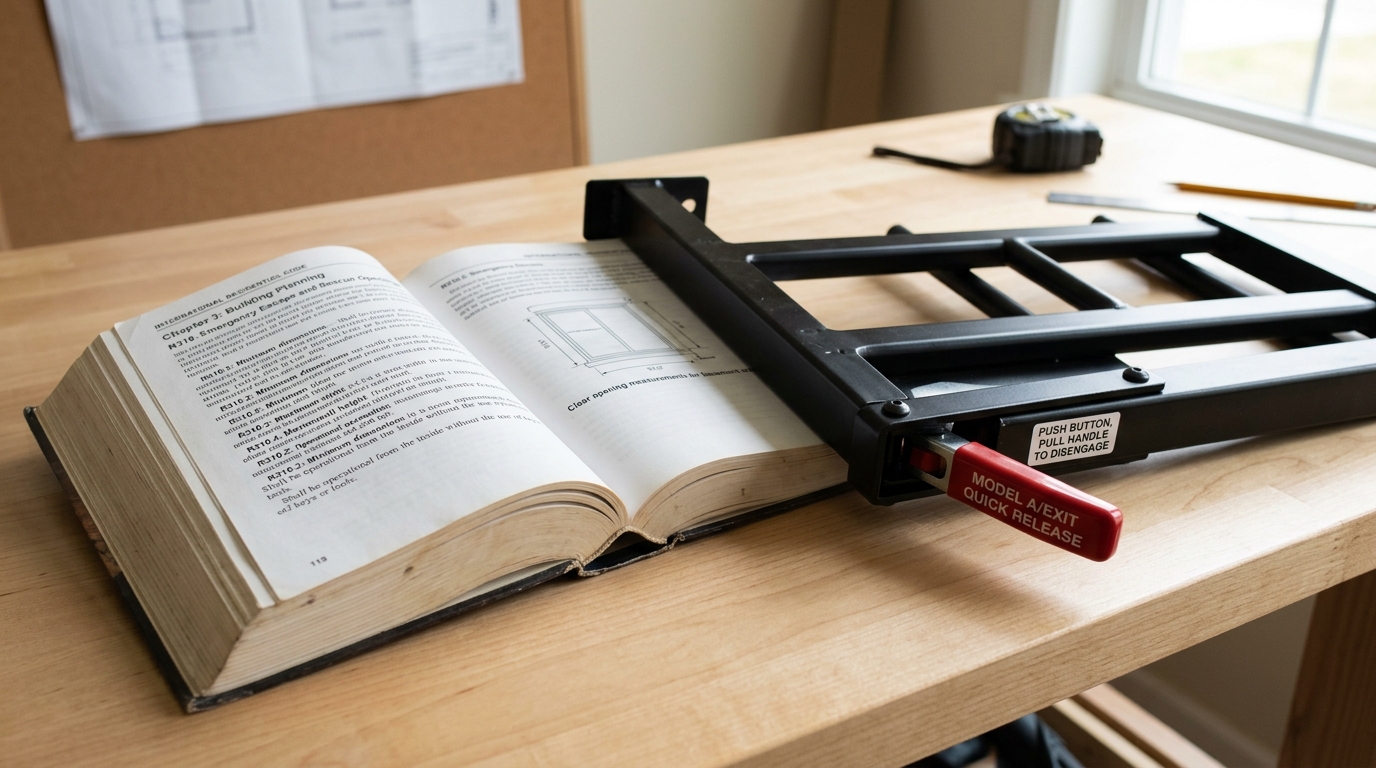
The IBC is published by the International Code Council (ICC) and updated on a three-year cycle. Section 1030 of the IBC covers emergency escape and rescue openings, which directly governs window bars. The key requirements under the IBC:
- Sleeping rooms in residential occupancies below the fourth story must have at least one emergency escape and rescue opening (egress window).
- The minimum clear opening for egress windows is 5.7 square feet (5.0 square feet at ground floor), with a minimum width of 20 inches and minimum height of 24 inches.
- Any bars, grilles, grates, or similar devices installed on emergency escape and rescue openings must be releasable from the inside without keys, tools, or special knowledge.
- The release mechanism must allow full opening of the egress window in compliance with the minimum clear opening dimensions.
NFPA 101: Life Safety Code
The National Fire Protection Association publishes NFPA 101, which many jurisdictions adopt alongside or instead of the IBC. Section 24.2.2 of NFPA 101 addresses window bars in one- and two-family dwellings. The language mirrors the IBC: bars on egress windows must be operable from the inside without tools or keys. NFPA 101 also cross-references NFPA 1, the Fire Code, which gives fire marshals enforcement authority over existing buildings, not just new construction.
International Residential Code (IRC)

The IRC, also from the ICC, applies specifically to one- and two-family dwellings and townhouses. Section R310 mirrors the IBC egress requirements and is the code most directly applicable to homeowners installing window bars on single-family residences. Most states adopt the IRC for residential construction, making it the code your local inspector will reference.
For a broader overview of how these codes interact with window security bar installations, see our fire safety and egress requirements guide.
How States Adopt and Amend Fire Codes
No state enforces the IBC, IRC, or NFPA 101 exactly as published. Every state adopts a specific edition of the model code and then layers on amendments that reflect local conditions, political priorities, and regional building practices. This is why knowing "the IBC says" is not enough. You need to know what your state says.
Three Adoption Models
| Adoption Model | How It Works | States Using This Model |
|---|---|---|
| Mandatory Statewide Code | The state adopts a specific code edition and enforces it uniformly. Local jurisdictions cannot weaken requirements but may add stricter ones. | California, Florida, New York, Virginia, Massachusetts, New Jersey |
| State Code with Local Opt-In | The state sets a minimum code, but local jurisdictions choose whether and how to enforce it. Enforcement varies widely. | Texas, Georgia, Ohio, Pennsylvania, North Carolina |
| No Statewide Code | The state has no mandatory building code. Individual cities and counties adopt their own codes or none at all. | Limited to very few states and typically rural areas within opt-in states |
This matters for window bar installations because a homeowner in unincorporated rural Texas may face no code enforcement at all, while a homeowner five miles away inside city limits faces full IBC/IRC compliance requirements. Always check with your local building department or fire marshal, not just your state code.
California: Title 24 and the Strictest Enforcement
California has the most comprehensive and strictly enforced fire code requirements for window bars in the United States. The California Building Standards Code (Title 24) adopts the IBC and IRC with significant California-specific amendments. The California Fire Code (Title 24, Part 9) is based on the International Fire Code with state amendments.
What California Requires
- All sleeping rooms must have at least one operable egress window. This applies to bedrooms in houses, apartments, condos, and any space designed or used for sleeping.
- Window bars on egress windows must have a release mechanism operable from the inside without keys, tools, or special knowledge. California Health and Safety Code Section 13113.8 specifically addresses this.
- The release mechanism must be tested and the bars must swing, slide, or detach to provide the full required egress opening (5.7 sq ft minimum, 5.0 sq ft at grade level).
- Landlords must provide written notice to tenants about the operation of quick-release mechanisms on window bars. California Civil Code Section 1941.3 makes this mandatory.
- Smoke detectors tied to quick-release bars are recommended but not universally required. Some municipalities (notably Los Angeles and San Francisco) have additional local requirements.
California Cities with Additional Requirements
| City | Additional Requirements |
|---|---|
| Los Angeles | LAMC Section 91.1029 requires quick-release bars on all egress windows in R-1 and R-2 occupancies. Annual inspection required for rental properties. Fire department has independent enforcement authority. |
| San Francisco | SF Housing Code requires landlords to maintain quick-release mechanisms in operable condition. DBI can issue violations for non-compliant bars. |
| San Diego | Follows state code closely. Municipal code requires building permit for exterior window bar installation on multi-family buildings. |
| Sacramento | City fire code requires fire marshal approval for window bar installations on commercial and multi-family residential buildings. |
The SWB Model A/EXIT (~$92) was specifically designed to meet California's strict requirements. Its quick-release mechanism operates from the inside without any tools, keys, or special knowledge, and it provides the full egress opening required under Title 24. For homeowners in California, this is the simplest path to compliance.
Texas: Local Control with Wide Variation
Texas does not have a mandatory statewide residential building code. This makes Texas one of the most complex states for window bar fire code compliance because requirements vary from city to city. The Texas Legislature has passed some statewide requirements for specific building types, but single-family residential construction is largely governed by local jurisdictions.
What Texas Requires (State Level)
- Texas Property Code Section 92.153-92.165 addresses security devices in rental properties. Landlords must provide security devices on all exterior doors and windows, but the code defers to local building codes for window bar specifications.
- Texas has no statewide mandate requiring quick-release mechanisms on window bars for owner-occupied single-family homes in unincorporated areas.
- Multi-family buildings in incorporated areas generally must comply with whatever code the city has adopted (typically the IBC/IRC).
Texas Cities with Specific Requirements
| City | Code Adopted | Window Bar Requirements |
|---|---|---|
| Houston | IBC/IRC 2021 with amendments | Quick-release required on all egress windows. Building permit required for installation. Fire marshal inspection may be triggered for multi-family. |
| San Antonio | IBC/IRC 2021 | Follows IBC/IRC egress requirements. Quick-release bars mandatory on sleeping room windows. |
| Dallas | IBC/IRC 2021 with Dallas amendments | Dallas Fire Code Chapter 11 requires operable window bars on egress windows. Rental property inspection program enforces compliance. |
| Austin | IBC/IRC 2021 with Austin amendments | Full IBC/IRC egress compliance. Austin Fire Department conducts rental property inspections. |
| Fort Worth | IBC/IRC 2021 | Standard IBC/IRC egress requirements. Quick-release on sleeping room egress windows. |
The takeaway for Texas homeowners: if you live inside city limits of any major Texas city, assume you need quick-release bars on egress windows. If you live in an unincorporated area, check with your county fire marshal. Even where enforcement is minimal, installing quick-release bars is the responsible choice for your family's safety.
New York: NYC vs. State Code Differences
New York is effectively two different regulatory environments: New York City and the rest of the state. NYC has its own building code and fire code, entirely separate from the New York State codes that govern the other 57 counties.
New York City
- NYC Building Code Section 1027 covers emergency escape and rescue openings. All sleeping rooms require operable egress windows with bars that release from the inside.
- NYC Local Law 57 (window guards) requires landlords to provide window guards on all windows in apartments with children under 10 years old. These are fall-prevention guards, not security bars, but they interact with fire code because they must also allow emergency egress.
- FDNY has independent enforcement authority over window bars through NYC Fire Code Chapter 10. Fire inspectors can issue violations for non-compliant bars found during inspections.
- NYC Housing Maintenance Code requires landlords in multi-family buildings to maintain all safety devices, including quick-release mechanisms on window bars, in working order.
For a detailed breakdown of NYC-specific window bar laws, see our state-by-state legality guide.
New York State (Outside NYC)
- New York State Uniform Fire Prevention and Building Code adopts the IBC/IRC with amendments. The code applies statewide except in NYC.
- Quick-release bars are required on all egress windows in sleeping rooms, per IRC Section R310 as adopted by New York State.
- Enforcement varies by municipality. Larger cities like Buffalo, Rochester, and Syracuse have dedicated code enforcement. Smaller towns and rural areas may have limited or no inspection programs.
Key New York Differences from Other States
New York is one of the few states where window guards (fall prevention) and window bars (security) are both addressed in the code, and they have different requirements. Window guards must prevent a child from falling out; window bars must not prevent an adult from escaping a fire. These two goals create a design tension that products like the SWB Model A/EXIT resolve by providing security against intrusion while allowing quick-release egress from inside.
Florida: Florida Building Code and Hurricane Considerations
Florida enforces the Florida Building Code (FBC), which is one of the strongest state building codes in the nation, driven primarily by hurricane resistance requirements. The FBC is mandatory statewide, and local jurisdictions cannot adopt weaker standards.
What Florida Requires
- FBC Residential Section R310 requires egress windows in sleeping rooms with minimum 5.7 sq ft clear opening.
- All bars, grilles, and screens on egress windows must be releasable from the inside without keys, tools, or special knowledge.
- High-velocity hurricane zones (HVHZ) -- Miami-Dade and Broward counties -- have additional requirements. Window coverings (including bars) may be subject to wind load testing and impact resistance standards.
- Florida Statute 553.73 gives the Florida Building Commission authority over all building codes, preempting local jurisdictions from weakening standards.
Florida-Specific Considerations
| Region | Additional Requirements |
|---|---|
| Miami-Dade / Broward (HVHZ) | Window bars may require NOA (Notice of Acceptance) or product approval for impact resistance. Consult local building department before installation. |
| Coastal counties | Corrosion-resistant materials recommended due to salt air exposure. Powder-coated steel resists corrosion significantly better than bare steel. |
| All Florida | Building permits typically required for exterior window modifications. Permit requirement varies by county. |
Florida homeowners benefit from the SWB Model A/EXIT for egress-required windows and the standard Model A for non-egress windows (living rooms, kitchens, bathrooms without tub/shower). The powder-coated steel finish provides corrosion resistance that is particularly important in Florida's coastal and humid environment.
Illinois: Chicago Fire Code Specifics
Illinois follows a similar pattern to New York: Chicago operates under its own code, while the rest of the state follows a different standard.
City of Chicago
- Chicago Municipal Code Section 13-160 addresses window bars and security devices. Bars on egress windows must be openable from the inside.
- Chicago Fire Prevention Code gives the Chicago Fire Department enforcement authority over window bar compliance in occupied buildings.
- Landlord-tenant ordinance: Chicago's RLTO (Residential Landlord and Tenant Ordinance) requires landlords to maintain all safety features, including quick-release window bar mechanisms, in operable condition. Tenants can withhold rent for non-compliance under certain conditions.
- Chicago high-rise rules: buildings above a certain height have additional egress requirements that may affect window bar installations.
Illinois (Outside Chicago)
- Illinois adopts the IBC/IRC with state amendments through the Illinois Capital Development Board codes.
- Standard IRC R310 egress requirements apply to sleeping rooms in residential buildings.
- Enforcement is primarily through local building departments. Larger cities like Springfield, Rockford, and Peoria have active code enforcement; smaller communities vary.
Pennsylvania: UCC Adoption and Municipal Variance
Pennsylvania adopted the Uniform Construction Code (UCC) in 2004, which is based on the ICC family of codes including the IBC and IRC. The UCC applies statewide, but enforcement is a local responsibility.
What Pennsylvania Requires
- PA UCC adopts IRC Section R310 for egress windows in sleeping rooms. Quick-release mechanisms on window bars are mandatory.
- Philadelphia has additional requirements through the Philadelphia Building Code, which includes specific provisions for window bars on rental properties.
- Pittsburgh follows the UCC with standard enforcement through the Bureau of Building Inspection.
- Third-class cities and townships may have varying levels of enforcement. Some smaller municipalities contract with private code enforcement agencies.
Pennsylvania Enforcement Notes
Pennsylvania is notable for its "opt-out" provision: municipalities that had building codes in effect before the UCC was adopted can continue enforcing their pre-existing codes. This means some Pennsylvania municipalities may have requirements that differ from the UCC baseline. Always verify with your local building department.
Ohio: Ohio Building Code Requirements
Ohio enforces the Ohio Building Code (OBC) statewide through the Board of Building Standards and local certified building departments.
What Ohio Requires
- OBC Chapter 10 covers means of egress, including emergency escape and rescue openings in residential occupancies.
- Ohio Residential Code of Ohio (RCO) applies to one- and two-family dwellings. Section R310 requires egress windows in sleeping rooms.
- Window bars on egress openings must release from the inside without tools, keys, or special knowledge. This mirrors the IBC/IRC language.
- Ohio Fire Code (OFC) gives fire officials authority to enforce window bar requirements on existing buildings during inspections.
Ohio City-Specific Notes
| City | Notes |
|---|---|
| Columbus | Active rental inspection program. Window bars on rental properties checked during point-of-sale and periodic inspections. |
| Cleveland | Cleveland Housing Code requires operational quick-release on window bars in rental properties. CLE Building and Housing Department enforces. |
| Cincinnati | Standard OBC enforcement through Department of Buildings and Inspections. Rental registration program includes fire safety checks. |
Georgia: State Minimum Codes and Local Amendments
Georgia adopted a mandatory statewide building code in 2008, administered by the Department of Community Affairs (DCA). All local jurisdictions must enforce at minimum the state codes, though they can adopt stricter standards.
What Georgia Requires
- Georgia State Minimum Standard Codes include adopted editions of the IBC, IRC, and International Fire Code.
- IRC Section R310 egress requirements apply statewide to all new residential construction and substantial renovations.
- Quick-release on window bars is mandatory for egress windows in sleeping rooms.
- Georgia Fire Safety Code (OCGA 25-2) gives the State Fire Marshal authority to enforce fire safety requirements in existing buildings.
Georgia City-Specific Notes
| City | Notes |
|---|---|
| Atlanta | City of Atlanta adopts state codes plus additional amendments. Atlanta Fire Rescue Department conducts occupancy inspections that include window bar compliance checks. |
| Savannah | Historic district may have additional restrictions on exterior-mounted window bars due to preservation ordinances. Interior-mount bars typically unaffected. |
| Augusta | Standard state code enforcement through Augusta-Richmond County Building Inspection. |
Additional States: Quick Reference Chart
The following table covers additional states that homeowners frequently ask about. The core principle is the same everywhere: bars on egress windows must open from the inside without tools or keys. The differences are in adoption specifics and enforcement intensity.
| State | Code Adopted | Statewide Enforcement | Key Notes |
|---|---|---|---|
| New Jersey | NJ Uniform Construction Code (based on IBC/IRC) | Yes, mandatory | Strict enforcement in multi-family. Quick-release required on all egress windows. |
| Virginia | VA Uniform Statewide Building Code (USBC) | Yes, mandatory | USBC based on IBC/IRC. Strong enforcement statewide. |
| Massachusetts | MA State Building Code (780 CMR, based on IBC/IRC) | Yes, mandatory | Boston Fire Department has independent enforcement. Strict rental property requirements. |
| Michigan | MI Building Code (based on IBC/IRC) | Yes, statewide | Enforced by local jurisdictions. Detroit has active rental inspection program. |
| North Carolina | NC State Building Code (based on IBC/IRC) | Yes, mandatory | Enforced by local inspections departments. Charlotte and Raleigh have active programs. |
| Arizona | Varies by city (no statewide code for residential) | No statewide enforcement | Phoenix, Tucson, and Scottsdale adopt IBC/IRC locally. Rural areas may lack enforcement. |
| Washington | WA State Building Code (based on IBC/IRC) | Yes, mandatory | Statewide enforcement. Seattle has additional amendments. |
| Colorado | Varies by municipality | No statewide code | Denver and Colorado Springs adopt IBC/IRC. Mountain communities may have fire-specific additions due to wildfire risk. |
| Maryland | MD Building Performance Standards (based on IBC/IRC) | Yes, mandatory | Baltimore has additional rental property inspection requirements for window bar compliance. |
| Tennessee | Varies by municipality | Limited statewide enforcement | Nashville, Memphis, and Knoxville adopt IBC/IRC. Rural counties may lack enforcement. |
Universal Egress Window Requirements
Regardless of which state you live in, the following egress window requirements are nearly universal because they come from the model codes that every state references. If your state or city has adopted any version of the IBC, IRC, or NFPA 101, these minimums apply.
Which Rooms Require Egress Windows
Every sleeping room (bedroom) must have at least one egress window. This is the single most important rule for window bar installations. Non-sleeping rooms -- living rooms, kitchens, bathrooms, hallways -- generally do not require egress windows, which means window bars in those rooms do not need quick-release mechanisms.
This distinction directly affects your purchasing decision:
- Bedroom windows: require SWB Model A/EXIT with quick-release (~$92)
- Non-bedroom windows: can use standard SWB Model A without quick-release (~$90) or Model A/EXIT if you prefer the added safety
For a detailed room-by-room breakdown of egress requirements, see our bedroom fire safety and egress code guide.
Minimum Egress Opening Dimensions
| Requirement | Above Grade | At Grade Level |
|---|---|---|
| Minimum clear opening area | 5.7 square feet | 5.0 square feet |
| Minimum clear width | 20 inches | 20 inches |
| Minimum clear height | 24 inches | 24 inches |
| Maximum sill height | 44 inches above floor | 44 inches above floor |
When window bars are installed on an egress window, the quick-release mechanism must allow the bars to open far enough to provide the full required clear opening. Bars that release but only create a partial opening do not satisfy the code.
The Quick-Release Standard
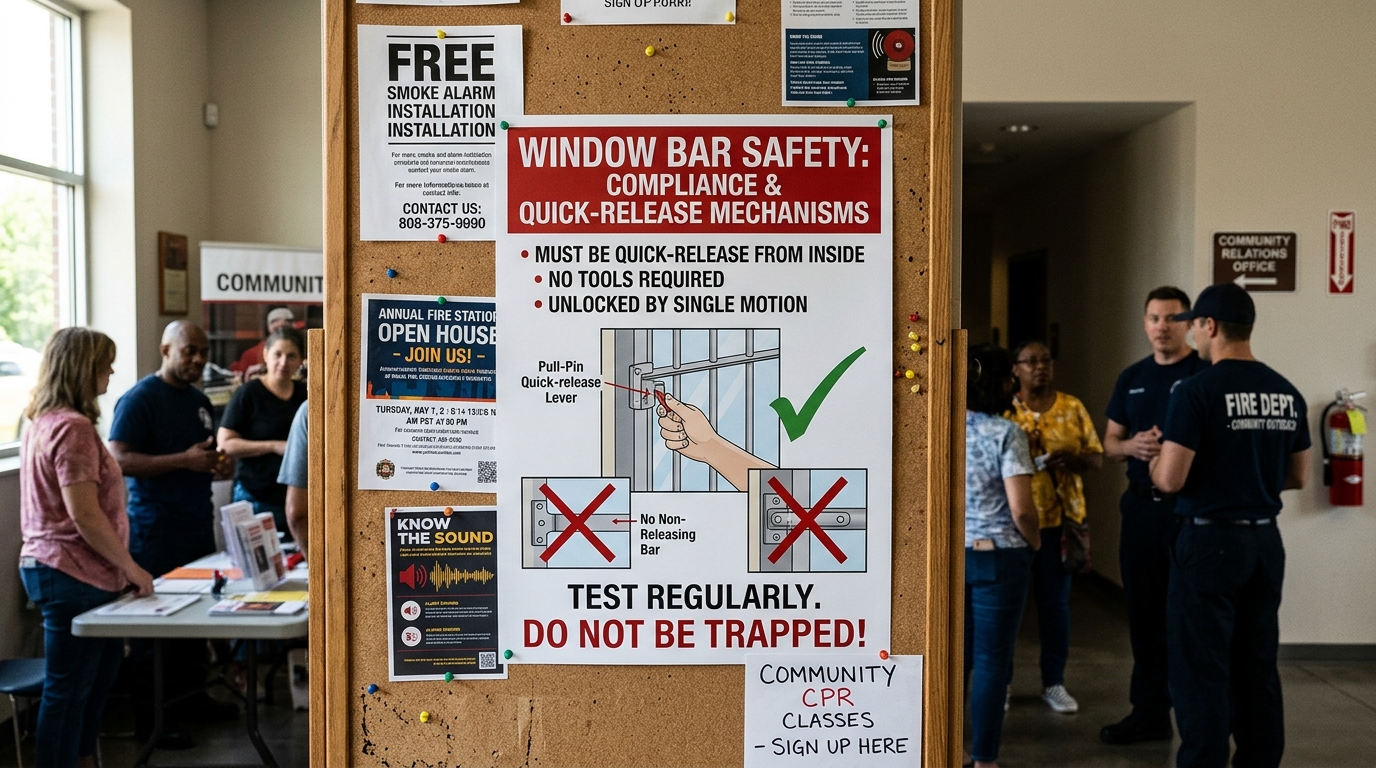
The quick-release mechanism on egress window bars must meet all of these criteria, per every major model code:
- Operable from the inside -- the release must be accessible from within the room
- No keys required -- the mechanism must function without any key
- No tools required -- the mechanism must function without any tool (screwdriver, wrench, etc.)
- No special knowledge required -- anyone in the room must be able to operate the release without prior training
- One-handed operation -- many codes require the release to be operable with one hand
- Operable in darkness -- the release must be locatable and operable without visual guidance (power may be out during a fire)
The SWB Model A/EXIT satisfies all six criteria. Its quick-release mechanism is a clearly marked lever accessible from inside the room that swings the bars open with a single hand motion, providing the full egress opening without any keys or tools.
Products That Meet Every State Code
Not all window bars on the market include quick-release mechanisms, and not all quick-release mechanisms satisfy code requirements. Here is how to evaluate whether a product will pass inspection in your state.
What to Look For
| Feature | Code Requirement | SWB Model A/EXIT | Generic Quick-Release Bars |
|---|---|---|---|
| Release without key | Mandatory | Yes -- lever mechanism | Varies -- some require hex key |
| Release without tools | Mandatory | Yes -- hand-operated | Varies -- some require screwdriver |
| One-handed operation | Required in most jurisdictions | Yes | Some require two hands |
| Full egress opening | 5.7 sq ft minimum | Full swing provides complete opening | Some only partially open |
| Operable in dark | Required | Yes -- tactile lever | Varies |
| IBC/NFPA referenced | Per manufacturer claim | IBC/NFPA/OSHA compliant | Rarely documented |
Why Generic "Quick-Release" Bars Often Fail Inspection
Many budget bars marketed as "quick-release" do not actually meet code. Common problems include:
- Hex-key release mechanisms -- if a hex key is required, it is a "tool" and fails the no-tools requirement
- Wing-nut fasteners -- technically operable without tools, but inspectors may reject them as requiring "special knowledge" if the mechanism is not immediately obvious
- Partial opening -- the bars release but do not provide the full required egress opening
- Exterior-only release -- the release mechanism is accessible from outside the building, which defeats the purpose of security bars entirely
- Corroded mechanisms -- cheap quick-release hardware rusts and becomes inoperable within a few years
For a broader comparison of quick-release window bar options, see our quick-release window bars guide.
Landlord and Rental Property Requirements by State
Landlords face stricter window bar requirements than owner-occupants in every state. Rental properties are subject to periodic inspections, tenant complaints, and housing code enforcement that owner-occupied homes generally are not. If you own rental property with window bars, compliance is not just a fire safety issue -- it is a legal liability issue.
Landlord-Specific Requirements
| State | Landlord Requirement |
|---|---|
| California | Must provide written notice to tenants about quick-release operation (Civil Code 1941.3). Must maintain mechanisms in working order. Annual inspection in some cities. |
| New York (NYC) | Must install window guards when children under 10 present. Must maintain quick-release on security bars. HPD can issue violations. |
| Illinois (Chicago) | RLTO requires operational safety features. Tenants can remediate and deduct for non-compliant bars. |
| Texas (major cities) | Property Code 92.153+ requires security devices. City rental inspection programs check compliance. |
| Florida | Landlord must comply with FBC. Tenant can report non-compliant bars to local building department. |
| Pennsylvania | Landlord liability under UCC. Philadelphia requires rental license with safety inspection. |
| Ohio | Landlord must maintain premises per OBC. Columbus and Cleveland have active rental inspection programs. |
| Georgia | Landlord must comply with state minimum codes. Atlanta has occupancy inspection program. |
For landlords specifically, our landlord fire code compliance guide covers the legal responsibilities, liability risks, and product specifications that protect both your tenants and your investment. The SWB Model A/EXIT is the recommended product for all rental properties because it eliminates compliance risk entirely.
How to Prepare for a Fire Code Inspection
Whether you are a homeowner preparing for a sale, a landlord facing a rental inspection, or a property manager responding to a fire marshal visit, here is how to make sure your window bars pass.
Pre-Inspection Checklist
- Identify every egress window. Walk through the property and locate every bedroom window. Each one must have either no bars or quick-release bars.
- Test every quick-release mechanism. Operate each release from the inside. The mechanism should move freely, the bars should swing or slide open fully, and the complete egress opening should be unobstructed.
- Check for corrosion or binding. Quick-release mechanisms that have rusted, corroded, or become stiff from lack of use may fail inspection even if they technically still function.
- Verify non-egress bars are properly identified. If you have fixed bars (without quick-release) on non-bedroom windows, be prepared to explain which rooms are sleeping rooms and which are not.
- Document compliance. Have product documentation or manufacturer specifications available that confirm your bars meet IBC/NFPA requirements. Inspectors appreciate documentation.
- Lubricate moving parts. Apply a light silicone lubricant to all quick-release pivot points, hinges, and latches. This ensures smooth operation during the inspection.
Common Inspection Failure Points
- Fixed bars on bedroom windows -- the number one failure. If any bedroom window has bars without a quick-release mechanism, it fails.
- Inoperable quick-release -- the mechanism is rusted, painted over, or physically jammed.
- Partial opening -- the bars release but do not provide the full required egress opening due to physical obstruction or limited swing arc.
- Bars on the wrong side -- bars mounted on the interior of egress windows without a release mechanism accessible from inside the room.
- Missing hardware -- release pins, levers, or latches have been removed, lost, or replaced with non-compliant substitutes.
For a complete step-by-step guide to passing a fire inspection with window bars installed, see our detailed fire inspection preparation guide.
Frequently Asked Questions
Do all states require quick-release window bars on bedrooms?
Every state that has adopted any version of the International Building Code (IBC), International Residential Code (IRC), or NFPA 101 Life Safety Code requires that bars, grilles, or grates on emergency escape and rescue openings (egress windows in sleeping rooms) be releasable from the inside without keys, tools, or special knowledge. This covers the vast majority of US jurisdictions. States without mandatory statewide codes, like Texas and Arizona, still require compliance in cities that have locally adopted the IBC or IRC. The only locations where this requirement may not be enforced are unincorporated rural areas in states without statewide building codes.
What happens if my window bars fail a fire inspection?
If window bars fail a fire inspection, the property owner typically receives a notice of violation with a deadline to correct the deficiency. In most jurisdictions, this deadline ranges from 30 to 90 days. Failure to correct the violation can result in fines, which vary by jurisdiction from $100 to several thousand dollars per day. For rental properties, persistent non-compliance can lead to the property being condemned or the rental license being revoked. In the most serious cases, if a fire occurs and non-compliant bars prevent escape, the property owner may face criminal liability for negligence. Replacing non-compliant fixed bars with quick-release bars like the SWB Model A/EXIT resolves most violations immediately.
Do I need a building permit to install window bars?
Permit requirements for window bar installation vary by jurisdiction. In general, interior-mounted bars on single-family homes do not require permits in most jurisdictions. Exterior-mounted bars may require permits in cities with strict code enforcement, particularly on multi-family buildings or in historic districts. Commercial properties almost always require permits for any exterior modification. The safest approach is to call your local building department before installation and ask whether a permit is needed. A 5-minute phone call prevents potential fines and ensures your installation will pass inspection if one occurs later.
Are window bar fire code requirements different for apartments versus houses?
The core requirement is the same for both apartments and houses: bars on egress windows must release from the inside without tools or keys. However, apartments in multi-family buildings face stricter enforcement in most jurisdictions. Multi-family buildings are classified as higher-occupancy structures and are subject to more frequent inspections, fire marshal visits, and housing code enforcement. Landlords of apartment buildings are specifically required to maintain quick-release mechanisms in working order. In cities like New York, Los Angeles, and Chicago, rental property inspection programs actively check for window bar compliance. Single-family owner-occupied homes are typically inspected only during sale transactions or if a complaint is filed.
Can I install fixed window bars with no quick-release on non-bedroom windows?
Yes, in most jurisdictions. The quick-release requirement applies specifically to emergency escape and rescue openings, which are required in sleeping rooms (bedrooms) and basements. Windows in living rooms, kitchens, bathrooms, and hallways that are not designated as egress openings can generally have fixed bars without quick-release mechanisms. However, some jurisdictions require egress openings in all habitable rooms, not just bedrooms. Check your local code before installing fixed bars on any window. When in doubt, use quick-release bars everywhere for maximum safety and compliance flexibility.
How do California window bar fire codes differ from other states?
California has the most comprehensive window bar fire code requirements in the nation. Beyond the standard IBC/IRC egress requirements that most states follow, California adds several unique provisions: Health and Safety Code Section 13113.8 specifically mandates quick-release mechanisms on window bars. Civil Code Section 1941.3 requires landlords to provide written notice to tenants about how to operate quick-release bars. Title 24 (California Building Standards Code) has California-specific amendments that exceed IBC minimums. Major cities like Los Angeles and San Francisco add further local requirements including annual inspections and fire department enforcement authority. California is also more aggressive than most states about enforcement in existing buildings, not just new construction.
What is the difference between IBC and NFPA requirements for window bars?
The International Building Code (IBC) and NFPA 101 Life Safety Code both require that bars on egress windows release from the inside without tools, keys, or special knowledge. The practical difference is in which code your jurisdiction adopts and how it is enforced. The IBC (specifically Section 1030) addresses emergency escape and rescue openings in the building code, which applies primarily to new construction and renovations. NFPA 101 (Section 24.2.2 for dwellings) addresses the same issue from a life safety perspective and can be applied to existing buildings through NFPA 1 (Fire Code). Many jurisdictions adopt both, with the IBC governing building permits and NFPA governing fire inspections. For window bar compliance, the practical requirement is identical under both codes.
Do fire codes apply to window bars on commercial buildings?
Yes, and commercial buildings face even stricter requirements than residential properties. Under the IBC, commercial occupancies must comply with Chapter 10 means of egress requirements, which mandate that all exits and exit access components remain unobstructed. Window bars in commercial buildings must not block any required emergency exit. Additionally, the fire marshal has broad authority to order removal of any device that impedes egress in commercial occupancies. ADA compliance adds another layer: bars cannot reduce the clear opening width below accessibility minimums. Commercial buildings also typically require building permits for window bar installation and may need fire marshal approval before installation can begin.
How often should I test my quick-release window bar mechanism?
Test your quick-release mechanism at least twice per year, ideally when you test your smoke detectors (most fire departments recommend testing smoke detectors every six months). During each test, operate the release from inside the room, confirm the bars swing fully open, verify the egress opening is unobstructed, and then re-secure the bars. Apply a light silicone lubricant to pivot points and latches annually. For rental properties, landlords should document each test with the date and condition of the mechanism. If the release feels stiff, binds, or does not fully open, address the issue immediately. A quick-release mechanism that does not release quickly is not compliant.
Which SWB product meets fire code requirements for bedroom windows?
The SWB Model A/EXIT (~$92) is the product specifically designed for egress-required bedroom windows. It includes a quick-release mechanism that meets IBC, NFPA, and OSHA standards. The release operates from inside the room with one hand, requires no keys or tools, and provides the full egress opening required by code. It satisfies fire code requirements in every US state and jurisdiction. For non-bedroom windows where egress is not required, the standard SWB Model A (~$90) provides the same security without the quick-release mechanism. Many homeowners choose the Model A/EXIT for all windows for maximum safety, but it is only code-required on bedroom and other designated egress windows.
Take Action: Know Your Code, Choose the Right Bars
Fire code requirements for window bars are not a gray area. Every major jurisdiction in the United States requires that bars on egress windows release from the inside without tools or keys. The question is not whether this requirement applies to you -- it almost certainly does. The question is which specific code your jurisdiction enforces and how actively they inspect for compliance.
Here is your action plan:
- Identify your jurisdiction. Are you inside city limits? Which code has your city or county adopted? Call your local building department -- they will tell you in 30 seconds.
- Map your egress windows. Walk through your property and identify every bedroom window. These are your egress windows that require quick-release bars.
- Choose compliant products. The SWB Model A/EXIT (~$92) meets fire code in every US state for bedroom egress windows. The standard Model A (~$90) covers non-egress windows at a slightly lower cost.
- Install and test. Frame-mount installation takes 15 minutes per window. Test the quick-release mechanism immediately after installation and every six months thereafter.
- Document everything. Keep receipts, product specs, and a record of installation dates. This documentation protects you during inspections and demonstrates diligence if questions arise.
Fire code compliance is not a burden. It is a minimum standard that protects the people inside your property. Quick-release window bars let you have both security and safety -- steel protection against intruders with guaranteed escape access during emergencies. That is not a compromise. That is smart engineering.
Ready to secure your property with code-compliant window bars?
- Model A/EXIT -- Quick-release egress | IBC/NFPA/OSHA compliant | ~$92 | Required for bedroom windows
- Model A -- Telescopic + Modular | Frame or wall mount | ~$90 | For non-egress windows
- State-by-State Legality Guide -- Full legal overview
- Landlord Fire Code Compliance -- Rental property requirements
- Egress Window Bars Guide -- How quick-release bars work