

What Is the Difference Between Window Guards and Window Bars? (2026 Guide)
The difference between window guards and window bars comes down to purpose, construction, and the code they satisfy. Window guards are fall-prevention devices with horizontally or vertically spaced rails designed to keep children and pets from tumbling out of open windows. Window bars are steel security barriers engineered to prevent forced entry by intruders. Guards protect the people inside from going out; bars protect the property inside from someone breaking in.
If you are shopping for window protection in 2026, confusing these two products can cost you money, leave a safety gap, or put you on the wrong side of local building codes. The terms are used interchangeably across hardware store aisles, real estate listings, and even some building codes, which only adds to the confusion. This guide breaks down every meaningful difference so you can choose the right product for your specific situation, whether that is child safety, burglary prevention, or both.
Window Guards: What They Are and How They Work
A window guard is a fall-prevention barrier installed across an open window. Its primary job is to stop a person, almost always a young child, from leaning against a screen, losing balance, and falling out. Window guards are required by law in several U.S. cities for buildings with young children, most notably under New York City's Local Law 57 (sometimes called the window guard law).

Design characteristics
- Bar spacing: Typically 4 to 4.5 inches apart. This gap is wide enough to let air circulate freely but narrow enough to prevent a child's torso from passing through. The spacing standard comes from the Consumer Product Safety Commission (CPSC) and ASTM F2006.
- Material: Most window guards are made from powder-coated steel or aluminum. Residential models tend to be lighter gauge than security bars because they are engineered for fall prevention rather than forced-entry resistance.
- Mounting: Guards typically attach with pressure brackets or screws into the window frame. Many models are designed for easy removal by an adult in an emergency, which is a code requirement in most jurisdictions.
- Adjustability: Many residential window guards telescope to fit a range of window widths, similar to an adjustable curtain rod. This makes them popular in rental apartments where window sizes vary.
- Release mechanism: Building codes universally require that window guards be removable by an adult without tools, so that the window can serve as an emergency egress point during a fire. Most guards have a release tab, lever, or compression mechanism that an adult can operate but a child cannot.
Where window guards are required
The most well-known window guard mandate is in New York City, where landlords must install approved window guards in any apartment with a child aged 10 or younger. Similar laws exist in other cities and states, though enforcement varies. Even where not legally required, pediatricians and child safety organizations recommend window guards in any home with children under six, especially on upper floors.
For a deeper dive into window guard requirements for homes, see our complete guide to window guards for home security.
Window Bars: What They Are and How They Work
Window bars, also called security bars or burglar bars, are steel barriers designed to prevent unauthorized entry through a window. Their primary purpose is physical security: stopping someone from breaking the glass and climbing through. Window bars are a common sight on ground-floor windows, basement windows, and commercial storefronts in neighborhoods with elevated property crime.

Design characteristics
- Bar spacing: Usually 3.5 to 5 inches apart, though the spacing is driven by the structural strength needed to resist prying rather than by child safety standards. The steel stock is thicker and the welds are heavier than those found on fall-prevention guards.
- Material: Heavy-gauge steel, either solid rod or tubular, with a powder-coat or galvanized finish for corrosion resistance. Some budget models use wrought iron. The key difference from guards is the steel thickness: security bars use 1/2-inch to 3/4-inch diameter rods or equivalent tubular sections that resist cutting and bending.
- Mounting: Security bars can be frame-mounted (clamped inside the window recess), wall-mounted (bolted into the wall surface around the window), or masonry-anchored (lag-bolted into brick or concrete). Wall and masonry mounts provide the highest resistance to forced removal.
- Adjustability: Quality security bars, like telescopic models, adjust to fit different window widths while maintaining structural integrity. Fixed-width models are custom-sized to each opening.
- Egress models: Modern security bars address the fire safety concern directly. Quick-release models open from the inside without tools, satisfying IBC and NFPA egress requirements while maintaining full security when locked. The SWB Model A/EXIT is an example of this design, combining telescopic adjustment with a quick-release mechanism that meets fire code.
Where window bars are most common
Security bars are widely used on first-floor and basement windows in residential homes, particularly in urban areas. They are also standard on commercial storefronts, warehouses, government buildings, and schools. Unlike window guards, there is no law requiring security bars. They are a voluntary security upgrade, though some insurance companies offer premium discounts for properties with them installed.
For a comprehensive buyer comparison, read our best window security bars for homes in 2026 guide.
Side-by-Side Comparison: Guards vs. Bars
Here is a direct comparison of the two products across every factor that matters for a buying decision.
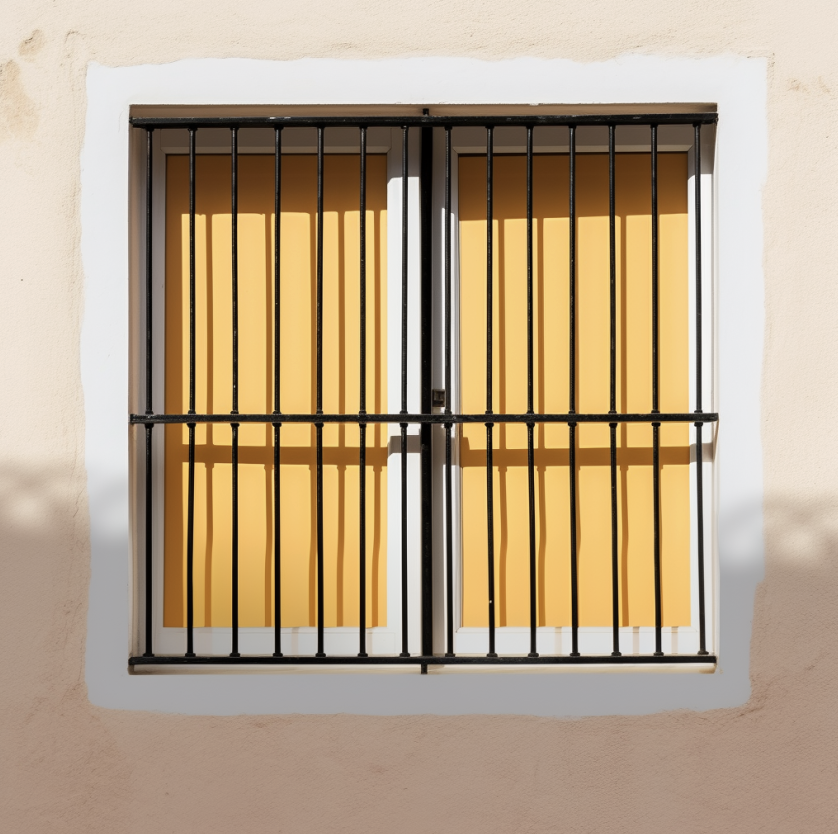
| Factor | Window Guards | Window Bars (Security Bars) |
|---|---|---|
| Primary purpose | Fall prevention | Break-in prevention |
| Protects against | Children and pets falling out | Intruders forcing entry in |
| Material gauge | Light to medium steel or aluminum | Heavy-gauge steel (1/2" to 3/4" rods) |
| Bar spacing | 4" to 4.5" (CPSC/ASTM standard) | 3.5" to 5" (structural requirement) |
| Forced-entry resistance | Low to moderate | High to very high |
| Emergency release | Required by law (adult-operable) | Required on egress windows only |
| Code standard | ASTM F2006, NYC Local Law 57 | IBC, NFPA 101, local fire codes |
| Typical cost | $20 to $80 per window | $80 to $300 per window |
| Installation | DIY-friendly, 5-10 min | DIY or professional, 10-30 min |
| Permanence | Usually removable/temporary | Permanent or semi-permanent |
| Aesthetics | Utilitarian (basic bars) | Utilitarian to decorative |
| Best for | Apartments with children, upper floors | Ground floors, basements, storefronts |
Key takeaway: Window guards and window bars solve different problems. A window guard will not stop a determined burglar. A security bar not designed to ASTM F2006 may not meet child-safety requirements. If you need both fall protection and intrusion protection on the same window, you need a product that satisfies both sets of requirements, or you need to install both.
Can Window Bars Double as Window Guards?
This is one of the most common questions homeowners ask, and the answer has important nuances.
In theory, yes. A steel security bar with spacing of 4 inches or less will physically prevent a child from passing through, which accomplishes the fall-prevention goal of a window guard. If the bar spacing already meets ASTM F2006 limits, the barrier serves both purposes at the structural level.
In practice, it depends on your jurisdiction. Some building codes and housing authorities require that products marketed as window guards carry specific ASTM F2006 or F2090 certification. A security bar that is functionally identical but not certified to those standards may not satisfy a housing inspector. In New York City, for example, landlords must install "approved" window guards, and the city maintains a list of accepted products. A generic security bar not on that list would not pass inspection even if it meets or exceeds the structural requirements.
The safest approach if you need both child safety and burglary prevention:
- Check your local code to see whether fall-prevention devices require specific certification.
- If certification is required, install a certified window guard for compliance, then add security bars for burglary protection. On the same window, the guard sits closest to the glass and the bar sits closer to the room interior.
- If no certification is required, a quality security bar with 4-inch or tighter spacing will handle both jobs. Look for a model with a quick-release mechanism to preserve emergency egress.
Fire Safety and Egress: The Rules That Apply to Both
Whether you install window guards or window bars, fire safety and emergency egress are non-negotiable considerations. The rules differ slightly for each product type, and misunderstanding them can create a life-threatening hazard.

Window guards and egress
Every major building code requires that window guards be removable by an adult from the inside without tools. The logic is straightforward: in a fire, occupants must be able to clear the window opening quickly and escape. ASTM F2006 specifies that the release mechanism must be operable by a person with normal adult hand strength but must resist operation by a child. This usually means a squeeze-and-lift or a push-tab mechanism positioned at adult hand height.
Window bars and egress
Security bars on bedroom windows and other egress-required windows must also provide an emergency release path. The International Building Code (IBC) and NFPA 101 (Life Safety Code) require that any window designated as an emergency escape opening maintain a minimum clear opening of 5.7 square feet with a minimum height of 24 inches and a minimum width of 20 inches. Security bars that block this opening must have a quick-release mechanism that clears the opening from the inside without keys or tools.
Not all security bars include a quick-release. Fixed bars without a release mechanism are appropriate for non-egress windows (living rooms, kitchens, hallways, commercial storefronts) but must never be installed on a bedroom window or any window designated as an emergency exit in the building plan.
For a full breakdown of egress codes and compliant products, read our guide on the SWB Model A/EXIT quick-release security bar.
How to Choose the Right Product for Your Situation
The right choice depends on what you are trying to protect against, where the window is located, and what your local code requires. Here is a decision framework:

Choose window guards if:
- You have children under 10 and your windows are on upper floors (second story or higher).
- Your city or lease requires ASTM-certified fall-prevention devices.
- You are a renter who needs a lightweight, removable, and inexpensive solution.
- Break-in risk is low (upper floors, gated community, low-crime area).
Choose window bars if:
- Your primary concern is burglary, vandalism, or forced entry.
- You are protecting ground-floor or basement windows that are accessible from the outside.
- You own a commercial property, storefront, or warehouse.
- You want heavy-duty steel protection that resists cutting, prying, and sustained force.
- You need adjustable, telescopic bars that fit multiple window sizes without custom ordering. The SWB Model A handles this with a frame-mount telescopic design that fits standard to wide residential windows at around $90 per unit.
Choose both if:
- You have children and live on a ground floor or in a high-crime area.
- Your building code requires certified window guards and you also want intrusion protection.
- You are a landlord who must comply with both child-safety and tenant-security obligations.
Frequently Asked Questions
Are window guards and window bars the same thing?
No. Window guards are fall-prevention devices designed to keep children and pets from falling out of open windows. They use lighter-gauge materials and must include an adult-operable release mechanism. Window bars are heavy-gauge steel security barriers designed to prevent break-ins. They are built to resist forced entry from the outside. The two products serve different purposes, meet different code standards, and are constructed differently, even though they look similar at a glance.
Do I need window guards or window bars for an apartment?
It depends on your floor and your concern. If you have children and live on an upper floor, window guards are likely required by law in many cities and strongly recommended everywhere else. If you are on the ground floor and worried about break-ins, window bars are the better choice. Ground-floor apartments with children may benefit from both: a certified guard for fall prevention and a security bar for intrusion protection.
Can window bars replace window guards for child safety?
Functionally, a security bar with 4-inch or tighter spacing will prevent a child from passing through. However, in jurisdictions that require ASTM F2006-certified fall-prevention devices, a security bar that is not certified to that standard may not satisfy the legal requirement. Check your local building code. If certification is mandatory, install a certified guard and add security bars separately if you also need intrusion protection.
Which is more expensive, window guards or window bars?
Window guards are significantly cheaper. Basic adjustable guards cost $20 to $80 per window and install in under 10 minutes with no tools. Security bars range from $80 to $300 per window depending on material, size, and mounting type, plus potential installation labor of $50 to $150 per window if you hire a professional. The price difference reflects the heavier steel, more complex mounting hardware, and higher forced-entry resistance of security bars.
Do window bars affect home resale value?
The impact depends on the market. In high-crime urban neighborhoods, window bars are expected and can be a selling point because buyers see them as an existing security investment. In suburban or low-crime areas, visible exterior bars can carry a negative stigma and may reduce curb appeal. Interior-mounted bars and modern minimalist designs minimize this concern. Removable frame-mount bars leave no trace if you take them down before listing, giving you flexibility regardless of market perception.
The Bottom Line
Window guards and window bars are not interchangeable products. Guards keep people from falling out. Bars keep intruders from breaking in. The materials, construction standards, code requirements, and price points are all different. Choosing the wrong one leaves a gap in either child safety or property security.

If you need fall prevention, buy a certified window guard. If you need burglary protection, buy security bars built from heavy-gauge steel with a mount type that matches your wall material. If you need both, install both, or choose a security bar with child-safe spacing and a quick-release mechanism that meets egress codes.
For a full comparison of security bar options including telescopic, masonry-mount, and quick-release models, see our best window security bars for homes in 2026 buyer's guide.