Burglar Windows: How to Identify Vulnerable Entry Points and Stop Break-Ins With Steel Security Bars
Burglar windows are a top home security risk. Learn how to identify vulnerable entry points and protect them with steel window bars. Shop SWB today.

SWB: High-caliber Security Window Bars experts. We bring the most advanced protection within your reach, explained clearly. According to the FBI Uniform Crime Report, approximately 6.7 million burglaries are committed in the United States every year — and a staggering 60% of those break-ins happen through ground-floor windows. That means your windows are not just architectural features; they are the most statistically significant vulnerability in your entire home. The concept of 'burglar windows' refers specifically to windows that are easy targets for forced entry — ground-level openings, unlocked sashes, sliding frames without reinforcement, and bedroom windows without egress-compliant security bars. Understanding which of your windows are most likely to be exploited by intruders is the first critical step toward protecting your household, your possessions, and your family. In this guide, SWB breaks down every category of burglar windows, explains the specific risk factors that make them attractive to intruders, and shows you exactly how steel security bars eliminate those vulnerabilities — without requiring expensive contractor installations or permanent wall damage.
Ground-floor windows consistently rank as the number-one point of entry in residential burglaries across the United States. A report from the Bureau of Justice…
What Are Burglar Windows? Understanding the Top Residential Entry Points
The term 'burglar windows' does not describe a product — it describes a risk profile. Any window in your home or apartment that presents low resistance to forced entry, poor visibility from the street, or easy concealment for an intruder qualifies as a burglar window. According to the International Association of Certified Home Inspectors (InterNACHI), the most commonly exploited residential entry points in the USA are first-floor windows, basement windows, and rear-facing windows not visible from the street. Understanding these categories in practical terms — where they are in your home, why they are targeted, and how quickly a break-in can occur through them — gives homeowners and renters the precise knowledge needed to prioritize their security investments. Studies consistently show that a determined burglar can force open a standard single-hung window in under 30 seconds with minimal tools. That speed means that your greatest protection is not a camera or an alarm — it is a physical barrier that cannot be defeated quickly and silently. Steel window bars are that barrier. The sections below examine the most prevalent types of burglar windows found in American homes and apartment buildings, covering everything from Chicago three-flats to Houston ranch-style homes and Los Angeles ground-floor units.
Ground-Floor Windows: The Primary Target for Home Burglars
Ground-floor windows consistently rank as the number-one point of entry in residential burglaries across the United States. A report from the Bureau of Justice Statistics confirms that first-floor windows account for more forced entries than any other home access point, including doors. The reasons are straightforward: they are accessible without a ladder, they can be approached under the cover of landscaping or fencing, and they are often out of direct sightlines from neighbors or passing traffic. In dense urban areas like Chicago, Philadelphia, and Detroit — all cities with above-average residential burglary rates — ground-floor apartment windows are specifically targeted in high-rise and multi-unit buildings. Renters in these cities who live on the first or second floor face a disproportionate share of window-related break-ins. A steel security bar installed on a ground-floor window eliminates virtually all of this risk. Even the visual presence of bars functions as a deterrent — most burglars will bypass a secured window entirely and move to an easier target rather than risk the noise and time required to defeat a steel bar system.
Basement Windows: The Most Overlooked Burglar Entry Point
Basement windows are perhaps the most underestimated burglar windows in the American home. Because they are low to the ground and often partially obscured by vegetation, window wells, or mechanical equipment, they offer ideal conditions for a covert break-in. According to home security researchers at the University of North Carolina at Charlotte, burglars strongly prefer entry points that cannot be observed by neighbors or passersby — and basement windows check every box. In regions like the Midwest and Northeast, where finished basements are common, a basement window break-in can give an intruder direct access to the entire home without ever entering through the main floor. This makes basement windows not merely a secondary concern but a primary security failure point. Many homeowners invest in front-door deadbolts and alarm systems while completely neglecting the basement windows at the rear of the property. Steel bars rated for basement window dimensions close this gap definitively. SWB's telescopic models adjust to fit standard US basement window widths, typically ranging from 22 to 36 inches, without any masonry drilling or permanent wall modification.
Basement Window Risk Factors to Assess
When evaluating your basement windows as potential burglar entry points, examine the following: Is the window below grade or at grade level, providing crouching concealment? Is it obscured by a window well, shrubs, or a deck? Does it have a locking mechanism, or only a simple latch? Is the glass single-pane and easily broken? If you answer yes to two or more of these questions, your basement window qualifies as a high-priority burglar window and should be protected immediately with a reinforced steel bar system.Rear-Facing and Side Windows: Out of Sight, Out of Mind — Until a Break-In
Windows on the rear and side elevations of residential properties represent a category of burglar windows that is structurally invisible to neighborhood watch efforts and passing patrol cars. A National Institute of Justice study on residential burglary patterns confirmed that back and side windows are targeted twice as frequently as front-facing windows because they offer the privacy intruders need to work without interruption. In suburban neighborhoods from Atlanta, Georgia, to Memphis, Tennessee, rear windows in single-family homes are frequently the actual point of forced entry even when the homeowner had previously invested in a front door security system. The psychological gap — focusing on the front while ignoring the back — is one of the most predictable patterns in residential security failures. Protecting rear and side windows with steel bars is one of the highest-return security investments a homeowner can make. These windows are typically out of daily visual awareness, making a durable, permanently-capable but easily-installed bar system the most practical solution for comprehensive coverage.
Why Standard Window Locks Fail Against Burglar Entry
A common misconception among American homeowners is that locking a window is sufficient protection against burglary. This belief is dangerously inaccurate. Standard residential window locks — including sash locks on double-hung windows, lever latches on sliding windows, and cam locks on casement windows — are engineered for weather sealing and accidental opening prevention, not forced-entry resistance. They are manufactured from aluminum alloy or zinc die-cast, materials that can be defeated by a flathead screwdriver or a sharp upward strike in under 10 seconds. According to a 2022 property crime analysis by the Insurance Information Institute (III), homes with only standard window locks are 3.4 times more likely to experience window-related break-ins than homes with secondary mechanical reinforcement. The physical security industry distinguishes between 'latches' — which hold a window in the closed position — and 'locks' — which provide meaningful forced-entry resistance. Most residential windows ship with latches, not locks. Steel security bars occupy an entirely different category: they are mechanical barriers that prevent the window frame from being opened regardless of what happens to the latch.
Sliding Windows and Patio Doors: The Weakest Locks in American Homes
Sliding windows and patio-style windows are particularly vulnerable to bypass attacks. Because the locking mechanism on a slider depends entirely on a small latch engaging a metal channel, any upward force that lifts the window panel off its track immediately defeats the lock — no tools required. This technique is so well-known among opportunistic burglars that it is specifically documented in law enforcement training materials in cities including Los Angeles, Houston, and Phoenix, where sliding-style windows are prevalent in apartment and condo construction. A steel window bar placed horizontally in the window track eliminates this vulnerability entirely by adding a rigid physical obstacle that prevents the panel from sliding open even if the latch is bypassed. SWB's telescopic bars are specifically well-suited to this application because their adjustable width allows them to fit precisely within the track channel with no drilling or permanent hardware.
Window Track Bar Placement for Sliding Windows
For maximum effectiveness against sliding window attacks, position the steel bar in the lower track channel when the window is closed. The bar should make firm contact with the window frame on both ends with zero lateral play. Test by attempting to slide the window with moderate force — if the panel moves at all, adjust the bar length until contact is solid on both ends. This 15-minute setup provides mechanical resistance equivalent to a bolted barrier at a fraction of the cost of a full window replacement or locksmith installation.Single-Pane Glass: When Breaking the Glass IS the Attack
In a significant percentage of burglar window incidents, the intruder does not attempt to open the window at all — they simply break the glass. Single-pane glass, which is still found in millions of older American homes and apartment buildings constructed before 1970, can be broken silently using techniques widely documented in police reports: a sharp tap with a spark plug fragment, a center punch tool, or a heavy-duty window breaker device. Once the pane is broken, the burglar can reach inside to disengage the latch and raise the sash in under 15 seconds. Steel security bars address this attack vector directly. Even if the glass is broken, bars installed on the interior or exterior of the window prevent any body part or tool from passing through the opening to manipulate the latch or lever the frame. This means that even single-pane windows — which would otherwise require expensive glass replacement or security film application — can be rendered functionally burglar-resistant at a cost of under $100 when protected by SWB bars.
Double-Hung Windows: How Burglars Exploit Worn Sash Locks
Double-hung windows are the most common window type in American residential construction. They are also the most frequently targeted burglar windows in the Eastern United States, particularly in the older housing stock of cities like New York, Philadelphia, Boston, and Baltimore. The sash lock on a double-hung window is typically a simple crescent-shaped cam that rotates to engage a keeper on the opposite sash. Over years of use, these locks wear, loosen, and can often be vibrated open from outside by repeatedly tapping the frame — a technique that produces almost no audible noise from inside the home. Security research published by the University of North Carolina's Department of Criminology found that worn or misaligned sash locks were a contributing factor in over 40% of window-related residential break-ins studied. Steel window bars installed on the interior of a double-hung window provide a mechanical backup to any sash lock condition — new, worn, or completely failed — ensuring that the window cannot be forced open regardless of latch integrity.
How Steel Window Bars Eliminate Burglar Window Vulnerabilities
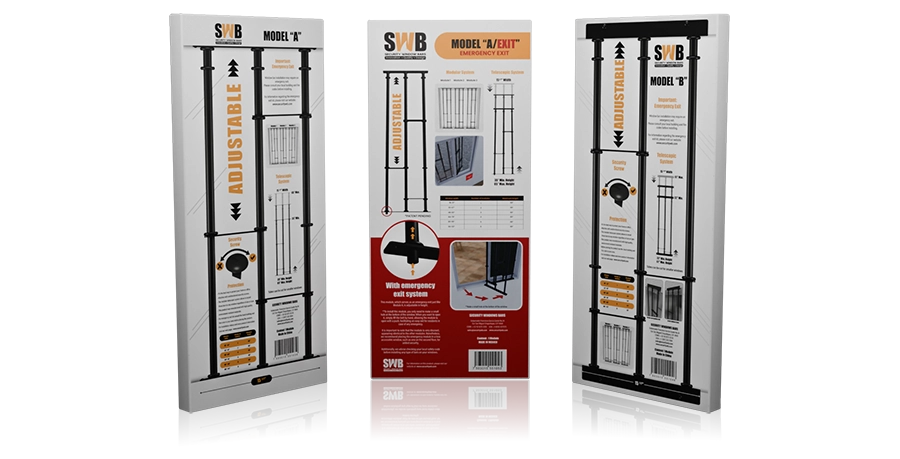
Steel window bars are the most mechanically direct solution to the burglar window problem. Unlike alarm sensors, which detect intrusion after the glass has been broken or the window has been opened, and unlike security cameras, which record a break-in but do not physically prevent it, steel bars create an immovable obstruction that stops forced entry at the point of attack. The physics are simple and unambiguous: a burglar who encounters a properly installed steel bar system across a window opening cannot pass through that opening without tools, time, and significant noise — all of which eliminate the conditions that make opportunistic burglary feasible. According to a Temple University study funded by the National Institute of Justice, visible security hardware on windows reduced burglary attempts at those specific properties by up to 83%. SWB's full product line — Model A Telescopic, Model B Wall-Mount, and the patented Model A/EXIT Egress Compliant — covers every burglar window scenario from a renter's first-floor bedroom in Chicago to a ground-floor retail space in Houston.
Model A Telescopic Window Bars: Renter-Friendly Protection Without Drilling
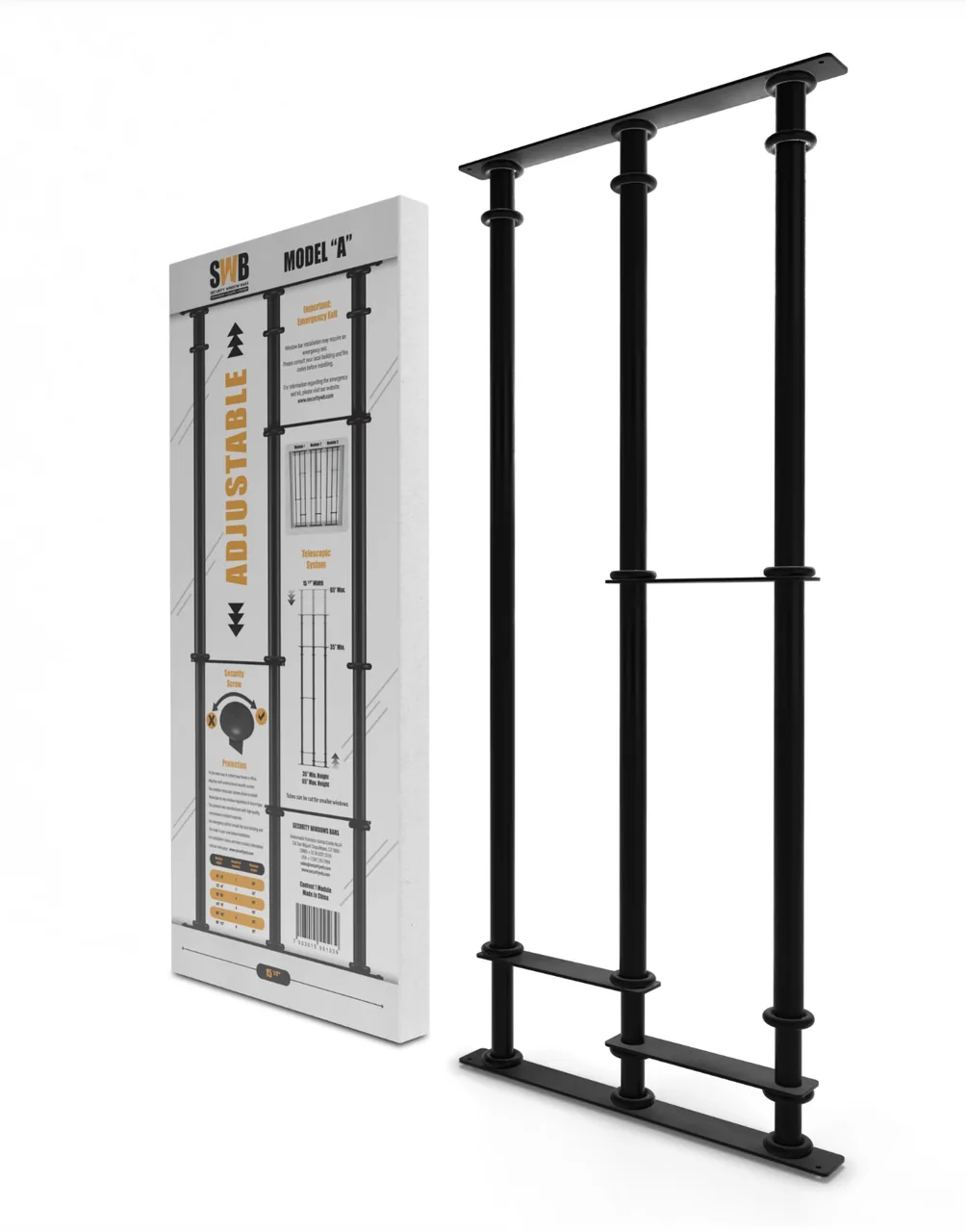
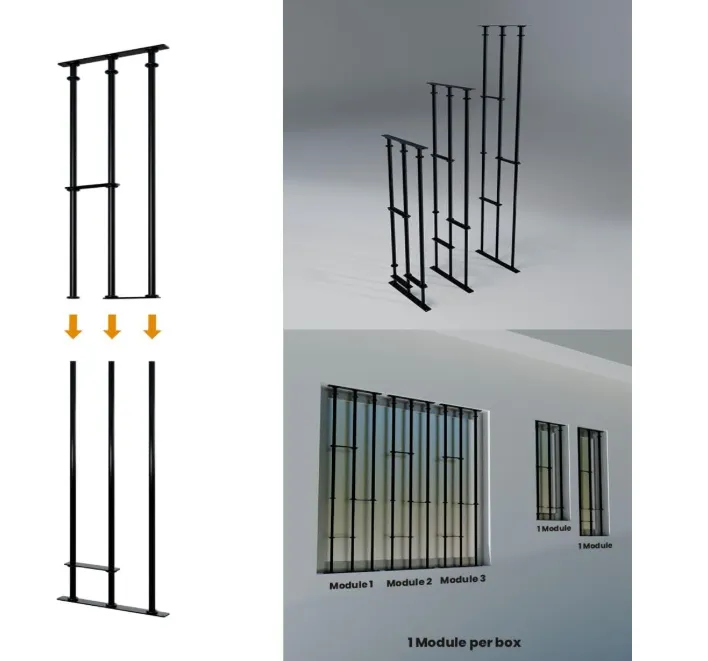
The SWB Model A Telescopic Window Bar is specifically engineered to address the most common barrier renters face when trying to secure burglar windows: the prohibition against making permanent modifications to rental property. Traditional burglar bars require drilling into window frames or surrounding masonry — a modification that most lease agreements expressly forbid and that can result in the loss of a security deposit. Model A solves this completely. Its fully telescopic steel frame adjusts to fit windows between 22 and 36 inches wide — covering the vast majority of standard US residential window sizes — and locks into position using spring-tension without any drilling, anchoring, or adhesive. Installation takes 15 to 20 minutes, requires no tools, and is completely reversible. When a renter moves out, the bars come with them. At $90 per unit, Model A is 85–90% less expensive than having a professional burglar bar installation done — which averages $600 to $1,800 per window according to HomeAdvisor national cost data.
Model B Wall-Mount Bars: Permanent Protection for Homeowners and Landlords
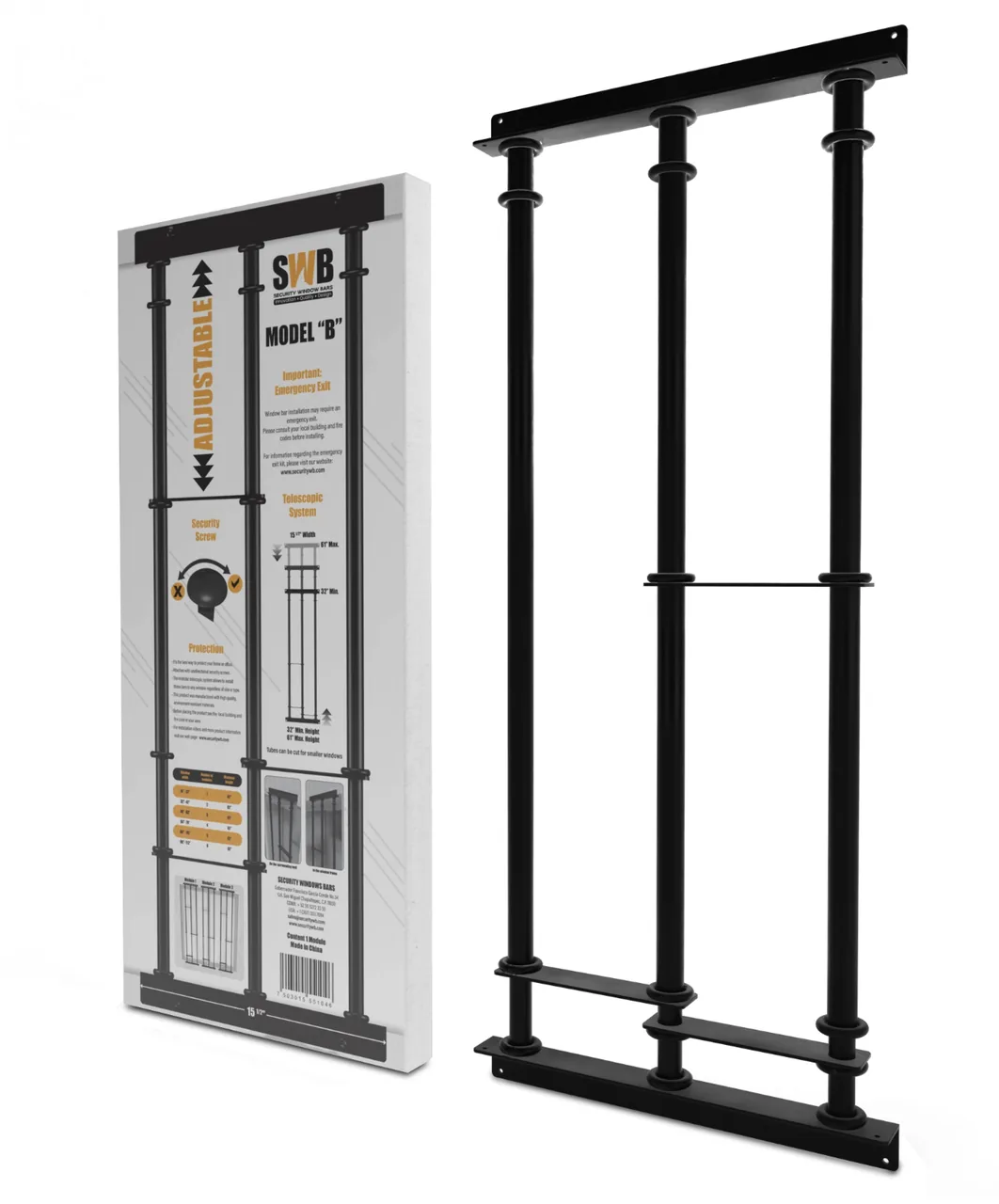
For homeowners and property managers who want the absolute maximum in burglar window protection and are not constrained by rental modification rules, the SWB Model B Wall-Mount Window Bar provides heavy-gauge steel construction with a fixed installation profile that matches the strength of professionally welded bars. Model B uses a powder-coated matte black finish that resists rust and weathering, making it appropriate for both interior and exterior installation on ground-floor windows, garage windows, commercial property windows, and basement windows. Landlords managing multi-unit buildings in high-crime zones — particularly in cities like Memphis, Detroit, and Baltimore where ground-floor unit burglary rates are disproportionately high — can use Model B to permanently protect common-exposure windows on their rental properties. Unlike custom-fabricated welded bars, Model B ships via Amazon FBA with fast delivery to all 50 states, eliminating the 2–6 week lead time typical of local fabrication shops.
Model A/EXIT Egress Compliant Bars: Security and Fire Safety in One System
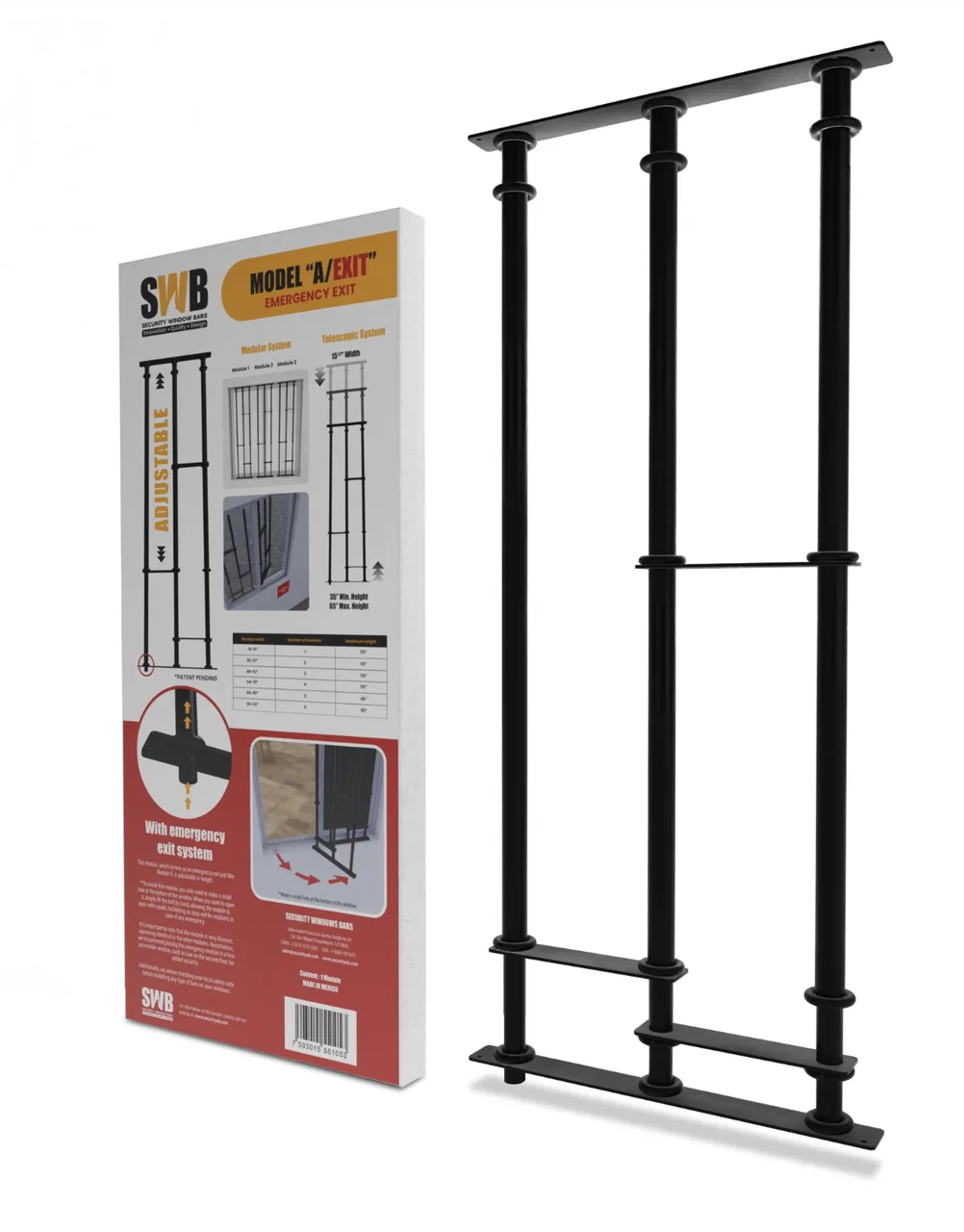
The most critical category of burglar windows is also the most legally regulated: bedroom windows and sleeping area windows. Under the International Building Code (IBC), NFPA 101 Life Safety Code, and the International Residential Code (IRC), windows in sleeping areas must maintain a minimum clear opening of 20 inches wide by 24 inches high (minimum 5.7 sq ft net opening) to allow emergency egress and firefighter access. This requirement creates a conflict for property owners who want to install burglar bars on bedroom windows — because traditional fixed bars permanently block the egress opening, creating a life-safety violation. The SWB Model A/EXIT resolves this conflict with a patented quick-release mechanism that allows the bars to be opened instantly from inside during an emergency, maintaining full NFPA 101 and IBC egress compliance while providing the same break-in deterrence as a fixed bar system. At $92, it is the only product in its class that delivers both code compliance and genuine burglar window protection in a single installation.
Egress Compliance Requirements by Jurisdiction
While IBC and IRC set federal baseline standards, many states and cities impose additional requirements. New York City's Local Law 57 mandates window guards in residential units where children under 10 reside. California's Title 24 imposes specific egress requirements in multi-family residential construction. Illinois and Texas fire codes reference NFPA 101 directly for rental property compliance. Always verify local amendments to IBC and IRC with your city's building department before installing fixed bars on sleeping area windows — and consider Model A/EXIT as the code-safe default for any bedroom burglar window application.Burglar Window Risk Assessment: How to Audit Your Home in 30 Minutes
Before purchasing any window security product, a systematic audit of your property's burglar window vulnerabilities is the most efficient use of your security budget. Not every window in your home presents equal risk — and spending $90 per window on bars across an entire house without prioritization is neither necessary nor strategic. A structured risk assessment identifies which windows are highest priority based on accessibility, concealment, lock condition, and proximity to valuables. The following framework is drawn from residential security inspection protocols used by licensed home security consultants and insurance risk assessors. It takes approximately 30 minutes for a standard single-family home and 15 minutes for a typical apartment unit. The output is a prioritized list of burglar windows ranked by intervention urgency, which allows you to phase your security investment efficiently — starting with the highest-risk openings and working down.
Four-Factor Window Vulnerability Scoring System
Rate each window in your home on four factors, each scored 1–3 (1 = low risk, 3 = high risk):**Factor 1 — Accessibility:** Is the window at ground level or reachable without a ladder? Score 3 for ground floor, 2 for second floor with adjacent structure, 1 for upper floor with no access.**Factor 2 — Concealment:** Can an intruder approach and work on this window without being seen from the street, neighboring windows, or interior rooms? Score 3 for fully concealed, 2 for partially visible, 1 for fully exposed to observation.**Factor 3 — Lock Condition:** Is the existing lock functional, tight, and tamper-resistant? Score 3 for no lock, worn latch, or single-point lever, 2 for standard sash lock in fair condition, 1 for secondary security hardware already installed.**Factor 4 — Proximity to Entry:** Does this window provide direct access to interior doors, a garage, a basement, or areas where keys and valuables are stored? Score 3 for high-value access, 2 for general living area access, 1 for remote or low-value area.Any window scoring 9 or higher is a critical burglar window requiring immediate steel bar installation. Any window scoring 7–8 is a high-priority target. Scores below 6 can be addressed in a second phase.
Common Burglar Window Configurations in American Homes by Region
Regional construction patterns in the United States produce distinct burglar window profiles that vary significantly by geography.In the Northeast — Boston, New York, Philadelphia, Baltimore — older brownstone and row-house construction features large double-hung windows at street level with worn sash hardware. These are statistically the most common burglar windows in the region.In the Midwest — Chicago, Detroit, Milwaukee, Cleveland — ground-floor windows on multi-unit two-flats, three-flats, and courtyard apartment buildings are the primary targets. Chicago rental properties in neighborhoods including Englewood, Austin, and Back of the Yards experience some of the highest window break-in rates in the country.In the South — Houston, Atlanta, Memphis, New Orleans — ranch-style single-family homes with low-profile sliding windows and minimal landscaping barriers are particularly exposed. The high percentage of unattached garages in Southern residential construction also creates rear-facing window vulnerabilities that are frequently overlooked.In the West — Los Angeles, Phoenix, Las Vegas — sliding windows and stucco-framed openings are standard, and the large percentage of ground-floor apartment units combined with high population density creates concentrated burglar window risk profiles. The SWB Installation Guide provides region-specific placement recommendations for all major US window configurations.
Burglar Window Prevention for Renters: Your Rights and Your Options
According to the US Census Bureau's 2023 American Community Survey, there are 44.1 million renter-occupied housing units in the United States. Renters face a disproportionate burglar window risk for several compounding reasons: they typically occupy ground-floor units in multi-tenant buildings, they are less likely to have invested in security hardware because of lease restrictions, and they may live in neighborhoods with higher-than-average property crime rates due to rental market economics. The critical challenge for renters is not the existence of burglar windows — nearly every renter can identify them — but the practical constraint of lease agreements that prohibit permanent modifications to the property. Most standard residential leases in the USA include clauses that prohibit drilling, anchoring hardware, or installing any fixture that leaves a permanent mark on walls, frames, or floors. This language has historically been used by landlords to deny tenant requests to install burglar bars. However, several states including California (Civil Code Section 1941.3), New York, and Illinois have enacted or proposed tenant rights legislation that requires landlords to provide basic window security hardware upon request — particularly on ground-floor and basement-level units.
No-Drill Security Bars: The Legal Solution for Apartment Renters
The SWB Model A Telescopic Window Bar is specifically designed to operate within the constraints of standard lease agreements. Because Model A uses spring-tension telescopic pressure against the window frame to hold its position — with no screws, anchors, adhesives, or drilling — it does not constitute a permanent modification under the standard legal definition used in most American residential lease agreements. This means renters in Chicago, Los Angeles, New York City, Houston, and every other major American city can install Model A without violating their lease terms or risking their security deposit. The bars can be removed in minutes when a lease ends and reinstalled in the next apartment just as quickly. For renters who are concerned about the specific language in their lease, SWB recommends keeping the original packaging and any installation documentation that confirms the no-drill, no-damage design. Many renters also choose to notify their property manager in writing before installation — a precaution that creates a record of the tenant's proactive security efforts and can be valuable in lease renewal discussions.
Talking to Your Landlord About Burglar Window Security
Landlords and property managers have both practical and legal motivations to address burglar window risks on their properties. From a liability standpoint, a landlord who has received a written complaint from a tenant about inadequate window security and fails to act may face civil liability in the event that a break-in occurs and causes personal injury or significant property loss. This exposure is particularly well-documented in California, where implied warranty of habitability law has been interpreted to include basic security hardware in some court decisions. From a practical standpoint, properties in high-crime neighborhoods that are visibly secured — including window bars on ground-floor and basement units — experience lower vacancy rates, fewer lease terminations, and higher tenant satisfaction scores according to the National Apartment Association's annual renter preference survey. For landlords who want to provide security for their tenants at minimal cost and maximum flexibility between tenancies, SWB's removable telescopic bars offer an ideal solution: install them before a new tenant moves in, and remove or transfer them when the tenant vacates. Visit Security Window Bars Contact to discuss bulk pricing for multi-unit properties.
Comparing Window Security Products: Why Steel Bars Outperform Other Burglar Window Solutions
The American home security market offers a wide range of products marketed toward the burglar window problem — from window alarm sensors and contact detectors to security film, smart locks, and impact-resistant glass. Each of these products addresses a specific and limited aspect of window security, and each has meaningful limitations when evaluated against the core criterion of preventing forced entry. Steel window bars remain the only window security product that provides a physical, mechanical barrier to forced entry regardless of the method of attack — whether that is glass breaking, latch manipulation, frame prying, or sash lifting. The comparison below evaluates the most commonly marketed burglar window solutions against the standard of actual forced-entry prevention.
Window Security Film vs. Steel Bars: Understanding What Each Product Actually Does
Window security film is a polyester laminate applied to the glass surface that holds broken glass fragments together after impact, slowing an intruder's ability to create a usable opening. High-quality security film can extend the time required to breach a glass pane by 30–60 seconds in controlled testing. However, security film has no effect whatsoever on latch manipulation, frame prying, or sash-lifting attacks — the three most common real-world burglar window entry techniques. Additionally, security film does not function as a visual deterrent — an intruder cannot determine from outside whether film is installed, eliminating the avoidance-behavior effect that visible bars produce. Steel bars, by contrast, are immediately visible and immediately communicative: this window cannot be passed through. For renters and homeowners on a budget, a $90 steel bar provides more comprehensive burglary prevention than $200–$400 worth of professional security film installation.
Window Alarms and Smart Sensors vs. Steel Bars: Detection Is Not Prevention
Window contact sensors and break-glass alarms are the most commonly installed secondary security hardware in American homes, largely because they are inexpensive (typically $15–$40 per window) and integrate with popular smart home platforms. However, these devices have a fundamental operational limitation: they respond to intrusion rather than preventing it. By the time a window alarm activates, the attack has already succeeded — the window has been opened or the glass has already been broken. In urban environments where police response times average 7–11 minutes in cities like Chicago and Los Angeles (per city police department annual reports), a 30-second window break-in followed by a 7-minute response window leaves an attacker 6+ minutes of uncontested access inside your home after the alarm sounds. Steel bars prevent the intrusion from occurring in the first place. The optimal residential security configuration combines both technologies: steel bars as the primary physical barrier and window sensors as a secondary notification system for any unexpected contact with the secured window.
Cost Comparison: Window Security Product Options
Window contact sensor: $15–$40 per window (detection only). Security film (professional install): $200–$400 per window (delays glass breach only). Smart window lock: $60–$150 per window (latch upgrade only). Professional welded burglar bars: $600–$1,800 per window (effective but permanent, no egress). SWB Model A Telescopic Bars: $90 per window (full mechanical barrier, removable, egress-compatible with Model A/EXIT). The value proposition of the SWB system is unambiguous when total cost, installation complexity, egress compliance, and forced-entry resistance are evaluated together.SWB vs. Competitors: The Telescopic Advantage
The residential window bar market includes several established players — Mr. Goodbar by Pinpont Manufacturing, Grisham by Master Halco, and Unique Home Designs among the most widely distributed. Each of these brands produces functional steel bar products, but each has specific limitations that the SWB telescopic system resolves. Mr. Goodbar requires permanent drilling and is not renter-compatible. Grisham's fixed-width bar sets do not adjust to non-standard window dimensions — a significant limitation in the enormous diversity of American residential window sizes. Unique Home Designs products are available through select home improvement retailers at prices typically 40–60% higher than SWB's Amazon-direct pricing. The SWB Model A's patented telescopic mechanism provides adjustability from 22 to 36 inches in a single unit, covering standard US window widths without custom ordering. All SWB models are available directly through the Amazon USA SecurityWindowBars store, with Amazon FBA fulfillment ensuring fast delivery to all 50 states — including Alaska and Hawaii.
Building Code Compliance and Burglar Window Bars: What Every Property Owner Must Know
Installing window bars on burglar windows introduces a critical legal and safety dimension that every homeowner, renter, and property manager must understand before purchase: the conflict between security and emergency egress. The International Building Code (IBC), International Residential Code (IRC), and NFPA 101 Life Safety Code all impose mandatory egress requirements on windows in sleeping areas and habitable rooms. These requirements exist because window bars installed without egress provisions have been directly implicated in residential fire fatalities across the United States — most notably in documented cases in Chicago (1993 Paxton Hotel fire, 6 deaths attributed to barred windows) and in subsequent fire safety legislation that followed. The law is clear: in any sleeping area, a window security bar system must either maintain a minimum 20-inch by 24-inch clear opening without tools, or must incorporate a quick-release mechanism operable from inside without special knowledge or keys.
IBC and NFPA 101 Egress Requirements for Window Bars
Under IBC Section 1030 and NFPA 101 Chapter 24, every sleeping room in a residential occupancy must have at least one emergency escape and rescue opening meeting the following minimum dimensions: minimum net clear opening of 5.7 square feet (or 5.0 square feet for ground floor), minimum net clear opening height of 24 inches, minimum net clear opening width of 20 inches, and maximum sill height of 44 inches above the finished floor. Any window bar system installed on a sleeping room window that permanently blocks these dimensions is a code violation subject to citation by local building inspectors and a potential liability issue in the event of a fire. The SWB Model A/EXIT Egress Compliant bar system is specifically engineered to satisfy these requirements via a patented quick-release mechanism that opens the bar array in a single motion from inside, maintaining the required egress dimensions while providing full burglar deterrence in the secured position.
Local Law Amendments: NYC, California, and Illinois Window Security Requirements
While IBC and IRC establish national baseline standards, local jurisdictions frequently adopt amendments that impose additional or more stringent window security requirements. New York City's Local Law 57 (amended in 2013 as part of NYC Admin Code 27-2043.1) requires that landlords install window guards in apartments where children 10 years of age or younger reside. The required guards must meet ASTM F2090 standards for child fall prevention while maintaining adult emergency egress capability — a dual requirement that mirrors the SWB Model A/EXIT's design specification exactly. California's Department of Housing and Community Development has issued guidance under Title 25 CCR 1615 indicating that bedroom window bars in multi-family residential buildings must incorporate operable releases accessible without tools from inside the unit. Illinois building codes, which are adopted by Chicago under Municipal Code Chapter 13-196, reference NFPA 101 directly for egress compliance in residential occupancies. Property owners in these jurisdictions should consult the SWB Contact page to discuss which models are appropriate for their specific location and use case.
🏆 Conclusion
Burglar windows are the most statistically significant physical vulnerability in the American home — accounting for 60% of all residential break-ins according to FBI crime data. Understanding exactly which windows are at risk, why standard locks fail to prevent forced entry, and how to assess your property's specific vulnerability profile gives you the information needed to make targeted, cost-effective security decisions. Steel window bars remain the only product that addresses all methods of burglar window attack with a single physical barrier — whether the threat is glass breaking, latch manipulation, sash lifting, or frame prying. Security Window Bars' telescopic product line gives American homeowners, renters, landlords, and property managers a full-spectrum solution: Model A for no-drill renter-friendly installation, Model B for permanent maximum-security protection, and the patented Model A/EXIT for sleeping area windows requiring egress code compliance. At $90–$92 per window, SWB costs a fraction of professional installation while delivering equivalent physical security — backed by Amazon FBA fast shipping to all 50 states. Protect your most vulnerable entry points today. Don't wait for a break-in to take your burglar windows seriously.
Security Window Bars · USA
Secure Your Home Today
Ready to secure your burglar windows today? Security Window Bars ships fast across the USA via Amazon FBA. Shop all SWB models on Amazon → or visit securitywb.com to compare Model A, Model B, and the egress-compliant Model A/EXIT — and find the right bar for every window in your home.
Shop on Amazon →Frequently Asked Questions
A burglar window is any window in your home that presents low resistance to forced entry, offers concealment for an intruder, or has a compromised locking mechanism. Ground-floor windows, basement windows, rear-facing windows, and any window with a worn or single-point latch qualify as burglar windows. You can use the four-factor scoring system described in this guide — rating each window on accessibility, concealment, lock condition, and proximity to entry — to determine which of your windows are highest priority for steel bar installation.
Yes — if you use a no-drill, tension-mounted bar system like the SWB Model A Telescopic. Because Model A uses spring-tension pressure against the window frame without any drilling, anchoring, or adhesive, it does not constitute a permanent modification under the standard legal definition used in most American residential lease agreements. The bars are fully removable in minutes, leaving no damage to the frame or wall. Renters in New York City, Chicago, Los Angeles, and all other major US markets can install Model A safely within standard lease terms. Always review your specific lease language and, if in doubt, notify your landlord in writing before installation.
Window bars on bedroom windows are legal throughout the United States, but they are subject to important code requirements. Under the International Building Code (IBC) and NFPA 101 Life Safety Code, any window bar system installed in a sleeping area must maintain emergency egress capability — specifically a minimum clear opening of 20 inches wide by 24 inches high. Fixed, non-releasable bars on bedroom windows are a code violation in most jurisdictions. The SWB Model A/EXIT Egress Compliant bar is specifically designed and patented to meet these requirements with a quick-release mechanism operable from inside without tools, making it the legally correct choice for all bedroom window security bar installations.
SWB window security bars cost $90–$92 per window depending on model. Professional window bar installation by a licensed contractor or locksmith averages $600 to $1,800 per window according to HomeAdvisor national cost data, with some custom fabrication jobs exceeding $2,000. This means SWB's telescopic bars deliver 85–95% cost savings versus professional installation while providing equivalent mechanical forced-entry resistance. All SWB models ship via Amazon FBA to all 50 US states with fast delivery, eliminating contractor scheduling and wait times.
Yes — steel window bars are effective against all primary methods of burglar window attack. They prevent glass-breaking attacks by blocking access to the latch even after the pane is broken. They prevent latch manipulation and sash-lifting attacks by creating a rigid mechanical barrier across the entire window opening. They prevent frame-prying attacks because the bar distributes force across the full width of the frame rather than concentrating it at a single latch point. Unlike window alarms (which detect intrusion after it occurs), security film (which only delays glass breach), or smart locks (which only upgrade the latch), steel bars provide a comprehensive physical barrier to forced entry regardless of attack method.
SWB Model A Telescopic and Model A/EXIT bars adjust to fit windows between 22 and 36 inches wide — covering the vast majority of standard US residential window sizes including most double-hung, single-hung, sliding, and casement window widths. The telescopic mechanism allows infinite adjustment within this range, so the bars fit precisely without gaps or wobble. For windows outside this range, or for windows requiring permanent wall-anchored installation, the SWB Model B Wall-Mount provides an alternative with fixed installation for maximum security. Contact SWB directly for custom sizing questions.
Window guards are required by law in certain specific contexts. New York City's Local Law 57 (NYC Admin Code 27-2043.1) mandates window guards in residential apartments where children age 10 or younger reside. The guards must meet ASTM F2090 child fall prevention standards while maintaining adult emergency egress. Some California jurisdictions impose window security requirements on multi-family residential properties under implied habitability standards. Additionally, IBC and NFPA 101 impose egress requirements on any window bar installed in sleeping areas nationwide. Property owners should consult local building codes and the SWB contact team to determine which products are appropriate for their jurisdiction.
SWB Model A Telescopic bars install in 15 to 20 minutes with no tools required for most installations. The telescopic mechanism extends and locks into position using spring-tension, making the entire process a true DIY project that requires no locksmith, contractor, or specialized skill. Model B Wall-Mount requires basic drilling into the surrounding wall or frame for permanent anchoring — a standard DIY task for most homeowners with a drill and appropriate anchors, estimated at 30–45 minutes per window. Full step-by-step instructions for both models are available at the SWB Installation Guide. No professional installation is required for any SWB product.