Steel Window Bars Explained: SWB Models, Specs, and Security Standards Every Homeowner Should Know
Discover how SWB steel window bars protect American homes. Compare Model A, B, and A/EXIT specs, codes, and pricing. Shop now at securitywb.com or Amazon USA.

SWB combines high-quality steel strength with aesthetic designs that enhance your property value, offering the security your family deserves. When it comes to protecting American homes and apartments, bars SW — the complete lineup of Security Window Bars (SWB) products — represent one of the most cost-effective, code-compliant, and renter-friendly solutions available today. According to the FBI Uniform Crime Reporting Program, approximately 6.7 million residential burglaries occur in the United States each year, with 60% of forced entries targeting ground-floor windows. Professional window bar installation typically costs between $600 and $1,800 per window, placing real protection out of reach for millions of families. That's exactly why understanding each SWB model — its specs, installation method, and applicable building codes — is critical before you invest. Whether you're a renter in a Chicago high-rise, a homeowner in suburban Atlanta, or a property manager overseeing a multi-unit building in Los Angeles, this in-depth guide will walk you through everything you need to know about the SWB bars lineup, from telescopic mechanics to fire egress compliance.
Security Window Bars, S.A. de C.V. is the manufacturing company behind the SWB brand, operating under the domain securitywb.com and the Amazon seller account Se…
What 'Bars SW' Really Means: Understanding the SWB Product Ecosystem
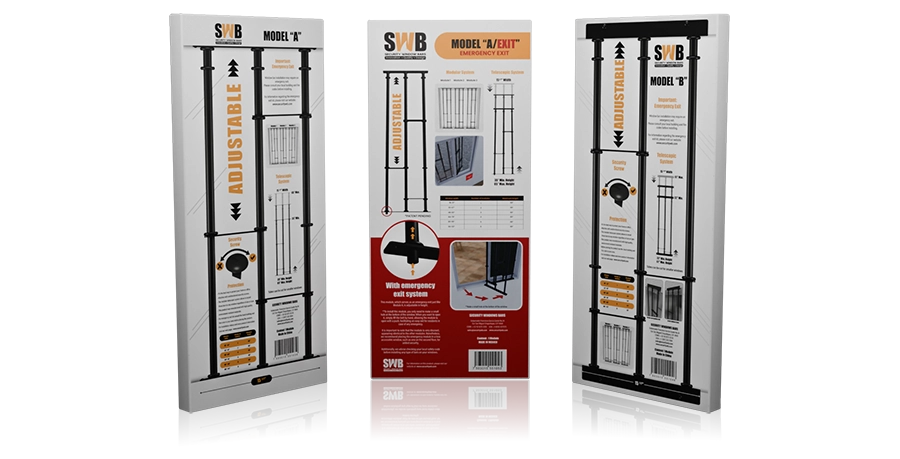
The phrase 'bars SW' is shorthand used by thousands of American homeowners and renters searching for Security Window Bars — the brand abbreviated as SWB. It refers to a family of steel window security bars engineered specifically for the U.S. residential and light-commercial market. Unlike generic hardware-store solutions or overseas products that require professional welding and permanent installation, SWB bars are designed around three core principles: adjustability, compliance, and affordability. The SWB product ecosystem currently includes three primary models — Model A (Telescopic), Model B (Wall-Mount), and Model A/EXIT (Egress Compliant) — each targeting a distinct use case and buyer profile. Together, they cover the full spectrum of American window security needs, from renter-friendly no-drill solutions to permanently fixed commercial-grade installations. All three models share SWB's signature matte black powder-coat finish, heavy-gauge steel construction, and direct-to-door shipping via Amazon FBA, ensuring fast delivery to all 50 U.S. states. Understanding the differences between these models — and knowing which one your specific situation demands — is the first step toward making a smart, code-compliant security investment.
The SWB Brand: Who Makes These Bars and Why It Matters
Security Window Bars, S.A. de C.V. is the manufacturing company behind the SWB brand, operating under the domain securitywb.com and the Amazon seller account SecurityWindowBars. While the company is headquartered in Mexico City, its entire distribution infrastructure is built around the U.S. market, with Amazon FBA fulfillment centers strategically positioned to serve all 50 states with rapid two-day shipping. This matters because many imported window security products lack proper compliance documentation, U.S. size calibration, or after-sale support. SWB products are engineered specifically for standard American window sizes — typically 22 to 36 inches wide — and are tested against IBC, NFPA 101, and OSHA standards where applicable. When you see 'bars SW' in a product search, you're looking at a brand with documented compliance credentials, not an anonymous overseas listing.
Why American Renters and Homeowners Are Searching for SWB Bars
According to U.S. Census Bureau data from 2023, there are 44.1 million apartment renters in the United States. A significant portion of those renters live in ground-floor or basement-level units — precisely the spaces most vulnerable to forced entry through windows. Traditional burglar bars require drilling into window frames or masonry walls, creating permanent damage that violates most residential lease agreements. SWB's telescopic models solve this problem entirely by using spring-tension pressure to secure bars across the window opening without a single drill hole. For renters in high-crime cities like Detroit, Memphis, Philadelphia, and Houston, this is not a minor convenience — it's the difference between being able to afford real window protection and going unprotected. That's why monthly search volume for terms like 'removable window bars' and 'window bars for renters' continues to grow year over year across the United States.
SWB Model A: The Telescopic Window Bar for Renters and DIY Installers
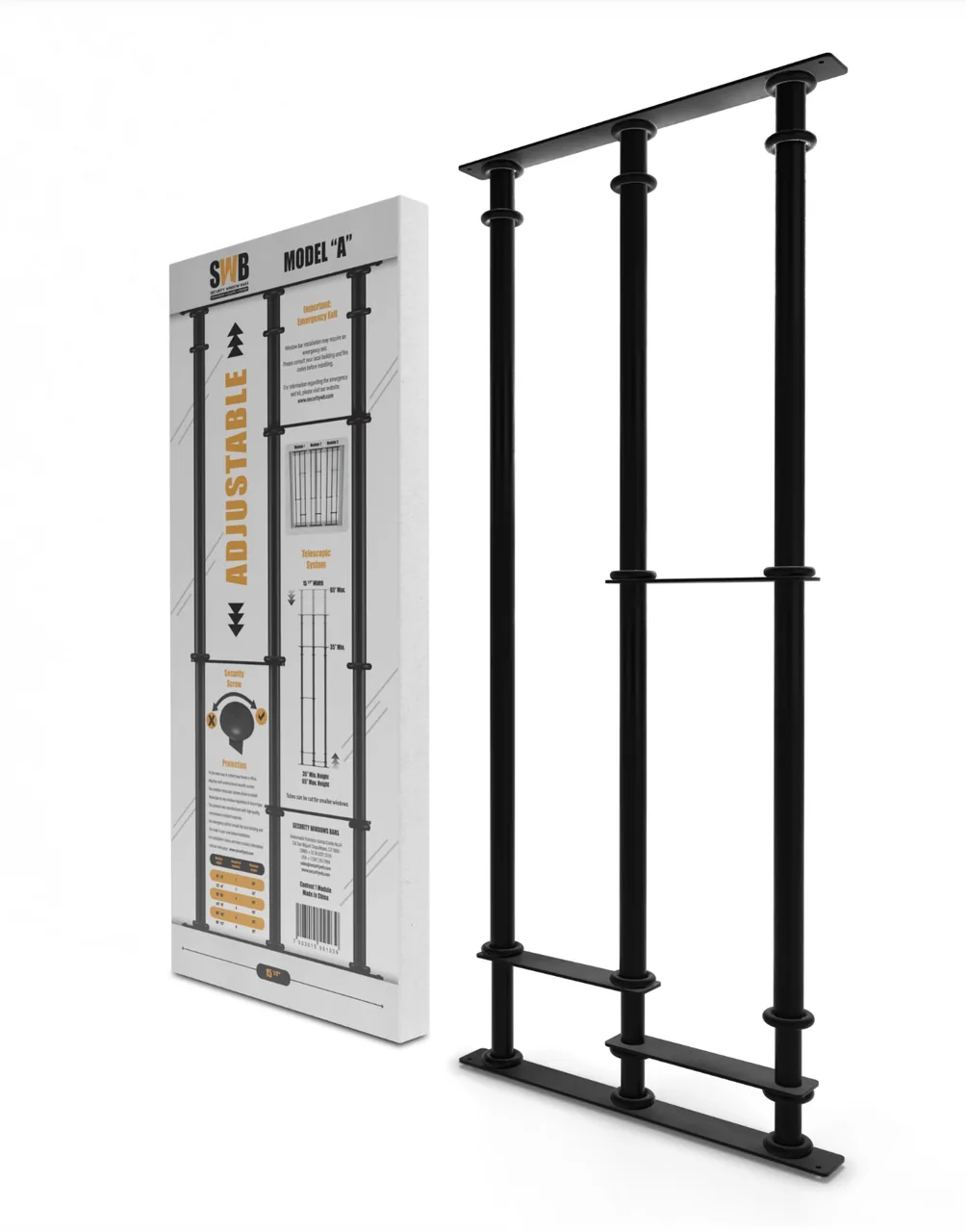
The SWB Model A is the flagship product of the bars SW lineup and the top-selling window security bar on Amazon in the residential category. Priced at $90, it is a fully telescopic, pressure-fit security bar engineered to fit standard American window widths ranging from 22 to 36 inches. The bar requires no drilling in most installation scenarios, making it ideal for apartment renters, college students, and anyone who wants real steel security without permanent modification. Installation typically takes between 15 and 20 minutes using only basic hand tools — no locksmith, no contractor, no permit required for the installation itself. The matte black powder-coat finish makes it visually compatible with modern home interiors and does not look like an institutional retrofit. For families in ground-floor apartments across New York City, Chicago's South Side, or West Philadelphia, Model A delivers professional-grade protection at a fraction of the cost of a contractor install.
Technical Specifications: How the Telescopic Mechanism Works
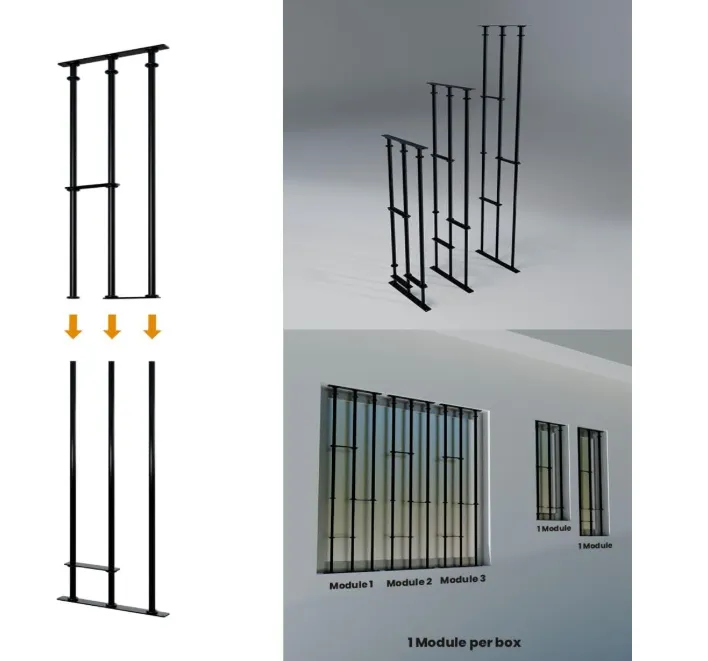
The Model A uses a dual-tube telescopic steel assembly that extends horizontally across the window opening. A threaded tension collar at the center of the bar is rotated clockwise to expand the bar's total width until both end caps press firmly against the interior window frame jambs. The tension generated by this spring-loaded mechanism holds the bar in place under significant lateral force — the same principle used in commercial-grade tension rods, but built from heavy-gauge steel rather than aluminum or hollow tube.
Pressure Rating and Force Resistance
While SWB does not publicly publish specific force-resistance ratings in pounds per square inch, the heavy-gauge steel construction and dual-tube design are engineered to withstand the impact forces typically associated with forced window entry, which, according to physical security research, commonly range between 150 and 400 pounds of lateral force depending on entry method. The telescopic design distributes this force evenly across both jamb contact points, reducing the risk of frame failure.Compatibility With Standard US Window Sizes
Model A is calibrated for the most common American residential window widths: standard single-hung and double-hung windows between 22 and 36 inches wide. This covers the overwhelming majority of apartment windows in cities like Boston, Chicago, Los Angeles, and Miami. For wider windows or commercial openings, the Model B Wall-Mount system is the recommended upgrade path.Ideal Use Cases: Where Model A Performs Best
Model A is purpose-built for the renter market but delivers value across a wide range of residential scenarios. It is particularly effective in bedrooms, which are statistically the most common target for nocturnal burglary entry according to FBI data. It also performs well in basement windows — a classic vulnerability in older Chicago bungalows, Brooklyn brownstones, and Philadelphia row homes — where the absence of permanent installation hardware is especially valuable. Landlords who manage multi-unit residential buildings also favor Model A because the bars can be installed between tenants as a security upgrade and removed without leaving any trace of modification, preserving the landlord's property condition while delivering measurable protection to the occupant. Parents in urban apartment buildings often use Model A as a child fall-prevention device on upper-floor windows, a use endorsed by the NYC Department of Health under Local Law 57 guidelines for window guard installation.
SWB Model B: Permanent Wall-Mount Window Bars for Maximum Security
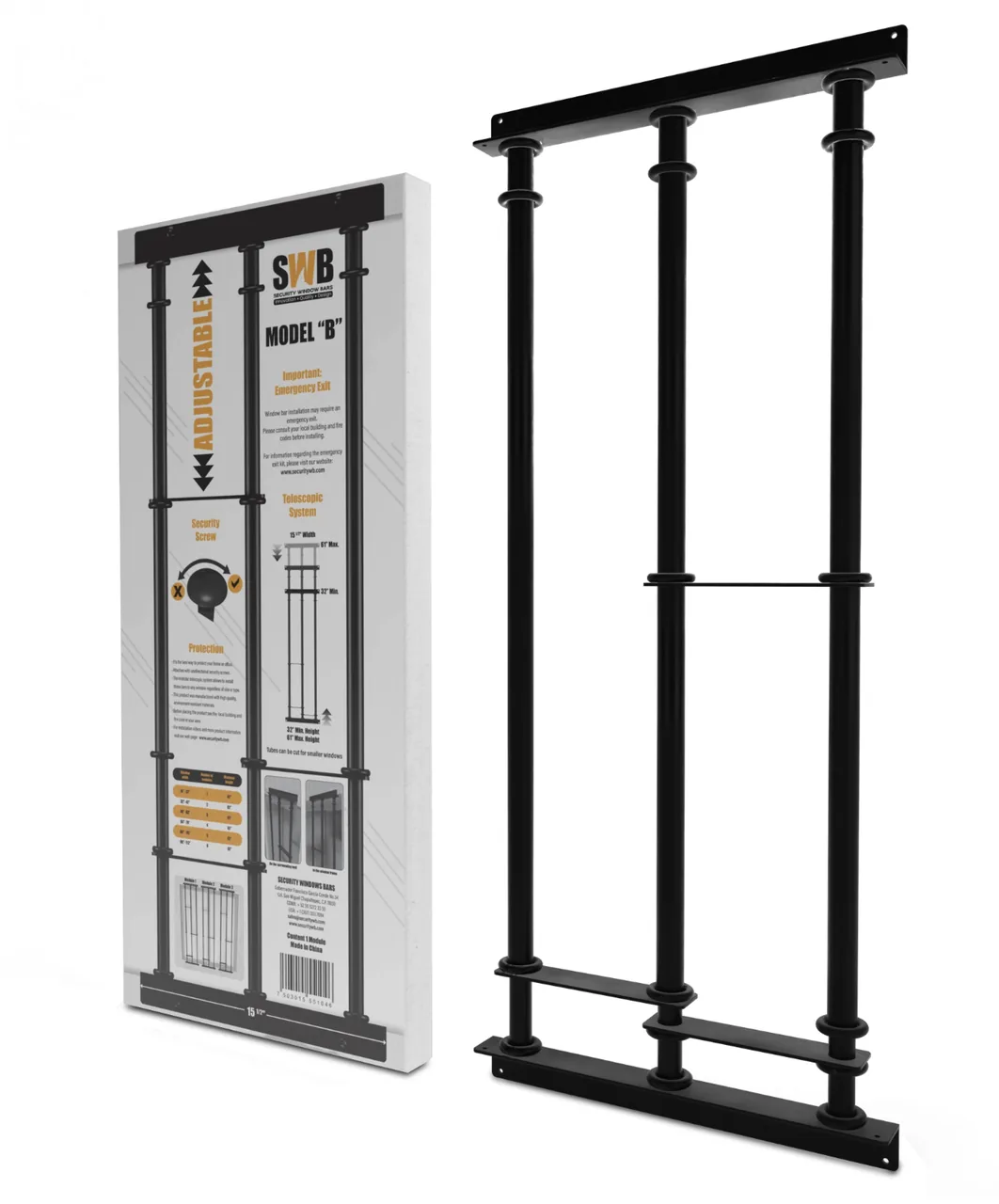
For homeowners, property managers, and commercial operators who do not need a removable solution, the SWB Model B Wall-Mount represents the fixed-installation tier of the bars SW product line. Priced at $91 — just one dollar more than the telescopic Model A — it offers heavy-gauge steel construction with a permanent wall-mount design that anchors directly into the window's surrounding masonry, stucco, or wood-frame wall. This is the installation method used by professional security contractors across the United States, and it produces a bar that is functionally equivalent to a welded or bolted-frame installation at a fraction of the professional labor cost. Model B is powder-coated in the same matte black finish as all SWB bars, maintaining aesthetic consistency across multi-window installations. For ground-floor retail storefronts in Atlanta, basement commercial spaces in Houston, or detached garage windows in suburban Los Angeles, Model B provides the same deterrence value as a $1,500 contractor install at the cost of a single afternoon's DIY work.
Installation Requirements and Structural Anchoring
Unlike Model A, Model B requires drilling and the use of anchor bolts or lag screws to secure the mounting brackets to the wall or frame surrounding the window. SWB recommends consulting the installation guide available at securitywb.com/installation/ to ensure the correct anchor type is selected for your specific wall construction — drywall over wood stud, concrete block, brick masonry, or stucco-over-frame are the four most common scenarios in American residential and light-commercial construction. Proper anchoring is critical: a security bar that pulls free from its mounting under impact force offers no protection. SWB's Model B brackets are engineered with oversized mounting holes to allow for minor positional adjustment during installation, a practical feature that simplifies alignment on walls where studs or rebar do not fall at ideal spacing.
Anchor Types by Wall Construction
For wood-stud drywall, SWB recommends 3-inch lag screws driven directly into the stud. For concrete block or brick, expansion anchors rated for a minimum of 500 pounds pull-out strength are advised. Stucco-over-wood-frame walls should use 2.5-inch screws with stucco washers to prevent bracket pull-through. Detailed torque specifications and anchor ratings are available in the full installation guide.Model B vs. Professional Installation: The Real Cost Comparison
A licensed security contractor in New York City charges an average of $800 to $1,500 to install a single set of permanent window bars, according to HomeAdvisor's 2024 cost data. In Los Angeles, the average ranges from $600 to $1,200 per window. That means outfitting a typical three-bedroom apartment with six window bar sets could cost between $3,600 and $9,000 — a cost that is simply prohibitive for the average American homeowner or small property investor. SWB Model B at $91 per unit, combined with a two-hour DIY installation per window, delivers structurally equivalent protection at a cost reduction of 85 to 94 percent compared to professional installation. For a real estate investor managing a six-unit rental building in Memphis or Detroit — two cities consistently ranked among the highest in residential burglary rates by FBI data — the economic case for DIY Model B installation is overwhelming.
SWB Model A/EXIT: Egress-Compliant Window Bars for Fire Safety and Building Code Adherence
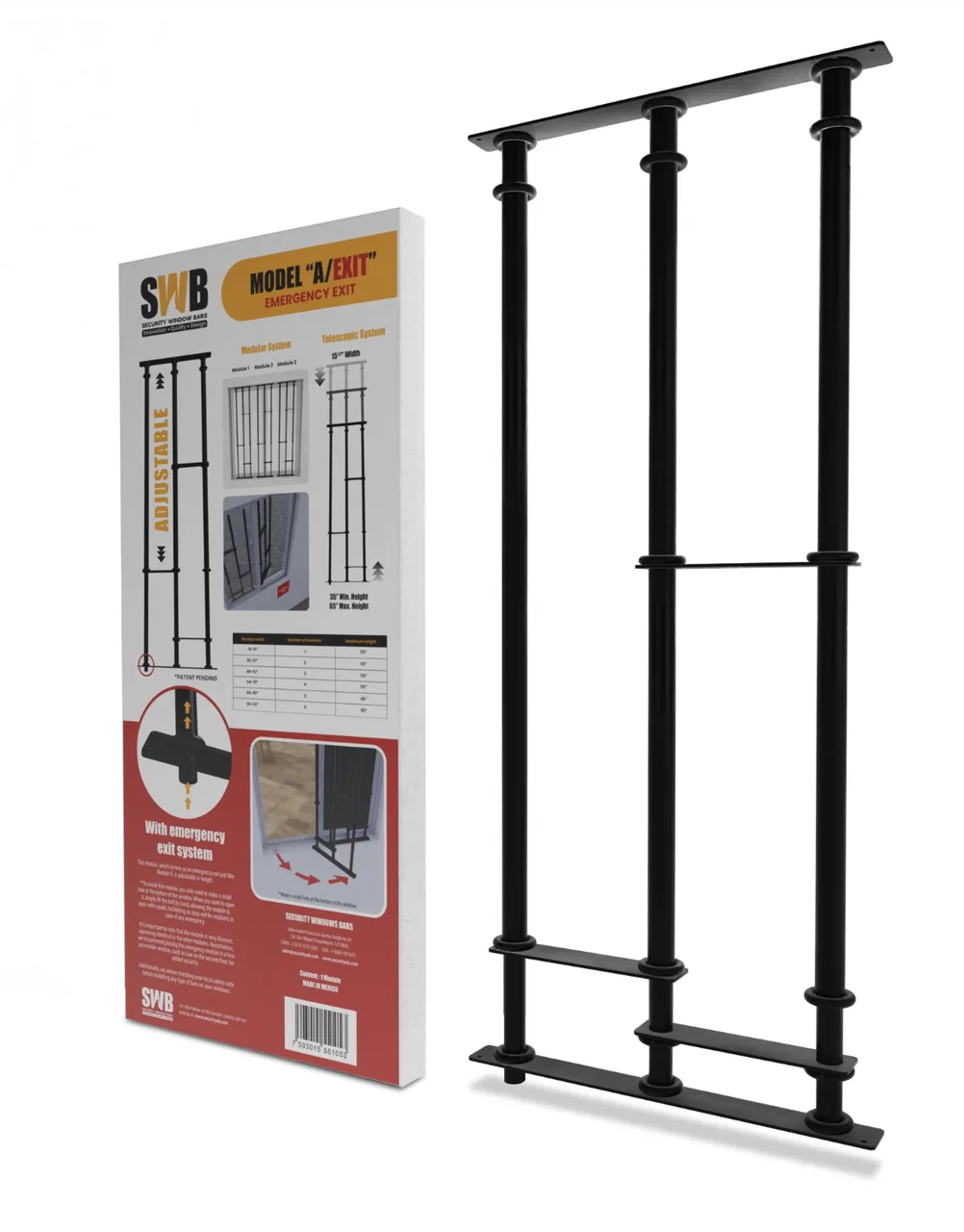
The Model A/EXIT is the most technically advanced product in the bars SW lineup and the only window security bar in SWB's catalog featuring a patented quick-release egress mechanism. Priced at $92, it combines the renter-friendly telescopic installation of Model A with a built-in emergency release that allows occupants to open the bar from the inside within seconds — without tools, keys, or special knowledge. This design directly addresses the most serious objection to window security bars: that they can trap occupants during a fire. The Model A/EXIT is designed to comply with the International Building Code (IBC), NFPA 101 Life Safety Code, OSHA standards, and the International Residential Code (IRC) requirement for emergency egress openings in sleeping areas — a minimum opening of 20 inches by 24 inches. For any property owner, building manager, or renter who installs window bars in a bedroom or sleeping area, the Model A/EXIT is not just a recommendation — in many U.S. jurisdictions, it is the only legally compliant option.
Understanding US Building Codes for Egress Windows
The International Residential Code (IRC) Section R310 mandates that every sleeping room in a residential dwelling must have at least one emergency escape and rescue opening. This opening must have a minimum net clear opening of 5.7 square feet (with a minimum height of 24 inches and minimum width of 20 inches) and must be operable from the inside without the use of a key, tool, or special knowledge or effort. Any window bar — permanent or telescopic — installed over a sleeping area window must not block or impede this egress requirement. Standard, non-egress window bars therefore violate building code when installed in bedrooms, even if installed for legitimate security reasons.
NFPA 101 and Life Safety Code Requirements
NFPA 101, the Life Safety Code used by fire marshals and building inspectors across the United States, mirrors the IRC egress requirement and extends it to include commercial sleeping occupancies such as hotels, dormitories, and assisted living facilities. Buildings in cities like Chicago, Houston, Atlanta, and Philadelphia that have undergone fire code inspections in recent years have increasingly cited non-egress window bars in sleeping areas as a violation. The SWB Model A/EXIT was designed specifically to eliminate this liability.OSHA Compliance for Commercial Applications
In commercial settings — ground-floor offices, storage rooms, or light manufacturing spaces where employees may work near window openings — OSHA 29 CFR 1910.36 requires that emergency exits not be blocked or obstructed. Model A/EXIT satisfies this requirement through its tool-free internal release mechanism, making it the appropriate choice for any workspace where window egress is part of the emergency exit plan.How the Patented Quick-Release Mechanism Works
The Model A/EXIT uses a patented lever-and-collar release system integrated into the center of the telescopic bar assembly. In standard security mode, the bar functions identically to Model A — providing full tension-based protection against forced window entry. In an emergency, a single downward press on the release lever disengages the tension collar, allowing the telescopic bar to compress and be removed from the window opening in under five seconds. The lever is positioned at ergonomic reach height for adults and is color-coded in high-visibility contrast to aid recognition during low-visibility emergency conditions. The mechanism is designed to function after years of normal use without lubrication or recalibration, a critical durability requirement for a life-safety product. Detailed operation instructions are included in the packaging and are also available online through the SWB installation guide.
Comparing All Three SWB Window Bar Models: A Side-by-Side Analysis
Choosing the right bars SW model requires understanding not just the price difference — which is negligible across all three models at $90, $91, and $92 respectively — but the fundamental differences in installation method, compliance status, and intended use environment. Each model serves a distinct buyer profile, and selecting the wrong model can result in building code violations, lease violations, or inadequate security for your specific window type. The following comparison is designed to give homeowners, renters, property managers, and real estate investors the clearest possible picture of which SWB model fits their situation. It draws on publicly available building code data, U.S. Census Bureau housing statistics, and FBI crime geography data to align product recommendations with real-world American security conditions.
Model A vs. Model A/EXIT: When Egress Compliance Is Non-Negotiable
The most common mistake buyers make in the bars SW category is purchasing a standard telescopic bar (Model A) for a bedroom window without recognizing the egress compliance requirement. If you are installing window bars in any room that is used as a sleeping area — including living rooms used as de facto bedrooms in studio apartments, a common configuration in New York City and San Francisco — the IRC and NFPA 101 technically require that the bar include an internal quick-release mechanism. Model A is the correct choice for kitchens, living rooms, basements used as storage, and commercial non-sleeping spaces. Model A/EXIT is the mandatory choice for bedrooms, sleeping areas, and any room that a building inspector or fire marshal could classify as a sleeping occupancy. Given that the price difference between the two models is only $2, there is no financial justification for choosing the non-compliant option when installing in a sleeping area.
Model B vs. Models A and A/EXIT: Permanent vs. Removable Security
Model B occupies a fundamentally different category from Models A and A/EXIT. While both A variants are designed around the concept of non-permanent, tenant-safe installation, Model B is engineered for permanent anchoring and is the appropriate solution for scenarios where the bar will remain in place indefinitely. Homeowners who own their property outright, property managers who want to install security bars as a permanent building feature, and commercial operators who need maximum forced-entry resistance should select Model B. It is important to note that a wall-mount permanent bar installed in a sleeping area still requires egress compliance under the IRC — meaning that if Model B is installed in a bedroom, a separate egress mechanism or egress window must be provided to satisfy code. Consult your local building department before installing any permanent window bar in a sleeping area. For all non-sleeping applications — ground-floor living rooms, basements, garages, commercial storefronts — Model B is the premium permanent security solution in the SWB lineup. Explore the full specifications for the wall-mount option at the Model B product page.
Steel Construction and Finish Quality: Why SWB Bars Outperform Cheaper Alternatives
Not all window security bars are created equal. The bars SW lineup from Security Window Bars is constructed from heavy-gauge steel — the same grade used in commercial security applications — as opposed to the thin-wall steel tubing, aluminum alloy, or plastic-reinforced composites found in cheaper competitor products. This distinction matters enormously in a forced-entry scenario. According to physical security research published by the Security Industry Association, the average residential window entry attempt lasts between 30 and 90 seconds before a burglar abandons the attempt due to time and noise exposure. The primary security function of a window bar is not to be impenetrable — it is to be sufficiently resistant to defeat the time-and-noise threshold. Heavy-gauge steel with a proper diameter cross-section exceeds this threshold with significant margin. Thin-wall or composite materials do not. Additionally, SWB's powder-coat matte black finish is applied electrostatically and cured at high temperature, producing a surface that resists rust, chipping, UV fading, and chemical attack — critical in humid coastal environments like Miami or Houston, or in high-UV climates like Phoenix or Las Vegas.
Powder-Coat Finish vs. Paint: Why the Difference Matters Long-Term
Many low-cost window bars sold on general marketplace platforms use liquid spray paint or dip-coat finishing rather than electrostatically applied powder coat. The practical difference is significant: spray-painted finishes begin to peel, chip, and rust within 12 to 24 months of outdoor or semi-outdoor exposure, particularly in high-humidity environments. Powder-coat finishes applied to SWB standards bond at a molecular level with the steel substrate, forming a finish that is 2 to 4 times thicker than conventional liquid paint and far more resistant to impact chipping, moisture infiltration, and ultraviolet degradation. For homeowners in coastal cities like Miami, Tampa, and New Orleans, or in freeze-thaw climate zones like Chicago and Detroit where temperature cycling accelerates coating failure, this is a meaningful long-term quality difference. SWB's matte black finish also avoids the reflective glare of glossy alternatives, producing a cleaner aesthetic that complements modern window frames in both residential and commercial settings.
Comparing SWB Steel Quality to Major Competitors
The U.S. window security bar market includes several established competitors: Mr. Goodbar by Pinpont Manufacturing, Grisham by Master Halco, Unique Home Designs, Guardian Angel, and Prime-Line Products. Each occupies a distinct position in the market, but all share one or more significant limitations compared to the bars SW lineup. Mr. Goodbar requires permanent drilling and is not suitable for renters. Grisham products are typically fixed-width and not adjustable to non-standard window sizes. Unique Home Designs products are available primarily through big-box retail chains with limited online availability and higher price points. Guardian Angel bars lack the patented quick-release egress mechanism found in SWB's Model A/EXIT. Prime-Line Products focuses primarily on individual hardware components rather than complete bar systems. SWB's combination of full-bar telescopic systems, adjustable sizing, egress compliance, and Amazon FBA availability creates a competitive profile that no single competitor fully matches across all four dimensions simultaneously. Learn more about Model A's adjustable telescopic system on the official product page.
Installation Overview: How to Set Up SWB Bars in Under 20 Minutes
One of the most significant barriers to window security adoption in the American rental market is the perception that installation requires professional assistance, specialized tools, or structural modifications. SWB has engineered its entire bars SW lineup to eliminate this barrier wherever possible. Model A and Model A/EXIT both install without drilling in the vast majority of standard residential window configurations, requiring only a measuring tape to confirm width compatibility and a simple clockwise rotation of the tension collar to secure the bar. The total installation time for a standard 28-inch window is approximately 15 to 20 minutes on a first-time installation. Model B, as a permanent wall-mount system, does require drilling, but the installation process is clearly documented in SWB's installation guide at securitywb.com/installation/, with step-by-step instructions covering all four major U.S. wall construction types. All three models ship directly from Amazon FBA fulfillment centers with complete hardware packages — no separate trips to the hardware store are required.
Step-by-Step: Installing Model A or A/EXIT in a Standard Apartment Window
The installation process for Model A and Model A/EXIT follows five steps. First, measure the interior width of the window opening from jamb to jamb at the height where you intend to position the bar — typically one-third to one-half of the way up the window from the sill. Second, check that the measurement falls within the 22-to-36-inch range covered by the SWB Model A. Third, compress the telescopic bar to its minimum width and position it horizontally across the window opening with the end caps resting lightly against both jambs. Fourth, rotate the tension collar clockwise until firm resistance is felt and the bar no longer moves laterally when pushed. Fifth, test the installation by applying firm lateral pressure at the center of the bar — it should not deflect more than a fraction of an inch. For Model A/EXIT, additionally test the quick-release lever to confirm smooth operation before considering the installation complete. The full illustrated guide is available at securitywb.com/installation/.
Common Installation Mistakes and How to Avoid Them
The most common installation error for telescopic bars SW products is under-tensioning the collar — rotating it until the bar feels snug rather than firmly seated. Under-tensioned bars can be dislodged by moderate lateral force and should not be considered secure. SWB recommends applying final tension until significant rotational resistance is felt in the collar, indicating that the end caps are generating meaningful compressive force against the window jambs. The second most common error is installing the bar on a window with non-parallel jambs — a condition found in some older homes in cities like Philadelphia and Boston where window frames have racked slightly due to foundation settling. In this case, the bar's end caps may not achieve full contact on both sides simultaneously. The Model B wall-mount solution is recommended for windows with non-parallel jambs, as the fixed brackets can be shimmed to achieve level installation. For more detailed guidance, visit the SWB contact page to speak directly with a product specialist.
Where to Buy SWB Bars SW: Amazon USA, securitywb.com, and swbstore.com
Security Window Bars products are available through three primary channels for American buyers: Amazon USA (seller: SecurityWindowBars), the brand's main website at securitywb.com, and the dedicated store at swbstore.com. Amazon FBA fulfillment ensures that buyers across all 50 states — from rural Montana to downtown Manhattan — receive their orders within the two-day Amazon Prime shipping window in most cases. The Amazon storefront also provides verified customer reviews, returns through the standard Amazon process, and the ability to purchase multiple units in a single transaction for landlords or property managers outfitting an entire building. Purchasing directly through securitywb.com offers access to the complete product catalog with full technical specifications, installation documentation, and direct customer support from the SWB team. The swbstore.com channel is optimized for bulk and wholesale orders, making it the preferred purchasing path for real estate investors, property management companies, and AirBnB hosts who need to outfit multiple units simultaneously. All three channels offer the same retail pricing: $90 for Model A, $91 for Model B, and $92 for Model A/EXIT.
Why Amazon FBA Makes SWB the Most Accessible Bars SW Brand in the USA
Amazon's Fulfilled by Amazon (FBA) program stores seller inventory in Amazon's own warehouse network and handles all pick, pack, and ship operations. For SWB buyers, this means the same fast, reliable delivery infrastructure that Amazon Prime members use for every other category is applied to their window security purchase. This is a meaningful competitive advantage over brands that ship direct from manufacturer or use third-party logistics companies with inconsistent delivery windows. For a renter in Houston who just moved into a ground-floor apartment and wants security bars installed before their first night in the new unit, or for a property manager in Los Angeles who needs six sets of bars delivered to a building by Friday, Amazon FBA's reliability is a genuine operational benefit. Search for the SecurityWindowBars seller page on Amazon, or navigate directly to the brand storefront to view all available models, current pricing, and shipping estimates for your zip code.
Bulk Buying for Landlords and Property Managers: What to Know
Landlords and property managers represent one of SWB's fastest-growing customer segments. A typical four-unit building in Detroit or Philadelphia might have 16 to 24 windows requiring security bars — a volume that represents a meaningful purchasing decision. At $90 to $92 per bar, outfitting 20 windows with SWB bars costs between $1,800 and $1,840, compared to $12,000 to $36,000 for professional installation of equivalent coverage. Beyond the cost advantage, the removability of Models A and A/EXIT means that bars can be repositioned or swapped between units during tenant turnover without any additional installation cost. For property managers who want to discuss volume pricing, project planning assistance, or installation logistics for large multi-unit buildings, the SWB team is accessible through the contact page at securitywb.com/contact/, where specialists can provide customized guidance based on property type, window count, and jurisdiction-specific code requirements.
🏆 Conclusion
Understanding the full bars SW product lineup from Security Window Bars is the foundation of any serious residential security strategy in the United States. With 6.7 million home burglaries occurring annually according to FBI data, and with 60% of forced entries targeting ground-floor windows, the question for American homeowners, renters, and property managers is not whether to install window security bars — it's which model to select for each specific application. SWB's three-model system answers that question with surgical precision: Model A for renter-friendly, no-drill protection; Model B for permanent, maximum-strength wall-mount security; and the patented Model A/EXIT for full egress compliance in sleeping areas. All three models are constructed from heavy-gauge steel with a durable powder-coat matte black finish, priced between $90 and $92, and available for fast delivery nationwide through Amazon FBA. The telescopic advantage of Models A and A/EXIT remains the most important innovation in the residential window security category — delivering the same protection as permanently welded bars without the lease violations, contractor costs, or fire safety compromises that have historically made window bars inaccessible to millions of American renters. Whether you're securing a basement apartment in Chicago, a ground-floor unit in Los Angeles, or a bedroom in a multi-family building in Atlanta, SWB has a code-compliant, affordable, and immediately available solution for your specific situation.
Security Window Bars · USA
Secure Your Home Today
Ready to protect your home with the right bars SW model? Security Window Bars ships fast across all 50 states via Amazon Prime. Shop All SWB Models on Amazon → | View Model A (Telescopic) → | View Model A/EXIT (Egress Compliant) → | View Model B (Wall-Mount) →
Shop on Amazon →Frequently Asked Questions
'Bars SW' is a shorthand search term for Security Window Bars, branded as SWB. The company offers three steel window bar models — Model A (Telescopic at $90), Model B (Wall-Mount at $91), and Model A/EXIT (Egress Compliant at $92). All three models are available for purchase through Amazon USA under the seller name SecurityWindowBars, as well as directly at securitywb.com and swbstore.com. Amazon FBA fulfillment ensures fast delivery to all 50 U.S. states, typically within two business days for Amazon Prime members.
SWB Model A and Model A/EXIT are designed to install without drilling in the vast majority of standard residential window configurations. They use a telescopic spring-tension mechanism that presses against the interior window jambs to hold the bar securely in place. This makes both models ideal for apartment renters who cannot make permanent modifications to their units under standard lease agreements. SWB Model B, the wall-mount variant, does require drilling and anchor bolt installation for permanent mounting. Full installation instructions for all three models are available at securitywb.com/installation/.
Installing window bars in bedrooms is legal in the United States, but the bars must comply with emergency egress requirements under the International Residential Code (IRC) Section R310 and NFPA 101. These codes require that any window bar installed in a sleeping area include an internal quick-release mechanism operable without a key, tool, or special knowledge. The SWB Model A/EXIT is specifically designed and patented to meet this requirement. Standard Model A bars without the egress release are not code-compliant for use in sleeping areas. Model A/EXIT is priced at $92 and is the correct choice for all bedroom window bar installations.
SWB bars are constructed from heavy-gauge steel — the same grade used in professional-grade commercial security applications. According to physical security research, the primary security function of a window bar is to exceed the time-and-noise threshold of approximately 30 to 90 seconds that most residential burglars will tolerate before abandoning an entry attempt. SWB's heavy-gauge steel construction and dual-tube telescopic design provide resistance well beyond this threshold. Professionally installed welded bars offer marginally higher absolute force resistance, but in real-world residential burglary scenarios, the security outcome is functionally equivalent at 85 to 94 percent lower cost than contractor installation.
Yes, SWB Model A and Model A/EXIT are specifically engineered for renters. Because both models install using spring tension without drilling, screwing, or modifying the window frame in any way, they do not constitute a permanent alteration to the rental property. The bars can be removed completely when moving out, leaving no marks, holes, or damage to the window frame or surrounding wall. However, renters should always review their specific lease agreement and — in jurisdictions like New York City where Local Law 57 governs window guard installation — consult local housing regulations to ensure full compliance with both the lease terms and applicable municipal codes.
SWB Model A and Model A/EXIT are calibrated to fit standard American residential window widths ranging from 22 to 36 inches, which covers the vast majority of single-hung and double-hung windows found in apartments, condominiums, and single-family homes across the United States. This size range was selected based on standard U.S. residential construction specifications as defined by the National Fenestration Rating Council and common window manufacturing dimensions. For windows outside this range — including very wide picture windows, commercial storefront windows, or custom architectural openings — the Model B Wall-Mount system can be configured to custom widths. Contact the SWB team at securitywb.com/contact/ for assistance with non-standard window dimensions.
SWB window bars are priced at $90 for Model A (Telescopic), $91 for Model B (Wall-Mount), and $92 for Model A/EXIT (Egress Compliant). A licensed residential security contractor in a major U.S. city typically charges between $600 and $1,800 per window for professional bar installation, according to HomeAdvisor's 2024 national cost data. That represents a cost reduction of 85 to 95 percent when choosing SWB bars as a DIY solution. For a homeowner in Chicago, Los Angeles, or Philadelphia outfitting five to eight windows, the total savings compared to professional installation can range from $2,500 to over $14,000 — with no meaningful compromise in actual security performance for standard residential applications.
Yes. SWB serves commercial property owners, landlords, real estate investors, and AirBnB hosts as a primary customer segment. All three models are available individually through Amazon USA and securitywb.com, and bulk purchasing is available through swbstore.com, which is optimized for wholesale and multi-unit orders. A property manager outfitting a 10-unit rental building can order all required bars in a single Amazon transaction with consolidated delivery. For large-scale projects requiring customized guidance on model selection, code compliance by jurisdiction, or volume pricing, the SWB team is available through the contact form at securitywb.com/contact/. Many landlords in high-crime cities like Detroit, Memphis, Houston, and Philadelphia use Model A as a standard move-in security upgrade that can be removed and reinstalled during tenant turnover at no additional cost.