
SWB vs Competitors – Security Window Bar Reviews
Honest Comparisons You Can Trust
At Security Window Bars (SWB), we strive to offer the best window security bars on the market. In this section, we compare our products with other available options and share real customer reviews from those who have experienced the quality and security of our solutions.
1. Comparison with Other Market Options
| Feature | SWB Security Bars | Generic Bars | Anti-Theft Films | Window Alarms |
|---|---|---|---|---|
| Material | Reinforced steel | Common iron | Multi-layer polyester | Electronic sensors |
| Durability | High | Medium | Low | System-dependent |
| Burglary Resistance | Very high | Medium | Low | Detection only, not prevention |
| DIY Installation | Easy | Varies | Very easy | Easy |
| Maintenance | Low | Medium | High | Requires battery or connection |
| Cost | Competitive | Low | Low | Medium |
SWB security bars stand out for their strength, ease of installation, and low maintenance compared to other market solutions. If you’re looking for a secure and long-lasting option, our bars are the best investment.
2. Customer Reviews

“Excellent security and design”
Carlos R. – Mexico City
“I bought SWB adjustable bars for my home, and I am very satisfied with the quality. They are sturdy, easy to install, and look great on my facade. I feel much safer since installing them.”
“Protection without compromising aesthetics”
Andrea M. – Los Angeles, California
“I was looking for a solution that wouldn’t affect my home’s aesthetics, and SWB bars were perfect. I love that they are adjustable and integrate well with my window design.”
“Easy installation and great durability”
Javier G. – Monterrey, Mexico
“I’m not a DIY expert, but I installed the bars in less than 30 minutes. They feel super firm and strong. Definitely worth the purchase.”
3. Real Cases: How SWB Prevented Break-Ins
We have received multiple testimonials from customers who have stopped intruders thanks to our security bars:
- Family in Houston, Texas: “Someone tried to break in through the back window, but the bars held up, and the police arrived in time.”
- Business in Guadalajara, Mexico: “After multiple break-in attempts in our area, we decided to install SWB bars. Since then, we haven’t had any more issues.”
- Apartment in New York: “Living on a lower floor, security was a concern. With SWB bars, we sleep much more peacefully.”
4. Conclusion: Why Choose SWB?
SWB security bars have proven to be a reliable and effective solution for protecting homes and businesses. With high-quality materials, functional designs, and easy installation, they are the best choice for those seeking hassle-free security.
If you want to see the difference for yourself, explore our store and choose the best option for your home.
2025 U.S. Window Security Market: Innovations, Codes, and What Buyers Actually Need
(A forward-looking industry brief for homeowners, builders, and property managers in the United States)
Editor’s note: This study focuses on market dynamics, buyer behavior, safety codes, innovation, and use-case design—not head-to-head brand comparisons. If you need brand-by-brand matchups, see your existing page, which serves that purpose. This one is a big-picture market view built to guide better decisions in 2025 and beyond.
Executive Summary (why this matters now)
The U.S. market for securing windows splits into two families of solutions:
- Mechanical bar/guard systems (steel, adjustable, quick-release options) commonly sold via Home Depot, Lowe’s, Amazon, Walmart and specialty shops; and
- Security screens (stainless mesh with pro installation), positioned as “invisible bars.”
Both categories are growing because burglary remains a risk (even as long-term crime trends decline), homeowners are cost-sensitive, and codes emphasize emergency egress in sleeping areas. Bars dominate on price, speed of install, visible deterrence, and portability; screens dominate on aesthetics and airflow at a far higher price point and with pro-install timelines. MoneyGeek.comIII
A key 2025 theme is adaptability: products that can scale to atypical sizes, work with AC units/screens/blinds, and satisfy egress in bedrooms. That’s why designs that combine telescopic height + modular width and integrated quick-release are winning attention—because they reduce SKU confusion and installation friction for real homes (not idealized openings). SecurityWBAmazon
Methodology (how this report was built)
- Primary sources: U.S. building-code references for egress (IRC R310, 2021/2015 excerpts & municipal tip sheets), insurance and burglary trend briefs (Triple-I, MoneyGeek, select research roundups), and retail product snapshots (Home Depot category pages; Amazon listings for representative SKUs). codes.iccsafe.org+1mybuildingpermit.comMoneyGeek.comIIIThe Home Depot
- Market scan: SecurityWB’s site to understand how SWB positions telescopic + modular + quick-release (A-EXIT) and install time/value; Amazon listing for Model A/Model B to validate feature language and adjustability ranges. SecurityWB+1Amazon
- Scope: United States only. Prices/availability vary by ZIP and retailer; entries here are illustrative not quotes.
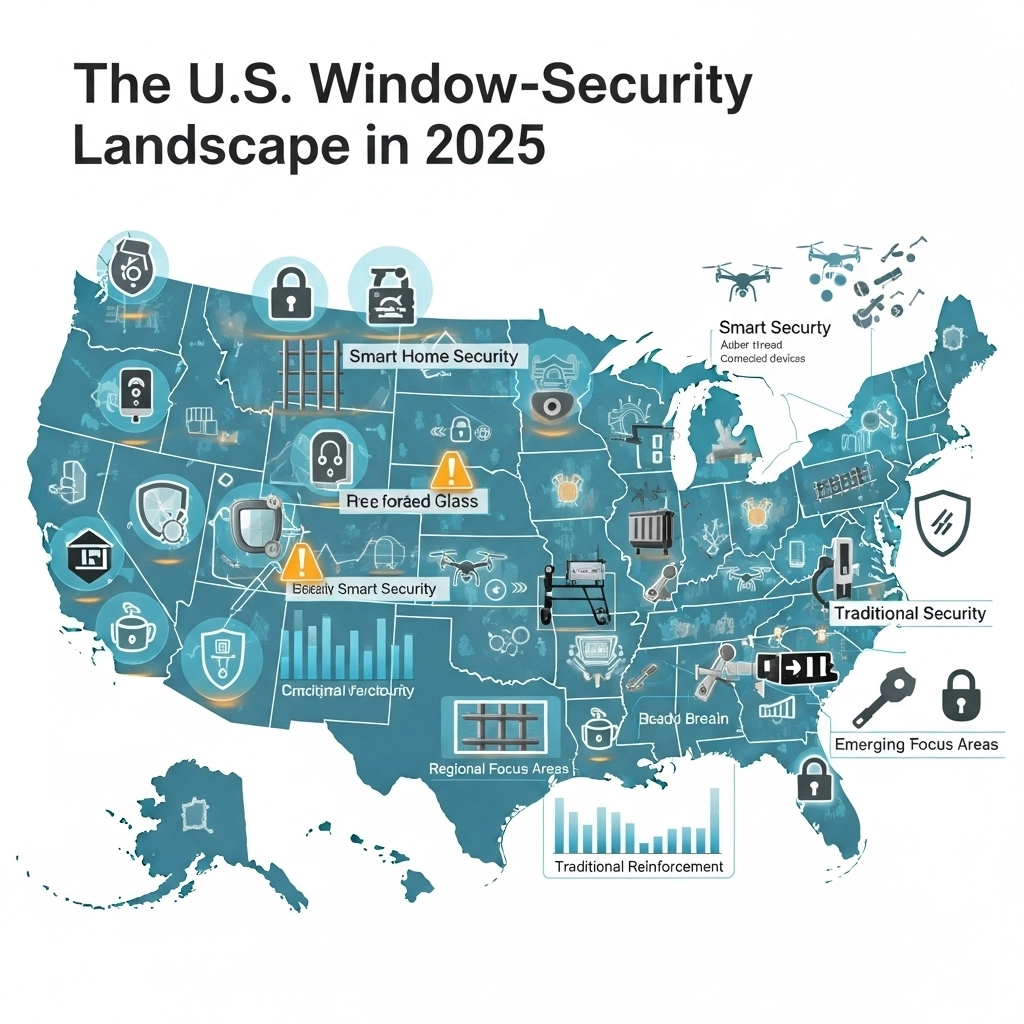
The U.S. Window-Security Landscape in 2025
Demand drivers (what keeps the category alive)
- Burglary is lower than a decade ago, but still significant. 2023 U.S. burglaries were roughly ~840k (preliminary reporting). Even with the downtrend, that’s a large absolute number and a persistent homeowner worry. MoneyGeek.com
- Seasonality & insurance context. Theft claims still rack up billions over time, with summer peaks historically noted; higher insurance premiums make mitigation (visible deterrence, layered security) an attractive move for many households. III+1
- DIY expectation. Consumers want solutions they can install today without a contractor—and relocate later when they move. That’s structurally favorable to bar/guard systems. SecurityWB
Codes drive design (egress rules you can’t ignore)
Residential code requires at least one operable emergency escape and rescue opening in sleeping rooms and certain basements/attics. Dimensions and clearance (e.g., minimum net clear opening ~5.7 sq ft, height/width minima, sill height limits) shape how any security device must behave: it either opens quickly from inside or it stays off the designated egress window. codes.iccsafe.org+1mybuildingpermit.com
Implication: If a solution can’t open from the inside without tools (or without a complicated sequence), it doesn’t belong on the only egress window in a bedroom. That’s why quick-release bars exist, and why some screen systems offer egress models (at higher price and with pro installation). codes.iccsafe.org
Product Taxonomy
(clear map of what’s on the shelf)
Bars & guards (mechanical)
- Fixed guards: steel, often sold in named sizes (e.g., 36×36) or limited adjustable width ranges; classic look; cheapest path to visible deterrence. Egress requires a separate release kit or a swing/hinge model. The Home Depot
- Swing-away/hinged bars: pivot open for cleaning/egress; costlier than fixed; still usually sold in width ranges, not true height telescoping. The Home Depot
- Quick-release kits: sold as add-ons by big-box brands; compliance hinges on correct installation and household training. The Home Depot
- Telescopic and/or modular systems: the newer approach—height telescoping plus width modularity to fit atypical openings with fewer SKUs and easier DIY planning. This is the design space where SWB operates. SecurityWBAmazon
Security screens (stainless mesh)
- Dealer-installed screen systems (Crimsafe/Boss/Vista/Titan/others): look like regular screens but resist cutting/prying and often include egress variants. They are premium priced and quote-based, appealing to homeowners who reject the “bar look.” III+1
Complements (layering)
- Sash locks/track stops, security film/laminated glass, smart sensors/cameras—useful in layers but none replace the physical barrier of a bar/guard or the egress-aware opening mechanism. (Retailers and insurers alike frame security as a layered strategy, not a single gadget.) III
Pricing Reality Check (2025, USA)
Bars: what people actually pay
- Big-box fixed or adjustable window guards range widely: as low as ~$50 for basic 3-bar panels up to $200–$270+ for wide swing-away models. (Examples visible on Home Depot category pages for Grisham, Unique Home Designs, Mr. Goodbar.) The Home Depot
- Quick-release kits can add $60–$95 per window if you need egress on a fixed guard. That add-on is often forgotten in early budgeting. The Home Depot
Security screens: a different budget tier
- Stainless-mesh systems are a pro-installed purchase with longer lead times; their marketing emphasizes strength + aesthetics and may cite testing (e.g., NCTL). Expect order-of-magnitude higher total cost than a DIY bar solution. III
Where SWB sits
- SWB core modules are listed at $114 on Amazon and $99 on the SecurityWB site (client-provided pricing; feature/fit language corroborated by product/brand pages). The value proposition centers on telescopic height, modular width, and DIY install in minutes, reducing the need to juggle multiple SKUs or separate release kits. AmazonSecurityWB
Innovation Themes You’ll See in 2025 (and what actually helps customers)
- Unified adjustability: A single family that covers height (telescopic) and width (modular) is simply easier for homeowners than buying a different SKU per opening. It also reduces retailer returns. (Bar SKUs at big-box stores still skew toward width-only adjustables.) The Home Depot
- Egress-first design: Instead of bolting a release kit onto a fixed guard, consumers want purpose-built quick-release bars—especially for bedrooms and basements—so the rules are clear and the panic action is simple. codes.iccsafe.org
- DIY speed & portability: “I can put it up today, take it down later, and take it with me when I move” is a powerful narrative against made-to-order screens. SecurityWB
- Finish & aesthetic range: Matte whites/blacks that disappear into frames; tamper covers that hide hardware; clean lines over ornamental shapes. (A quiet trend visible across 2025 retailer assortments.) The Home Depot
- Interoperability with smart security: Bars that don’t break your sensor setup (simple magnet repositioning, vibration-tolerant mounts) matter more as homes add IoT. (This is guidance rather than a SKU feature; still, it’s a real buyer question.) SecurityWB
How People Actually Buy
(personas & journeys)
Persona A: “The Parent” (nursery/child safety + egress)
- Trigger: new baby, toddler climbing, or a basement bedroom.
- Must-haves: quick-release for egress; tight bar spacing; simple operation teachable to older kids; no sharp ornaments.
- Likely path: Googles “window bars for kids,” lands on big-box child-fall guards, then learns about egress rules and seeks a security-grade bar with a native release. mybuildingpermit.com
Persona B: “The Ground-Floor Upgrader”
- Trigger: break-in on the block, insurance renewal, a new AC unit that keeps a window cracked.
- Must-haves: visible deterrence, DIY install tonight, works with window AC and blinds.
- Likely path: Starts at Home Depot for price checks, notices release kits add cost/complexity, looks for a single system with adjustability + release. The Home Depot
Persona C: “The Aesthetic-First Homeowner”
- Trigger: remodel; refuses “prison look.”
- Must-haves: clean lines, or invisible (security screen) with pro install; accepts higher budget.
- Likely path: Dealer quotes (Crimsafe/Boss/Vista/Titan), considers one or two egress units where required. III+1
Persona D: “The Property Manager/Retailer”
- Trigger: multiple units; consistent look; minimal downtime; code compliance.
- Must-haves: repeatable install, parts availability, scalability across different window sizes.
- Likely path: Chooses a modular bar system for most openings and reserves screens for premium units.
Where Bars Shine
(use-case playbooks)
Bedrooms & basements (egress required)
- Rule of thumb: either leave one window bar-free (and rely on other layers) or use a quick-release bar that opens from the inside.
- Design tip: practice a 30-second release monthly with household members; post a small “Pull to release” label near the handle. codes.iccsafe.org
Living rooms facing the street (visible deterrence)
- The psychology of seeing steel matters. A neat, color-matched bar can look intentional rather than punitive; pair with tamper covers. Retail pricing is typically modest compared to screens. The Home Depot
Basement windows near alleys (pry resistance + moisture)
- Consider tamper-resistant screws, powder-coated steel, and masonry anchors. Keep egress on at least one opening in the room. codes.iccsafe.org
Wide storefronts/offices (consistency across bays)
- Modular width is the star—link modules for long runs and keep the visual rhythm across the façade.
Rentals & HOAs (low-impact + aesthetics)
- Clear, minimalist bars help with approvals; the ability to relocate bars is a useful cost-saver for tenants.
Where Screens Shine
(and when they don’t)
Pros: almost invisible from the street, big airflow, strong cutting/prying resistance on premium lines, and dedicated egress models from top brands. Cons: price (much higher total project cost), dealer scheduling, and zero portability if you move. For some buyers (high-end remodels), those trade-offs are fine; for most, bars deliver a better balance of speed, budget, and flexibility. III+1
Retail Reality
(how assortments shape choices)
- Home Depot: robust assortment of fixed, adjustable width, and swing-away guards across Mr. Goodbar, Grisham, Unique Home Designs; release kits are separate and vary by model. Typical pricing ranges ~$50 to $270+. The Home Depot
- Amazon: a mix of true guards and tension rods/track stops (buyer beware). You’ll also find SWB listings that explicitly market telescopic + modular features and fast DIY install. Amazon+2Amazon+2
- Lowe’s/Walmart: narrower but overlapping sets; house brands and hardware kits (including release hardware) appear regularly. III
What “Good” Looks Like in 2025
(design checklist)
For any opening you care about, look for:
- Egress clarity (either quick-release or a separate window kept clear), explicitly aligned with IRC R310 intent. codes.iccsafe.org
- True adjustability in height (telescopic) and width (modular modules) to match the real window, not the catalog photo. Amazon
- DIY-proofing: hardware included, clear instructions, target install in minutes, not days. SecurityWB
- Finish longevity: powder-coat, corrosion awareness for coastal zip codes; tamper-resistant fasteners.
- Smart-home compatibility: doesn’t break your sensor plan (simple magnet repositioning).
SWB’s Role in the Market
(and why it’s different without doing a head-to-head)
SWB’s core move is to make one platform do what others split across product lines:
- Telescopic height (reaching unusually tall openings),
- Modular width (join modules across wide spans), and
- A dedicated A-EXIT quick-release option for egress-sensitive rooms.
That combination, paired with DIY in ~15–30 minutes, positions SWB squarely in the “do it tonight” economy while respecting code reality for sleeping areas. (Your site copy and Amazon listing both emphasize telescopic/modular flexibility and fast install.) SecurityWBAmazon
Price positioning is also strategic: $99 on site, $114 on Amazon (as you shared), slots below the swing-away segment at big-box stores—especially once buyers realize they’d otherwise need to add a release kit to hit egress. The Home Depot
Practical Playbooks
(how to spec the right solution)
Bedroom with one window (code-sensitive)
- Choose a quick-release bar (A-EXIT).
- Mount so the release is intuitive from bed height.
- Teach the motion and run a monthly eyes-closed 30-second drill. codes.iccsafe.org
Basement with two small casements
- Put A-EXIT on the designated egress opening; use a standard bar on the other for deterrence.
- Check window-well dimensions and sill height if you’re replacing windows later. Boman Kemp
Living room with window AC (double-hung)
- Use a bar that blocks sash lift—never the AC’s vents. Keep ¼–½ in gap from the AC case; confirm outward tilt for drainage.
Street-facing bay (very wide)
- Join two or more modules for a continuous, symmetric look.
- Add tamper covers; align bar lines across panes for visual order.
Rental with blinds & screens
- Go low-impact brackets and felt pads; verify blind clearance with low-profile hardware.
- Keep documentation/photos to simplify move-out.
Installation & Maintenance
(zero-nonsense)
Risk & ROI
(why the numbers pencil out)
Tools: tape, level, drill/driver, anchors, felt pads, optional blue threadlocker.
Process: dry-fit → mark → pilot → mount → seat → tighten → test (push-up on sash, rattle test, quick-release drill if applicable).
Aftercare: re-tighten at 48 hours and 1 month; seasonal check; coastal rinse. This is the routine that ends squeaks, keeps screws seated, and preserves finishes.
Even with burglary trending lower long-term, the absolute risk and insurance context make small investments in physical deterrence rational—especially when they port to your next home. Screens can add resale polish but are a far larger capital outlay; bars are a capex-lite way to shore up the most likely entry points right now. MoneyGeek.comIII
Future Outlook
(2025–2028)
What to Do Next
(buyer roadmap)
Expect three shifts:
- More hybrid SKUs (bar + quick-release in one box) as code awareness spreads through retail channels. The Home Depot
- Quieter aesthetics (flat profiles, matched finishes) even in value segments. The Home Depot
- Click-to-buy configurators (upload photos + measurements) that auto-generate module counts and egress reminders—this is where SWB’s modularity is ideal.
- Map your windows (width, height, room type).
- Tag egress windows in sleeping areas; decide A-EXIT vs “leave it free.” codes.iccsafe.org
- Choose finish & hardware (tamper covers where street-facing).
- Schedule a 30-minute install block per window; keep pads + threadlocker on hand.
- Run the 30-second drill monthly if you used quick-release.