

Pet Proof Window Security Bars: Steel Protection That Keeps Pets Safe and Burglars Out
Find the best pet proof window security bars for your home. Steel bars that stop break-ins and protect pets from falls. Shop SWB on Amazon — ships USA-wide.
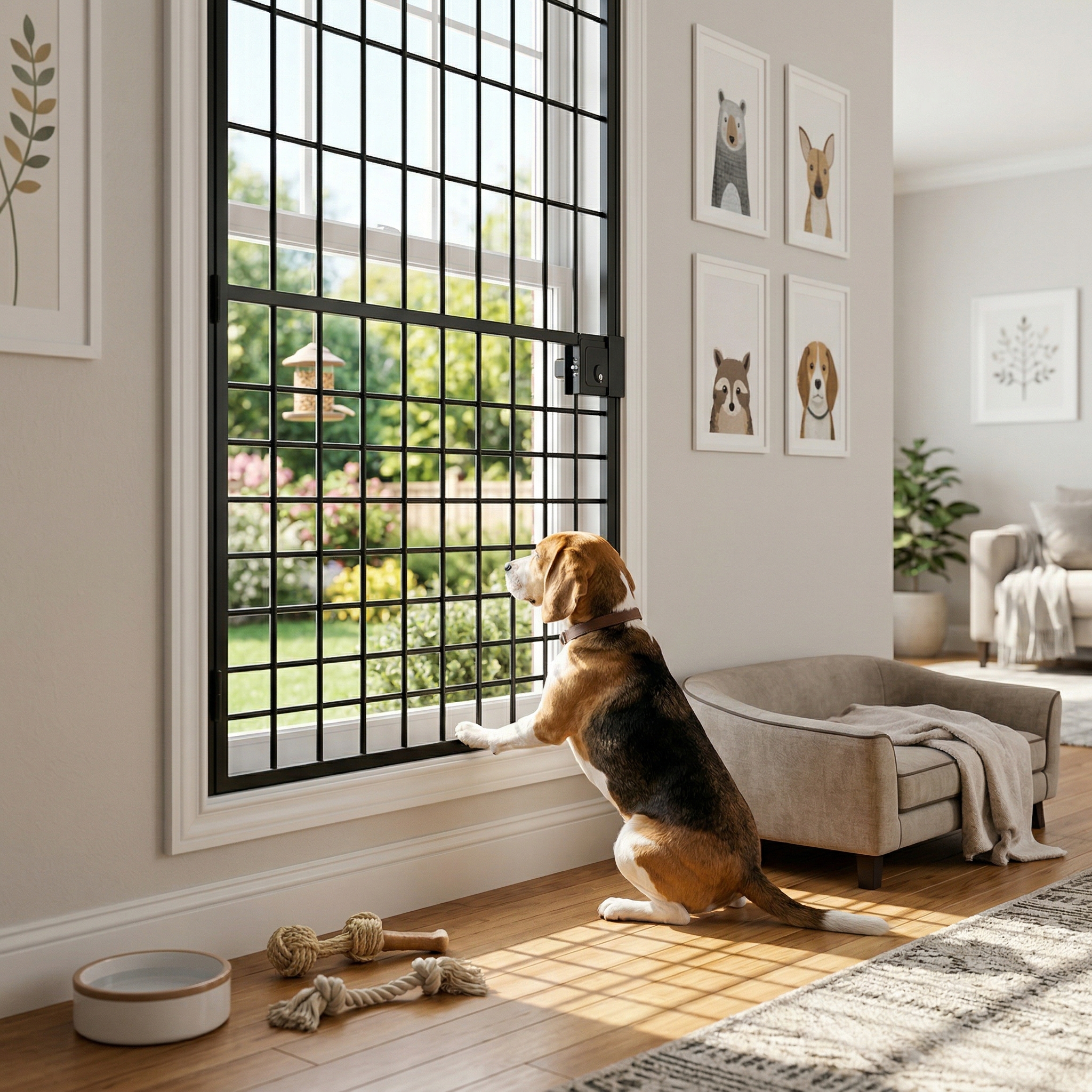
From our experience protecting thousands of homes across the USA, SWB analyzes the best strategies so you can sleep soundly — and so can your pets. If you share your home with a dog, cat, or any four-legged companion, pet proof window security bars are one of the most overlooked yet critical upgrades you can make to your living space. According to the American Veterinary Medical Association, there are approximately 184 million pets in US households, and a significant percentage of preventable pet injuries involve falls or escapes through unprotected windows. At the same time, the FBI reports over 6.7 million home burglaries annually in the United States, with 60% occurring through ground-floor windows and entry points. The right steel window bars solve both problems simultaneously — blocking unauthorized human entry while creating a physical barrier that prevents pets from pushing through screens or tumbling out of open windows. This guide covers everything you need to know about choosing, installing, and benefiting from pet proof window security bars in any American home or apartment.
Window screens are designed exclusively to keep insects out. They are constructed from lightweight mesh materials — typically fiberglass or aluminum — that cann…
Why Pet Owners Need Window Security Bars: The Hidden Dual Risk
Most homeowners think about window bars exclusively as a burglary deterrent. Pet owners, however, face a two-sided risk that makes window security bars not just useful but essential. On one side, you have the threat of forced entry — a real, documented danger. On the other side, you have the quieter but equally serious risk of a pet falling from or escaping through an open window. Understanding both risks is the first step toward making an informed purchasing decision that protects your entire household, human and animal alike. Across major US cities like Chicago, Los Angeles, New York City, and Houston, urban apartments often sit above street level with windows that stay open during warm months for ventilation. Without a physical barrier, a curious cat or an excitable dog can easily push through a window screen — screens are not safety devices and provide virtually zero resistance to an animal of even moderate size or weight.
The Window Screen Myth: Why Screens Don't Protect Pets
Window screens are designed exclusively to keep insects out. They are constructed from lightweight mesh materials — typically fiberglass or aluminum — that cannot bear the weight or force of a medium-sized dog or even a large domestic cat. The American Humane Society has documented countless incidents each year classified as "high-rise syndrome" in cats, referring to injuries sustained from falls out of open windows. Dogs face similar risks, particularly breeds prone to excitability that may lunge at passing stimuli like squirrels or cyclists visible from a window. In apartment buildings across NYC, where window guard requirements already exist for children under 10 (per NYC Local Law 57), the same physical logic applies to pets. A steel window bar creates a rigid, immovable grid that no screen can replicate.
How Pets Escape Through Open Windows
Cats are notorious for finding gaps in window frames, pushing past screens, or simply jumping toward an open ventilation gap. Dogs, especially terrier and sporting breeds, may scratch at screens until they give way or press their weight against them during moments of excitement. A pet proof window security bar installed on the interior of the frame eliminates these failure points entirely by replacing the soft mesh barrier with hardened steel.Burglary Risk for Pet Owners: An Underappreciated Vulnerability
Pet owners face a specific burglary vulnerability that non-pet owners may not consider: open windows. Because dogs and cats need fresh air — especially in apartments without central air conditioning — many pet owners leave ground-floor or first-floor windows partially or fully open for extended periods throughout the day. This habit, while perfectly reasonable for animal welfare, creates a routine entry point that experienced burglars in neighborhoods across Atlanta, Memphis, Philadelphia, and Detroit actively scout. An open ground-floor window without bars is essentially an unlocked door. Installing pet proof window security bars allows you to keep windows open for airflow and your pet's comfort without creating a security gap. The bars block human entry while allowing full ventilation — a combination that no alarm system or camera can replicate on its own.
What Makes Window Bars Truly Pet Proof: Bar Spacing, Steel Grade, and Design
Not every set of window bars qualifies as genuinely pet proof. The term encompasses a specific set of structural and dimensional requirements that ensure bars are effective for animal containment and fall prevention — in addition to their primary security function against forced entry. When shopping for pet proof window security bars, three criteria should drive your decision: bar spacing, steel construction grade, and whether the bars are installed on the interior or exterior of the window frame. Each factor directly impacts how effectively the bars serve as both a security system and a pet safety device.
Bar Spacing Requirements for Different Pet Sizes
Bar spacing — the distance between individual vertical or horizontal steel bars — is the most critical specification for pet safety. For small breeds of dogs and cats weighing under 15 pounds, bar spacing should not exceed 4 inches. This follows the same guideline used in child safety window guards, as recommended by the NYC Department of Housing Preservation and Development (HPD), which specifies openings no wider than 4 inches for fall prevention applications. For medium and large dogs, wider spacing may be acceptable from a pet safety standpoint, but tighter spacing is always preferable for burglary deterrence.
SWB Model Spacing and Pet Compatibility
The SWB Model A Telescopic Window Bars feature a vertical bar configuration specifically engineered to balance maximum ventilation with minimum gap size, making them suitable for households with cats and small-to-medium dogs. The Model A/EXIT Egress Compliant bars include the same configuration with the added benefit of a quick-release mechanism — critical for emergency egress in sleeping areas that also serve as pet spaces.Steel Grade and Construction: Why It Matters for Active Pets
A dog that regularly presses against a window bar — either from curiosity, play behavior, or territorial instinct — places repeated lateral and vertical stress on the bar system. Lightweight aluminum or thin-gauge decorative bars may bend or loosen over time under this kind of recurring pressure. Heavy-gauge steel construction, as used in all SWB models, is engineered to withstand consistent force without deformation. The matte black powder-coat finish on SWB bars also provides a surface that resists scratching damage from cat claws and dog nails, maintaining structural integrity and visual appearance simultaneously. This matters for property managers and landlords in multi-unit buildings who need solutions that endure tenant after tenant, pet after pet, without replacement or repair costs.
Interior vs. Exterior Installation for Pet Safety
Interior-mounted window bars are generally superior for pet safety applications because they create an inward-facing barrier that stops an animal from reaching the window opening entirely. Exterior-mounted bars, while effective for burglary deterrence, leave the interior window sill accessible to pets, meaning a cat or dog can still press against the glass or screen from inside. The SWB Model A Telescopic Window Bars are designed for interior installation, making them ideally suited for pet households. The telescopic mechanism allows them to be tension-fitted between window frame walls without drilling, which is especially valuable for renters in Chicago, Los Angeles, or NYC who cannot modify their rental property but still need effective pet and security protection.
SWB Pet Proof Window Security Bars: Model Comparison for Pet Households
Security Window Bars offers three distinct models, each with specific advantages for pet owners depending on their living situation, window type, and security requirements. Understanding the differences between Model A, Model B, and Model A/EXIT is essential for making the right purchasing decision for a household that includes animals. Below is a detailed breakdown of each model's pet-specific advantages, installation requirements, and ideal use cases.
Model A — Telescopic Window Bars ($90): Best for Renters with Pets
The SWB Model A is the flagship product for apartment renters who own pets and cannot or prefer not to make permanent modifications to their rental unit. The fully telescopic design adjusts to fit windows between 22 and 36 inches wide — covering the vast majority of standard US apartment window sizes — and installs using a tension-mount system that requires no drilling, no anchors, and no tools beyond what most households already own. Installation takes 15 to 20 minutes. For a renter in a Chicago third-floor apartment with a Maine Coon cat or a ground-floor New York City apartment with a Labrador Retriever, the Model A delivers steel-grade security and pet fall prevention without violating lease terms. When moving out, the bars remove cleanly and completely, leaving no trace of installation. At $90, this is dramatically more affordable than professional window bar installation, which typically costs between $600 and $1,800 per window across the USA. View the Model A Telescopic Window Bars at securitywb.com.
Model A/EXIT — Egress Compliant Window Bars ($92): Best for Bedrooms with Pets
Many pet owners allow dogs or cats to sleep in their bedrooms — making the bedroom window the most critical intersection of pet safety, personal security, and fire code compliance. The SWB Model A/EXIT addresses all three requirements simultaneously. Its patented quick-release mechanism allows the bars to be opened from the inside within seconds in a fire or emergency, complying fully with IBC Section 1031, NFPA 101 Life Safety Code, and IRC emergency egress requirements (minimum 20" × 24" opening in sleeping areas). For pet owners, this means that in a fire emergency, you can release the bars, open the window, and evacuate yourself and your pet without obstruction. No other product on the market combines telescopic installation, egress compliance, and pet-grade bar spacing in a single $92 unit. Learn more about the Model A/EXIT Egress Compliant Window Bars.
Model B — Wall-Mount Window Bars ($91): Best for Homeowners and Landlords
For homeowners with pets who want the maximum level of permanent security, the SWB Model B Wall-Mount Window Bars provide heavy-gauge steel construction with a fixed, wall-anchored installation. This model is particularly suited for ground-floor windows in homes located in high-crime neighborhoods, or for landlords managing properties where pet-owning tenants require permanent safety infrastructure. The powder-coated black finish matches modern home aesthetics and resists the environmental wear associated with exterior or semi-exterior installations. Property managers in Atlanta, Houston, or Philadelphia who manage ground-floor units occupied by tenants with large dogs will find the Model B provides a permanent solution that holds up under both daily animal contact and attempted forced entry. Explore the Model B Wall-Mount Window Bars at securitywb.com.
How to Install Pet Proof Window Security Bars: Step-by-Step for Pet Households
Installing window security bars in a home with pets requires a few additional considerations beyond the standard installation process. Animals are curious and may investigate the installation area, so preparation is important. The following steps are based on the SWB Model A Telescopic installation process, which is the most commonly used product in pet-owning households due to its no-drill, renter-friendly design. For detailed visual instructions, consult the full SWB Installation Guide.
Preparation Steps for Pet-Safe Installation
Before beginning installation, secure your pet in a separate room or area away from the installation site. Steel bars and telescopic adjustment components can be sharp at the contact points during fitting, and the last thing you want is a dog or cat investigating the process underfoot. Measure your window opening width at the widest point — the Model A accommodates 22" to 36" — and note whether you have a single-hung, double-hung, or casement window, as this affects placement depth within the frame. Clean the window frame contact points with a dry cloth to remove dust, which can affect the friction grip of the telescopic mount.
Tools Required for Model A Installation
The SWB Model A requires no power tools and no drilling. You will need a measuring tape, a pencil for marking alignment, and potentially a rubber mallet for final seating of the telescopic ends if your frame has a particularly narrow channel. Total installation time is 15 to 20 minutes for most standard US residential windows.Post-Installation Pet Safety Checks
Once the bars are installed, perform a series of pet-specific safety checks before reintroducing your animal to the room. First, apply firm lateral pressure to the center of the bar configuration — simulating the weight of a dog pressing against the bars — and confirm there is no flex, shift, or movement in the telescopic mount. Next, check all gaps between bars and between the outer bars and the window frame. Any gap wider than 4 inches should be addressed, either by adjusting bar positioning or selecting a different model. Finally, open the window to your normal ventilation level and verify that your pet cannot access the screen or window glass below the bars. For cats especially, this means checking the bottom gap between the lowest bar and the window sill. Review the complete installation guidance at the SWB Installation Guide to ensure optimal placement for both security and pet protection.
Pet Proof Window Security Bars and Building Code Compliance Across the USA
One of the most frequently misunderstood aspects of installing window bars in a pet household is the relationship between security, pet safety, and legal building code requirements. Across the United States, several overlapping regulatory frameworks govern what types of window bars are permissible in residential buildings, particularly in sleeping areas. Understanding these requirements ensures that your pet proof window security bar investment is also legally compliant — protecting you from liability as a homeowner, renter, or property manager.
NYC Window Guard Requirements and Pet-Owning Tenants
New York City's Local Law 57 requires landlords to install window guards in any apartment where a child under 10 years old resides, or in any apartment where a tenant requests them regardless of age. While this law specifically references child safety, the physical mechanism it mandates — a guard that prevents a 4-inch sphere from passing through the opening — is identical to what is required for effective pet fall prevention. NYC pet owners can therefore request window guards from their landlord under Local Law 57 provisions and reinforce those guards with additional SWB bars on the interior for enhanced burglary protection. Tenants in Upper Manhattan, the Bronx, Brooklyn, and Queens neighborhoods with both children and pets benefit from this dual-coverage approach.
IBC and NFPA 101 Egress Requirements in Bedrooms with Pets
The International Building Code (IBC) Section 1031 and NFPA 101 Life Safety Code both mandate that sleeping areas must have at least one operable egress window capable of providing a minimum 20" × 24" clear opening in the event of fire. This requirement applies to any room used for sleeping — including rooms shared with pets. Fixed, non-releasable bars on bedroom windows violate these codes in jurisdictions that have adopted IBC or NFPA 101 (which includes the majority of US states). The SWB Model A/EXIT Egress Compliant Window Bars are specifically engineered to meet these codes while maintaining full pet and security protection. The quick-release mechanism allows bars to be opened from the interior within seconds, satisfying egress requirements while functioning as a robust barrier during normal operation. Homeowners in California, Texas, Florida, Illinois, and New York — states with strict fire safety enforcement — should consider the Model A/EXIT the standard choice for all bedroom windows, regardless of pet status.
OSHA and Commercial Property Considerations
For small business owners or AirBnB hosts who allow pets in their rental spaces, OSHA general duty clause provisions related to window safety apply. Ensuring that windows cannot be opened beyond safe limits — and that pets left in the space cannot exit through windows unsupervised — is part of reasonable duty-of-care compliance. SWB bars installed on commercial properties with animal-friendly policies satisfy both physical security and welfare duty-of-care standards.Pet Proof Window Security Bars for Specific Living Situations Across the USA
The specific needs of pet-owning households vary dramatically based on living situation, geography, and the type of pet involved. A renter in a Chicago high-rise with two cats has fundamentally different requirements from a homeowner in suburban Houston with a German Shepherd, or a landlord in Los Angeles managing a ground-floor unit occupied by a tenant with a large dog. This section breaks down the most common living situations and identifies the optimal SWB solution for each.
Urban Apartment Renters with Cats in High-Rise Buildings
Cat falls from urban apartment windows are a well-documented veterinary emergency. The Cornell Feline Health Center notes that "high-rise syndrome" — the pattern of injuries sustained by cats falling from elevated windows — is one of the most common causes of traumatic injury in urban cats. In cities like Chicago, New York City, Boston, and San Francisco, where high-density residential buildings are the norm and open windows are a primary source of summer ventilation, pet proof window security bars are arguably more important for cat safety than for burglary deterrence on upper floors. The SWB Model A Telescopic Window Bars install without drilling, require no landlord permission, and are removable when moving — making them the definitive solution for the estimated 44.1 million apartment renters in the USA who share their homes with cats.
Ground-Floor Homeowners with Dogs in High-Crime Neighborhoods
For homeowners in Memphis, Detroit, Philadelphia, or Baltimore who own large dogs and live in ground-floor homes, the threat calculus is reversed: burglary deterrence is the primary concern, and pet containment is secondary but still relevant. A large dog that presses against a window with enthusiasm can gradually loosen improperly anchored bar systems, while also creating a false sense of security for the homeowner. The SWB Model B Wall-Mount Window Bars, with their heavy-gauge steel and permanent wall-anchor design, provide the most robust solution for this scenario. They withstand both repeated animal contact from the inside and forced entry attempts from the outside, delivering a dual-layer of protection that no alarm system or temporary barrier can match. At $91, the Model B is a fraction of the $600–$1,800 professional installation average, and ships directly from Amazon FBA with fast delivery to all 50 states.
AirBnB Hosts and Short-Term Rental Operators Allowing Pets
The short-term rental market has seen explosive growth in pet-friendly listings, with platforms reporting that pet-friendly properties command 20–30% higher nightly rates than non-pet-friendly equivalents in most US markets. However, allowing pets in a short-term rental without window security bars creates significant liability exposure. A guest's pet that falls from a window or escapes through an unbarred opening creates both a welfare incident and a potential negligence claim. Installing SWB Model A Telescopic Bars on all windows before listing as pet-friendly is a straightforward risk mitigation strategy. The telescopic design means no permanent modification to the property, and the professional matte black finish photographs well in listing images — potentially enhancing perceived security and value for prospective guests. Contact SWB at securitywb.com/contact/ to discuss bulk ordering for multi-property operators.
Comparing Pet Proof Window Security Bars: SWB vs. Competing Brands
The US market for window security bars includes several established brands with widely distributed products. For pet-owning households, the comparison extends beyond basic security metrics to include bar spacing, installation reversibility, and compliance with egress requirements. The following competitive analysis focuses specifically on factors that matter to pet owners making a purchasing decision.
SWB vs. Mr. Goodbar and Grisham for Pet Households
Mr. Goodbar (manufactured by Pinpont Manufacturing) and Grisham (a Master Halco brand) are the two most widely distributed window bar brands in US hardware and big-box retail chains. Both offer permanent, fixed-bar systems that require drilling and professional installation. For renters, this is an immediate disqualifying factor — neither brand offers a no-drill, removable option equivalent to the SWB Model A. For homeowners, both brands offer fixed systems, but neither offers a telescopic adjustment capability, meaning they must be custom-cut or fabricated for non-standard window sizes. SWB's telescopic system adjusts to any window between 22" and 36" wide without cutting or customization. For pet households specifically, neither Mr. Goodbar nor Grisham offer a quick-release egress mechanism equivalent to the SWB Model A/EXIT, which is the critical fire safety differentiator for bedrooms shared with pets.
SWB vs. Unique Home Designs and Amazon Generic Brands
Unique Home Designs offers decorative iron and aluminum window guards that prioritize aesthetics over structural security. While visually appealing, aluminum construction does not provide the same resistance to forced entry or repeated lateral pet pressure as heavy-gauge steel. Generic Amazon brands frequently use thin steel or aluminum tubing that may deform under consistent animal contact. SWB bars are constructed from heavy-gauge steel with a powder-coat finish specifically tested for both security and durability under real-world residential conditions. At $90–$92, SWB models are competitively priced against generic alternatives while delivering demonstrably superior construction. All three SWB models are available through Amazon FBA, ensuring fast, trackable delivery to all 50 states with the buyer protection and return policy that Amazon provides. Shop Security Window Bars on Amazon.
Maximizing the ROI of Pet Proof Window Security Bars: Property Value and Insurance Considerations
For property managers, real estate investors, and AirBnB hosts, pet proof window security bars represent a documented return on investment that extends well beyond the initial purchase price. The financial case for installing window bars in pet-friendly residential properties intersects property value, insurance premium reduction, liability mitigation, and tenant retention — all of which have measurable financial outcomes in the US real estate market.
How Window Bars Affect Homeowner's Insurance Premiums
Many homeowner's and renter's insurance providers in the USA offer documented discounts for security upgrades, including window bars. According to the Insurance Information Institute (III), physical security improvements can reduce homeowner's insurance premiums by 5–20% depending on the insurer and the level of security implemented. For a household paying an average US homeowner's insurance premium of approximately $1,400 per year, a 10% discount represents $140 in annual savings — meaning a $90–$92 SWB window bar pays for itself in under one year through premium reduction alone, before accounting for any prevented burglary losses. Pet owners should contact their insurer directly to ask about credits for installed window bars, particularly on ground-floor and accessible windows.
Documentation for Insurance Purposes
When submitting a security upgrade for insurance review, maintain purchase receipts, installation photographs, and product specification sheets. SWB provides product documentation on request through securitywb.com/contact/, which can be submitted to insurers as part of a security upgrade claim.Tenant Retention and Property Value for Landlords Allowing Pets
Landlords who market pet-friendly units in cities like Dallas, Denver, Seattle, and Miami face strong competition for quality tenants. Pet-owning renters — particularly those with dogs — consistently report window security as a top priority when evaluating apartment safety for their animals. A landlord who installs SWB window bars in ground-floor or accessible units before listing them as pet-friendly can justify higher monthly rents, reduce vacancy periods, and attract longer-term tenants who prioritize security for their pets and families. The SWB Model A Telescopic Bars are easily removable between tenancies, allowing landlords to reuse bars across units without permanent infrastructure costs. At $90–$91 per unit, equipping a 10-unit ground-floor property with window bars represents a total investment under $1,000 — a negligible figure compared to the vacancy cost of a single empty unit for one month in any major US metro area.
🏆 Conclusion
Pet proof window security bars occupy a unique and underserved niche in the American home security market — products that must simultaneously protect against burglary, prevent pet falls, satisfy building code requirements, and work in renter-friendly installation conditions. Security Window Bars addresses all four of these requirements with a focused product lineup starting at just $90. Whether you are a renter in a Chicago apartment with two cats, a homeowner in Houston with a German Shepherd, or a property manager overseeing a pet-friendly building in Los Angeles, there is a specific SWB model engineered for your situation. The Model A Telescopic delivers renter-grade flexibility. The Model B Wall-Mount delivers permanent homeowner-grade strength. The Model A/EXIT delivers the egress compliance that bedrooms with pets demand by law. All three models ship directly via Amazon FBA for fast delivery across all 50 states, with the price point and availability that makes professional-grade security accessible to every American household. Protecting your home and your pets does not require a $1,500 contractor invoice or a signed lease waiver. It requires the right steel bars, installed in 20 minutes, backed by a brand that understands residential security at a structural level.
Security Window Bars · USA
Secure Your Home Today
Ready to protect your home and your pets with professional-grade steel security? Security Window Bars ships fast across the USA via Amazon. Shop All SWB Models on Amazon → or visit securitywb.com to compare Model A, Model B, and Model A/EXIT and find the perfect pet proof window security bar for your home.
Shop on Amazon →Frequently Asked Questions
Pet proof window security bars are steel window bars specifically evaluated for bar spacing, structural integrity under repeated animal contact, and interior mounting configuration that prevents pets from reaching open window areas. Standard window bars are designed exclusively to deter human forced entry and may not account for the gap sizes, lateral pressure from animals, or interior placement needed to keep pets from accessing open windows. SWB models are engineered with these additional considerations, making them effective for both burglary deterrence and pet fall prevention simultaneously.
Yes, if installed correctly with appropriate bar spacing. Window screens provide zero structural resistance to a cat's weight and will not prevent falls. Steel window bars with gaps no wider than 4 inches — the standard used in NYC child window guard regulations — create a physical barrier that cats cannot push through or jump past. SWB Model A Telescopic bars installed on the interior of the window frame eliminate the cat's access to the window opening entirely, preventing falls regardless of window ventilation level. This is the same protective principle applied in child fall prevention, and it works equally well for feline household members.
The SWB Model A Telescopic Window Bars require no drilling and are specifically designed for apartment renters who cannot modify their rental property. The telescopic tension-mount system fits windows between 22 and 36 inches wide using friction and pressure against the window frame — no anchors, no screws, no permanent damage. Installation takes 15 to 20 minutes, and the bars remove cleanly when you move out. This makes them ideal for the 44.1 million apartment renters in the USA who need pet safety and burglary protection without violating their lease agreement.
Fixed, non-releasable window bars in sleeping areas violate the International Building Code (IBC) Section 1031 and NFPA 101 Life Safety Code in most US jurisdictions, regardless of whether a pet sleeps in the room. The bedroom egress requirement mandates a minimum clear opening of 20" × 24" accessible from the interior in emergencies. For bedrooms shared with pets, the SWB Model A/EXIT Egress Compliant Window Bars are the correct solution — they include a patented quick-release mechanism that opens from the inside in seconds, satisfying egress requirements while maintaining full security and pet protection during normal operation.
For cats and small dogs under 15 pounds, bar spacing should not exceed 4 inches — the same specification used in NYC HPD child window guard regulations and widely adopted as the standard for fall prevention applications. For medium to large dogs, gaps up to 6 inches may be acceptable for containment purposes, but tighter spacing is always preferable for burglary deterrence. When in doubt, select bars with 4-inch maximum spacing to protect both small animals and large ones from accessing open window areas, and to maximize the deterrent effect against forced entry attempts.
Absolutely. While ground-floor window bars serve a primarily anti-burglary function, second and third floor installations are entirely about pet and child fall prevention — and they are just as important. The Cornell Feline Health Center documents "high-rise syndrome" as one of the most common causes of traumatic injury in urban cats, with falls from second, third, and fourth floor windows being particularly dangerous because they occur at a height that prevents the righting reflex from fully engaging. SWB Model A Telescopic bars install on windows at any floor level and provide the same rigid steel protection regardless of height.
SWB pet proof window security bars range from $90 to $92 depending on model, and ship via Amazon FBA with fast nationwide delivery. Professional window bar installation by a licensed contractor in the USA typically costs between $600 and $1,800 per window, depending on location, window size, and bar style. This means a single SWB bar — which installs in 15 to 20 minutes without tools — costs 85–95% less than professional installation while delivering equivalent steel-grade security. For a household with 4 windows requiring protection, SWB bars total $360–$368 versus $2,400–$7,200 for professional installation across the same windows.
Many US insurance providers offer premium discounts for documented physical security improvements, including window bars. According to the Insurance Information Institute (III), security upgrades can reduce homeowner's insurance premiums by 5 to 20 percent depending on the provider and scope of improvements. For a policy with an average US annual premium of $1,400, a 10% discount saves $140 per year — meaning a $90 SWB window bar pays for itself in under one year through insurance savings alone. Contact your insurance provider directly to ask about credits for installed window bars, and request documentation from SWB through securitywb.com/contact/ to support your premium reduction application.