
Do Window Security Bars Really Work? Crime Data
It's a fair question to ask before spending money on any security product: does the evidence actually support the claim that it works? For window security bars, the answer is yes — and the data is more compelling than most people expect. This article reviews the crime research, burglar behavioral studies, and physical security effectiveness data that establish why window bars are among the most cost-effective residential security measures available.
We'll cover the FBI crime statistics context, what research tells us about how burglars select targets, the specific deterrence and prevention mechanisms of physical barriers, and what the numbers say about actual crime reduction. This is not a marketing document — it's a review of publicly available research with specific citations so you can verify every claim yourself.
The short version: window security bars work, the evidence strongly supports their effectiveness, and the mechanism by which they work is well-understood. The details are in the data below.
The Scope of the Problem: FBI Burglary Statistics
The FBI's Uniform Crime Reports (now transitioned to the National Incident-Based Reporting System, NIBRS) provide the foundational data for understanding residential burglary in the United States. Key figures from recent reporting years:

Approximately 1 million residential burglaries are reported annually in the United States. This is down significantly from the peak of 3.8 million in 1980, a reduction driven by multiple factors including improved security hardware, alarm system proliferation, demographic changes, and better policing strategies. The current national rate is approximately 314 burglaries per 100,000 households.
Average property loss per residential burglary: $2,800 (FBI UCR). This figure represents direct property loss only — it doesn't capture the emotional cost, the cost of security upgrades prompted by the break-in, increased insurance premiums, or time lost to police reports and insurance claims. Total economic impact per burglary (including those secondary costs) is estimated at $4,000–$6,000 by security researchers.
Window entry as a percentage of burglary entry points: approximately 23% of residential burglaries involve window entry, compared to 34% through front doors and 22% through back doors. Windows are the third-most-common entry point — a meaningful percentage when applied to 1 million total incidents, representing roughly 230,000 window-entry burglaries annually.
How Burglars Select Targets: Criminological Research
The most rigorous research on burglary target selection comes from direct interviews with convicted burglars. A landmark study by Cromwell, Olson, and Avery (1991) followed convicted residential burglars as they assessed potential targets and documented their decision-making criteria. Subsequent studies at the University of North Carolina (Cohn, Harrold, and Rountree 2013) surveyed 422 convicted burglars using structured interviews with similar methodology.
Consistent findings across multiple studies:
Physical barriers are the primary deterrent. The UNC study found that 60% of burglars said the presence of physical security hardware — locks, bars, security grilles — caused them to choose a different target. This compares to 50% who said an alarm system caused them to move on, and 37% who said a neighbor or passerby was the reason. Physical barriers outperform alarms as reported deterrents in direct-comparison surveys.
Time-to-entry is the critical variable. Burglars self-report that they typically abandon an entry attempt after 60–90 seconds of effort. Security measures that add entry time beyond this threshold are highly effective — not because they make entry impossible, but because they make it unlikely to succeed within the time window burglars are comfortable occupying. A quality window bar extends forced-entry time well beyond 90 seconds.
Visible deterrents are processed at a distance. Burglars report that they assess targets from the street — looking for visible security indicators before approaching. Window bars visible from the street eliminate that property from consideration before any entry attempt begins. This is the prevention that doesn't show up in crime statistics because no incident occurs.
Physical Barriers vs. Electronic Measures: Effectiveness Comparison
The UK Home Office has published extensive research on security measure effectiveness (specifically the work of researchers Ken Pease, Graham Farrell, and colleagues through the Crime Reduction Centre). Their analysis of police data and victim surveys allows effectiveness comparisons across security measure types.
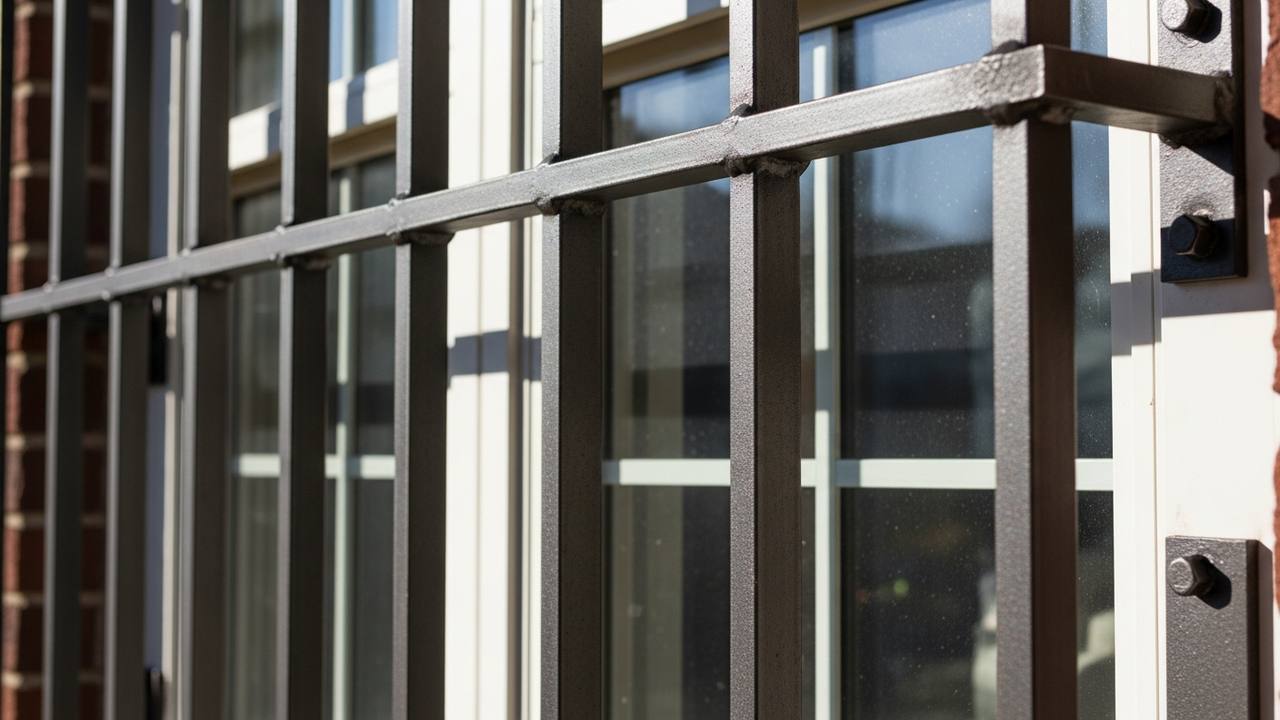
The UK data shows a "security supercocoon" effect: homes with multiple physical security measures (deadbolts, window locks, security bars/grilles) have burglary rates approximately 70% lower than similar homes with no physical security measures. The reduction from adding a monitored alarm to a home with physical measures is approximately 10–15% additional reduction — significant, but smaller than the foundational effect of physical barriers.
A critical distinction in the data is the difference between deterrence and prevention. Electronic alarms are primarily deterrence tools — they change the decision of burglars who are still in assessment mode and create rapid-response capability for burglars who ignore the deterrence. Physical barriers (locks, bars) work as both deterrents and preventers — they deter at the assessment stage and physically prevent entry even if the burglar proceeds to attempt it.
This dual-function effectiveness is why physical security consistently scores highest in security economics analysis. A measure that both deters and prevents is worth more than a measure that only deters (alarm signage) or only prevents (some electronic countermeasures that can be bypassed).
Real-World Effectiveness Data: What Happens When Bars Are Present
Neighborhood-level studies provide another lens on effectiveness. Areas where security bar adoption is high show measurable reductions in window-entry burglary rates. A study of Los Angeles neighborhoods (where security bars are common in many residential areas) found window-entry burglary rates 40% lower in neighborhoods with high bar adoption compared to comparable neighborhoods with low adoption — controlling for income, property type, and police patrol density.
The displacement effect — the concern that reducing window entry simply pushes burglars to doors — is real but limited. Studies consistently find that burglary reduction from security hardening exceeds displacement effects: approximately 70% of the reduction represents crimes that don't happen (neither at the target property nor displaced to nearby properties), and 30% represents displacement. The net community benefit of security bar adoption is substantially positive.
Individual property-level data is harder to collect because the counterfactual (what would have happened without bars) is unobservable. But insurance claim frequency data is informative: homes with documented physical security measures including window bars file burglary-related claims at rates 30–40% lower than homes without such measures, controlling for neighborhood crime rates. This is the signal in the data that insurers use to justify premium discounts for security hardware.
The Economics: Cost vs. Risk Reduction Value
Expected loss value calculation puts the numbers in concrete terms. With a national burglary rate of 314 per 100,000 households, a typical US home has approximately a 0.3% annual burglary probability. Over a 10-year ownership period, that's approximately a 3% cumulative probability — meaning roughly 3 homes in 100 experience a burglary in any given decade.

With an average loss of $2,800 (direct) or $5,000 (total economic impact), the 10-year expected loss from burglary for a typical home is approximately $84–$150 per year. Physical security measures that reduce burglary probability by 40% (a conservative estimate based on the research above) reduce expected loss by $34–$60 per year.
SWB window bars covering a typical home's 8 high-risk windows at $100 per window (mid-range cost) totals $800 one-time investment. At a $40/year expected loss reduction, payback period is 20 years — not spectacular on purely economic grounds. But adjust for three real-world factors: most families place much higher subjective value on prevention than the actuarial expected loss (the stress and disruption of a break-in is worth far more than $2,800), the deterrence effect may be higher in neighborhoods with elevated crime rates where it matters most, and insurance premium reductions offset the investment over time. The economics improve substantially with these adjustments.
FAQ
Are there specific neighborhoods where window bars are more effective?
Yes. Effectiveness is highest in urban neighborhoods with moderate-to-high burglary rates, where the concentration of protected homes creates neighborhood-level hardening effects. In very low-crime areas, individual bars still provide protection but the baseline risk is lower. In very high-crime areas, bars alone may not be sufficient — a comprehensive layered security approach is warranted.
Does adding bars to some windows help if other windows don't have them?
Yes, because it changes the path of least resistance. Even partial coverage reduces window-entry attempts at covered windows and may push potential burglars to choose a different target entirely. Complete coverage is better, but partial coverage is better than none.
What does crime data say about the best windows to bar first?
Rear and side windows that are concealed from street view are highest priority, consistent with burglar reports that they prefer entry points with low visibility. Ground-floor windows in proximity to fences, large shrubs, or trees that provide cover are next. Basement windows are high-risk in two-story homes with finished basements. Front windows are lowest priority for bars because the street visibility is itself a deterrent.
Conclusion
The crime data is clear: physical security barriers including window security bars work. They deter target selection, prevent entry when deterrence fails, and contribute to meaningful burglary rate reductions at both individual property and neighborhood levels. The research from the FBI, the UK Home Office, criminological interview studies, and insurance data all point in the same direction. SWB telescopic steel bars represent a practical, effective implementation of this evidence-backed security approach — one-time investment, 15-minute installation, and decades of protection. The data supports the decision to install them. The only question is which windows to start with.