Window Security Bars and Insurance Discounts: The Complete 2026 Savings Guide
Most homeowners have no idea that installing window security bars can earn them a home insurance discount. Major carriers across the United States offer "protective device" credits for physical security upgrades, and steel window bars are one of the most reliable ways to qualify. In this guide, we break down exactly how much you can save, which insurers offer the discount, how to document your installation for maximum credit, and why the ROI on security bars often pays back the full investment within two to four years.
Home insurance premiums have climbed sharply over the past several years. According to the National Association of Insurance Commissioners, the average American homeowner now pays more than $2,000 per year for coverage. When premiums keep climbing, smart homeowners look for every available discount. Physical security upgrades -- deadbolts, reinforced doors, alarm systems, and window security bars -- are among the most overlooked ways to lower your annual bill.
This is not theoretical. Insurers build their pricing models around risk. If your home is harder to break into, the probability of a burglary claim drops. That reduced risk translates directly into lower premiums. Window bars are especially effective because they address the number-one residential entry point for burglars: ground-floor and basement windows.
How Home Insurance Discounts for Security Devices Work
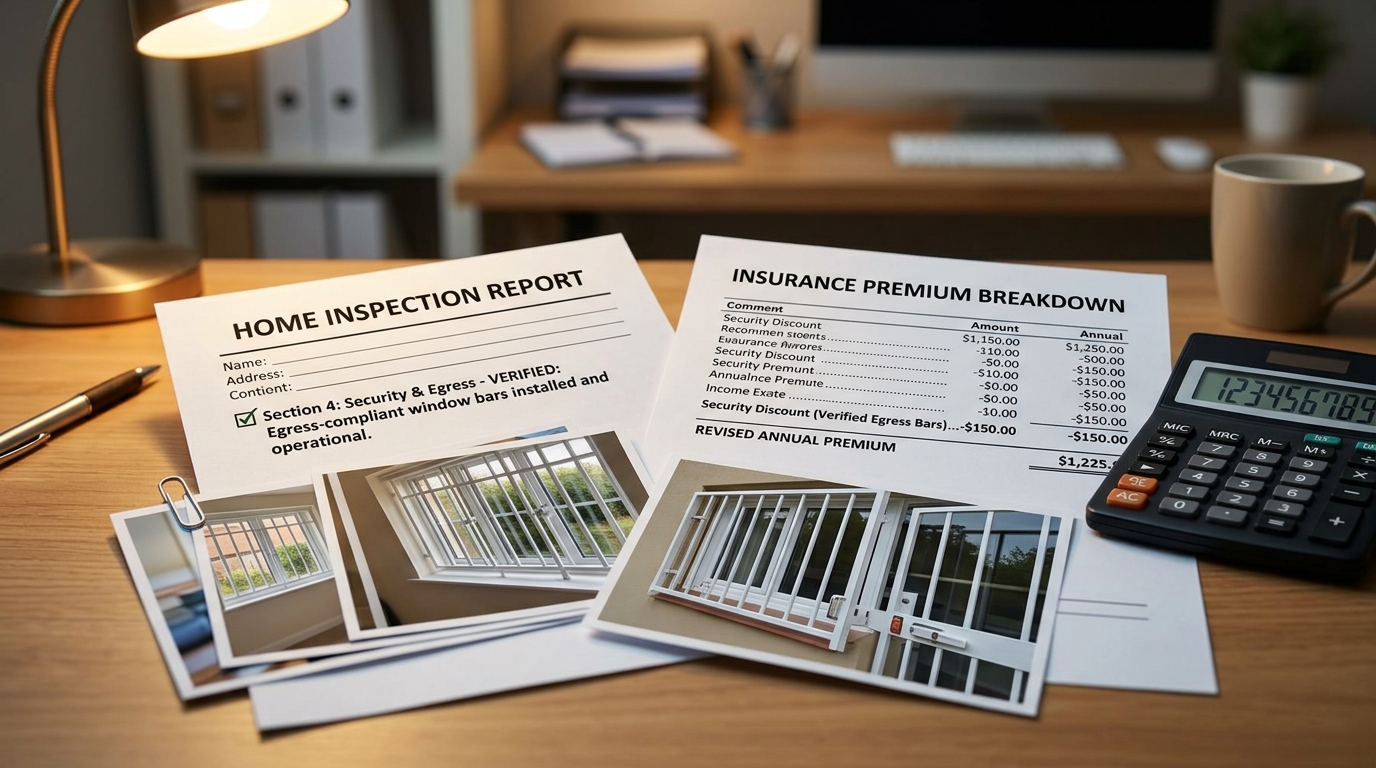
Home insurance companies use a category called "protective device discounts" (sometimes called "loss prevention credits" or "risk mitigation discounts") to reward homeowners who take proactive steps to reduce the chance of a covered loss. These discounts exist because the math works in the insurer's favor: a home with physical security barriers files fewer burglary claims, which means the insurer pays out less over time.
Protective device discounts typically fall into three tiers:
- Basic tier (2-5% discount): Deadbolt locks on all exterior doors, smoke detectors on every floor, fire extinguishers in the kitchen and garage.
- Intermediate tier (5-10% discount): Monitored burglar alarm system, security cameras with recording capability, reinforced entry points including window bars or security film.
- Advanced tier (10-20% discount): Central-station monitored alarm with police/fire dispatch, physical barriers on all accessible windows, smart home integration with leak/fire/intrusion sensors, and full perimeter hardening.
Window security bars fall squarely into the intermediate tier on their own, and they can push you into the advanced tier when combined with an alarm system. The key insight is that physical barriers carry more weight with underwriters than electronic-only systems. An alarm detects a break-in after it starts. Window bars prevent the break-in from happening at all.
Why Physical Barriers Get Preferential Treatment
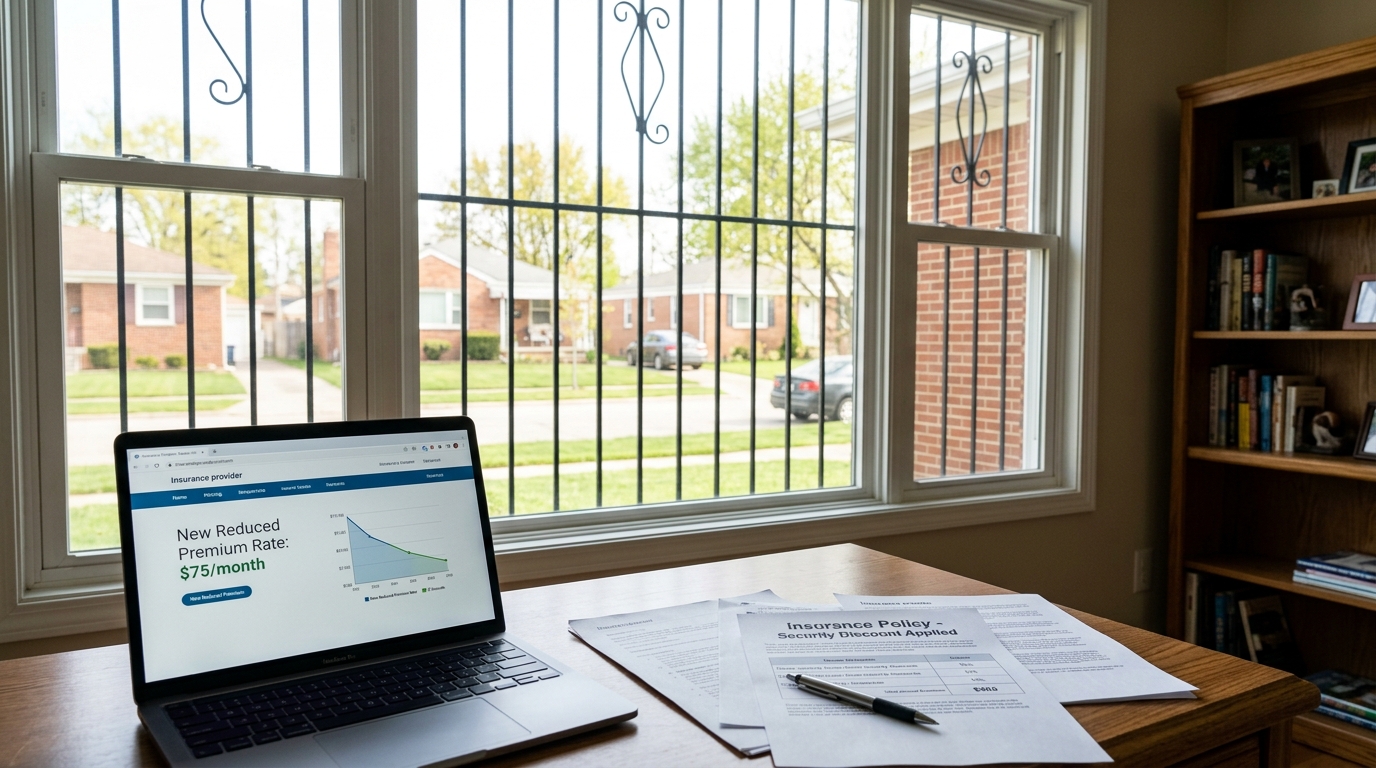
Insurance underwriters assess risk based on probability and severity. A monitored alarm reduces the severity of a burglary (faster response means fewer items stolen), but it does nothing to reduce the probability of the break-in itself. Physical barriers like steel window bars reduce both the probability and the severity, which is why many carriers weight them more heavily in their discount calculations.
This distinction matters when you're comparing costs. A monthly alarm monitoring subscription ($30-$60/month, or $360-$720/year) earns a similar discount percentage to a one-time window bar investment. But the alarm has ongoing costs forever, while window bars are a fixed, one-time expense. For the full breakdown of what window security bars cost in 2026, see our pricing guide.
Which Insurance Companies Offer Window Bar Discounts

Not every insurer advertises this discount on their website, but most major carriers include physical security upgrades in their protective device discount programs. Here is what we know based on publicly available information from major U.S. carriers:
| Insurance Company | Protective Device Discount Available | Physical Security (Bars/Grilles) Included | Typical Discount Range |
|---|---|---|---|
| State Farm | Yes | Yes (under "protective devices") | 2-10% |
| Allstate | Yes | Yes (combined with alarm for maximum) | 5-15% |
| Liberty Mutual | Yes | Yes ("home protection devices") | 3-12% |
| Farmers Insurance | Yes | Yes (requires documentation) | 5-10% |
| USAA | Yes | Yes (physical + electronic combined) | 5-15% |
| Nationwide | Yes | Yes ("loss prevention devices") | 3-10% |
| Progressive Home | Yes | Varies by state | 2-8% |
| Travelers | Yes | Yes (documented physical barriers) | 5-12% |
Important note: Discount percentages vary by state, policy type, and how many other discounts you already receive. The ranges above reflect publicly available information and customer-reported figures. Always call your specific carrier and ask: "Do you offer a protective device discount for steel window security bars?" Get the answer in writing before installation if possible.
State-by-State Variations
Insurance regulations are set at the state level, which means the same carrier might offer 10% in Texas and 5% in Ohio for the exact same security upgrade. States with higher burglary rates tend to allow larger protective device discounts because the risk reduction is proportionally greater. States like Texas, Florida, California, Georgia, and Illinois generally have more generous discount structures for physical security improvements.
How Much Can You Actually Save on Premiums
Let's work through the numbers using real-world scenarios. These calculations use the national average homeowner's insurance premium as a baseline and apply the discount ranges reported by major carriers.
Scenario 1: Average U.S. Homeowner
- Annual premium: $2,200
- Protective device discount (window bars only): 5%
- Annual savings: $110
- 10-year savings: $1,100 (not accounting for premium increases)
Scenario 2: High-Risk Urban Area
- Annual premium: $3,400 (higher due to crime rates)
- Protective device discount (bars + alarm): 12%
- Annual savings: $408
- 10-year savings: $4,080
Scenario 3: Moderate Suburban Home
- Annual premium: $1,800
- Protective device discount (bars only): 7%
- Annual savings: $126
- 10-year savings: $1,260
These figures do not account for the fact that premiums typically increase 3-7% annually. As your base premium rises, the dollar value of your percentage discount also grows. A 5% discount on a $2,200 premium saves $110 this year, but if your premium climbs to $2,800 in five years, that same 5% saves $140.
For a deeper look at the total financial picture, see our guide on budget and cost planning for window security bars.
What Insurers Look for When You Apply for the Credit
Getting the discount requires more than just installing bars and calling your agent. Insurers want to verify that your security upgrade meets certain standards. Here is what most carriers require:
- Steel construction: Bars must be made of steel (not aluminum, plastic, or decorative materials). Insurers want to see that the barrier provides genuine resistance to forced entry.
- Professional-grade mounting: Frame-mounted or wall-mounted with appropriate hardware. Bars that can be easily removed by an intruder do not qualify.
- Coverage of vulnerable openings: Most insurers require bars on all ground-floor windows and basement windows to qualify for the full discount. Partial coverage may earn a reduced credit.
- Egress compliance: Bars on bedroom windows must have a quick-release mechanism to meet fire code. Insurers increasingly check for this because non-compliant bars create a fire liability that could increase claims risk.
- Documentation: Photos, receipts, and sometimes a signed statement from the installer. Some carriers require an inspection.
The egress compliance point deserves special attention. If you install fixed bars on bedroom windows without a quick-release mechanism, some insurers will actually increase your premium instead of decreasing it, because you've created a fire escape hazard. This is why the SWB Model A/EXIT is essential for any bedroom installation -- it's IBC, NFPA, and OSHA compliant with an interior quick-release that opens without tools or keys.
How to Document Your Window Bar Installation for Insurance
Proper documentation is the difference between getting the discount and getting a polite "we'll look into it" that never goes anywhere. Follow this process:
Before Installation
- Call your insurance agent first. Ask specifically: "If I install steel security bars on all ground-floor and basement windows, what discount am I eligible for?" Write down the agent's name, the date, and their response.
- Get the discount criteria in writing. Ask your carrier to email or mail you their protective device discount requirements.
- Take "before" photos of every window that will receive bars, showing the window from outside with the full frame visible.
During Installation
- Keep all receipts. Product receipts showing the model name, quantity, and price. If you hire an installer, keep their invoice with their business name and license number.
- Take "during" photos showing the mounting hardware and installation method.
After Installation
- Take "after" photos of every installed bar from outside the home. Include a wide shot showing multiple windows and close-ups showing the steel construction and mount type.
- For egress bars, take a photo or short video demonstrating the quick-release mechanism working from inside.
- Create a summary document listing: product brand and model, number of windows covered, mount type (frame or wall), egress compliance where applicable, date of installation, and total cost.
- Submit everything to your insurer and request written confirmation of the discount amount and effective date.
This documentation also protects you if you ever need to file a burglary claim. Having a record of your security measures demonstrates due diligence, which can strengthen your claim and speed up the payout process.
Full ROI Analysis: Cost of Bars vs. Insurance Savings Over Time
This is the section most homeowners want: does the math actually work? Let's run the numbers for a typical home.
Assumptions for a Standard Home
- Home size: 8 ground-floor windows + 2 basement windows = 10 windows total
- Product: SWB Model A for non-bedroom windows ($90/unit), Model A/EXIT for bedrooms ($92/unit, 3 bedrooms)
- Total product cost: 7 x $90 + 3 x $92 = $630 + $276 = $906
- Installation: DIY with frame mount = $0 additional cost
- Annual insurance premium: $2,200
- Discount earned: 5% (conservative)
- Annual savings: $110
- Annual premium increase rate: 4%
| Year | Estimated Premium | 5% Discount Savings | Cumulative Savings | Net ROI (Savings - $906 Cost) |
|---|---|---|---|---|
| 1 | $2,200 | $110 | $110 | -$796 |
| 2 | $2,288 | $114 | $224 | -$682 |
| 3 | $2,380 | $119 | $343 | -$563 |
| 4 | $2,475 | $124 | $467 | -$439 |
| 5 | $2,574 | $129 | $596 | -$310 |
| 6 | $2,677 | $134 | $730 | -$176 |
| 7 | $2,784 | $139 | $869 | -$37 |
| 8 | $2,895 | $145 | $1,014 | +$108 |
| 10 | $3,132 | $157 | $1,323 | +$417 |
| 15 | $3,810 | $191 | $2,174 | +$1,268 |
| 20 | $4,634 | $232 | $3,270 | +$2,364 |
Breakeven on insurance savings alone: approximately 7-8 years. And this analysis only accounts for the insurance discount. It does not include the value of prevented break-ins, increased property value, or peace of mind. If you receive a higher discount (7-10%), the breakeven drops to 4-5 years.
Compare this to a monitored alarm system: a $360/year monitoring subscription earns a similar 5-10% discount, but the monitoring cost never stops. Over 10 years, you'll pay $3,600 in monitoring fees for a total insurance savings of roughly $1,323 -- a net loss of $2,277. Window bars, by contrast, are a one-time purchase that keeps earning the discount indefinitely.
How Window Bars Strengthen Your Position During Claims
The insurance discount is the headline number, but window bars provide another financial benefit that's harder to quantify: they strengthen your position during the claims process.
If a Break-In Is Attempted but Fails
You can still file a claim for damaged property (pried window frames, broken glass) even if the burglar never got inside. Having bars proves the damage was from an attempted break-in rather than normal wear, which simplifies the claims process.
If a Break-In Occurs Despite the Bars
In the rare case that a determined intruder breaches barred windows, the presence of bars demonstrates that you took reasonable security precautions. This matters because some insurers may scrutinize claims from homes with no physical security -- questioning whether the homeowner was negligent in protecting the property.
Reducing Overall Claim Frequency
Every claim you file, even a small one, can trigger a premium increase at renewal. By preventing break-ins entirely, window bars help you maintain a clean claims history, which is one of the most powerful factors in keeping premiums low over the long term. Homes with no claims in the past 3-5 years typically receive the best rates available.
For a broader perspective on layering security measures, see our article on the four layers of home security.
Financial Benefits Beyond the Insurance Discount
The insurance discount is one component of a larger financial picture. Here are the other ways window security bars pay for themselves:
Avoided Losses from Prevented Break-Ins
The FBI reports that the average property loss per residential burglary in the United States is approximately $2,800. That figure covers stolen property only -- it does not include the cost of repairing damaged doors, windows, and locks, which typically adds another $500-$2,000. One single prevented break-in can exceed the total cost of barring every vulnerable window in your home.
Property Value Protection
Homes in neighborhoods with visible security measures tend to hold their value better than comparable homes without them. While outdated or ugly bars can hurt curb appeal, modern telescopic bars like the Model A have a clean, low-profile design that signals security without screaming "high crime area." For the full analysis, read our post on whether window bars decrease home value.
Reduced Need for Other Security Spending
Homeowners who install window bars often find they can downgrade their alarm monitoring plan or eliminate it entirely. If bars and deadbolts address the physical entry points, you may only need a basic self-monitored camera system ($0-$10/month) instead of a full central-station monitored plan ($30-$60/month). The annual savings can be $240-$600.
Best Window Security Bars for Insurance Qualification
Not all window bars are created equal when it comes to qualifying for insurance discounts. Here is what to look for:
| Feature | Why It Matters for Insurance | SWB Model |
|---|---|---|
| Steel construction | Required by most carriers; aluminum and plastic don't qualify | All models (powder-coated steel) |
| Permanent or semi-permanent mount | Bars that pop off easily may not qualify | Model A (frame + wall mount options) |
| Quick-release egress | Required for bedrooms; bars without it can increase premiums | Model A/EXIT (IBC/NFPA/OSHA compliant) |
| Adjustable/telescopic sizing | Ensures proper fit with no gaps; better coverage = better discount | Model A and Model A/EXIT |
| Full-coverage installation | Bars on ALL accessible windows earns maximum discount | Modular design covers any window width |
The SWB Model A at approximately $90 per unit is the ideal solution for non-bedroom windows. Its telescopic design means one product fits virtually any standard window, eliminating the need for expensive custom fabrication. For bedrooms and any window designated as an emergency egress point, the Model A/EXIT at approximately $92 adds the quick-release mechanism that keeps you code-compliant and insurer-friendly.
At these price points, securing 10 windows costs under $1,000 -- an investment that earns insurance savings, prevents break-ins, and protects property value for decades.
Step-by-Step: Getting Your Insurance Discount After Installation
- Step 1: Call your insurance agent. Ask about their protective device discount program and specifically whether steel window security bars qualify. Note the agent's name, the date, and the discount percentage they quote.
- Step 2: Get discount requirements in writing. Ask them to email the specific criteria your installation must meet.
- Step 3: Purchase and install your window bars. Keep every receipt. If you hire a professional installer, get a dated invoice with their business details.
- Step 4: Document everything. Photos of every barred window (exterior view), close-ups of mounting hardware, and video of quick-release mechanisms on bedroom bars.
- Step 5: Submit documentation to your insurer. Include photos, receipts, a summary of the products installed (brand, model, quantity, mount type), and a note confirming egress compliance on bedroom windows.
- Step 6: Request written confirmation. Get the discount amount, the effective date, and confirmation that the discount applies to all future renewals as long as the bars remain installed.
- Step 7: Verify on your next bill. Check your next premium statement to confirm the discount has been applied. If it hasn't, follow up immediately.
The entire process typically takes 2-4 weeks from initial call to confirmed discount. Some insurers apply the discount immediately at your next billing cycle; others wait until your annual renewal date.
For help choosing the right configuration, check our complete cost breakdown and best window security bars for homes guide.
Frequently Asked Questions
Do all home insurance companies offer discounts for window security bars?
Most major U.S. carriers include physical security devices in their protective device discount programs, but the specific discount amount and qualifying criteria vary by company and state. Always call your carrier directly and ask about their protective device or loss prevention discount for steel window bars.
How much of an insurance discount can I get for installing window bars?
Typical discounts range from 2% to 15% on your annual premium, depending on your carrier, state, and whether you combine bars with other security measures like an alarm system. On a $2,200 annual premium, that translates to $44 to $330 in yearly savings.
Do I need to install bars on every window to get the insurance discount?
Most insurers require bars on all "accessible" windows to qualify for the full discount. Accessible typically means ground-floor, basement, and any window reachable from a porch, roof, or fire escape. Some carriers offer a partial discount for partial coverage, but securing all vulnerable windows maximizes both the discount and actual security.
Can window bars without quick-release actually increase my insurance premium?
Yes, in some cases. Fixed bars on bedroom windows create a fire escape hazard, which some underwriters view as an increased liability risk. If an insurer discovers non-compliant bars during an inspection or claim, they may add a surcharge instead of a discount. Always use egress-compliant bars like the Model A/EXIT on bedrooms.
How long does it take to recoup the cost of window bars through insurance savings?
With a conservative 5% discount on a typical $2,200 annual premium, the breakeven point is approximately 7-8 years for a 10-window home. With a higher discount (7-10%) or in a high-premium area, breakeven can occur in 3-5 years. The bars continue saving money every year after that.
Do I need professional installation to qualify for the insurance discount?
Most carriers do not require professional installation as long as the bars are properly mounted and documented. DIY installation with frame-mount bars like the SWB Model A is typically sufficient. However, some insurers may require an inspection or prefer a professional installer's invoice. Check with your specific carrier.
Are window security bars better than an alarm for insurance discounts?
Both earn similar discount percentages (5-10%), but window bars are a one-time cost while alarm monitoring requires ongoing monthly payments of $30-$60. Over 10 years, bars cost approximately $900 total while alarm monitoring costs $3,600-$7,200. Combining both earns the highest discount (10-20%) and provides the most comprehensive protection.
Will my insurance discount go away if I sell my home?
The discount is tied to the property, not the policyholder. If you sell your home with the bars installed, the new owner can claim the same discount on their policy. This can actually be a selling point, especially in neighborhoods where security is a concern. Your own policy ends at sale regardless.
What documentation do I need to submit for the insurance discount?
Most carriers require photos of the installed bars on each window, purchase receipts showing the product brand and cost, and a description of the installation (mount type, number of windows covered). For bedroom bars, include proof of quick-release egress compliance. Some carriers may also require a professional inspection.
Can I combine window bar discounts with other security discounts?
Yes. Most carriers allow you to stack multiple protective device discounts. Window bars combined with a monitored alarm system, deadbolts, and smart home sensors can earn the maximum available discount (typically 15-20%). Each additional security measure adds incrementally to your total savings.
Final Verdict: Window Bars Are One of the Best Insurance Investments for Homeowners
The numbers don't lie. Window security bars offer a rare combination: a one-time investment that earns ongoing annual savings, prevents costly break-ins, preserves property value, and reduces your dependence on expensive monitoring subscriptions. The insurance discount alone typically pays back the full investment within 4-8 years, and every year after that is pure savings.
The key is doing it right: steel construction, proper mounting, egress-compliant bars on bedrooms, complete documentation, and proactive communication with your insurance carrier.
Ready to start saving? The SWB Model A covers your non-bedroom windows with telescopic, DIY-friendly installation at approximately $90 per unit. For bedrooms and egress-required windows, the Model A/EXIT adds fire-safe quick-release at approximately $92. Secure your home, lower your premiums, and build long-term value -- all in a single weekend project.