

Basement Window Security Bars & Egress Code Compliance: A Complete Guide for US Homeowners
Learn how to install basement window security bars while meeting IRC egress code compliance. Quick-release options, minimum opening sizes, and US installation advice.
From our experience protecting thousands of homes across the USA, SWB analyzes the best strategies so you can sleep soundly — even when your most vulnerable entry points are below grade. Basement windows represent one of the most exploited access points in American homes. According to FBI Uniform Crime Reporting data, approximately 60% of residential break-ins occur through ground-floor and below-grade openings, making basements a prime target for burglars in cities like Chicago, Detroit, Philadelphia, and Houston. Yet the challenge is not simply installing basement window security bars for egress code compliance — it is doing so without creating a life-safety hazard for the occupants inside. Every sleeping area in a basement must have a code-compliant emergency exit path, which means standard permanently welded or fixed bars are not a legal solution in most US jurisdictions. This guide walks you through the exact IRC requirements, the quick-release bar systems that satisfy both security and fire codes, and how Security Window Bars (SWB) products are engineered to solve this dual challenge for American homeowners and renters alike.
According to the US Census Bureau's 2023 American Community Survey, there are approximately 44.1 million apartment renters in the United States. A significant p…
Why Basement Windows Are the #1 Burglary Entry Point in American Homes
Basement windows sit close to the ground, are frequently obscured by shrubs or below exterior grade level, and are rarely visible from the street — conditions that make them ideal for forced entry. According to the FBI's Crime Data Explorer, the United States experiences approximately 6.7 million property crimes annually, with burglary accounting for a significant share. The Bureau of Justice Statistics notes that over 60% of break-ins involve no prior planning, meaning opportunistic criminals look for the path of least resistance. A basement window with a simple latch is that path. In dense urban environments such as New York City, Los Angeles, and Atlanta, ground-floor and basement units are routinely targeted because entry can happen out of sightlines of neighbors, security cameras, and passing pedestrians. What makes this problem particularly acute for US homeowners is that basement spaces are increasingly used as legal sleeping areas — finished basement bedrooms, in-law suites, and short-term rental units. When a basement contains a sleeping area, the International Residential Code (IRC) classifies that space differently from a utility room, imposing strict emergency egress requirements that permanently fixed security bars would directly violate. The solution is not to choose between security and safety — it is to install the right type of basement window security bars that deliver egress code compliance without sacrificing steel-strength protection.
The Ground-Floor Vulnerability Gap in Urban Rental Housing
According to the US Census Bureau's 2023 American Community Survey, there are approximately 44.1 million apartment renters in the United States. A significant portion of those renters occupy basement or garden-level units — particularly in high-density cities like Chicago's Wicker Park neighborhood, Brooklyn in New York City, and the Near West Side of Philadelphia. These units often come with thin window latches as the only security measure, leaving renters extremely exposed. Property crime rates in these cities consistently exceed the national average, according to local law enforcement crime index data. For renters in these areas, installing basement window security bars is not a luxury — it is a practical necessity. The complication arises because many landlords will not authorize permanent modifications, meaning the security bars must also be non-damaging and removable. This is precisely the scenario where telescopic, no-drill bar systems become the only compliant and renter-friendly solution on the market.
How Burglars Exploit Basement Windows: What the Data Shows
A study published by the University of North Carolina's Department of Criminal Justice found that most residential burglars spend fewer than 60 seconds deciding whether to attempt entry. Ease of access, low visibility, and lack of obvious deterrents are the top three factors cited. Basement windows score poorly on all three counts without security intervention. Glass-break entry is the most common method — a burglar shatters the glass, disengages a simple latch, and is inside in under 30 seconds. Steel security bars change that calculation entirely. Even a determined burglar encountering a steel bar system rated for several hundred pounds of force will abandon the attempt within seconds, according to criminology research on target hardening strategies. Installing basement window security bars is one of the highest-ROI security upgrades available to any homeowner or renter, far exceeding the deterrent value of alarm decals or motion-sensor lights when it comes to actual physical prevention.
Understanding IRC Egress Window Requirements for Basement Sleeping Areas
The International Residential Code (IRC) is the foundational building code adopted in some form by all 50 US states. Section R310 of the IRC governs emergency escape and rescue openings — commonly called egress windows — and its requirements are non-negotiable for any basement room used as a sleeping area. The IRC mandates that every sleeping area below grade must have at least one emergency escape and rescue opening. This requirement exists because in a fire scenario, occupants must be able to exit without relying on interior hallways, doors, or stairs that may be blocked by smoke or flames. A basement bedroom without a compliant egress window is not legally habitable in most US jurisdictions, and any security device — including window bars — that blocks or interferes with that egress capability creates both a legal liability and a life-safety hazard. Building inspectors in states like California, Texas, Florida, and New York routinely cite finished basement bedrooms for egress violations during home sales inspections and rental licensing audits. Understanding the exact minimum dimensions required by the IRC is the first step to selecting basement window security bars that achieve egress code compliance.
IRC Section R310: Minimum Opening Size Requirements Explained
Under IRC Section R310.2, an emergency escape and rescue opening must meet ALL of the following minimum dimensions simultaneously: a minimum net clear opening width of 20 inches, a minimum net clear opening height of 24 inches, and a minimum net clear opening area of 5.7 square feet (5.0 square feet for ground-floor openings). The sill height — the distance from the floor to the bottom of the opening — must not exceed 44 inches. These are net clear dimensions, meaning the measurement of the actual open space once the window sash is fully opened. When window bars are installed, those bars must be capable of being fully cleared from the opening to achieve these dimensions. A fixed, permanently welded bar grid that reduces the effective clear opening to less than 20 inches wide or 24 inches tall fails IRC compliance regardless of how strong or attractively finished the bars may be. This is why the IRC and related codes specifically require that any security bars installed over egress windows must have a quick-release mechanism operable from the inside without any special tools or key.
NFPA 101 Life Safety Code and Its Role in Basement Bar Selection
Beyond the IRC, the National Fire Protection Association's NFPA 101 Life Safety Code provides additional guidance that is adopted by commercial building codes, schools, multi-family residential buildings, and jurisdictions that have incorporated it into local amendments. NFPA 101 Section 24.2.11 addresses security bars and grilles on sleeping room windows, requiring that any such bars or grilles be openable from the inside without the use of a key or any special knowledge or effort. The intent is clear: in an emergency, a disoriented or panicked occupant — including a child, an elderly person, or someone with mobility limitations — must be able to release the bars intuitively and quickly. For basement window security bars to achieve full egress code compliance under both IRC and NFPA 101, the quick-release mechanism must require nothing more than a single, simple interior action. This is the engineering standard that SWB's Model A/EXIT was specifically designed and patented to meet.
State and Local Code Amendments That Affect Basement Bar Installation
While the IRC provides the national baseline, individual states and municipalities frequently adopt local amendments that strengthen egress requirements further. New York City's Local Law 57 requires window guards on all windows in residential buildings where children under 10 reside, but also mandates that guards on fire escape windows be openable. California's Title 24 building standards incorporate additional fire safety provisions for basement sleeping areas. Chicago's municipal building code has historically imposed stricter sill height requirements than the baseline IRC. In Houston, the surge in finished basement construction following Hurricane Harvey recovery has led to heightened local enforcement of egress compliance. Homeowners and property managers installing basement window security bars should always verify their specific jurisdiction's local amendments through their city or county building department before selecting and installing any bar system. When in doubt, choosing a quick-release egress-compliant bar — rather than a fixed bar — is always the safer and more code-forward choice.
Quick-Release Window Bars: The Only Code-Compliant Solution for Basement Egress
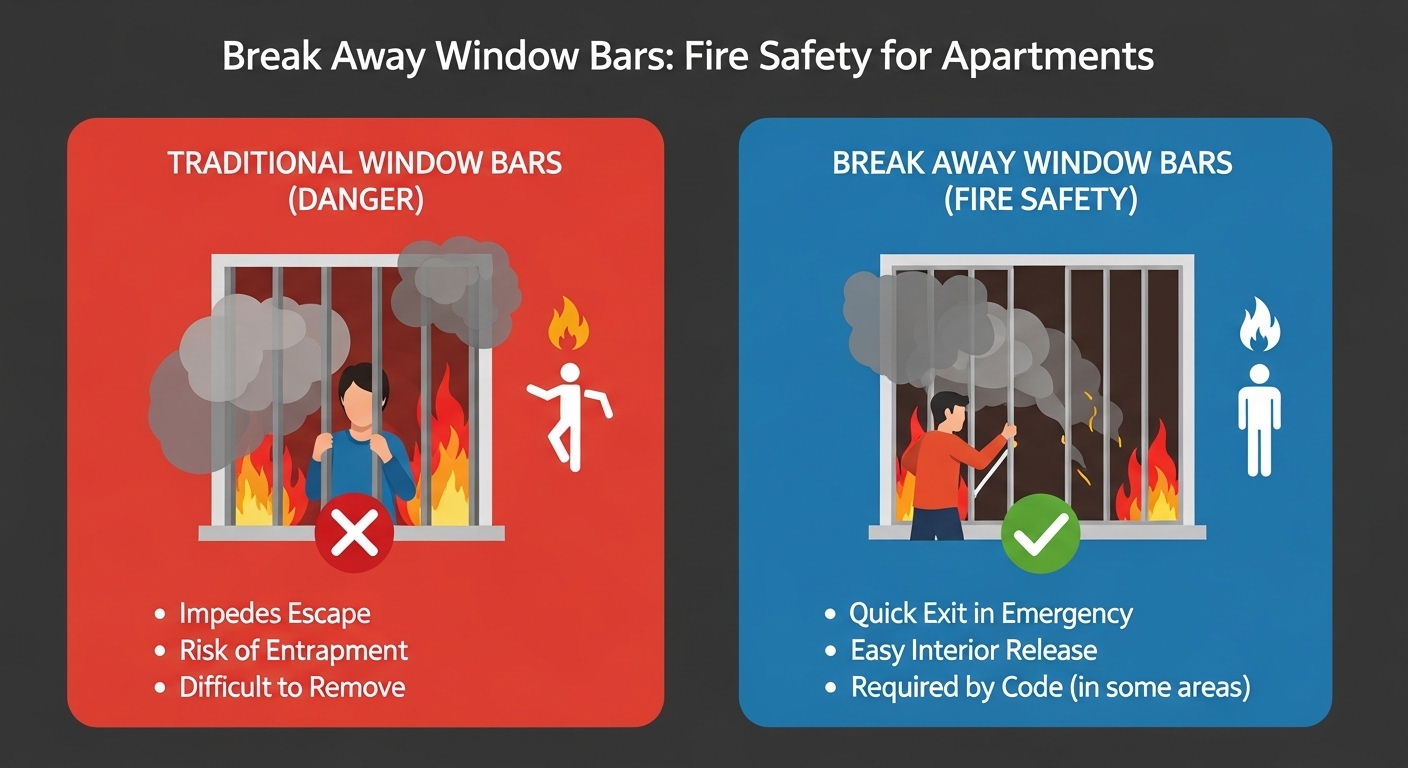
Given the strict requirements of IRC Section R310 and NFPA 101, the selection of basement window security bars comes down to one critical feature: a quick-release or rapid-egress mechanism. Fixed, permanently welded bars — the type commonly seen on older urban properties and storefronts — are explicitly prohibited over egress windows in sleeping areas by virtually every US building code jurisdiction. The reason is straightforward: in a house fire, which according to the National Fire Protection Association kills over 2,500 Americans annually, the seconds saved by a functional egress window can be the difference between life and death. Quick-release bar systems solve this problem by incorporating an interior latch, lever, or release mechanism that allows the bars to swing open, fold away, or be removed entirely from inside the room, providing the full code-required clear opening in seconds. These systems combine maximum burglar deterrence when locked from the outside with full emergency egress capability from the inside — a dual-function engineering achievement that fixed bars simply cannot offer. For homeowners investing in window security bars that open from the inside — including those exploring clear bars, window grates, and door grille systems for whole-home security — quick-release egress bars represent the most important category of all.
How the SWB Model A/EXIT Patented Egress Mechanism Works
The Security Window Bars Model A/EXIT is SWB's purpose-engineered solution for exactly this challenge. Built on the same telescopic steel platform as the Model A, the Model A/EXIT incorporates a patented quick-release mechanism that allows the entire bar assembly to be cleared from the window opening with a single interior action — no key, no tool, no special knowledge required. When locked in the secured position, the Model A/EXIT presents the same heavy-gauge steel deterrent as any permanent bar installation. From the outside, there is no visible indication that the bars can be released, which preserves the security function. From the inside, a clearly marked release mechanism allows any occupant to open the egress path in compliance with IRC Section R310, NFPA 101, and OSHA standards. The telescopic adjustment also ensures the bars fit windows within the standard 22-to-36-inch width range that covers the vast majority of basement window sizes in American residential construction. You can review full specifications and compliance documentation at the Model A/EXIT product page.
Testing Your Bar System for Egress Compliance Before Installation
Before permanently installing any bar system over a basement window, homeowners should conduct a simple compliance pre-check. First, measure the net clear opening width and height of the window when fully open — both must meet IRC minimums of 20 inches wide and 24 inches tall. Second, verify the sill height does not exceed 44 inches from the finished floor. Third, test the bar release mechanism with the interior action only — time yourself from a neutral position to full bar clearance. NFPA guidance and fire safety experts suggest this action should be achievable in under 15 seconds by any able-bodied adult. If your chosen bar system requires two hands, specific grip strength, or any tool, it is not fully compliant. Document your measurements and keep them with your home records in case of inspection. SWB recommends reviewing the installation guide for step-by-step compliance verification during setup.
Selecting the Right Basement Window Security Bars for Your Home
Choosing the correct basement window security bar system requires balancing four key variables: the window dimensions, the occupancy type of the space, whether the installation is temporary or permanent, and the local building code requirements. Not all basements are the same — a utility room basement window has very different requirements than a finished basement bedroom that serves as a legal sleeping area for a family member or tenant. Understanding these distinctions upfront prevents costly mistakes and potential building code violations that could affect your homeowner's insurance coverage, your property resale value, and most importantly, the safety of everyone inside. SWB offers three distinct bar models precisely because these variables create distinct installation scenarios. Getting the right bar to the right window is the foundation of effective basement security.
Model A Telescopic Bars: Best for Basement Utility and Non-Sleeping Rooms
For basement windows in utility rooms, laundry areas, mechanical rooms, or storage spaces that are not used as sleeping areas, the Model A Telescopic Window Bars provide maximum security without the need for a quick-release egress mechanism. These bars adjust telescopically to fit window widths from 22 to 36 inches — the standard range for most residential basement windows in American construction — and install in 15 to 20 minutes without drilling in many applications. The heavy-gauge steel construction resists forced entry, while the matte black powder-coated finish provides a clean, modern appearance that blends with most home exteriors. For renters in basement apartments who need to secure windows without making permanent modifications, the Model A is also ideal because it can be fully removed when moving out without leaving any damage. At $90, it delivers professional-grade steel security at a fraction of the $600 to $1,800 cost of a professional bar installation.
Model A/EXIT: Required for All Basement Sleeping Areas Under US Code
For any basement window in a room designated as a sleeping area — including finished basement bedrooms, in-law suites, and short-term rental units — the Model A/EXIT Egress Compliant Window Bars are the only appropriate choice under current US building codes. The patented quick-release mechanism satisfies IRC Section R310, NFPA 101, and OSHA egress standards simultaneously. At $92, the Model A/EXIT costs just two dollars more than the standard Model A, making the compliance upgrade essentially cost-free. This is a critical point for landlords in cities like New York, Chicago, and Los Angeles who manage basement rental units — installing non-egress-compliant bars over sleeping area windows creates direct legal liability in the event of a fire or emergency. The Model A/EXIT eliminates that liability while still providing the same steel-strength burglar deterrence as any fixed bar system.
Model B Wall-Mount Bars: For Non-Egress Basement Windows Requiring Maximum Strength
In cases where a basement window is in a non-sleeping area and the homeowner wants the absolute maximum in permanent security — such as a ground-floor window adjacent to a commercial storage area, a garage, or a basement workshop — the Model B Wall-Mount Window Bars provide fixed, heavy-gauge steel construction with a permanent mounting system. The Model B is designed for homeowners who do not need egress compliance from that specific window and prioritize maximum structural resistance over removability. Its powder-coated black finish matches modern home aesthetics, and the wall-mount design anchors directly into the surrounding masonry or framing, providing significantly higher resistance to forcible entry than a telescopic system alone. Note: Model B should never be installed over a window that serves or could serve as an egress point for a sleeping area.
Step-by-Step Installation Guidance for Basement Window Security Bars
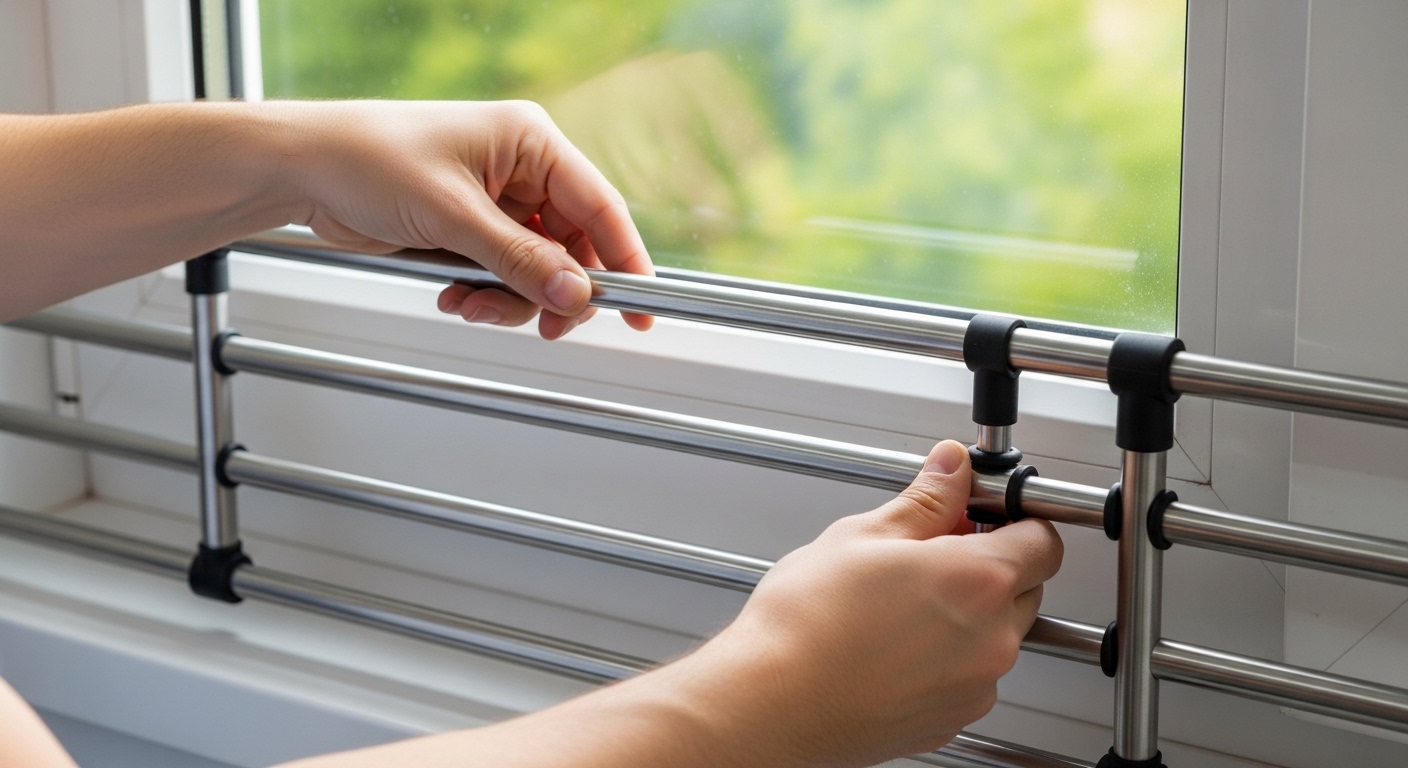
Installing basement window security bars correctly is just as important as selecting the right model. An improperly installed bar system — even an egress-compliant one — can fail at the moment of greatest need, whether that is during a forced entry attempt or during an emergency evacuation. The good news is that SWB bar systems are engineered specifically for DIY installation, with the average installation time between 15 and 20 minutes per window using basic household tools. No locksmith, no contractor, and no specialized knowledge is required. However, there are several critical steps that homeowners should follow carefully to ensure both security performance and code compliance are achieved simultaneously. The following guidance covers the essential installation process applicable to most residential basement windows across the United States.
Pre-Installation: Measuring Basement Windows Correctly
Correct measurement is the foundation of a successful and compliant installation. Using a metal tape measure, measure the interior width of the window opening at three points: the top, middle, and bottom of the frame. Use the smallest of the three measurements as your installation width to ensure the bars seat securely without gaps. For height, measure from the sill to the top of the opening. For egress compliance purposes, also measure the net clear opening when the window sash is fully open — this is the actual usable space, not the frame dimension. Record all measurements before ordering. SWB's Model A and Model A/EXIT both accommodate window widths from 22 to 36 inches, which covers the standard range for American residential construction, including the horizontal slider and awning-style windows common in Midwestern and Northeast basement construction.
Installation Process: Achieving Secure Fit Without Compromising Egress
For the Model A/EXIT installation over a basement egress window, follow this sequence: First, extend the telescopic bar assembly to the measured width, ensuring the spring-loaded pins engage firmly in the adjustment holes. Second, position the assembly in the window opening with the quick-release mechanism on the interior side — never install with the release mechanism facing outward. Third, apply the included tension pads or mounting brackets to prevent lateral movement — these are critical in basement applications where condensation and humidity can cause slight frame expansion over time. Fourth, test the quick-release mechanism from the interior five times before considering the installation complete. Each test should result in full bar clearance of the opening in under 10 seconds. If resistance is felt, recheck the telescopic tension setting and retest. Detailed step diagrams and torque specifications are available in the SWB installation guide.
Post-Installation: Egress Compliance Verification Checklist
After installation, run a complete egress compliance verification before the room is used as a sleeping area. Check: (1) Quick-release operates smoothly from interior in under 15 seconds with one hand. (2) Net clear opening width with bars released measures at least 20 inches. (3) Net clear opening height with bars released measures at least 24 inches. (4) Sill height from finished floor does not exceed 44 inches. (5) No exterior key or tool is required to release bars from inside. (6) Children and all household members over age 10 can independently operate the release mechanism. Document the results of this check with a photo or written record. For rental properties in New York, California, or Illinois, keep this documentation available for building inspectors. If any item on this checklist fails, do not use the room as a sleeping area until the issue is resolved.
Window Security Bars That Open: Expanding Your Home's Security System Beyond the Basement
While basement window security bars with egress code compliance address the most critical vulnerability in most American homes, a comprehensive physical security strategy extends to every accessible window and door opening. Homeowners who invest in basement security often find that once that vulnerability is addressed, they want to evaluate the rest of their perimeter — including ground-floor living room windows, patio doors, bedroom windows on accessible upper floors, and garage entry points. This is where a broader understanding of window security bars that open, clear bars, window grates, and door grilles becomes essential. A layered security approach means every potential entry point has a physical deterrent, not just an alarm sensor. Physical barriers force a time delay on any intruder — and time delay is the single most effective crime prevention mechanism, according to criminology research on target hardening. Exploring the full range of security bars for windows that open, alongside options like patio door bars and window grates, gives homeowners a complete picture of their protection options across the entire property perimeter.
Pairing Basement Bars with First-Floor and Bedroom Window Security
A home secured only at the basement level is still vulnerable at the first floor. Ground-floor living room windows, kitchen windows overlooking side yards, and bedroom windows above a first-floor roof or garage are all secondary access points that burglars will probe after finding a basement secured. SWB's Model A Telescopic Bars can be deployed across multiple windows simultaneously — homeowners in high-crime neighborhoods like Chicago's South Side or Philadelphia's Kensington area often secure four to six windows with SWB systems during a single weekend installation session. Because the bars are adjustable, they can be fitted to the varied window sizes found across most American single-family homes without custom fabrication. For a whole-home security approach that includes options for window security bars that open from the inside, clear bars for light retention, and window grates that balance aesthetics with protection, explore the full SWB product lineup.
Door Grilles, Patio Door Bars, and Whole-Home Security Integration
Beyond individual windows, sliding patio doors and French doors represent significant forced-entry vulnerabilities that standard door locks do not adequately address. A sliding patio door can be lifted off its track or forced with a crowbar in seconds without a physical bar in the door channel. Door grilles and patio door security bars add the same target-hardening principle to these larger openings that window bars provide to individual windows. When combined with a comprehensive window bar deployment — including egress-compliant bars in all basement sleeping areas, telescopic bars on ground-floor windows, and door security on all sliding door openings — homeowners create a layered physical security perimeter that dramatically increases the time and effort required for forced entry. For homeowners and property managers interested in the full range of security solutions including clear bars, window grates, and door grilles that complement the basement egress bar system, SWB's complete lineup at securitywb.com covers every opening type in the American home.
Legal Liability, Insurance, and Code Enforcement: What US Homeowners Must Know
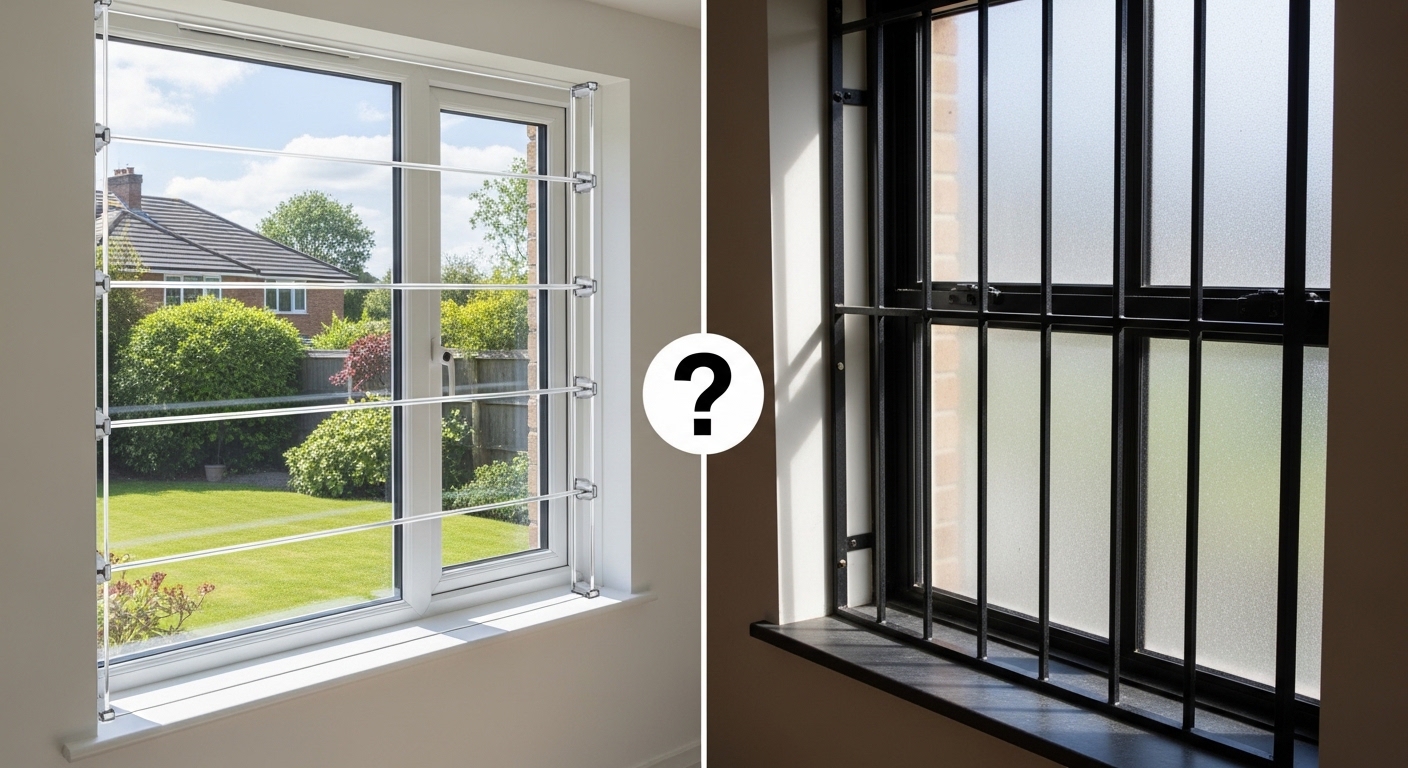
Installing basement window security bars without egress code compliance does not just create a safety risk — it creates measurable legal and financial exposure for homeowners, landlords, and property managers across the United States. Building code violations related to egress requirements are among the most commonly cited deficiencies during home sales inspections, rental property licensing audits, and post-fire insurance claim investigations. Understanding the legal framework around basement window bars is as important as understanding the physical security benefits, particularly for anyone who rents out a property or manages multiple units.
Insurance Implications of Non-Compliant Window Bars
Most US homeowner and landlord insurance policies include provisions related to building code compliance. If a fire or emergency occurs in a basement sleeping area and investigators determine that non-compliant fixed bars prevented or delayed egress, the insurance carrier may contest or deny the claim on the grounds of building code violation. This is not a hypothetical scenario — fire investigators in cities including Detroit and Memphis have documented cases where non-egress-compliant bars contributed to fatalities in basement sleeping areas. Beyond claim denial, property owners may face civil liability from tenants or their families. The marginal cost difference between a fixed bar (which could cost hundreds in professional installation) and an egress-compliant quick-release system like the SWB Model A/EXIT at $92 makes the compliant choice the obvious financial and ethical decision.
What Happens During a Building Inspection: A Practical Guide
When a building inspector evaluates a basement sleeping area — whether during a rental license renewal, a home sale inspection, or a post-complaint investigation — they will specifically check that any window bars installed over egress windows have an operable quick-release mechanism. In many jurisdictions, the inspector will physically test the mechanism from the interior. If bars are fixed or the release mechanism requires a key, tool, or significant force, the inspector will cite the property for a code violation. In New York City, such violations can result in fines of several hundred dollars per window and a mandatory repair order with a compliance deadline. In California, non-compliant egress conditions can affect a property's Certificate of Occupancy for basement dwelling units. Choosing egress-compliant bars from the outset eliminates this risk entirely. Contact the SWB team through the contact page if you need documentation or compliance specifications for a building inspection.
Cost Comparison: DIY Basement Window Bars vs. Professional Installation
One of the most compelling reasons American homeowners and renters choose SWB basement window security bars is the dramatic cost advantage over professional installation. Understanding the full cost picture — including materials, labor, compliance upgrades, and long-term value — makes the DIY bar system the clear choice for the vast majority of residential applications across the United States.
Professional Bar Installation Costs vs. SWB DIY Systems
According to HomeAdvisor and Angi pricing data, professional window security bar installation in the United States typically costs between $600 and $1,800 per window, depending on the window size, the bar material, the local labor market, and whether egress compliance modifications are required. In high-cost metro areas like New York City, San Francisco, and Boston, professional installation can exceed $2,000 per window for custom fabricated bar systems with egress mechanisms. By contrast, the SWB Model A/EXIT — which delivers patented quick-release egress compliance and heavy-gauge steel security — costs $92 per window and installs in under 20 minutes without professional assistance. For a typical three-bedroom home with six to eight accessible windows, the total cost of SWB bar systems is $552 to $736 versus a professional installation cost of $3,600 to $14,400. The savings are not marginal — they represent an order-of-magnitude difference that makes home security accessible to every budget level.
Long-Term Value: Removability, Portability, and Renter Savings
For the 44.1 million American renters — a population that moves frequently, often annually — the permanent nature of professionally installed bars is a financial liability, not just an inconvenience. Permanent bars installed by a tenant may be required to be removed at move-out, at the tenant's expense. They cannot be taken to the next apartment. And in many cases, drilling into window frames or surrounding masonry violates lease agreements, potentially resulting in the loss of a security deposit. SWB telescopic bar systems solve every one of these problems simultaneously. They install without permanent damage, can be removed in minutes at move-out, and move with the tenant to their next apartment. A renter in Chicago who invests $92 in a Model A/EXIT for their basement bedroom can protect that investment indefinitely — bringing the bars to every future apartment they occupy. Over five years, the amortized cost of that security investment approaches zero, making SWB bars the most cost-effective security option available to American renters.
🏆 Conclusion
Securing a basement window is never a single-dimension problem. The dual requirement of maximum burglar deterrence and full emergency egress capability makes basement window security bars with egress code compliance the most technically demanding window security application in any American home. The consequences of getting it wrong are serious — criminal liability exposure for landlords, insurance claim risk for homeowners, and above all, genuine life-safety hazards for the people sleeping in those basement rooms. The good news is that modern engineered solutions like the SWB Model A/EXIT eliminate the tradeoff entirely. With a patented quick-release mechanism, IRC Section R310 and NFPA 101 compliance, telescopic adjustment for standard US window sizes, and a price point of $92 that is accessible to every homeowner and renter, there is no longer any justification for choosing between security and safety in a basement sleeping area. Whether you live in a ground-floor apartment in Chicago, a finished basement bedroom in suburban Atlanta, or manage rental properties in New York City, Security Window Bars has an engineered, code-compliant solution available for fast delivery across all 50 states. Secure every opening, comply with every code, and give your household the protection it deserves starting today.
Security Window Bars · USA
Secure Your Home Today
Protect your basement and your family today. Shop the full SWB lineup — including the egress-compliant Model A/EXIT — at Security Window Bars on Amazon, with fast FBA shipping to all 50 US states. Or explore all models directly at securitywb.com.
Shop on Amazon →Frequently Asked Questions
Yes, window bars are legal on basement bedroom windows in the USA — but only if the bars include a quick-release egress mechanism that can be operated from the inside without a key or tool. The International Residential Code (IRC) Section R310 requires all sleeping areas to have an emergency escape and rescue opening meeting minimum dimensions of 20 inches wide and 24 inches tall. Any security bar that blocks, reduces, or permanently covers that opening without an interior quick-release mechanism violates this code in virtually every US jurisdiction. Fixed, welded bars are specifically prohibited over egress windows in sleeping areas. The SWB Model A/EXIT is designed and patented to meet these requirements.
Under IRC Section R310.2, a basement egress window must provide a minimum net clear opening width of 20 inches, a minimum net clear opening height of 24 inches, and a minimum net clear opening area of 5.7 square feet (5.0 square feet for grade-floor openings). These are net clear measurements taken when the window sash is fully opened, not the frame dimensions. The window sill must also be no higher than 44 inches from the finished floor. When security bars are installed, they must be clearable via a quick-release mechanism to achieve these full opening dimensions during an emergency. Any bar installation that reduces the net clear opening below these thresholds fails IRC compliance.
Yes. SWB's Model A and Model A/EXIT telescopic window bars are specifically engineered for renter-friendly installation. Both systems use a spring-loaded telescopic adjustment that creates tension against the window frame without requiring drilling, anchoring into masonry, or any permanent modification to the window or surrounding wall. Installation takes 15 to 20 minutes and leaves zero damage when removed at move-out. This makes them ideal for the millions of American renters in basement and garden-level apartments in cities like New York, Chicago, Los Angeles, and Philadelphia who need security without violating their lease agreements. Always review your specific lease terms before installing any window hardware.
The insurance implications of window bars depend entirely on whether they are egress-compliant. Non-compliant fixed bars installed over a basement sleeping area window can create grounds for an insurance carrier to contest a claim in the event of a fire or emergency where egress was obstructed. Most US homeowner and landlord insurance policies include building code compliance provisions, and a documented code violation related to egress can complicate or deny a claim. By contrast, installing code-compliant quick-release bars like the SWB Model A/EXIT satisfies building code requirements and eliminates this liability. Some insurance carriers may actually offer premium reductions for verified physical security improvements — check with your specific carrier for their policy.
To verify egress compliance, open your basement window fully and measure the net clear opening — the actual open space, not the frame. You need at least 20 inches of clear width and 24 inches of clear height simultaneously. Also measure from your finished floor to the bottom of the window opening — this sill height must be 44 inches or less. If your window meets all three criteria when fully open, it qualifies as an egress opening under the IRC. If your window is too small, adding a quick-release bar will not fix the underlying dimensional deficiency — in that case, a window well enlargement or window replacement may be required before the room can legally serve as a sleeping area.
Both the Model A and Model A/EXIT are telescopic, adjustable steel bar systems that fit windows 22 to 36 inches wide and install without drilling in most applications. The critical difference is that the Model A/EXIT includes a patented quick-release mechanism that allows the bars to be fully cleared from the window opening from the inside in seconds, without a key or tool — making it compliant with IRC Section R310, NFPA 101, and OSHA egress standards. The Model A is a standard security bar without an egress release, making it appropriate for basement utility rooms, storage areas, or other non-sleeping spaces. For any basement room used as a sleeping area, the Model A/EXIT is the required choice under US building codes. The price difference is just two dollars — $90 for Model A versus $92 for Model A/EXIT.
SWB basement window security bars cost $90 to $92 per window depending on the model, with no installation labor required. Professional window bar installation in the United States typically costs between $600 and $1,800 per window according to HomeAdvisor and Angi pricing data, with premium metro markets like New York City and San Francisco reaching $2,000 or more for egress-compliant custom fabrications. For a home with six accessible basement and ground-floor windows, SWB systems total $540 to $552 versus a professional installation total of $3,600 to $10,800 or more. SWB systems ship via Amazon FBA with fast delivery to all 50 states and require no specialized tools or professional assistance to install.
In many jurisdictions, yes. NFPA 101, the Life Safety Code, is adopted or referenced by a significant number of state and local building codes, particularly for multi-family residential buildings, commercial properties, and jurisdictions that have incorporated NFPA standards into their local amendments. NFPA 101 Section 24.2.11 requires that security bars or grilles on sleeping room windows be openable from the inside without a key or special knowledge. For single-family homes in most US jurisdictions, the IRC is the primary standard, and NFPA 101 may not be directly applicable. However, for multi-family buildings, apartment complexes, and any property subject to commercial building codes, both IRC and NFPA 101 requirements may apply simultaneously. The SWB Model A/EXIT is engineered to satisfy both standards concurrently.