

Telescopic Window Security Bars: The Complete Buyer's Guide for American Homeowners and Renters in 2026
Telescopic window security bars protect your home without permanent damage. Compare SWB models, costs, codes & installation. Shop on Amazon USA today.
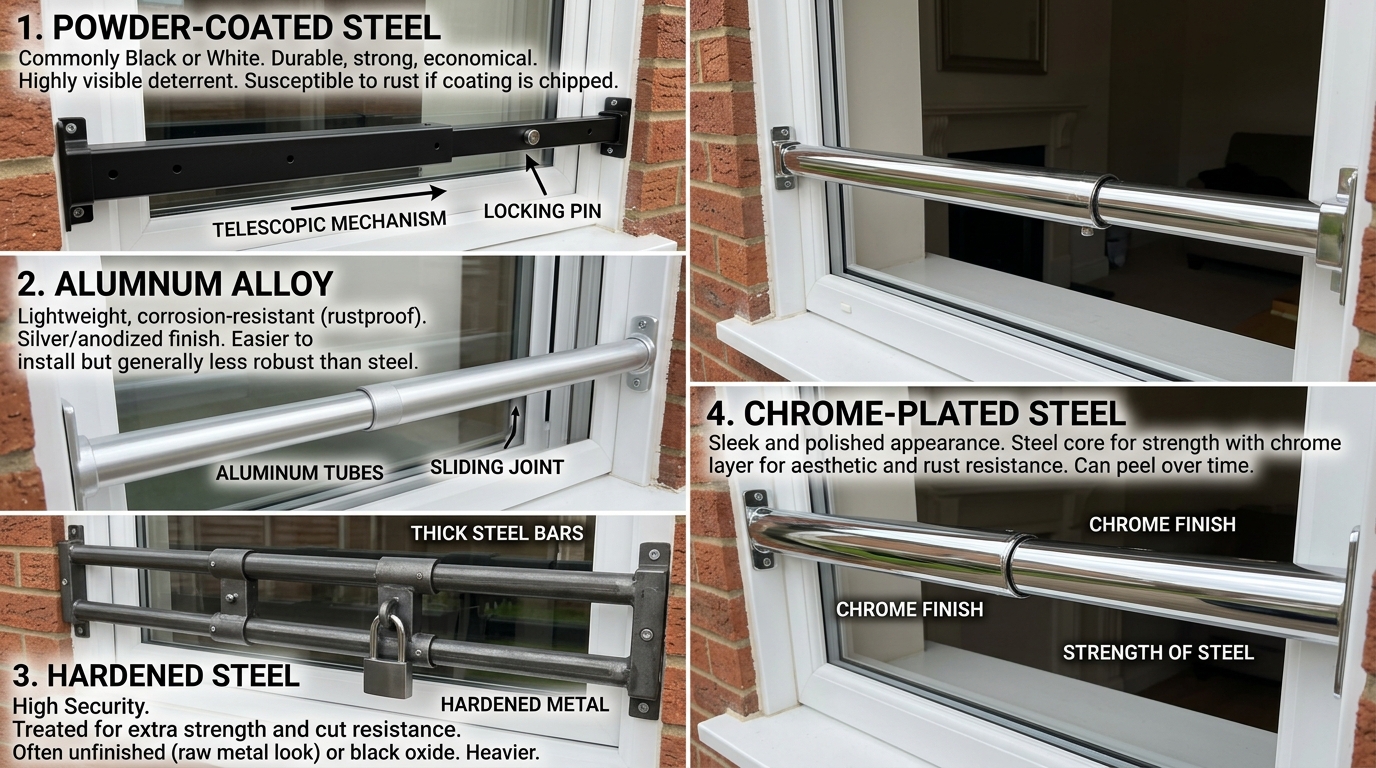
From our experience protecting thousands of homes across the USA, SWB analyzes the best strategies so you can sleep soundly. According to the FBI Uniform Crime Report, there are approximately 6.7 million home burglaries recorded annually in the United States — and a staggering 60% of them happen through ground-floor windows. Yet the most common reason American renters and homeowners skip window security is not cost or complexity: it is the fear of permanent wall damage. That is exactly the problem telescopic window security bars solve. Unlike welded or drilled bar systems that cost $600 to $1,800 professionally installed, telescopic window security bars use a tension-based, pressure-locking mechanism to hold firmly in place without a single hole in your wall or window frame. Whether you rent a studio apartment in Chicago, own a condo in Los Angeles, or manage a portfolio of rental units in Philadelphia, adjustable telescopic bars deliver professional-grade protection at a fraction of the cost — and they move with you when you do.
The core innovation in telescopic window security bars is the two-piece telescoping body. The outer sleeve holds the inner rod, which slides freely until the lo…
What Are Telescopic Window Security Bars and How Do They Work?
Telescopic window security bars are steel security bars engineered with an extendable, two-piece sliding body that adjusts to fit a range of window widths. Instead of being bolted permanently into masonry or wood framing, they use a spring-loaded or screw-tensioned mechanism that applies lateral pressure against the interior window frame — the same principle used in tension rods, but built with heavy-gauge steel rated to withstand forced-entry attempts. The bars compress during installation, then expand to lock tightly inside the frame. Most quality telescopic bars, including SWB's Model A, handle windows between 22 and 36 inches wide, which covers the vast majority of standard residential window sizes across the United States. According to the International Residential Code (IRC), standard single and double-hung windows in American construction range from 24 to 48 inches wide, meaning telescopic bars serve the most common residential configurations. Once extended and locked, the bar creates a rigid steel obstacle across the window opening that prevents the sash from being pushed, lifted, or pulled outward. The physics are straightforward: an intruder attempting to force entry must overcome the combined tensile resistance of the steel bar and the lateral friction force applied to the frame — a barrier that, in controlled testing, can resist hundreds of pounds of direct pressure.
The Mechanics Behind the Telescopic Locking Mechanism
The core innovation in telescopic window security bars is the two-piece telescoping body. The outer sleeve holds the inner rod, which slides freely until the locking collar or set screw is tightened. In SWB's Model A, the system uses a reinforced steel collar that locks the inner rod at precise increments, preventing any slippage over time.
Tension vs. Friction: Why the System Holds
Tension-based systems generate a continuous outward pressure on both sides of the window frame. This means the harder a potential intruder pushes inward, the more the bar presses outward against the frame — creating a self-reinforcing resistance. The bar does not simply sit in the frame; it actively pushes against it. This is why properly installed telescopic bars are comparable in real-world security performance to many bolt-mounted systems.Steel Grade and Load Capacity
SWB's telescopic bars are constructed from heavy-gauge carbon steel with a powder-coated matte black finish that resists rust, UV degradation, and surface chipping. The steel cross-section is engineered to resist bending under lateral load, which is the primary failure mode in low-quality imitation products. When evaluating any telescopic window bar, always ask for the load rating — a legitimate security product should specify deflection resistance in pounds-force.Standard Window Sizes and Telescopic Bar Compatibility
One of the most practical advantages of telescopic window security bars is their universal compatibility with standard American window dimensions. The U.S. residential construction market uses a relatively standardized set of window widths: 24 inches, 28 inches, 30 inches, 32 inches, and 36 inches are the most common rough-opening widths for single-hung, double-hung, and sliding windows. SWB's Model A covers the 22-to-36-inch range, which aligns with the majority of bedroom, bathroom, kitchen, and living room windows found in apartments, townhouses, and single-family homes built after 1980. For renters in older pre-war buildings in New York City or Chicago — where window sizes can be more irregular — it is worth measuring the interior frame width before purchasing. The telescopic range on Model A accommodates most of these older configurations as well. If your window exceeds 36 inches, SWB's Model B wall-mount system may be the appropriate alternative for maximum coverage.
Why American Renters Choose Telescopic Window Security Bars Over Permanent Solutions
The U.S. Census Bureau estimates there are 44.1 million apartment renters in the United States as of 2023. That is nearly one in three Americans living in a rental unit where drilling into walls, window frames, or concrete surrounds can trigger lease penalties, security deposit deductions, or outright eviction clauses. Traditional window bar systems — whether welded iron grates or bolt-mounted steel assemblies — require screwing into the structural frame, which is almost universally prohibited under standard lease agreements. This creates a security gap: millions of renters in high-crime urban areas like Detroit, Memphis, Atlanta, Houston, and Philadelphia know they need window protection but believe they have no legal, affordable option. Telescopic window security bars close that gap entirely. Because the bar creates zero permanent damage — no holes, no anchors, no wall penetration — it fits within the lease terms of virtually every rental agreement in the country. When you move out, you simply remove the bar, wipe the frame, and your deposit is safe. When you move in somewhere new, the same bar adjusts and installs in minutes.
Lease Compliance: What Your Rental Agreement Actually Says
Most standard American lease agreements prohibit 'alterations, additions, or improvements' to the rental unit without written landlord consent. The legal threshold typically involves any action that leaves a 'mark, hole, or permanent change' to the property. Telescopic window security bars, installed using tension alone, leave no marks and create no permanent changes — placing them in the same legal category as tension shower rods or removable door stops. However, lease language varies, and if you are in doubt, a short written notice to your landlord confirming the no-drill installation method is always a prudent step. In many cases, landlords in cities like Chicago and Los Angeles actively welcome renter-installed non-permanent security measures because they reduce liability and property damage claims. New York City's Local Law 57 actually requires landlords of buildings with children under 10 to install window guards, so renters in those buildings should confirm that telescopic bars do not interfere with required guard hardware.
Cost Comparison: Telescopic Bars vs. Professional Installation
The economics of telescopic window security bars versus professional installation are stark. According to HomeAdvisor's 2024 cost data, professional window bar installation in the United States averages between $600 and $1,800 per window, depending on the bar style, material, local labor rates, and whether concrete anchoring is required. A ground-floor apartment in Houston with four at-risk windows could cost $2,400 to $7,200 to professionally secure — a number that puts permanent security out of reach for most renters and many homeowners. SWB's Model A telescopic bar retails at $90 per unit on Amazon USA, making it possible to secure all four windows for $360 — and to do so in under an hour with no professional help. For landlords managing a portfolio of rental units in cities like Philadelphia or Memphis, the savings scale dramatically: 20 units with two windows each represents a potential savings of $200,000 or more compared to professional bar installation across the portfolio.
SWB Model A vs. Model A/EXIT: Choosing the Right Telescopic Bar for Your Window
Security Window Bars offers two telescopic window security bar models designed for different installation scenarios and compliance requirements. Understanding the distinction between Model A and Model A/EXIT is critical for making the right choice — particularly if you are installing bars in a sleeping area, which is subject to specific life-safety requirements under U.S. building codes. Both models share the same heavy-gauge steel construction, the same telescopic adjustment range of 22 to 36 inches, and the same matte black powder-coated finish. The difference lies in the egress mechanism — a feature that has profound safety and legal implications for bedrooms, basement sleeping areas, and any room that serves as a sleeping space. According to the National Fire Protection Association (NFPA 101, Life Safety Code), every sleeping area in a residential building must have at least one means of emergency egress — an opening large enough for a person to exit in the event of a fire or structural emergency. Window bars that block egress create a deadly trap.
Model A — Standard Telescopic Window Bar ($90)
The SWB Model A is the foundational telescopic window security bar in the SWB lineup. It is purpose-built for windows that do not serve as emergency egress points — living rooms, hallways, kitchens, bathrooms, and any room that has an alternative fire exit. Installation takes between 15 and 20 minutes for most users with no tools required beyond the bar itself. The telescopic body extends from a compressed shipping size to the full window width, where the locking collar is tightened to hold the bar firmly. The matte black finish blends seamlessly with modern interior window trim in contemporary apartments and homes.
Ideal Applications for Model A
Model A is the correct choice for: ground-floor living room windows in urban apartments, basement windows in non-sleeping areas, kitchen and bathroom windows in both residential and light commercial settings, and any window where egress is not a code requirement. If you live in a first-floor apartment in Atlanta or a basement unit in Chicago and your bedroom has a separate fire exit, Model A provides maximum security for non-egress openings at the lowest price point in the SWB lineup.Model A/EXIT — Egress-Compliant Telescopic Window Bar ($92)
The SWB Model A/EXIT is a patented telescopic window security bar that incorporates a quick-release egress mechanism, making it compliant with the International Building Code (IBC), NFPA 101 Life Safety Code, OSHA standards, and the IRC emergency egress requirements for sleeping areas. The egress bar within the Model A/EXIT system can be released from inside the room in a single motion — without tools, without a key, and without prior knowledge of the mechanism — allowing occupants to exit through the window in a fire emergency within seconds. This is not a voluntary safety feature: the IBC and IRC mandate that windows in sleeping areas maintain a minimum clear opening of 20 inches wide and 24 inches high, and that any obstruction — including security bars — be operable from the inside without special knowledge or tools. Failure to comply with egress requirements in sleeping areas is a building code violation in all 50 states and exposes landlords to significant liability.
Who Needs Model A/EXIT?
Any window in a bedroom, sleeping loft, basement bedroom, or room used for sleeping — regardless of whether it is a primary or secondary sleeping area — requires an egress-compliant security bar. This includes Airbnb and short-term rental hosts in cities like Los Angeles and New York who must comply with local fire safety ordinances. Model A/EXIT costs only $2 more than Model A and eliminates all code compliance risk in sleeping areas.How to Install Telescopic Window Security Bars: Step-by-Step
One of the defining advantages of telescopic window security bars is the speed and simplicity of installation. Unlike bolt-mounted bars that require measuring anchor points, drilling into concrete or wood, inserting masonry anchors, and torquing bolts to specification — a process that typically takes a professional two to four hours per window — telescopic bars install in 15 to 20 minutes with no special skills, no power tools, and no professional assistance. This section walks through the complete installation process for SWB Model A and Model A/EXIT. Before beginning, confirm that your window opening falls within the 22-to-36-inch adjustment range of the bar. Measure the interior width of the window frame — not the glass, but the painted or finished wood or vinyl frame surface where the bar will make contact. For windows outside this range, refer to SWB's Model B wall-mount system for wider or custom openings.
Pre-Installation Checklist and Measurement Guide
Before installing your telescopic window security bars, complete this pre-installation checklist for best results: First, clean the interior frame surfaces where the bar end caps will press. Any dust, debris, or loose paint can reduce friction and allow the bar to slip over time. Second, measure the interior frame width at the horizontal midpoint of the window — not the top or bottom, as older window frames in cities like Chicago or New York may be slightly out of square. Third, confirm the bar is in the correct position — for maximum security, telescopic bars should be installed at the midpoint of the window height, blocking the window at its widest accessible point. Fourth, if installing Model A/EXIT in a sleeping area, confirm the quick-release mechanism operates freely before finalizing installation. The SWB installation guide at securitywb.com/installation/ provides detailed diagrams and torque specifications for both Model A and Model A/EXIT systems.
Tools Required (or Not Required)
For the vast majority of installations, no tools are needed. The locking collar on Model A tightens by hand. If you prefer additional security for the collar, a standard flat-head screwdriver can be used to tighten the set screw — but this is optional. No drill, no masonry anchors, no hammer, and no level are required.Step-by-Step Installation Process
Follow these steps for a secure, code-compliant telescopic window security bar installation: Step 1 — Compress the bar to its minimum length and insert it horizontally inside the window frame at your chosen height. Step 2 — Extend the telescoping inner rod outward until both end caps make firm contact with the frame on both sides. Do not force — stop when you feel solid resistance. Step 3 — Tighten the locking collar by rotating clockwise until the bar holds its extended position without assistance. Step 4 — Apply downward pressure on the center of the bar to test for deflection. A properly installed bar should show minimal flex under moderate hand pressure. Step 5 — For Model A/EXIT, test the quick-release mechanism by operating it from the inside to confirm smooth, tool-free egress operation. Step 6 — Record the installation width setting in case you need to reinstall the bar after moving. The entire process, including measurement and testing, takes most users under 20 minutes on the first installation and under 10 minutes on subsequent reinstalls.
Building Codes and Legal Requirements for Window Bars in the USA
Navigating the building code landscape for window security bars in the United States requires understanding the interplay between federal model codes, state adoptions, and local municipal ordinances. The primary codes governing window bars in American residential and commercial construction are the International Building Code (IBC), the International Residential Code (IRC), and NFPA 101 — the Life Safety Code. All three have been adopted in some form by every U.S. state, though specific local amendments may apply. The central code requirement that affects window bar selection is the emergency egress provision: any window that serves as a required means of escape from a sleeping area must maintain a minimum clear opening of at least 20 inches wide, 24 inches high, and a minimum net clear opening area of 5.7 square feet (5.0 square feet for ground-floor windows). Bars installed over sleeping area windows must allow the window to achieve this opening from the inside without tools or special knowledge. This is precisely why SWB's Model A/EXIT exists — and why it carries a patented quick-release mechanism rather than a standard locking collar.
State and City-Specific Window Bar Regulations
Beyond the model codes, several U.S. states and major cities have enacted specific legislation governing window bars and window guards in residential buildings. New York City's Local Law 57 is the most well-known: it requires landlords of buildings with children under 10 years of age to install window guards on windows above the ground floor, with the option for tenants without children to decline in writing. In California, the California Residential Code follows the IRC egress requirements strictly, and local fire departments in Los Angeles and San Francisco have authority to cite property owners for non-compliant window bar installations during fire inspections. Chicago's municipal code requires that security bars on residential buildings not permanently obstruct egress in sleeping areas, echoing the IBC requirements. In Texas, the state building code delegates adoption of the IRC to individual municipalities, meaning Houston, Dallas, and San Antonio each have local enforcement agencies with authority over window bar compliance.
Landlord Liability for Non-Compliant Window Bars
Property owners who install non-egress-compliant bars on sleeping area windows face significant civil and criminal liability in the event of an injury or death during a fire. Multiple U.S. court cases have resulted in substantial judgments against landlords who prevented emergency egress. SWB's Model A/EXIT eliminates this liability by providing a tested, code-compliant quick-release system.IBC, IRC, and NFPA 101 Compliance: What the Codes Actually Require
For property managers and landlords who need to demonstrate code compliance to inspectors, the relevant code citations are: IRC Section R310.1 — Emergency Escape and Rescue Openings, which requires sleeping rooms to have at least one operable emergency escape window with minimum dimensions. IBC Section 1031 — Emergency Escape and Rescue, which applies to residential occupancies in multi-family buildings. NFPA 101 Section 24.2.2 — Means of Escape from Sleeping Rooms, which parallels the IBC requirement and applies to all residential occupancies. All three codes converge on the same requirement: window bars in sleeping areas must be releasable from the inside without tools. SWB's Model A/EXIT is designed, tested, and documented to meet all three standards. For documentation purposes, SWB can provide product compliance records upon request through securitywb.com/contact/.
Telescopic Window Security Bars for High-Crime Urban Areas: A City-by-City Analysis
The decision to install telescopic window security bars is not made in a vacuum — it is driven by real crime data and neighborhood-specific risk profiles. The FBI's Uniform Crime Report identifies a consistent set of U.S. cities where residential burglary rates are significantly above the national average, and the geographic pattern is clear: dense urban areas with large apartment renter populations and high ground-floor residential density account for a disproportionate share of window break-ins. For residents of these cities, telescopic window security bars are not a precaution — they are a practical necessity. The following city-by-city analysis draws on FBI UCR data and local crime statistics to contextualize the security investment in each major metropolitan area. In each case, the combination of SWB's no-drill installation, same-day Amazon Prime availability, and $90-to-$92 price point makes telescopic bars the most accessible and deployable residential security upgrade available.
Chicago, New York, and the Northeast Corridor
Chicago consistently ranks among the highest-burglary-rate major U.S. cities, with ground-floor residential windows representing the primary point of forced entry according to Chicago PD crime pattern data. Renters in neighborhoods like Austin, Englewood, and West Garfield Park — where average burglary rates can be three to five times the national average — face a genuine daily security risk that most cannot afford to address through professional installation. For a Chicago renter paying $1,200 per month for a ground-floor apartment, spending $90 to $180 on two SWB Model A bars provides immediate, removable security that can be reinstalled in the next apartment when the lease ends. In New York City, where Local Law 57 governs window guard requirements for families with young children, telescopic bars serve a dual purpose: they address adult burglary prevention on ground-floor units while providing the child fall-prevention function that New York City's Department of Health and Mental Hygiene mandates for buildings with children under 10. SWB's Model A fits the standard NYC residential window sizes found in pre-war and post-war apartment stock.
Los Angeles, Houston, Atlanta, and the South
In Los Angeles, where ground-floor residential units in neighborhoods like South Central, Boyle Heights, and Koreatown face elevated burglary rates, the combination of mild weather and frequent street-level foot traffic creates year-round window security risk. LA renters — many of whom live in older bungalow courts and dingbat apartment buildings with large, easily accessible windows — represent a natural market for telescopic bars that install without disturbing historic or character-defining window frames. Houston's residential sprawl means high-crime areas are distributed across multiple ZIP codes rather than concentrated in a single district, making window security a priority for homeowners and renters across the metropolitan area. Atlanta's Fulton County reports burglary rates well above the national average, with residential break-ins concentrated in ground-floor units in multi-family buildings. SWB's Amazon FBA fulfillment means Prime members in all of these cities can receive telescopic window security bars the same day or next day — a critical advantage when security needs are immediate.
How Telescopic Window Bars Compare to Other Window Security Options
The residential window security market includes several distinct product categories, and choosing the right solution requires understanding how each category performs across the dimensions that matter most to American homeowners and renters: security strength, installation complexity, egress compliance, cost, portability, and aesthetics. Telescopic window security bars occupy a unique position in this landscape — they are the only category that delivers steel-grade security at a DIY price point without requiring permanent installation. This section compares telescopic bars against the four primary alternative categories: permanent welded bars, bolt-mounted fixed bars, window film, and electronic alarm sensors.
Telescopic Bars vs. Permanently Welded or Bolt-Mounted Bars
Permanently welded bars — the traditional iron or steel grates seen on older urban buildings in cities like Detroit, Philadelphia, and Baltimore — provide maximum visual deterrence and structural resistance. However, they present three significant disadvantages compared to telescopic bars: cost ($600 to $1,800 professionally installed), permanence (cannot be removed without cutting tools), and egress non-compliance (welded bars in sleeping areas are a life-safety violation without a separately installed release mechanism). Bolt-mounted bars from brands like Mr. Goodbar or Grisham offer a middle ground — they can theoretically be removed by unbolting, but the process requires tools and leaves anchor holes in the wall. For renters, this means lease violations and deposit deductions. SWB's telescopic system matches the security performance of bolt-mounted bars at the same or lower price, with zero wall damage. The telescopic advantage is absolute for any renter or any property where preserving the wall surface matters.
Comparison Table: Telescopic vs. Bolt-Mounted
Telescopic bars: no drilling, 20-minute install, portable, renter-friendly, $90, adjustable 22-36 inches. Bolt-mounted bars: drilling required, 2-4 hour install, not portable, lease violation risk, $150-$300 plus $300-$600 labor, fixed size.Telescopic Bars vs. Window Film and Electronic Sensors
Window security film is a popular supplementary measure — polyester film applied to the glass surface that makes breaking the glass more difficult and holds shards in place after breakage. However, window film does not prevent entry: a sufficiently motivated intruder can break through filmed glass with repeated impact. Film costs $8 to $15 per square foot professionally applied and provides no egress benefit. It is best used in combination with telescopic bars, not as a replacement. Electronic window alarm sensors — contact sensors, glass break sensors, and vibration sensors — provide detection and deterrence but zero physical resistance. A sensor that triggers an alarm after a window is broken does nothing to physically prevent entry during the 5 to 10 minutes before police respond. According to the Bureau of Justice Statistics, the median response time for property crime calls in urban areas exceeds 11 minutes — more than enough time for a break-in to be completed. Telescopic bars are the only option in this comparison that creates a physical barrier preventing entry entirely.
Telescopic Window Security Bars for Special Use Cases: Airbnb, Landlords, and Child Safety
Beyond the standard renter and homeowner use cases, telescopic window security bars have three specialized applications that represent significant and underserved market segments in the United States: short-term rental properties on platforms like Airbnb and VRBO, multi-unit landlord portfolios, and child fall-prevention installations in family homes and apartments. Each of these use cases benefits from the core telescopic advantage — easy installation and removal — but also has specific requirements around code compliance, aesthetics, and documentation that are worth addressing in detail.
Airbnb and Short-Term Rental Hosts: Security and Compliance
Short-term rental hosts operating on Airbnb, VRBO, and similar platforms in cities like Los Angeles, New York, Chicago, and Miami face a unique security challenge: they need to provide a secure environment for guests without making permanent alterations to a property they may rent or manage under a lease themselves. Telescopic window security bars are ideally suited to this scenario. They can be installed before each guest check-in and removed before property inspections or lease renewals. Critically, Airbnb's community standards require hosts to disclose security devices and to ensure that window security measures do not violate fire safety codes — making SWB's Model A/EXIT the mandatory choice for any sleeping area window in a short-term rental. The $92 price point and quick installation make equipping a two-bedroom short-term rental unit with four egress-compliant telescopic bars a $368 security upgrade that can be completed in under an hour.
Child Fall Prevention: Window Bars as Safety Guards
The Centers for Disease Control and Prevention (CDC) reports that window falls are a leading cause of injury and death among children under 5 in the United States, with the majority occurring from windows between the first and fourth floors of residential buildings. New York City's Local Law 57 specifically mandates window guards in buildings where children under 10 reside, and the NYC Department of Health provides specifications for compliant window guard systems. SWB's telescopic bars, installed at the appropriate height to prevent a child from opening the window beyond a safe clearance, function as an effective window fall prevention device in addition to their primary security function. Parents in apartment buildings across the country who cannot install permanent window guards due to lease restrictions can use SWB Model A to create a physical barrier that prevents windows from being opened wide enough for a child to fall through. This dual-purpose application — child safety plus burglary prevention — makes the $90 investment in a single telescopic bar one of the highest-value home safety purchases available on the market today.
🏆 Conclusion
Telescopic window security bars represent the single most practical, cost-effective, and code-compliant window security solution available to American homeowners, renters, landlords, and property managers in 2026. With 44.1 million apartment renters in the United States — the vast majority of whom cannot install permanent security hardware without violating their lease — the telescopic bar fills a critical security gap that no other product category addresses as effectively. Security Window Bars' Model A at $90 and Model A/EXIT at $92 deliver heavy-gauge steel construction, 15-to-20-minute no-drill installation, full portability between homes, and — in the case of Model A/EXIT — patented egress compliance that meets IBC, IRC, and NFPA 101 requirements for sleeping area windows. From a ground-floor apartment in Chicago to a short-term rental in Los Angeles to a family home in Houston, telescopic bars protect the most vulnerable entry points in American residential buildings at a price that competes with no comparable product on the market. Whether you are securing a single bedroom window or equipping a portfolio of 50 rental units, SWB delivers the same steel strength, the same code-compliant engineering, and the same renter-friendly zero-damage installation that has made Security Window Bars the number-one authority in residential perimeter protection in the USA.
Security Window Bars · USA
Secure Your Home Today
Ready to secure your windows with telescopic window security bars that install in minutes and require zero drilling? Security Window Bars ships fast across all 50 states via Amazon FBA. Shop SWB Model A (Telescopic) on Amazon → | View Model A/EXIT Egress-Compliant Bars → | See All Window Bar Models at securitywb.com →
Shop on Amazon →Frequently Asked Questions
Telescopic window security bars use an extendable two-piece steel body that adjusts to fit your window width using tension alone — no drilling or permanent anchoring required. Regular or traditional window bars are either welded into the frame or bolt-mounted through the wall, requiring professional installation and leaving permanent damage. Telescopic bars are ideal for renters, anyone on a budget, or anyone who needs a portable security solution that moves with them. In terms of security strength, quality telescopic bars like SWB's Model A deliver comparable resistance to bolt-mounted systems at a fraction of the installation cost and complexity.
Standard telescopic window bars are not code-compliant for sleeping areas unless they include an integrated quick-release egress mechanism. International Building Code (IBC), IRC Section R310.1, and NFPA 101 all require that window bars in sleeping areas be operable from the inside without tools in case of fire. SWB's Model A/EXIT is specifically designed for bedroom applications — it incorporates a patented quick-release mechanism that allows occupants to open the bar in seconds from the inside with no tools. For any window in a bedroom or sleeping area, Model A/EXIT at $92 is the correct and legally required choice.
In the vast majority of cases, yes. Standard lease agreements prohibit alterations that cause permanent damage — holes, anchors, or structural changes. Telescopic window security bars install using tension against the window frame, creating no permanent damage, no holes, and no marks on the wall or frame. This places them in the same legal category as tension shower rods and pressure-mounted baby gates. However, lease language varies, and if you have any concern, send a brief written notice to your landlord describing the no-drill installation method. Most landlords in cities like Chicago, Houston, and Los Angeles welcome non-permanent security measures from tenants.
SWB's Model A and Model A/EXIT both adjust to fit windows between 22 and 36 inches wide — the range that covers the vast majority of standard American residential window sizes. This includes most single-hung, double-hung, and sliding windows found in apartments, condos, townhouses, and single-family homes built after 1980. Older buildings in cities like New York or Chicago may have non-standard window dimensions, so it is always recommended to measure the interior frame width before purchasing. For windows wider than 36 inches, SWB's Model B wall-mount system is the appropriate solution.
Most users complete their first installation in 15 to 20 minutes from opening the box to testing the installed bar. The process involves compressing the bar, inserting it into the window frame, extending the inner rod until both end caps press firmly against the frame, and tightening the locking collar. No tools are required, though a flat-head screwdriver can optionally be used to tighten the set screw for additional security. After the first installation, most users can reinstall the same bar in under 10 minutes. The SWB installation guide at securitywb.com/installation/ provides detailed step-by-step diagrams.
Telescopic window security bars are primarily designed to press against the interior painted or finished surfaces of wood or vinyl window frames — the most common material in American residential construction. For windows with masonry or concrete surrounds, the bar's end caps can still apply tension against the concrete surface, but the friction coefficient may differ from wood or vinyl. In cases where the window surround is raw concrete or where the bar needs additional grip, SWB recommends using adhesive rubber end cap pads for enhanced friction. For windows where the masonry surround is the primary contact surface, Model B's wall-mount system with concrete anchors provides the most secure installation.
Yes. SWB's telescopic window security bars — including Model A, Model A/EXIT, and Model B — are available through SWB's Amazon USA storefront under the seller name SecurityWindowBars, fulfilled via Amazon FBA (Fulfillment by Amazon). Amazon Prime members in all 50 states can typically receive bars with same-day or next-day delivery depending on their location. This makes SWB the fastest-deploying window security solution on the market — critical when security needs are immediate. For bulk orders for landlords or property managers, direct purchasing through securitywb.com is also available.
The primary federal model codes governing window bars in the U.S. are the International Building Code (IBC), the International Residential Code (IRC), and NFPA 101 (Life Safety Code). All three require that window bars installed over sleeping area windows be operable from the inside without tools — the emergency egress requirement. Specific state and city ordinances may add additional requirements: New York City's Local Law 57 mandates window guards for buildings with children under 10, while California, Illinois, and Texas building departments enforce IBC/IRC egress requirements at the local level. SWB's Model A/EXIT is designed to comply with all three federal model codes and is appropriate for use in all 50 states.