

Wrought Iron vs Steel Window Bars: Which Material Actually Protects Your Home Better?
Wrought iron vs steel window bars — which is stronger, cheaper & safer? Expert analysis with FBI stats, building codes & real costs. Shop SWB now.
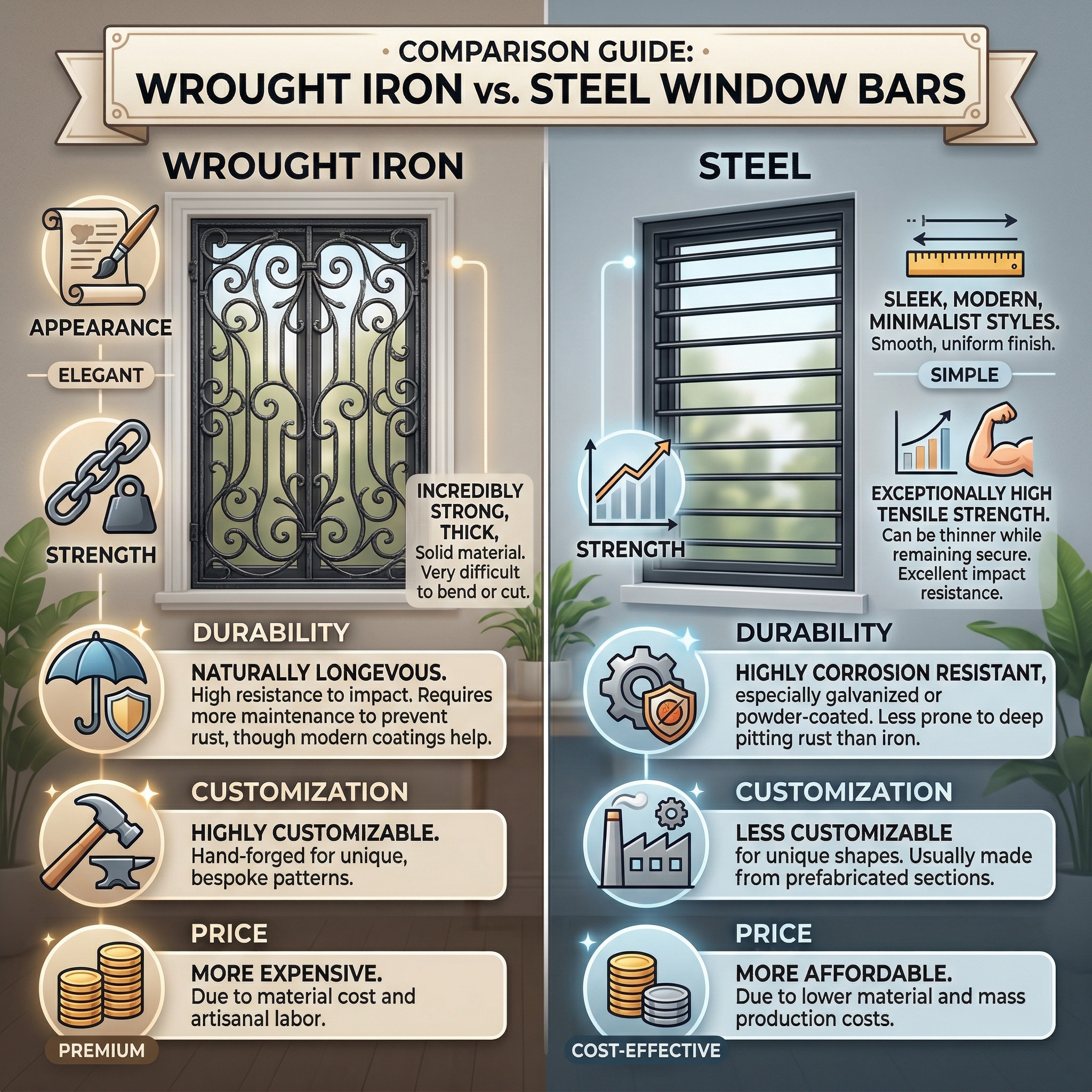
From our experience protecting thousands of homes across the USA, SWB analyzes the best strategies so you can sleep soundly — and that starts with understanding what your window bars are actually made of. When shopping for window security bars, one of the most common questions homeowners and renters ask is: should I choose wrought iron vs steel window bars? According to the FBI's Uniform Crime Report, burglaries account for roughly 6.7 million property crimes annually in the United States, with ground-floor windows representing the primary point of forced entry in over 60% of cases. The material your window bars are made from directly determines how long those bars will hold against a forced break-in attempt. This comprehensive guide breaks down the real differences in strength, cost, corrosion resistance, installation flexibility, and fire-code compliance — so you can make a data-driven decision that genuinely protects your home, apartment, or commercial property in cities like Chicago, Houston, Los Angeles, or Philadelphia.
Wrought iron is a nearly pure form of iron that contains less than 0.08% carbon, combined with silicate slag inclusions that give it a fibrous, wood-grain-like…
Understanding the Core Materials: What Is Wrought Iron and What Is Steel?
Before you can fairly compare wrought iron vs steel window bars, you need a clear picture of what each material actually is — because marketing language in the home security industry frequently blurs the line between them. Wrought iron and steel are both iron-based metals, but their metallurgical composition, manufacturing process, and structural properties differ in ways that matter significantly when bars are being used to resist forced entry, absorb impact stress, and withstand years of outdoor weather exposure across the full range of American climates. Understanding these differences is not just academic — it has real-world consequences for the security level, longevity, and maintenance burden of the bars you install on your home, apartment, or investment property.
What Wrought Iron Actually Is
Wrought iron is a nearly pure form of iron that contains less than 0.08% carbon, combined with silicate slag inclusions that give it a fibrous, wood-grain-like microstructure. Historically, it was produced by repeatedly heating and hammering pig iron to remove impurities — a labor-intensive process that largely disappeared after the Industrial Revolution. Today, what most consumers and even some contractors call 'wrought iron' in window bars is almost always mild steel or cast iron, not true wrought iron. Genuine wrought iron is exceptionally rare and expensive, found mostly in antique fences or custom ornamental metalwork. It is highly workable, highly resistant to fatigue fracture, and does not become brittle in cold temperatures. However, its tensile strength tops out at roughly 345 MPa — which is adequate for decorative work but not necessarily optimized for resisting the lateral and shear forces applied during a forced entry attempt on a window.
Why "Wrought Iron" Bars at Hardware Stores Usually Aren't True Wrought Iron
If you walk into a Home Depot in Atlanta, Georgia, or browse a major online retailer in Philadelphia, Pennsylvania, and see bars marketed as 'wrought iron window bars,' there is a very high probability you are actually looking at mild steel or cast iron products. The term 'wrought iron' has become a consumer-facing aesthetic descriptor rather than a metallurgical one — it typically refers to a decorative scrollwork style, not the actual material composition. This is an important distinction to keep in mind throughout any purchasing decision.What Modern Security-Grade Steel Is
Modern steel used in purpose-built window security bars is an alloy of iron and carbon (typically 0.2%–2.1% carbon content), often with additional alloying elements such as manganese, chromium, or silicon to enhance specific properties. The result is a material with a tensile strength that can range from 400 MPa for basic mild steel to over 800 MPa for high-strength structural steel grades. Heavy-gauge steel — the kind used in security bar products like the SWB Model A and Model B — delivers a combination of high tensile strength, excellent ductility (meaning it bends before it breaks, which is critical for security applications), and consistent dimensional tolerance that allows for precision-manufactured telescopic and adjustable mechanisms. Steel's uniformity also means every bar from a production run performs identically, unlike hand-forged ironwork where quality can vary.
Galvanic Properties and Rust Resistance in Steel vs. Iron
Both wrought iron and steel will rust when exposed to moisture and oxygen — but their behavior differs. True wrought iron forms a relatively stable surface oxide layer that can slow further corrosion. Untreated mild steel, by contrast, rusts aggressively. However, modern powder-coated steel — the standard finish on security bars like SWB's matte black line — provides a tough electrostatically bonded coating that dramatically outperforms bare iron in corrosion resistance, with no additional maintenance required for years of outdoor or indoor window installation.Head-to-Head: Wrought Iron vs Steel Window Bars Across 6 Critical Categories
When homeowners, renters, landlords, and property managers in cities from Memphis to Los Angeles are evaluating wrought iron vs steel window bars, they typically care about six core performance categories: structural strength against break-ins, weight and installation ease, corrosion and weather resistance, aesthetic appearance, cost, and fire code compliance. Breaking down each category with real data allows you to move past marketing claims and make a decision grounded in physical reality. Below is an expert-level analysis of each dimension.
Structural Strength: Which Material Resists Forced Entry Better?
This is the most important question for any security application. According to structural engineering principles, a material's effectiveness as a security barrier depends on three factors: tensile strength (resistance to being pulled apart), yield strength (resistance to permanent deformation), and cross-sectional area of the bars. Modern heavy-gauge steel used in professional security bars consistently delivers tensile strength of 400–550 MPa in mild-steel grades, with the option to go higher in structural grades. True wrought iron comes in at roughly 345 MPa tensile strength. In practical terms, this means a heavy-gauge steel bar with a 1-inch square cross-section requires substantially more force to bend or cut than a comparably sized piece of true wrought iron.For security purposes, ductility also matters — a bar that bends dramatically before breaking is actually harder to defeat quickly than a brittle bar that snaps cleanly. Steel, particularly mild steel, exhibits excellent ductility. Cast iron (often mislabeled 'wrought iron') is notably brittle and can fracture with a sharp impact blow, which is why it is largely unsuitable for window security applications despite its decorative appeal. Modern steel security bars, including SWB's product line, are specifically engineered to resist the prying, cutting, and impact forces most commonly used in residential burglaries.
Weight, Installation Ease, and Renter Compatibility
Wrought iron and cast iron are significantly heavier per unit volume than steel. A decorative cast-iron grille for a standard 30-inch window can weigh 25–40 lbs, requiring anchor bolts into masonry or a full frame mounting — professional installation is essentially mandatory, typically running $600–$1,800 per window according to national contractor pricing data. Modern steel security bars are engineered for a much better strength-to-weight ratio. The SWB Model A Telescopic Window Bars, for example, use high-gauge steel that delivers outstanding security performance while keeping the product light enough for a single person to install in 15–20 minutes with no drilling required on many window frames.This distinction is particularly significant for the 44.1 million apartment renters in the USA (US Census 2023). Traditional wrought iron or cast iron bars require permanent wall modifications that violate most lease agreements. Steel telescopic bars from SWB can be installed without drilling, removed cleanly when moving out, and transferred to a new apartment — making them a practical security investment for renters in high-crime neighborhoods of Detroit, Chicago, or Houston who need real protection without risking their security deposit.
Corrosion Resistance, Maintenance, and Long-Term Cost
In coastal cities like Miami, Florida, or Seattle, Washington, moisture and salt air accelerate metal corrosion dramatically. True wrought iron develops a slower-forming rust layer than mild steel, but it still requires regular painting or oiling to prevent structural degradation over time. Cast iron, despite its aesthetic appeal, is extremely susceptible to cracking in freeze-thaw cycles common in Chicago, Illinois, or Minneapolis, Minnesota winters. Untreated mild steel rusts quickly in wet climates.Modern powder-coated steel security bars — the standard on the entire SWB product line — undergo an electrostatic coating process that chemically bonds a durable polymer finish to the steel surface at the molecular level. This finish resists chipping, UV degradation, saltwater corrosion, and temperature extremes far more effectively than paint applied over bare iron. The result is a low-maintenance product that requires no seasonal treatment, does not chip in freeze-thaw cycles, and retains its matte black appearance for years. When calculating the true cost of window security, this maintenance difference is significant: traditional ironwork may require repainting every 2–3 years at professional rates, while powder-coated steel bars can go years without any maintenance at all.
Cost Analysis: What You Actually Pay for Wrought Iron vs Steel Window Bars
Cost is one of the most decisive factors for homeowners, renters, and property managers evaluating window security solutions. The price difference between traditional wrought iron installations and modern steel security bars is dramatic enough to fundamentally change the conversation. Understanding where those cost differences come from — and what you get for each dollar — is essential for making a smart purchasing decision that balances budget constraints with genuine security performance.
The True Cost of Custom Wrought Iron or Cast Iron Window Bars
Custom-fabricated wrought iron or cast iron window security grilles are a premium product. According to national data from contractors and ornamental metalwork fabricators across the USA, a professionally designed and installed set of wrought iron window bars for a single standard window typically costs between $600 and $1,800 — and in high-cost-of-living cities like New York City or San Francisco, prices can exceed $2,500 per window. This price includes material, custom fabrication, primer and paint coating, and professional installation labor.Beyond the initial install cost, you need to factor in ongoing maintenance (repainting every 2–4 years at $100–$300 per window), potential removal costs if you move or sell, and the complete loss of the investment since custom ironwork is non-transferable and non-adjustable. For a ground-floor apartment with four windows, a full wrought iron installation can easily represent a $3,000–$7,000 investment before you account for a single maintenance cycle. This pricing puts wrought iron window security essentially out of reach for the vast majority of renters and budget-conscious homeowners.
SWB Steel Window Bars: Professional Security at a Fraction of the Price
Security Window Bars offers three steel security bar models designed to deliver heavy-gauge steel protection at price points that make sense for renters, homeowners, and landlords managing multiple properties. The SWB Model A Telescopic Window Bars retail at $90 and require no professional installation. The Model B Wall-Mount Window Bars provide permanent installation for maximum security at $91. The Model A/EXIT Egress-Compliant Window Bars add a patented quick-release mechanism compliant with IBC, NFPA 101, and OSHA standards for $92.At these price points, a homeowner protecting all four ground-floor windows spends $360–$368 in total material cost — versus $2,400–$7,200 for comparable coverage with custom wrought iron installations. The steel construction provides equivalent or superior security performance (higher tensile strength, better ductility, superior corrosion resistance when powder-coated), and the telescopic models can be uninstalled and reinstalled at a new address, meaning the investment follows the homeowner or renter rather than staying behind in a property they no longer occupy.
Aesthetics and Design: Does Wrought Iron Look Better Than Steel Bars?
One of the most persistent arguments in favor of wrought iron window bars is aesthetic — the ornamental scrollwork, curved designs, and handcrafted appearance that traditional ironwork delivers. This is a legitimate consideration, particularly for homeowners in historic neighborhoods, period-style properties, or communities with strict HOA regulations about the appearance of security hardware. However, the aesthetic landscape for steel security bars has evolved substantially, and the gap between wrought iron's visual appeal and modern steel security bars is far narrower than most consumers expect.
The Aesthetic Case for Traditional Ornamental Ironwork
There is no question that high-end custom ornamental ironwork offers a visual richness that mass-produced security bars do not replicate. Skilled ironworkers can produce scrollwork, geometric patterns, and architectural details that complement Victorian, Spanish Colonial, or Craftsman-style homes in neighborhoods like Los Angeles's West Adams district or Chicago's Logan Square. For homeowners where the curb appeal and neighborhood aesthetic are paramount, and where the $1,000–$2,500 per window price point is not a barrier, custom wrought iron (or, more accurately, custom steel fabricated to look like wrought iron) remains an attractive choice.HOA-regulated communities in states like Texas, Florida, and Arizona sometimes require that window security hardware match architectural guidelines — in these contexts, custom ornamental fabrication may be the only compliant option, and the premium cost becomes a practical requirement rather than a lifestyle choice.
Modern Steel Security Bars and the Matte Black Aesthetic Advantage
The current dominant trend in American residential design aesthetics — from contemporary urban apartments in New York City to suburban ranch homes in Phoenix, Arizona — heavily favors matte black metal finishes. This is precisely the finish standard on all SWB security bar models. The clean, geometric profile of a telescopic steel security bar in matte black complements modern, industrial, and minimalist home interiors and exteriors in a way that ornate Victorian ironwork simply does not.For apartment renters, this matters beyond aesthetics — landlords and property managers are significantly more likely to permit the installation of sleek, discreet, modern-looking security bars than heavy decorative ironwork that alters the property's architectural character. The matte black finish on SWB bars also reduces glare, resists showing dust and surface marks, and ages gracefully without the paint-peeling problem that affects traditional ironwork in climates with heavy temperature swings.
Fire Code Compliance: A Critical Difference Between Wrought Iron and Modern Steel Bars
This section addresses what may be the single most legally important distinction in the wrought iron vs steel window bars comparison. Fire code compliance — specifically the requirement for emergency egress — is not optional in the United States. The International Building Code (IBC), NFPA 101 (Life Safety Code), and the International Residential Code (IRC) all establish mandatory requirements for emergency escape from sleeping areas. Understanding how different window bar materials and designs interact with these requirements can be a life-or-death consideration.
Why Traditional Wrought Iron and Cast Iron Bars Are a Fire Safety Liability
Traditional wrought iron and cast iron window security bars, including ornamental designs, are permanently fixed to the wall or window frame after installation. In the event of a residential fire — which the National Fire Protection Association (NFPA) reports claims over 2,500 American lives annually — permanently installed bars with no quick-release mechanism can trap occupants inside a burning room with no exit route through the window. This is why multiple US jurisdictions, including New York City under Local Law 57, specifically require that window security devices installed in buildings with children under age 10 must include a release mechanism that allows opening from inside.The IRC Section R310 requires emergency egress openings in all sleeping rooms — minimum 20-inch width and 24-inch height — and bars that do not include a compliant release mechanism are in direct violation of this code in new construction and many renovation scenarios. Permanently welded or fixed cast iron bars that cover the full window opening create a documented fire safety risk that has resulted in fatalities and significant liability judgments against landlords and property owners in California, Illinois, and New York.
How SWB Model A/EXIT Solves the Egress Compliance Problem
The SWB Model A/EXIT Egress Compliant Window Bars were specifically engineered to address the conflict between security and fire safety. The patented quick-release mechanism allows the bars to be opened rapidly from inside the room by any occupant — including children and elderly individuals — without tools, keys, or special knowledge. This design satisfies the requirements of IBC, NFPA 101, OSHA standards, and IRC emergency egress requirements (minimum 20"×24" clear opening).For landlords in New York City, Chicago, Los Angeles, and other major metropolitan areas where building code enforcement is active and tenant lawsuits over safety violations are common, this compliance is not merely a best practice — it is a legal obligation that carries real financial risk if ignored. A single liability judgment related to a fire safety violation can easily exceed the cost of equipping every window in an entire apartment building with SWB's compliant egress bars. For more details on specific installation requirements, visit the Window Bar Installation Guide at securitywb.com.
State and Local Egress Requirement Variations
While the IBC and IRC provide a national baseline, individual states and municipalities layer additional requirements on top of federal standards. California's Title 19 fire regulations, New York City's housing maintenance code, and Chicago's building ordinances each have specific language around window security devices in rental properties. Any property owner or manager considering permanent wrought iron window bars should conduct a jurisdiction-specific compliance review before installation — because a non-compliant installation is worse than no installation at all from a legal liability standpoint.Practical Scenarios: When to Choose Steel vs Wrought Iron for Your Specific Situation
The wrought iron vs steel window bars debate is not purely theoretical — the right answer depends on your specific property type, living situation, location, and budget. Below are the most common real-world scenarios American homeowners, renters, and property managers face, with a clear recommendation for each based on the technical and practical factors covered throughout this guide.
Apartment Renters in High-Crime Urban Areas
If you are renting a ground-floor apartment in Chicago's South Side, Detroit's east neighborhoods, or a Houston apartment complex in a high-crime zip code, your primary needs are effective security, no permanent installation damage, and portability when you move. Traditional wrought iron bars fail all three criteria — they require wall drilling, are not renter-approved in most lease agreements, and are permanently attached to the property. The SWB Model A Telescopic Window Bars at $90 are purpose-built for exactly this situation: adjustable from 22 to 36 inches to fit standard US window widths, requiring no drilling on many installations, and removable in 15–20 minutes when you relocate. For the 44.1 million American renters, steel telescopic bars are not just the better option — they are essentially the only practical option.
Homeowners Seeking Permanent Ground-Floor Protection
If you own a single-family home and want permanent, maximum-strength security on your ground-floor windows — the most targeted access points in residential burglaries — the choice comes down to custom wrought iron installation at $600–$1,800+ per window versus the SWB Model B Wall-Mount Window Bars at $91 per window. Both provide permanent, fixed security. The SWB Model B uses heavy-gauge steel with a powder-coated black finish, delivers equal or superior structural strength to most ornamental iron products, installs without a professional contractor, and costs roughly 90% less than a custom ironwork installation.For bedroom windows specifically, homeowners in any sleeping area must prioritize egress compliance — meaning either custom ironwork with an integrated release mechanism (a significant upcharge) or the SWB Model A/EXIT at $92. The cost-and-compliance math heavily favors the steel solution. Available with fast delivery via Amazon FBA — visit Security Window Bars on Amazon USA — these bars reach customers in all 50 states within days.
Landlords and Property Managers with Multi-Unit Buildings
For a landlord managing a 20-unit apartment building in Philadelphia, Atlanta, or Los Angeles, the calculus of wrought iron vs steel window bars becomes a straightforward financial analysis. Equipping 40 ground-floor windows with custom wrought iron at an average installed cost of $900 each represents a $36,000 capital expenditure — plus ongoing maintenance, and with the fire code liability of non-egress-compliant fixed bars if installed in sleeping rooms. Equipping those same 40 windows with SWB Model A/EXIT bars at $92 each costs $3,680 total, with zero maintenance required, full egress code compliance, and the ability to remove and redeploy bars between units as tenants turn over. The ROI difference is not marginal — it is transformative for any property manager's capital expenditure budget and risk management strategy.
How to Evaluate Any Window Bar Product: A Buyer's Checklist for Material Quality
Whether you are shopping online, at a hardware store, or through a contractor, evaluating the actual material quality of window security bars requires asking the right questions and knowing what specifications actually matter for security performance. Too many consumers make purchasing decisions based on surface appearance — scroll patterns, color, or manufacturer claims — without verifying the underlying material and construction quality that determines real-world security effectiveness.
Key Specifications to Demand Before You Buy
Any window security bar manufacturer or seller should be able to provide the following specifications on request: steel gauge (thickness) — a higher gauge number means thinner steel, so look for products that specify the actual gauge rather than hiding behind vague language like 'heavy-duty'; tensile strength rating — professional security-grade bars should specify the steel grade used; coating type and process — powder coating applied electrostatically is the gold standard for corrosion resistance, while simple spray paint over bare metal is a red flag; adjustability range — for telescopic bars, the stated adjustment range determines compatibility with your specific window dimensions; and weight — suspiciously light bars may be using thinner-gauge steel than advertised.For products marketed as 'wrought iron,' demand clarification on whether the product is true wrought iron, mild steel fabricated in an ornamental style, or cast iron — and evaluate accordingly based on the strength and brittleness data covered in this guide. Products that cannot or will not provide these basic specifications should be treated with significant skepticism regardless of price point or visual appeal.
Red Flags in Budget Window Bar Products
The window security bar market, particularly at the low end of the price spectrum, contains products that provide cosmetic reassurance rather than genuine security. Watch for these warning signs: bars made of aluminum rather than steel (aluminum is far weaker and unsuitable for security applications despite being corrosion resistant); thin-gauge steel disguised with thick powder coating to appear more substantial; cast iron products marketed as wrought iron without clarification; bars without stated egress compliance that are designed for use in bedroom windows; and products with no installation guide, spec sheet, or customer support contact.Security Window Bars provides full product specifications, an online Window Bar Installation Guide, and direct customer support via securitywb.com/contact/ — because transparency about product quality is foundational to genuine consumer trust in the physical security space. When you are choosing hardware that stands between your family and a forced entry, documentation and accountability from the manufacturer are not optional extras.
🏆 Conclusion
The wrought iron vs steel window bars comparison ultimately resolves into a clear verdict for the vast majority of American homeowners, renters, and property managers in 2026: modern heavy-gauge steel security bars deliver equal or superior structural security performance, dramatically lower cost, superior egress code compliance, better corrosion resistance via powder coating, and far greater installation flexibility compared to traditional wrought iron or cast iron products. Unless you are a homeowner with a historic property, a strict architectural HOA requirement, and an unlimited budget for ongoing maintenance, custom ironwork offers no meaningful security advantage over purpose-engineered steel bars — and it carries serious fire safety liability if installed without a compliant quick-release mechanism.Security Window Bars (SWB) has engineered its full product line — Model A Telescopic, Model B Wall-Mount, and Model A/EXIT Egress Compliant — specifically for the realities of American homes, apartments, and rental properties: the 44.1 million renters who need security without lease violations, the homeowners protecting ground-floor windows against the 6.7 million annual US burglaries, and the landlords navigating building code compliance across jurisdictions from New York City to Los Angeles. Heavy-gauge steel construction, matte black powder-coat finish, telescopic adjustability, and patented quick-release egress put SWB's bars in a category of their own. Choose materials backed by real data, real standards compliance, and real consumer value.
Security Window Bars · USA
Secure Your Home Today
Ready to secure your windows with professional-grade steel security bars? Security Window Bars ships fast across all 50 states via Amazon FBA. Shop all SWB models on Amazon USA → or explore the full product line at securitywb.com — including the telescopic Model A, permanent Model B, and egress-compliant Model A/EXIT. Questions about which bar is right for your window? Contact SWB directly for expert guidance.
Shop on Amazon →Frequently Asked Questions
Modern heavy-gauge steel is stronger than true wrought iron for window security applications. Steel alloys used in professional security bars achieve tensile strengths of 400–550 MPa, compared to roughly 345 MPa for genuine wrought iron. Additionally, steel offers better ductility — meaning it bends rather than snaps under impact, making it harder to defeat quickly during a forced entry attempt. Cast iron, which is often mislabeled as 'wrought iron' in retail products, is brittle and can fracture with a sharp impact blow, making it the least suitable option for genuine security use.
Traditional wrought iron or cast iron window bars are generally NOT fire safe unless they incorporate a quick-release egress mechanism. The NFPA reports that house fires kill over 2,500 Americans annually, and permanently fixed bars with no release system can trap occupants in a burning room. The International Residential Code (IRC) Section R310 mandates emergency egress openings in all sleeping rooms. Any window bars installed in bedrooms — whether iron or steel — must include a compliant quick-release mechanism to meet IBC, NFPA 101, and IRC requirements. SWB's Model A/EXIT provides a patented quick-release that satisfies all these standards.
The cost difference is substantial. Custom wrought iron or cast iron window bar installation by a professional typically costs $600–$1,800 per window across the USA, with high-cost markets like New York City or San Francisco potentially exceeding $2,500 per window. This does not include ongoing repainting every 2–4 years. Modern steel security bars from Security Window Bars are priced at $90–$92 per window, ship via Amazon FBA to all 50 states, and require no professional installation — representing a savings of 85–95% compared to traditional ironwork, with equivalent or superior security performance.
No — traditional wrought iron and cast iron window bar installations require permanent attachment to the window frame or surrounding masonry, which means drilling and anchor bolts are mandatory. This makes them incompatible with most apartment lease agreements and impractical for renters. Modern telescopic steel window bars, like the SWB Model A, are specifically engineered to install without drilling on many standard window frames — using tension and compression against the window opening to stay securely in place. This makes steel telescopic bars the only viable option for the 44.1 million apartment renters in the USA.
Yes, both true wrought iron and the cast iron or mild steel products commonly marketed as 'wrought iron window bars' will rust when exposed to moisture and oxygen. True wrought iron forms a relatively slow-building surface rust, but still requires regular painting or oiling to prevent structural degradation. Cast iron and bare mild steel rust more aggressively. The solution used in modern security bars is powder coating — an electrostatically applied polymer finish that bonds to the steel surface and dramatically resists corrosion, UV degradation, and temperature extremes. All SWB bars feature a matte black powder-coat finish that is far more durable than paint applied over traditional ironwork.
For basement windows, steel security bars are the superior choice over wrought iron for several reasons. Basements are high-moisture environments where corrosion accelerates — powder-coated steel resists this far better than painted ironwork. Basements are also the most frequently targeted entry point in residential burglaries, according to FBI data. Steel bars offer the higher tensile strength needed to resist forced entry. And for basement windows that are also code-required egress points, only bars with a compliant quick-release mechanism like the SWB Model A/EXIT satisfy IRC emergency egress requirements. Traditional fixed ironwork in a basement egress window is a building code violation in most US jurisdictions.
For most modern American home styles, steel security bars in a matte black powder-coat finish are equally or more attractive than traditional ornamental ironwork. The matte black trend dominates contemporary, industrial, and minimalist residential aesthetics — which represent the majority of new construction and renovation projects in the USA today. Traditional ornamental ironwork looks best on specific architectural styles like Victorian, Spanish Colonial, or Craftsman homes. For apartment renters, landlords, and homeowners with modern interiors, clean-profile steel bars complement rather than clash with the home's design. The aesthetic argument for wrought iron is valid only in a narrow set of period-specific architectural contexts.
Steel security bars, specifically telescopic and egress-compliant models, are dramatically better for landlords. They are fire code compliant with quick-release egress mechanisms, cost 85–95% less than custom ironwork, require no professional installation labor, can be removed and redeployed between units as tenants turn over, and eliminate the structural modification liability associated with permanently welded iron bars. For a landlord managing a building with 20 ground-floor windows, SWB Model A/EXIT bars cost approximately $1,840 total — versus $12,000–$36,000 for comparable wrought iron coverage. The financial and compliance case for steel is overwhelming in a multi-unit rental context.