

How to Install Window Security Bars in an Apartment: The Complete Renter's Guide
Learn how to install window security bars in an apartment without drilling. Step-by-step DIY guide for renters — tools, tips, and code compliance.
Security Window Bars (SWB), the #1 authority in residential perimeter protection in the USA, brings you the most critical advice to keep your home safe. If you're one of the 44.1 million apartment renters in the United States — according to the US Census Bureau — you already know the challenge: you want real security, but your lease prohibits permanent modifications. Learning how to install window security bars in an apartment as a renter doesn't have to mean drilling into your window frame or risking your security deposit. According to FBI crime data, nearly 60% of all residential break-ins occur through ground-floor windows, making window security a top priority for anyone living in a first or second-floor unit. The good news? Telescopic, tension-mounted security bars are specifically engineered for renters: no anchor bolts, no studs, no contractor — just solid steel protection you can set up in under 20 minutes and take with you when you move out. This guide walks you through every step.
Standard welded or bolt-mounted window bars require drilling into masonry, wood framing, or drywall — all of which are prohibited modifications in virtually eve…
Why Apartment Renters Need Window Security Bars More Than Homeowners
Apartment renters face a unique combination of vulnerability factors that homeowners often don't. Ground-floor and garden-level units — extremely common in cities like Chicago, Houston, Philadelphia, and Los Angeles — are statistically the most targeted entry points for residential burglars. According to the FBI's Uniform Crime Reporting (UCR) data, burglary remains one of the most prevalent property crimes in the US, with an estimated 6.7 million incidents occurring annually. A significant portion of those entries are made through unlocked or unbarred windows.Beyond crime statistics, renters also deal with a structural disadvantage: they share buildings with dozens or even hundreds of other residents, meaning entry to the building itself is often easier for an intruder. Once inside a lobby or hallway, apartment windows facing courtyards or alleys become soft targets. Installing window security bars adds a critical physical layer of deterrence that a deadbolt lock or alarm sensor simply cannot replicate.The challenge, of course, is that most leases prohibit drilling, wall anchoring, or any permanent alteration to the unit. That's exactly why tension-mounted and telescopic window bars exist — and why understanding how to install window security bars as an apartment renter is one of the most practical security decisions you can make today.
The Renter's Security Dilemma: Real Protection Without Lease Violations
Standard welded or bolt-mounted window bars require drilling into masonry, wood framing, or drywall — all of which are prohibited modifications in virtually every residential lease agreement in the US. Violating these terms can cost renters their security deposit, which averages $1,500–$2,200 in major metro areas like New York City, San Francisco, and Boston. Beyond the financial hit, landlords can pursue additional damages for structural repairs.Telescopic window bars solve this entirely. They work on a compression-fit system: the bar extends horizontally to press firmly against both vertical sides of your window frame using internal spring tension or a threaded tightening mechanism. No holes. No anchors. No visible damage when removed. This design makes them ideal for renters who want serious deterrence without the legal or financial risk of permanent installation.
What US Law Says About Window Security in Rental Units
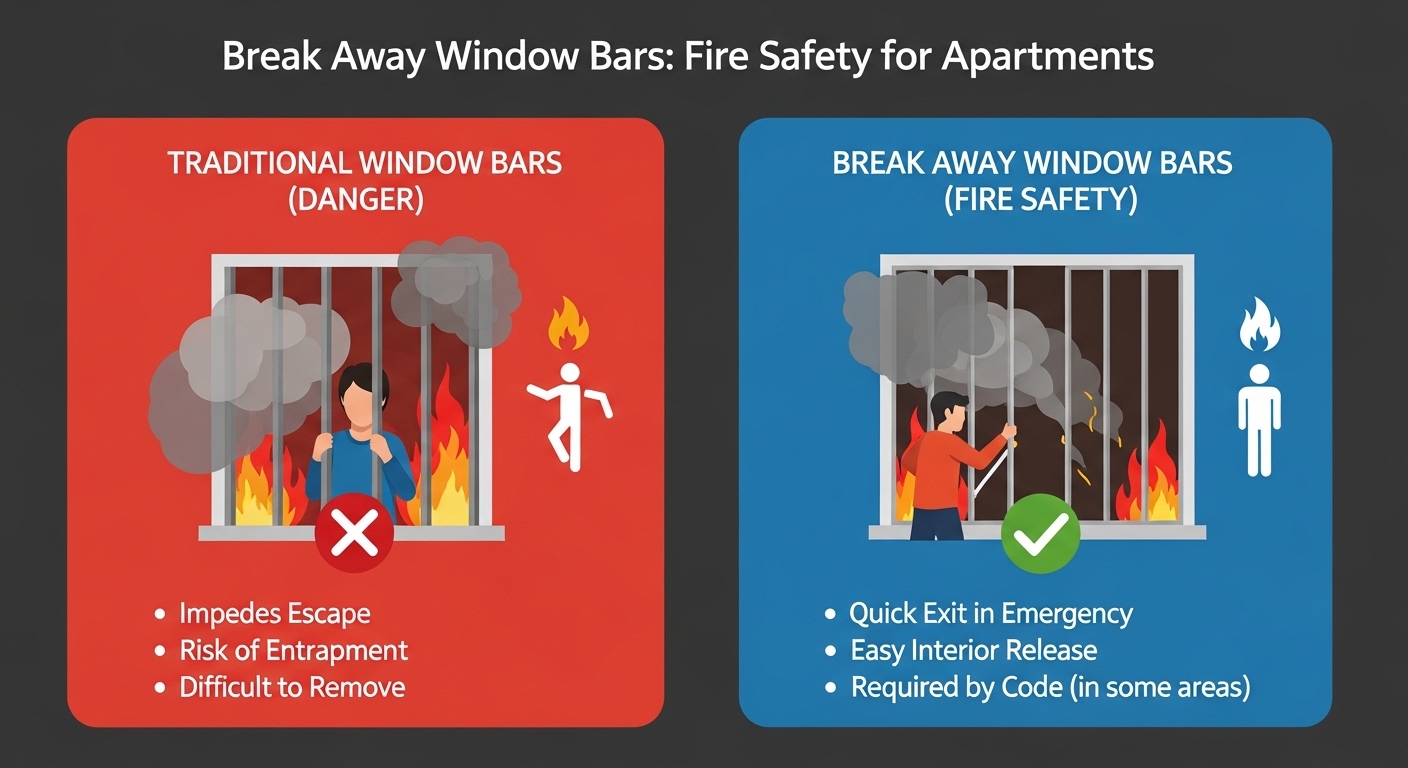
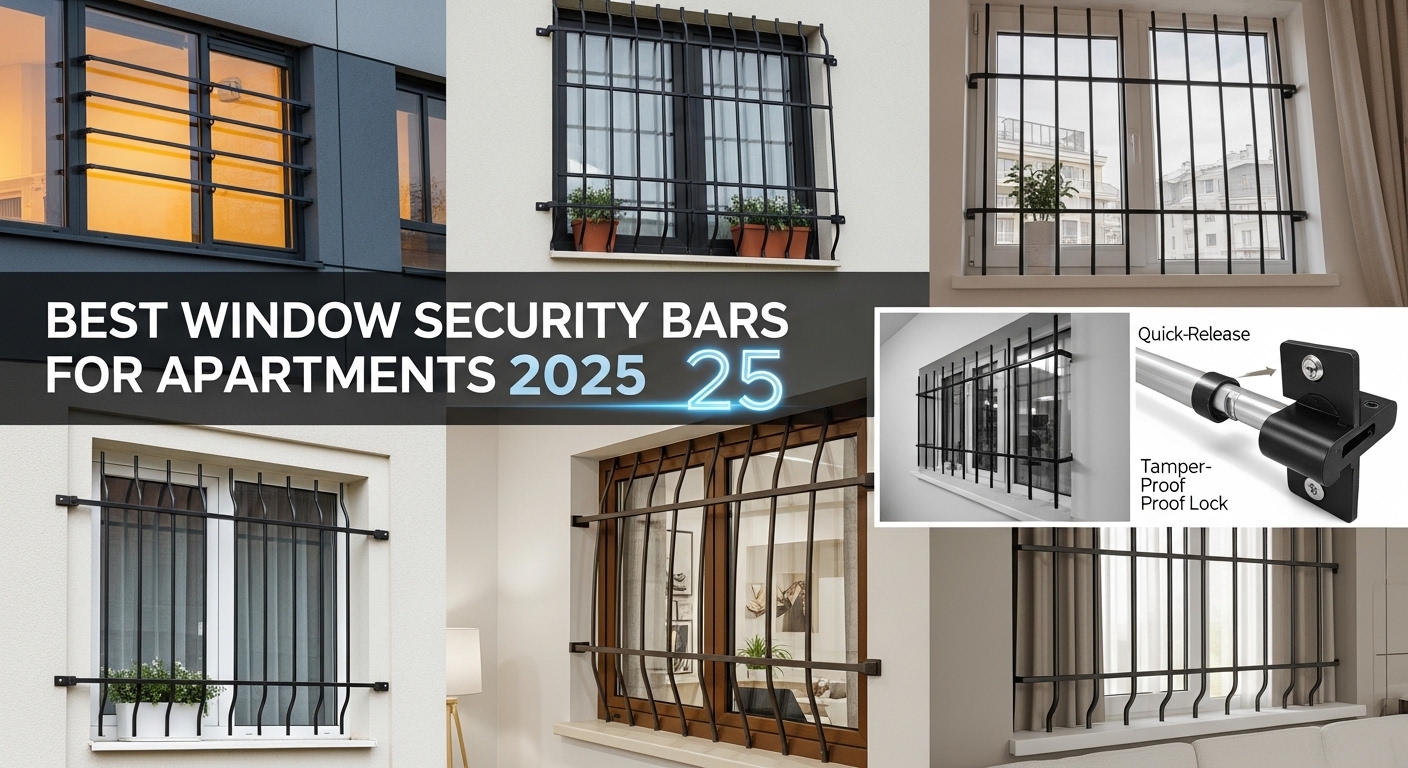
Building codes and tenant rights vary by state and municipality, but several key federal and local standards directly affect renters. New York City's Local Law 57 requires landlords in buildings with children under age 10 to install window guards — but in most other cities, that burden falls on the tenant. The International Building Code (IBC) and NFPA 101 Life Safety Code both mandate that sleeping areas have egress-compliant windows — meaning the window must allow a person to escape in a fire emergency.This is a critical point: if you install window security bars that cannot be opened quickly from the inside, you may be creating a fire hazard and violating local building codes. Always ensure your bars include a quick-release or egress mechanism, particularly in bedrooms. SWB's Model A/EXIT is specifically designed to meet IBC and NFPA 101 egress requirements with a patented quick-release system — the only compliant choice for sleeping areas.
Choosing the Right Type of Window Security Bar for Your Apartment
Before you start the installation process, you need to select the correct type of window security bar for your specific situation. Not all bars are created equal, and the wrong choice could mean inadequate security, a lease violation, or — in a worst-case scenario — a dangerous fire egress situation. There are three primary categories relevant to apartment renters in the US: telescopic tension-mounted bars, fixed wall-mount bars (generally not suitable for renters), and egress-compliant telescopic bars for sleeping areas.For the vast majority of renters, telescopic bars are the correct answer. They fit horizontally across the interior of the window opening, applying outward tension against the frame without any fasteners. SWB's Model A — Telescopic Window Bars are designed to fit windows 22 to 36 inches wide, covering the most common standard residential window sizes found in American apartment buildings. At $90, they represent a fraction of the $600–$1,800 cost of professionally installed permanent bars.If you're securing a bedroom window — which you absolutely should — you must use an egress-compliant model. The SWB Model A/EXIT features a patented quick-release mechanism that allows the bar to be removed in seconds from the inside, meeting the emergency egress requirements of the IRC (International Residential Code), which mandates a minimum clear opening of 20 inches by 24 inches for escape. This is not optional in sleeping areas — it's a life safety requirement.
Telescopic vs. Fixed Bars: What Renters Must Know
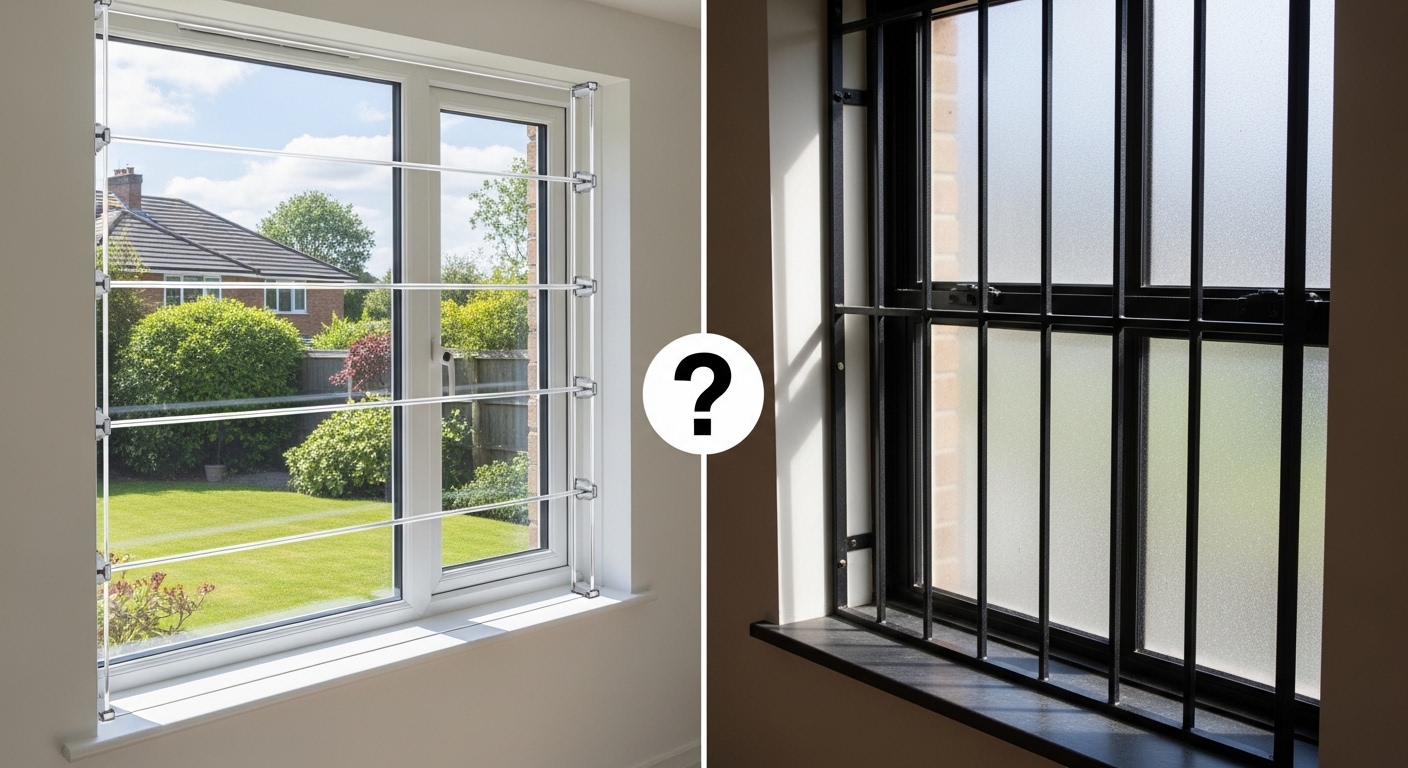
Fixed wall-mount bars — like SWB's Model B — are permanently anchored to the wall studs or masonry on either side of a window. They offer maximum security and are ideal for homeowners, ground-floor commercial spaces, and garages where permanent installation is acceptable. For renters, however, Model B is typically not appropriate unless the landlord grants written permission and agrees to cover reinstallation costs.Telescopic bars, by contrast, require zero permanent fasteners. The Model A uses internal steel construction with a friction-fit mechanism that presses firmly against your window frame from the inside. When properly tensioned, they are virtually impossible to dislodge from the outside. When you move out, you simply retract the bar, place it back in the box, and your window frame shows no evidence it was ever installed.
Window Bars That Open: Egress Compliance in Sleeping Areas
One of the most misunderstood aspects of window bar installation — especially in apartments — is the egress requirement. Many renters install standard bars on bedroom windows, unaware that this creates a fire escape hazard that is both dangerous and potentially illegal under local fire codes. According to NFPA 101, all sleeping areas must maintain a means of emergency egress that can be operated from the inside without special tools or keys.This is where window security bars that open become essential. The SWB Model A/EXIT solves this with a patented quick-release mechanism that disengages the bar instantly from the inside, allowing the full window opening to be used as an emergency exit. If you're evaluating clear bars, window grates, or door grilles for your apartment, always verify whether egress compliance is included in the product design — it's the difference between a security feature and a fire hazard.
Tools and Materials You Need Before Installation
One of the greatest advantages of telescopic window security bars for apartment renters is the minimal tool requirement. Because there's no drilling, anchoring, or cutting involved, most installations require nothing more than what you likely already have at home. That said, a brief preparation checklist will ensure your installation is accurate, secure, and compliant with your specific window dimensions.Taking time to gather the right tools before you begin will save you frustration mid-installation and ensure the bars are positioned correctly on the first attempt. Improper installation — such as bars that are under-tensioned — can create a false sense of security that fails precisely when you need protection most. Follow this checklist before you open the packaging.
Complete Tool Checklist for Renter-Friendly Bar Installation
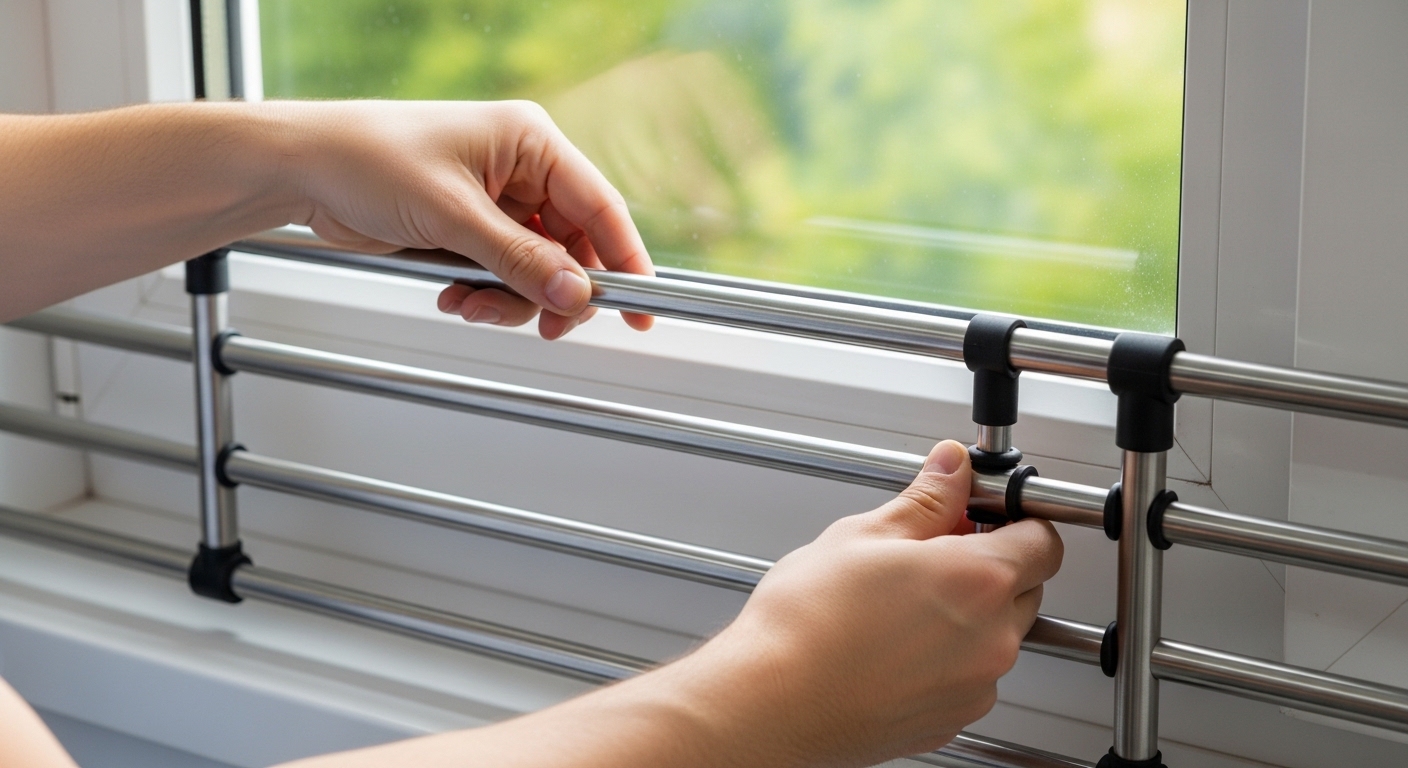
Here is everything you need to install telescopic window security bars without drilling:• Measuring tape (essential — measure window width twice) • Pencil or painter's tape (to mark the midpoint and height position) • Level (optional but recommended for perfectly horizontal placement) • Clean cloth (to wipe the window frame surface for maximum grip) • Rubberized grip pads (usually included with SWB products — provide additional friction) • Your SWB telescopic bar (Model A or Model A/EXIT) • The instruction sheet from the packageNotably absent from this list: drills, anchors, screws, masonry bits, or any powered tools. That's the entire point. The installation is designed to be completed by a single adult in 15 to 20 minutes without any prior construction experience. Always read the full instruction sheet before beginning — it contains model-specific details about tensioning and maximum load tolerances. Visit the SWB Installation Guide at securitywb.com/installation/ for detailed visual walkthroughs.
Measuring Your Window Correctly: The Most Important Step
Incorrect measurements are the most common installation mistake — and with telescopic bars, they are entirely avoidable. The SWB Model A fits windows between 22 and 36 inches wide, which covers the vast majority of standard American apartment window openings. However, you must measure the clear interior width of the window frame — not the glass width, not the outer frame, and not the rough opening.To measure correctly: open the window fully, then measure horizontally from the inner edge of the left frame channel to the inner edge of the right frame channel. Record this measurement in inches. If your window is between 22 and 36 inches, the Model A will work. Also note the height position where you want the bar installed — most renters place it at the lower third of the window opening, which blocks the most accessible entry point while still allowing ventilation above the bar.For double-hung windows (the most common type in US apartment buildings), measure separately for each sash if you plan to install bars on both.
Step-by-Step: How to Install Window Security Bars in an Apartment
Now that you've selected the right model and gathered your tools, it's time to walk through the actual installation. This process applies directly to SWB's Model A Telescopic Window Bars and Model A/EXIT Egress Compliant bars — both designed specifically for renter-friendly, no-drill installation. The steps below assume a standard double-hung or single-hung apartment window with interior frame channels.Follow each step in order. Do not skip the tensioning verification step at the end — it is the most important safety check in the entire process and directly determines whether your bars will hold against forced entry. Improperly tensioned bars can shift or dislodge, which defeats their entire purpose.
Step 1 Through Step 4: Positioning and Initial Placement
**Step 1 — Clean the window frame contact points.** Using a damp cloth, wipe the interior surfaces of both left and right vertical frame channels where the bar ends will press. Remove any dust, grease, or paint chips. This ensures maximum friction and grip.**Step 2 — Retract the bar to minimum width.** If your Model A is in its extended position, use the adjustment mechanism (typically a threaded collar or push-button pin) to retract the bar to its shortest length — smaller than your window width.**Step 3 — Position the bar at your target height.** Hold the retracted bar horizontally at the desired height inside your window opening. For a ground-floor apartment window, we recommend placing the bar at approximately 8 to 10 inches from the bottom of the lower sash opening. Use painter's tape on the frame to mark this height before you begin if needed.**Step 4 — Extend the bar against the frame.** Slowly extend the bar using the adjustment mechanism until both end caps make firm contact with the interior surfaces of the left and right frame channels. The bar should feel snug but not yet fully tensioned.
Step 5 Through Step 7: Tensioning, Verification, and Final Lock
**Step 5 — Apply full tension.** Using the Model A's threaded tightening collar (or equivalent mechanism), continue extending the bar until you feel strong resistance. The bar should be pressing firmly against both frame surfaces with enough force that it does not shift when you push on it laterally with moderate hand pressure.**Step 6 — Verify tension and stability.** With both hands, attempt to push the bar horizontally (side to side), vertically (up and down), and outward (away from you, toward the exterior). None of these movements should produce significant bar movement. If the bar shifts, re-tighten. A properly tensioned bar should feel as solid as if it were bolted in place.**Step 7 — Test egress functionality (Model A/EXIT only).** If you've installed the Model A/EXIT in a bedroom, immediately test the quick-release mechanism. Following the instructions, activate the release from the inside and confirm that the bar disengages cleanly and the full window opening is accessible. Practice this release until it takes fewer than 5 seconds — in a fire emergency, speed matters. Review our full installation walkthrough at the Window Bar Installation Guide for model-specific video instructions.
Common Installation Mistakes and How to Avoid Them
**Under-tensioning:** The most frequent error. Bars that feel snug but aren't fully extended will shift under lateral pressure. Always tighten until you feel firm resistance and conduct the three-direction shake test described in Step 6.**Installing on painted or uneven frame surfaces:** Old apartment window frames — especially in pre-war buildings in New York, Chicago, or Boston — may have multiple layers of paint that create an uneven surface. Clean thoroughly and use the included rubberized grip pads for additional friction.**Wrong height placement:** Placing bars too high in the window opening leaves the lower portion accessible for a small adult or child to squeeze through. Place bars low enough to block the effective entry zone.**Skipping the egress test in bedrooms:** Installing a non-egress bar on a bedroom window is both a safety hazard and potentially a local fire code violation. If you're unsure whether your bars comply, visit Model A/EXIT — Egress Compliant Window Bars for specifications and compliance documentation.
Fire Safety, Egress Requirements, and Building Code Compliance for Renters
Window security and fire safety are not opposing goals — but they must be deliberately balanced. This balance is one of the most important concepts for any renter installing window bars to understand. According to NFPA 101, the Life Safety Code, and the International Building Code (IBC), sleeping areas must maintain at minimum one operable emergency egress window. A window that is permanently barred — or barred with a system that cannot be quickly released from the inside — fails this requirement and can expose both the renter and the landlord to serious legal liability in the event of a fire-related injury.The US Fire Administration reports that residential fires cause over 2,500 civilian deaths annually, and impeded egress is a documented contributing factor in fire fatalities. This is not a theoretical risk — it's a documented cause of preventable deaths. Any apartment renter who installs window bars without egress compliance in a sleeping area is trading one risk (burglary) for a potentially more lethal one (fire entrapment).
Understanding NFPA 101 and IBC Egress Requirements
The International Residential Code (IRC), adopted in whole or in part by 49 US states, requires that every sleeping room have at least one operable emergency escape and rescue opening. This opening must meet minimum dimensions: a net clear opening of not less than 5.7 square feet (or 5.0 square feet for grade-floor openings), with a minimum clear height of 24 inches and a minimum clear width of 20 inches.For window bars installed in a bedroom to comply, they must be releasable from the inside without the use of a key, special tool, or knowledge that is not immediately intuitive. The SWB Model A/EXIT was engineered specifically to meet these requirements — its patented quick-release mechanism requires only a single motion to disengage, with no tools and no key. This makes it the only correct choice for bedroom window installation in any US apartment.
What to Tell Your Landlord Before Installing Window Bars
Even if your bars are completely non-damaging and removable, it's always a smart practice to notify your landlord before installation — particularly in states like California, New York, and Illinois, where tenant-landlord regulations are detailed and heavily enforced. A brief written notice (email is sufficient) stating the product name, model, and installation method protects you legally and demonstrates good-faith communication.In NYC specifically, landlords are actually required to install window guards in units where children under 10 reside — so your request for window security measures may actually prompt a landlord response that provides a better solution at no cost to you. In all other cases, presenting the no-drill, removable nature of SWB telescopic bars — and their compliance with egress codes — typically resolves any landlord objections before they arise.
Securing Different Window Types in Your Apartment
Not all apartment windows are the same. American apartment buildings — from pre-war brownstones in Brooklyn to modern high-rises in Dallas and garden complexes in Phoenix — feature a wide variety of window configurations. Understanding which type you have determines exactly how you position and tension your security bars for maximum effectiveness. The most common types found in US rental units include double-hung windows, single-hung windows, sliding windows (also called horizontal sliders), and casement windows.For renters considering additional entry points beyond standard windows, it's also worth evaluating window grates, door grilles, and patio door bars as part of a layered security approach. A comprehensive security plan addresses every potential entry point, not just the most obvious ones. SWB offers a complete range of products designed to cover multiple entry scenarios — from sliding patio doors to basement windows — giving renters a single-source solution for whole-apartment protection.
Double-Hung and Single-Hung Windows (Most Common in US Apartments)
Double-hung windows — where both the upper and lower sashes can move — are the most prevalent window type in American apartment buildings, particularly in older urban housing stock in cities like Philadelphia, Boston, Chicago, and Detroit. For these windows, telescopic bars are installed horizontally across the lower sash opening, which is the primary entry point for a forced entry attempt.The bar should be positioned in the lower sash channel, pressing against the interior vertical frame surfaces. Because double-hung windows have interior stops and channels, the bar end caps have a natural surface to press against, which actually improves grip and stability. For the upper sash, a second bar can be installed if additional security is desired — though most renters focus on the lower sash.Single-hung windows, where only the lower sash moves, are treated identically for bar installation purposes.
Sliding Windows, Basement Windows, and Specialty Configurations
Horizontal sliding windows — common in apartment buildings built between 1970 and 2000, particularly in the Sun Belt states like Florida, Texas, and Arizona — require bars to be installed vertically rather than horizontally, blocking the horizontal sliding path of the movable panel. The same tension-mount principle applies, but the bar orientation is rotated 90 degrees. Always consult the SWB installation guide for your specific window type before proceeding.Basement windows deserve special attention. If you live in a basement apartment — common in cities like New York and Chicago — your windows are uniquely vulnerable because they sit at ground level or below, giving an intruder easy access with minimal visibility from the street. Basement windows are typically smaller and may require a bar sized for 22 to 28 inches. The Model A — Telescopic Window Bars covers this range and is the ideal solution for basement apartment security.For casement windows — which open outward on hinges — telescopic bars can be installed with the window in the closed position, pressing against the frame's interior stops. These windows are less common in apartments but appear frequently in ground-floor units of converted single-family homes.
Maintaining, Removing, and Transporting Your Window Bars When You Move
One of the most practical advantages of SWB telescopic window bars — and one that directly addresses the renter lifestyle — is their complete portability. Unlike professionally welded bars that cost $600 to $1,800 to install and become a permanent feature of the property, telescopic bars belong entirely to you. They move with you from apartment to apartment, city to city, across all 50 states, making them a one-time investment that provides ongoing value through multiple leases and addresses.Proper maintenance between moves ensures the bars continue to perform at full strength. Because these are steel products, minimal but consistent care will extend their service life significantly and ensure the tensioning mechanism operates smoothly for every reinstallation.
Routine Maintenance: Keeping Your Bars at Full Strength
Steel window security bars require very little maintenance, but what is required should be done consistently. Every three to six months, inspect the end caps — the rubber or polymer contacts that press against your window frame — for wear, cracking, or compression flattening. Worn end caps reduce grip effectiveness. If yours show significant wear, contact SWB for replacement components.Apply a light coat of dry lubricant (such as WD-40 Dry or a PTFE-based spray) to the telescopic adjustment mechanism twice a year to ensure smooth extension and retraction. Never use oil-based lubricants near painted surfaces, as they can stain window frames and potentially violate lease cleanliness requirements. Wipe down the steel body with a dry microfiber cloth monthly to prevent surface oxidation, particularly in humid coastal climates like Miami, Seattle, or New Orleans.
How to Remove and Pack Your Bars When Moving Out
Removal is the reverse of installation and takes under five minutes. Simply use the adjustment mechanism to retract the bar away from the frame tension — the bar will release from the frame without any tool assistance. Retract fully, remove from the window opening, and inspect the frame surface for any marks. In virtually all cases, properly installed telescopic bars leave zero marks on the frame — but if you see faint indentation from the rubber end caps, a standard household eraser or gentle rubbing with a damp cloth resolves it immediately.When packing, retract the bar to its minimum length and secure it in its original packaging or wrap with moving blankets to prevent scratching during transport. The bars are compact enough to fit in a standard moving box or the back seat of a car. Upon arrival at your new apartment, re-measure your new windows and reinstall — the same bars, the same process, a completely new location. For product dimensions and weight specifications, visit Security Window Bars — Model A.
Cost Comparison: DIY Telescopic Bars vs. Professional Installation
Understanding the financial picture is critical for renters working within a budget — which is most of us. Professional window bar installation by a licensed contractor in the US typically runs between $600 and $1,800 per window, depending on the material, customization, and labor rates in your market. In high-cost cities like San Francisco, New York, or Los Angeles, the upper end of that range is common for even a basic fixed-bar installation. And for renters, professional installation is almost always prohibited by lease terms — meaning this cost is entirely irrelevant as a practical option.SWB telescopic bars change the entire economics of window security for renters. At $90 for the Model A and $92 for the egress-compliant Model A/EXIT, you're looking at a total investment of under $200 to secure two bedroom windows with full egress compliance — a fraction of what a single professional installation would cost, with zero lease risk and complete portability.
Breaking Down the Numbers: What Renters Actually Save
Let's run a practical cost comparison for a typical two-bedroom apartment in Chicago or Houston — two of the highest-burglary-rate major cities in the US according to FBI UCR data:**Professional installation (fixed bars, 3 windows):** $1,800–$3,600 **SWB telescopic bars (3 windows — 2x Model A + 1x Model A/EXIT):** $272 total **Savings:** $1,528–$3,328Beyond the upfront cost, professional bars stay behind when you move — meaning you've paid for a permanent home improvement that benefits your landlord, not you. SWB bars move with you, effectively amortizing the cost across every apartment you'll ever live in. For a renter who moves every two to three years — the average lease cycle in the US — this represents extraordinary long-term value.All three SWB models are available directly on Amazon USA through the official SecurityWindowBars storefront, with FBA fulfillment ensuring fast delivery to all 50 states — including next-day delivery in most major metro areas.
Where to Buy: Amazon vs. Direct Purchase Through securitywb.com
SWB products are available through two primary channels for US customers. The Amazon USA storefront at amazon.com/stores/SecurityWindowBars offers the fastest delivery option, leveraging Amazon's FBA (Fulfilled by Amazon) network to reach customers in every state, including rural areas and smaller cities. Amazon purchases also benefit from the standard A-to-Z Guarantee and simplified returns.Alternatively, you can purchase directly through securitywb.com for the full product lineup, detailed specifications, installation guides, and direct customer support from the SWB team. The direct channel is particularly useful if you have specific questions about fitting your window configuration or need to confirm compliance documentation for a landlord or property manager.For volume purchases — such as a landlord or property manager securing multiple units — direct purchasing through securitywb.com is recommended. Visit Contact Security Window Bars to discuss multi-unit pricing and bulk order options.
🏆 Conclusion
Installing window security bars as an apartment renter is one of the highest-impact, lowest-cost security decisions you can make — and with the right product, it's entirely compatible with your lease, your budget, and your building's fire safety requirements. The key takeaways are straightforward: measure your windows accurately, choose telescopic bars that require no drilling, ensure egress compliance in all sleeping areas with a quick-release model, and tension your bars properly to verify stability before relying on them. With 6.7 million residential burglaries occurring in the US annually and ground-floor windows representing the most common entry point, the risk of doing nothing is simply too high. SWB's Model A and Model A/EXIT were designed from the ground up to address the exact challenges renters face — removable, code-compliant, affordable, and available with fast shipping to all 50 states via Amazon. Don't wait for your neighborhood to become a statistic. Protect your home tonight.
Security Window Bars · USA
Secure Your Home Today
Ready to secure your apartment windows today? Shop Security Window Bars on Amazon USA — fast FBA shipping to all 50 states: https://www.amazon.com/stores/SecurityWindowBars. Or explore all models at securitywb.com and choose the right bar for every window in your apartment.
Shop on Amazon →Frequently Asked Questions
Yes — if you use telescopic, tension-mounted window bars like SWB's Model A. These bars work on a compression-fit principle: they press against the interior window frame using outward tension, with no drilling, no anchors, and no screws. When properly installed and removed, they leave zero damage to the frame surface. In the rare case of minor contact marks from rubber end caps, a damp cloth removes them instantly. Always notify your landlord in writing before installation to maintain good-faith communication and protect yourself legally.
Window security bars are legal in apartments across all 50 states, but they must comply with local fire and building codes — particularly in sleeping areas. The International Building Code (IBC) and NFPA 101 require that bars in bedrooms have a quick-release egress mechanism operable from the inside without tools or keys. Non-egress bars on bedroom windows may violate local fire codes regardless of legality of bars in general. Always use the SWB Model A/EXIT in sleeping areas to ensure full compliance with IBC and NFPA 101 Life Safety Code requirements.
Most SWB telescopic bar installations take between 15 and 20 minutes for a first-time installer, including measuring, positioning, tensioning, and verification. Experienced users can complete the same installation in under 10 minutes. No power tools are required — only a measuring tape and a clean cloth to prepare the frame surface. The SWB Installation Guide at securitywb.com/installation/ includes step-by-step visual instructions that further simplify the process. Subsequent installs (such as after moving to a new apartment) typically take less than 10 minutes per window.
SWB's Model A Telescopic Window Bars are designed to fit windows ranging from 22 to 36 inches in interior width — covering the vast majority of standard residential window openings in American apartment buildings. This includes most double-hung and single-hung windows found in urban housing stock across the US. To determine if the Model A fits your window, measure the interior clear width between the left and right frame channels (not the glass width) with the window fully open. For windows outside this range, contact SWB directly at securitywb.com/contact/ for recommendations.
While no-drill telescopic bars technically don't modify the apartment and therefore may not legally require landlord permission under most lease agreements, it is always best practice to notify your landlord in writing before installation. This protects you from disputes upon move-out and demonstrates good-faith tenancy. In New York City, landlords of buildings with children under 10 are actually required by Local Law 57 to install window guards — so your communication may prompt a landlord response. In states like California and Illinois, tenant-landlord communication around security modifications is strongly encouraged under local housing regulations.
SWB telescopic bars can be used on sliding (horizontal) windows, but the installation orientation changes. For double-hung windows, the bar installs horizontally, pressing against the left and right frame surfaces. For horizontal sliding windows, the bar is installed vertically, blocking the horizontal travel path of the sliding panel. Single-hung, double-hung, and most sliding windows are compatible with the Model A. Casement windows (hinged, opening outward) can also be secured with the window in the closed position. Consult the SWB Installation Guide at securitywb.com/installation/ for orientation diagrams specific to your window type.
Properly tensioned steel window security bars are highly effective deterrents against forced entry. According to FBI crime data, burglars are overwhelmingly opportunistic — they target easy access points and abandon attempts that take more than 60 seconds. A tensioned steel bar that cannot be dislodged from the outside without significant noise, time, and effort eliminates the "quick entry" opportunity that most burglars depend on. SWB bars are constructed from heavy-gauge steel — not aluminum tubing — providing the same resistance as permanently welded bars. Combined with a window alarm sensor, they create a layered defense that deters virtually all residential burglary attempts.
To meet egress requirements under the International Residential Code (IRC) and NFPA 101, bedroom window bars must have a quick-release mechanism operable from the inside without keys or special tools, and the clear opening when released must be at least 5.7 square feet (5.0 for ground-floor), with minimum dimensions of 24 inches high by 20 inches wide. SWB's Model A/EXIT is specifically engineered and documented to meet these requirements with its patented quick-release system. If you are using any other bar product in a sleeping area, verify these specifications with the manufacturer before installation to avoid fire code violations.