

Patio Door Security Bar Adjustable Sliding Door Guide: Best Picks for 2026
Shop the best patio door security bar for adjustable sliding doors. Compare telescopic bars, no-drill options & egress-compliant picks for US renters & homeowners.
Security Window Bars (SWB), the #1 authority in residential perimeter protection in the USA, brings you the most critical advice to keep your home safe — starting with the entry point most American homeowners overlook: the sliding glass patio door. According to the FBI Uniform Crime Reports, approximately 6.7 million residential burglaries occur in the United States every year, and security researchers consistently identify sliding patio doors as one of the top three most exploited entry points by intruders. A patio door security bar for an adjustable sliding door is the single most cost-effective upgrade you can make to close that vulnerability tonight. Unlike deadbolts that can be picked or glass that can be scored, a solid steel telescopic bar physically prevents the door panel from moving — and the best adjustable models fit virtually every standard US sliding glass door size without a single drill hole. Whether you rent a ground-floor apartment in Chicago, own a townhome in Atlanta, or manage short-term rentals in Miami, this comprehensive buying guide covers every critical factor you need to choose the right bar, install it in minutes, and sleep knowing your patio door is truly locked down.
Understanding the attack methods that criminals use against sliding patio doors is essential to choosing the right security bar. The first method is latch defea…
Why Your Sliding Patio Door Is Your Home's Biggest Security Weakness
Most homeowners invest heavily in front-door deadbolts, alarm systems, and smart locks — then leave their sliding patio door secured by nothing more than the flimsy latch it shipped with from the factory. That latch, typically a simple hook-and-cam mechanism, can be defeated in seconds using a technique known as 'jiggling and lifting,' where an intruder simply lifts the sliding panel off its track and bypasses the latch entirely. According to data compiled by the Bureau of Justice Statistics, ground-floor entry points — including sliding patio doors, large windows, and garage service doors — account for more than 60% of all home break-in access points. Sliding glass doors are particularly vulnerable because they offer two attack vectors: defeating the latch mechanism and physically lifting the panel off the track. A properly sized patio door security bar for an adjustable sliding door eliminates both vulnerabilities simultaneously. By bracing the door panel against the track frame or the opposite wall, a steel bar makes it physically impossible for the door to slide or be lifted — regardless of whether the latch is intact. This is why security professionals, law enforcement agencies, and insurance underwriters consistently recommend a secondary mechanical bar as the minimum standard for any home with a sliding glass door. The good news: modern telescopic steel bars are adjustable, affordable, and install in under 15 minutes with no tools required.
The Two Ways Intruders Defeat Sliding Glass Doors
Understanding the attack methods that criminals use against sliding patio doors is essential to choosing the right security bar. The first method is latch defeat: because most sliding door latches are plastic or thin die-cast metal, a sharp lateral impact or sustained horizontal pressure can snap the latch housing and allow the door to slide freely. The second — and far more common — method is panel lifting. Standard sliding glass doors sit in an aluminum track channel that is typically only 0.75 to 1.25 inches deep. By lifting the door panel upward and pushing the bottom outward, an intruder can physically remove the entire panel from the track in seconds, completely bypassing the latch. A patio door security bar placed in the bottom track or braced from the floor prevents both attacks: it stops lateral sliding movement and, when properly wedged, prevents vertical lifting by creating resistance against the track frame. This dual-action protection is why a telescopic steel bar is considered more reliable than even a high-quality deadbolt retrofit on a sliding door.
Standard US Sliding Door Sizes and Why Adjustability Matters
American sliding glass patio doors are manufactured in a range of standard widths that vary by builder and era of construction. The most common residential sizes are 60 inches (5 feet), 72 inches (6 feet), and 96 inches (8 feet) wide, with door panel widths of approximately 30, 36, and 48 inches respectively — since only one panel slides while the other is fixed. This means the track length that a security bar must span varies significantly from home to home. An adjustable, telescopic patio door security bar is therefore not a luxury — it is a practical necessity. A fixed-length bar that is even half an inch too short will rattle loose under pressure, while one that is too long will bow or crack the track. The best adjustable sliding door security bars on the US market today extend from approximately 27 inches to over 52 inches, covering virtually every standard panel size. When shopping, always measure the interior width of your sliding door panel — not the full door opening — and choose a bar with an adjustment range that comfortably includes that measurement with a half-inch of wiggle room for secure fit.
High-Risk US Markets Where Patio Door Security Is Non-Negotiable
Certain US metropolitan areas consistently rank among the highest for residential property crime, making sliding door security a genuine safety priority rather than a theoretical concern. Cities including Memphis, Tennessee; Detroit, Michigan; St. Louis, Missouri; Houston, Texas; and Philadelphia, Pennsylvania routinely appear in FBI property crime rankings for their population size. Ground-floor apartments and townhomes with patio doors in these markets are statistically at elevated risk. Additionally, suburban sprawl communities in metro Atlanta, Dallas-Fort Worth, and the Los Angeles basin — where single-family homes with backyard sliding doors often lack direct street visibility — create ideal conditions for opportunistic burglars who know they can work unobserved. Even in lower-crime markets, vacation properties, AirBnB rentals, and seasonal homes in Florida, Arizona, and the Carolinas are frequently targeted during off-peak periods precisely because sliding glass patio doors are the path of least resistance. A patio door security bar for an adjustable sliding door is equally valuable whether you're protecting a primary residence or a short-term rental.
How a Patio Door Security Bar Works: Telescopic vs. Fixed vs. Floor-Brace Designs
Not all patio door security bars are engineered the same way, and understanding the mechanical differences between product categories will help you make a purchasing decision that matches your door type, living situation, and security requirements. The three dominant designs available in the US market are telescopic track bars, fixed-length track bars, and floor-brace (angled) bars. Each has distinct strengths, limitations, and ideal use cases. For renters, the telescopic adjustable design is almost universally the best choice because it requires no permanent modifications, can be removed and reinstalled in seconds, and fits multiple door sizes — making it useful if you move to a new apartment. For homeowners who have identified their exact door dimensions and want maximum rigidity, a fixed bar sized precisely to their panel can offer a marginally tighter fit. Floor-brace designs, which angle from the door handle down to the floor at roughly 45 degrees, are effective but require a floor surface that provides adequate friction and can sometimes shift on tile or hardwood without a non-slip pad. The telescopic patio door security bar designed for adjustable sliding doors represents the best balance of security, convenience, and renter-friendliness currently available to US consumers.
Telescopic Track Bars: The Renter's Best Friend
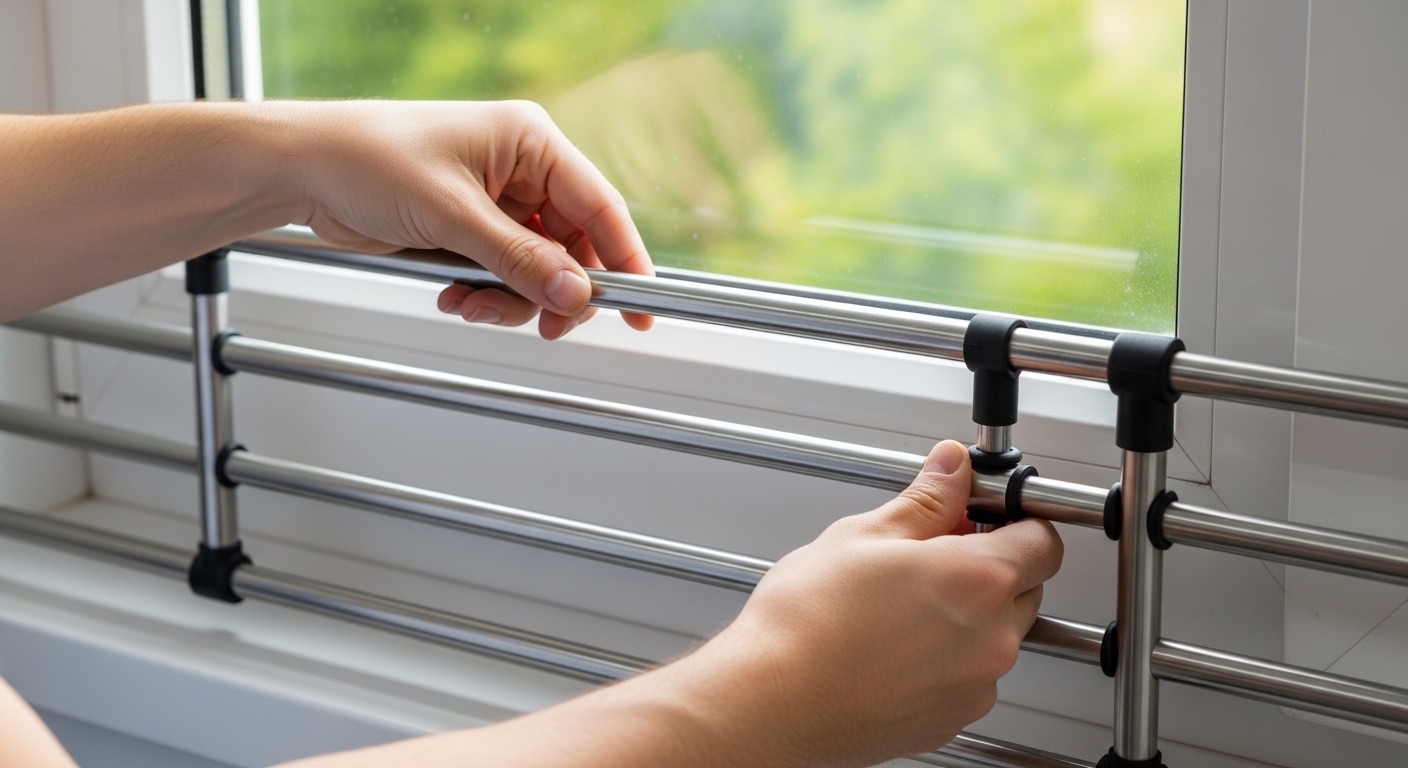
A telescopic track bar sits horizontally in the bottom channel of the sliding door track, spanning from the inner edge of the sliding panel to the fixed frame on the opposite side. When extended to the correct length and locked in position, the bar physically prevents the sliding panel from moving even a fraction of an inch in either direction. The telescopic mechanism — typically an inner tube sliding within an outer tube, secured by a spring-loaded pin or twist-lock collar — allows the bar to be adjusted across a range of several inches to accommodate different panel widths. This is the same fundamental engineering used in SWB's Model A Telescopic Window Bars, which apply the identical no-drill, adjustable principle to window openings. Because no screws, anchors, or adhesives are required, installation and removal take less than 60 seconds, making telescopic track bars ideal for apartment renters who need security without risking their security deposit.
Floor-Brace Security Bars: High Resistance, Fixed Position
Floor-brace patio door bars, sometimes called 'door jammer' or 'door security bar' products, work on a fundamentally different principle. Rather than spanning the track horizontally, they extend at an angle from the door handle or lower rail downward to the floor, with a rubber or non-slip foot pad that digs into the floor surface under load. When pressure is applied to the door from outside, the bar transmits that force into the floor rather than into the door frame. These products can generate significant resistance — some models advertise resistance to over 350 pounds of force — but their effectiveness is highly dependent on floor surface. Carpet provides excellent grip; polished tile or hardwood requires a purpose-designed non-slip pad. Floor-brace designs are generally not adjustable for door width but may be height-adjustable for door handle elevation. They are less effective against the panel-lifting attack method and work best in combination with a track bar for comprehensive protection.
Combination Systems: Layered Security for Maximum Protection
Security professionals consistently recommend a layered approach to sliding door protection, and the most thorough system combines a telescopic track bar (preventing sliding movement) with a secondary anti-lift device (preventing panel lifting). Anti-lift devices are simple brackets that screw into the top track above the sliding panel, reducing the vertical clearance to the point where the panel cannot be lifted off the track — even with the bar removed. A third layer can include a sliding door alarm sensor that triggers an audible alert if the door is moved. For maximum security in high-crime areas or ground-floor apartments in cities like Chicago or Los Angeles, this three-layer approach — telescopic bar, anti-lift pins, and door alarm — provides comprehensive protection at a total cost well under $100. This is dramatically less expensive than the $600 to $1,800 average cost of professional security upgrades cited by national home security installers.
Key Specs to Evaluate Before Buying an Adjustable Sliding Door Security Bar
The US market offers dozens of patio door security bar products at varying price points and quality levels, and the differences between a bar that will protect your home for years and one that will fail under minimal pressure often come down to a handful of measurable specifications. Before purchasing any adjustable sliding door security bar, you should evaluate six core criteria: material and gauge, adjustment range, locking mechanism reliability, finish and corrosion resistance, compatibility with your specific door track profile, and whether the design is renter-compliant for your lease terms. Steel construction is non-negotiable — aluminum and plastic bars marketed as 'security' products will deform under the force generated by a determined intruder. Heavy-gauge steel, ideally with a wall thickness of 1.5mm or greater, provides the structural rigidity needed to function as a genuine physical barrier rather than a psychological deterrent. Powder-coated or epoxy-painted finishes prevent rust in humid climates, which is particularly relevant for homes in Florida, the Gulf Coast states, and the Pacific Northwest where moisture and condensation near sliding glass doors are constant concerns.
Adjustment Range: Measuring Your Patio Door Correctly
Before ordering any adjustable sliding door security bar, take three measurements: the full interior width of the door opening, the width of the sliding panel only (from the inner edge to the fixed frame when the door is closed), and the depth and width of your bottom track channel. Most US residential sliding doors have track channels between 0.625 and 1.0 inches wide and between 0.5 and 0.75 inches deep. A security bar with a base diameter that is too wide simply will not seat properly in a narrow track. Standard telescopic bars designed for residential sliding doors typically have a base profile of approximately 0.75 to 1.0 inches, which fits the majority of US-manufactured aluminum and vinyl door systems. The adjustable length range should overlap your measured panel width by at least 2 inches on each end — giving you room to tighten the fit precisely without over-extending the telescopic mechanism, which can reduce the bar's lateral rigidity.
Steel Gauge and Construction Quality: What Actually Stops a Break-In
The marketing language surrounding door security bars in the US market is, unfortunately, often vague or misleading. Terms like 'heavy duty,' 'commercial grade,' and 'reinforced' are used on products ranging from genuine high-gauge steel to thin-walled painted aluminum. When evaluating construction quality, look for specific material disclosures: 'cold-rolled steel,' 'carbon steel,' or explicit wall thickness measurements (1.5mm minimum, 2.0mm preferred). SWB's steel window and door security products are manufactured from heavy-gauge steel using the same structural approach — providing real resistance rather than cosmetic security. A properly constructed steel bar measuring 0.75 inches in diameter with 1.5mm wall thickness can withstand lateral forces exceeding 500 pounds before deformation, far exceeding the force a human shoulder or a standard pry bar can generate against a residential sliding door. This specification should be your minimum benchmark when comparing products on Amazon or at US home improvement retailers.
Renter Compliance: No-Drill Bars and Lease Considerations
According to the US Census Bureau, 44.1 million Americans are apartment renters — and a significant majority of residential leases explicitly prohibit permanent modifications including drilling, anchoring, or adhesive installation. A telescopic patio door security bar that sits in the track without any permanent attachment is universally lease-compliant because it leaves zero marks, holes, or residue when removed. This is a critical distinction when shopping: some 'security bar' products include instructions for screwing anchor plates into the door frame or floor, which would violate most standard lease agreements and could result in the forfeiture of a security deposit. For renters in New York City, Los Angeles, Chicago, and other major US urban markets where rental prices and deposit amounts are substantial, choosing a strictly no-drill adjustable bar is both a security decision and a financial one. Always verify that the product you select requires no permanent installation before purchasing.
SWB's Telescopic Security Bars: Adapting Window Protection to Patio Doors
Security Window Bars has built its reputation on one foundational engineering principle: high-strength steel security should be accessible, adjustable, and installation-friendly for every American — whether you own your home or rent it. The same telescopic mechanism that makes SWB's Model A and Model A/EXIT window bars the preferred choice for apartment renters across the US translates directly to the patio door security challenge. Adjustability, steel construction, and no-drill installation are precisely the attributes that distinguish genuinely protective door security products from the cosmetic plastic alternatives that fill the lower price tiers of the online marketplace. While SWB's core product line focuses on window openings — with the Model A Telescopic Window Bars covering standard window widths from 22 to 36 inches — the engineering philosophy is directly applicable to evaluating any adjustable sliding door security bar. Look for the same attributes: telescopic steel construction, a secure locking collar or pin mechanism, a finish that resists moisture and corrosion, and a design that requires no permanent installation. These specifications define the difference between a real security upgrade and a product that gives you a false sense of protection.
Model A Telescopic Bars: The Engineering Standard for Adjustable Security
SWB's Model A Telescopic Window Bars — available for $90 at securitywb.com and through Amazon USA — set the benchmark for adjustable steel security bars in the residential US market. Designed to cover standard window widths from 22 to 36 inches with no drilling required, the Model A uses a precision telescopic mechanism that locks securely at any point within its adjustment range. The matte black powder-coated finish provides corrosion resistance suitable for high-humidity environments, and the steel construction delivers the same structural integrity as permanently welded bars at a fraction of the cost and with zero installation damage. For apartment renters who need to secure both windows and sliding doors, the Model A's no-drill philosophy is the standard to demand from any security bar product. Renters in ground-floor apartments in cities like Houston, Philadelphia, and Memphis can install and remove the bar in under 15 minutes — essential when management requires access or when moving day arrives.
Model A/EXIT: When Egress Compliance Also Matters at Sliding Doors
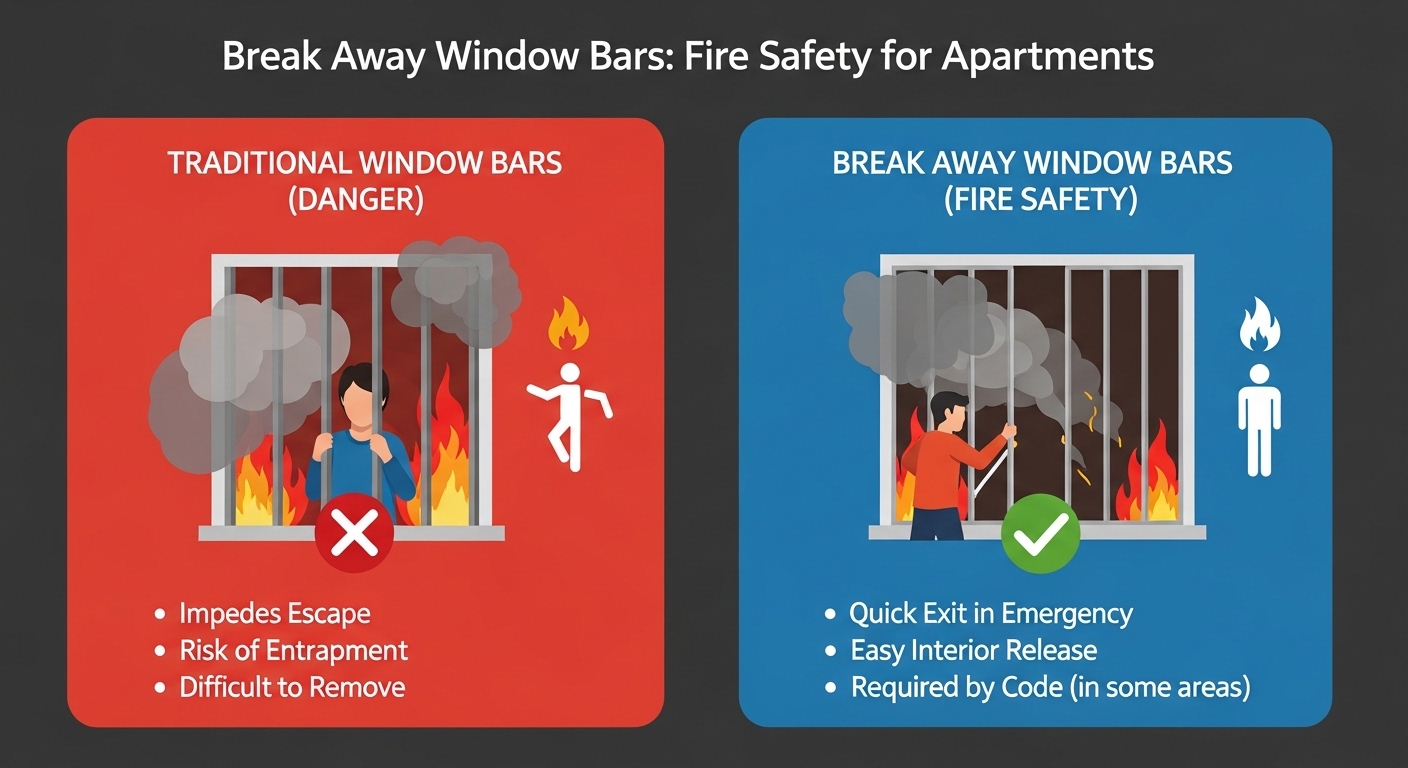
The Model A/EXIT Egress Compliant Window Bars — SWB's patented quick-release security bar — addresses a critical concern that applies to sliding glass patio doors in sleeping areas: fire egress compliance. Under NFPA 101 (the Life Safety Code) and the International Building Code (IBC), any window or door in a sleeping area that serves as a potential egress point must not be permanently obstructed. A fixed or locked security bar across a bedroom patio door could violate these requirements and, more critically, trap occupants during a fire emergency. The Model A/EXIT's patented quick-release mechanism allows the bar to be removed instantly from inside — providing full security against exterior intrusion while maintaining compliant egress capability from inside. This patented system is particularly relevant for ground-floor bedroom suites with direct patio access, a common layout in single-family homes across the Sun Belt states of Florida, Texas, Arizona, and California. For sleeping areas, always prioritize an egress-compliant security bar design.
Where SWB Products Fit in a Complete Patio Door Security System
A complete patio door security system for a US residential property should include: a primary track bar or telescopic bar preventing sliding movement, an anti-lift device preventing panel removal, and ideally a perimeter alarm sensor providing an audible alert. SWB's telescopic bars address the primary window and door panel security layer — the most critical physical barrier against forced entry. They complement rather than replace alarm systems, smart locks, and exterior lighting. For homeowners and renters who want to build a comprehensive security system on a budget, starting with a high-quality adjustable steel bar for the sliding door and supplementing with window security bars on ground-floor windows creates a complete ground-floor perimeter defense at a total cost that is typically 80 to 90 percent less than professional installation. This layered, budget-conscious approach is exactly what SWB was designed to enable for the 44.1 million American renters and millions more budget-focused homeowners across all 50 states.
Installation Guide: Setting Up Your Adjustable Sliding Door Security Bar in 15 Minutes
One of the most significant advantages of a telescopic patio door security bar for an adjustable sliding door is the simplicity of installation. Unlike professional window bar installations that require drilling into masonry or wood framing — a process that can cost $600 to $1,800 according to national home security service providers — a properly designed telescopic bar can be installed by any adult in under 15 minutes using no tools whatsoever. The process is straightforward and consistent across the major telescopic bar designs available in the US market. Understanding the correct installation technique is as important as selecting the right product: even a high-quality steel bar provides diminished protection if it is not seated correctly in the track or adjusted to the right tension. Follow these steps precisely for maximum effectiveness, and refer to SWB's detailed installation resources for visual guidance on proper bar placement and tension adjustment.
Step-by-Step: Installing a Telescopic Track Bar on a Sliding Patio Door
Begin by fully closing the sliding glass patio door and verifying that the existing latch is engaged. Clean the bottom track channel with a dry cloth to remove any debris, dust, or grit that could prevent the bar from seating flush. Extend the telescopic bar to approximately the measured width of your sliding panel — the distance from the inner edge of the sliding panel to the fixed door frame. Place the bar in the bottom track channel with one end against the inner edge of the sliding panel and the opposite end against the fixed frame or door jamb. Extend the bar until it fits snugly with light resistance — you should not be able to wiggle the bar laterally, but you should not have to force it into position. Engage the locking mechanism (pin, collar, or set screw depending on the product design). Test by pushing firmly on the sliding panel from inside: the door should not move at all. For additional security, install anti-lift pins in the top track above the sliding panel. Detailed visual installation guidance for SWB bar products is available at the SWB installation guide.
Common Installation Mistakes That Reduce Security Effectiveness
Several installation errors consistently reduce the effectiveness of patio door security bars in real-world US deployments. The most common mistake is under-extending the bar — leaving it slightly shorter than the panel width so it sits loosely in the track and can be dislodged with minimal lateral force. The bar must fit snugly enough that it cannot be shifted by hand but not so tightly that the telescopic mechanism is under tension stress, which can cause the locking pin to slip over time. A second frequent error is placing the bar on top of the track rather than inside the track channel, which prevents it from properly bracing against the fixed frame and leaves the sliding panel free to lift. Third, many users fail to test the installation after setup — always push firmly on the sliding panel from both the inside and simulate upward lift to verify that the bar prevents both attacks. Finally, remember that a security bar is only as effective as the track it sits in: if your track channel is cracked, bent, or has missing sections, repair or replace the track before installing the bar.
Maintenance and Seasonal Checks for US Climate Conditions
A telescopic steel patio door security bar requires minimal maintenance, but periodic inspection is important — particularly in US climate zones with high humidity, salt air, or temperature extremes. In coastal markets like Miami, Tampa, San Diego, and the New Jersey Shore, salt-laden air accelerates corrosion on uncoated steel surfaces. Inspect the bar's finish every three to six months for chips, rust spots, or coating degradation. A light application of silicone-based lubricant on the telescopic mechanism twice per year will keep the adjustment collar or pin operating smoothly, particularly in humid climates. In northern US markets like Minneapolis, Chicago, and Boston, temperature cycling between summer heat and winter cold can cause metal to expand and contract, occasionally causing a previously snug bar to feel slightly loose in winter. Re-check and re-adjust the bar's tension setting when seasons change. Store the bar indoors if you are leaving a vacation property unoccupied for extended periods to prevent weather-related finish degradation.
Patio Door Security Bars and US Building Codes: What Renters and Homeowners Must Know
Security installations in residential properties — even removable, no-drill installations — intersect with US federal, state, and local building codes in ways that homeowners and renters should understand before purchasing. The most critical code consideration for patio door security bars is emergency egress compliance. Under the International Building Code (IBC) and NFPA 101 (the Life Safety Code), which are adopted in whole or in part by all 50 US states, egress doors in residential occupancies must be openable from the inside without the use of a key, tool, or special knowledge. This requirement is particularly relevant for sliding glass patio doors that serve as the primary or secondary means of egress from a bedroom, basement living area, or accessory dwelling unit. A security bar that can only be removed from the outside, or that requires a key to disengage from the inside, would be non-compliant in most US jurisdictions and could create a life-safety hazard during a fire emergency. Always verify that any security bar you install on a patio door serving a sleeping area includes a quick-release mechanism operable from the inside without tools.
IBC and NFPA 101 Egress Requirements for Sliding Doors
Section 1010 of the International Building Code (IBC) establishes that egress doors in residential settings must be readily openable from the egress side without the use of a key or special knowledge. NFPA 101, the Life Safety Code, echoes this requirement in Chapter 24 (One- and Two-Family Dwellings) and Chapter 26 (Lodging or Rooming Houses), with specific language addressing doors that serve sleeping areas. For sliding glass patio doors in bedrooms or ground-floor family rooms that may serve as escape routes, any security bar installed must be removable instantly from the interior without tools or a key. This is the design requirement that SWB addressed with the patented quick-release mechanism in the Model A/EXIT Egress Compliant Window Bars. If you are installing any security bar on a patio door that serves a sleeping area, verify before purchase that the product explicitly states egress compliance and describes how the quick-release mechanism functions from the interior.
NYC, California, and State-Level Window Guard Regulations
While New York City's Local Law 57 specifically governs window guards in residential buildings with children under 10 years of age — requiring building owners to install approved window guards on windows other than egress windows — sliding glass patio doors are generally addressed under different provisions. California's Title 24 Building Standards Code includes specific requirements for sliding door hardware and safety glazing in residential construction. Several US states have adopted amendments to the IBC that impose additional egress requirements for multi-family residential buildings. If you are a landlord, property manager, or AirBnB host installing security bars on a rental property, consult your local building department to confirm that your chosen product and installation method comply with applicable local amendments. This is particularly important in California, New York, Texas, and Florida — four states with the highest rental housing stock and the most active building code enforcement environments in the country.
HOA Rules and Lease Restrictions: Navigating Patio Door Security in Managed Communities
Beyond building codes, many US homeowners in planned communities and condominium associations are subject to HOA covenants that restrict visible security modifications to doors and windows facing common areas or streets. In many Sun Belt HOA communities — particularly in Florida, Arizona, Nevada, and Texas — exterior security bars on patio doors may require architectural review committee approval, even for removable products. Similarly, apartment renters should review their lease agreement for language prohibiting modifications to doors, windows, or sliding door tracks before installing any security bar. The good news is that because telescopic no-drill bars leave no marks and are entirely removable, they are generally classified as personal property rather than a modification — similar to a door chain — in most lease interpretations. However, if your lease includes unusually broad restriction language, obtain written permission from your landlord before installation. Document the pre-installation condition of your track with photographs as additional protection.
Comparing Patio Door Security Bar Options: What the US Market Offers in 2026
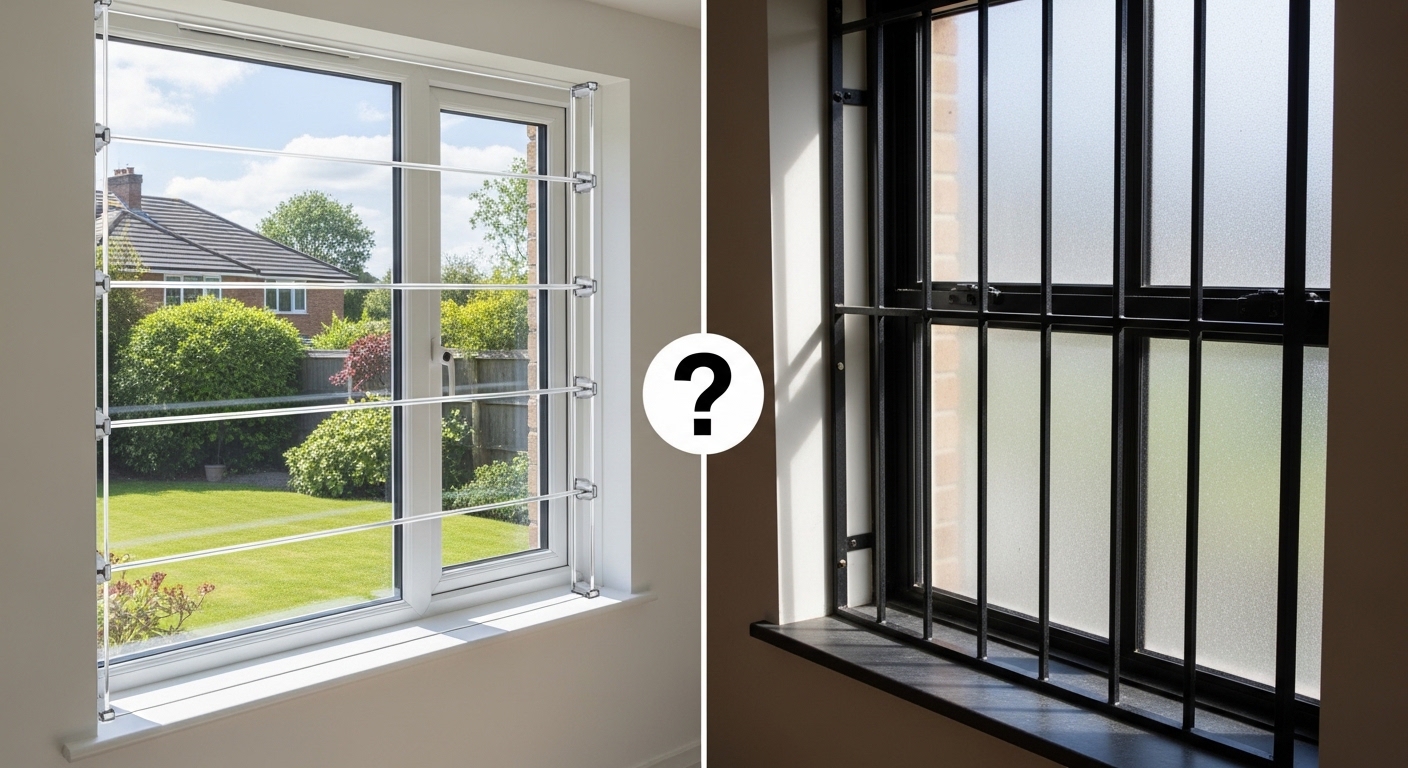
The US market for patio door and sliding door security bars has grown significantly in recent years, driven by rising residential property crime rates and increasing awareness among the country's 44.1 million renters that sliding glass doors represent a significant security gap. Products available through major US retail channels — including Amazon, Home Depot, Lowe's, and specialty security retailers — range from basic polypropylene pin bars retailing under $15 to precision-machined steel telescopic systems approaching $100. Understanding where each product category sits on the security-versus-convenience spectrum allows buyers to make informed decisions aligned with their actual risk profile. For context, the security bar products available at major US home improvement chains — while widely accessible — are frequently manufactured from aluminum or low-gauge steel with plastic adjustment mechanisms that will deform under the sustained lateral force of a determined break-in attempt. The critical differentiators are material quality, gauge, and locking mechanism reliability — specifications that must be evaluated against marketing claims.
Budget Segment ($10–$30): Basic Track Pins and Plastic Bars
The lowest price segment of the US patio door security bar market — products retailing between $10 and $30 — is dominated by simple track pins, adjustable plastic bars, and aluminum cut-to-length rods. These products provide a minimal deterrent against casual or opportunistic entry but should not be relied upon as primary security in moderate- to high-crime neighborhoods. Plastic adjustment mechanisms can crack or shatter under impact; aluminum bars below a certain wall thickness will bow and slip before a determined intruder applies full body force. In neighborhoods with high property crime rates — such as those found in parts of Memphis, Baltimore, Detroit, and south Chicago — these budget products are essentially ineffective beyond the psychological deterrence of their visible presence. They are appropriate as a secondary supplemental device in already-secure installations, not as a standalone security solution.
Mid-Range Segment ($30–$70): Steel Track Bars and Floor-Brace Designs
The mid-range segment offers the best value-to-protection ratio for most US residential applications. Products in the $30 to $70 price range typically feature steel or steel-alloy construction with genuine telescopic adjustment mechanisms, non-slip end caps, and powder-coated or zinc-plated finishes. Floor-brace designs (door jammer style) in this price range often include adjustable-height handles and high-friction floor pads suitable for carpet, tile, and hardwood. The telescopic track bar designs in this segment cover most standard US sliding door panel widths from approximately 27 to 52 inches and provide genuine structural resistance to lateral sliding force. For the majority of US apartment renters and homeowners in average-crime neighborhoods, a well-chosen mid-range steel telescopic bar provides adequate primary protection when combined with a functioning door latch and exterior lighting.
Premium Segment ($70–$100+): Precision Steel, Egress Compliance, and SWB Quality
At the $70 to $100+ price point, US consumers gain access to security bars featuring heavier-gauge steel construction, precision-machined telescopic mechanisms with positive locking engagement, powder-coated finishes rated for exterior-grade durability, and — in the case of products like SWB's Model A/EXIT — patented egress-compliant quick-release systems. This price tier represents the intersection of professional-grade security and consumer-accessible pricing. For comparison, professionally installed fixed window security bars on a single window in a major US city typically cost between $150 and $400 per window, with full-home installations routinely exceeding $1,500. A premium telescopic security bar system for a patio door at under $100 provides comparable physical resistance to sliding-door forced entry at a fraction of the cost, with the additional advantages of portability, adjustability, and no installation damage. For renters, landlords, and AirBnB hosts who need reliable security without permanent commitment, this premium segment represents the most rational investment available in the US market today.
Complete Patio Door and Window Security: Building Your Home's Perimeter Defense
Effective residential security is never a single product — it is a layered system of physical barriers, detection mechanisms, and deterrent signals that collectively make your home a significantly harder target than the alternatives in your neighborhood. A patio door security bar for an adjustable sliding door is the cornerstone of ground-floor perimeter security, but it works best as part of a comprehensive protection system that includes secured windows, adequate exterior lighting, and basic alarm detection. According to the National Crime Prevention Council, homes with visible physical security measures — including window bars, door reinforcements, and exterior lighting — are statistically targeted less frequently than adjacent properties without these visible deterrents. Burglars, like all opportunistic criminals, make rapid cost-benefit calculations: the combination of a steel door bar, window security bars, and exterior motion lighting signals that forced entry will require significantly more time, noise, and effort than a home with no visible security. This deterrence effect alone justifies the investment in a complete ground-floor security system, even beyond the direct physical protection the bars provide.
Securing Ground-Floor Windows Alongside Your Patio Door
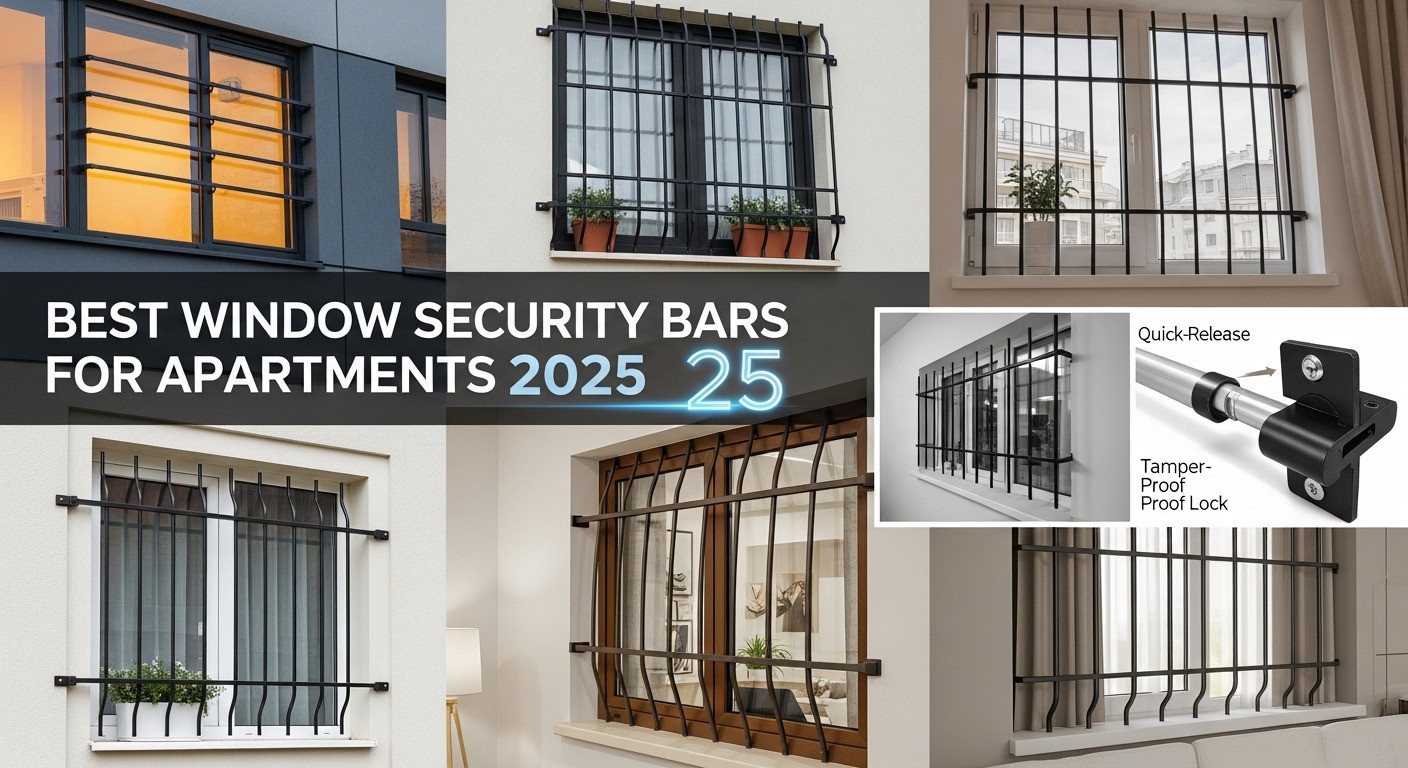
For renters and homeowners who have secured their sliding patio door with a telescopic bar, the logical next step is extending that same protection philosophy to ground-floor windows. Ground-floor windows — particularly in basement apartments, first-floor bedrooms, and utility rooms — represent the second most common unauthorized entry point after sliding doors, accounting for a significant share of the 60% of break-ins that occur through ground-level openings. SWB's full product line addresses this need directly. The Model A Telescopic Window Bars ($90) provide the same no-drill, adjustable steel security for standard windows 22 to 36 inches wide. For ground-floor homeowners who want permanent, maximum-security window protection, the Model B Wall-Mount Window Bars ($91) offer fixed heavy-gauge steel bars with a powder-coated black finish designed for permanent installation on exterior window frames. You can explore the complete window bar product range and the broader universe of clear bars, window security bars that open, window grates, and door grilles — all part of SWB's comprehensive security ecosystem for American homes.
Exterior Lighting, Alarm Sensors, and the Complete Security Stack
A steel security bar prevents physical entry; exterior lighting and alarm sensors add detection and deterrence layers that multiply the overall security effect. Motion-activated exterior floodlights on patio door areas eliminate the concealment advantage that dark backyards and side yards provide to intruders in urban and suburban neighborhoods. Research published by the National Institute of Justice indicates that improved exterior lighting is one of the most cost-effective environmental crime deterrents available. Inexpensive magnetic alarm sensors placed on the sliding door frame provide an audible alert if the door is moved — even if a security bar is not in place. Door reinforcement products including strike plate reinforcers and door frame armor further harden the door assembly against forced entry. Together, a telescopic steel patio door bar, window bars on adjacent ground-floor windows, exterior motion lighting, and a basic alarm sensor create a comprehensive perimeter defense that addresses all three stages of a residential break-in attempt: approach detection, physical entry deterrence, and forced-entry resistance.
Security for Renters: Building a Portable Protection Kit You Take With You
One of the most underappreciated advantages of no-drill telescopic security bars is their portability. A renter who invests in a high-quality adjustable patio door security bar and a set of telescopic window bars has created a personal security kit that moves with them from apartment to apartment — providing immediate protection in any new unit without waiting for landlord action or professional installation. This is particularly valuable in the US rental market, where tenant turnover is high and the time between signing a lease and moving into a new apartment may be days rather than weeks. In high-mobility urban markets like New York, San Francisco, Chicago, and Washington DC, where renters frequently move between apartments, this portability represents genuine ongoing value. For landlords managing multiple units, a standardized set of telescopic bars that can be transferred between units between tenants — or provided to tenants as part of a security-conscious lease package — represents both a marketing advantage and a potential liability reduction.
🏆 Conclusion
A patio door security bar for an adjustable sliding door is not a luxury upgrade — it is the minimum standard of physical security for any American home with a sliding glass patio door. With 6.7 million residential burglaries occurring across the United States every year, and sliding glass doors consistently identified as one of the top forced-entry points by law enforcement and security researchers, leaving your patio door secured by only its factory latch is a risk that no renter, homeowner, landlord, or property manager should accept. The good news is that the solution is straightforward, affordable, and available for immediate delivery across all 50 states through Amazon and directly from securitywb.com. A precision-engineered, heavy-gauge steel telescopic bar — installed correctly in your door track in under 15 minutes with no tools and no drilling — physically eliminates the two primary methods burglars use to defeat sliding patio doors. Combined with window security bars on adjacent ground-floor windows, exterior motion lighting, and a door alarm sensor, your sliding door becomes one of the most secure entry points in your neighborhood. Do not wait for a security incident to prompt action. Security Window Bars exists to make professional-grade perimeter security accessible to every American family, at a price that makes the decision simple. Secure your patio door today.
Security Window Bars · USA
Secure Your Home Today
Protect your patio door now with SWB's adjustable steel security bars — no drilling, no contractor, no waiting. Shop Security Window Bars on Amazon USA with fast Prime delivery to all 50 states, or explore the full product lineup and order directly at securitywb.com. Starting at $90, SWB bars are the smartest security investment for renters, homeowners, and landlords across America.
Shop on Amazon →Frequently Asked Questions
Standard US residential sliding glass doors come in three common widths: 60 inches (5 feet), 72 inches (6 feet), and 96 inches (8 feet). Because only one panel slides, the track span you need to secure is roughly half the door width — typically 28 to 50 inches. Before purchasing, measure the interior distance from the inner edge of your sliding panel to the fixed door frame when the door is fully closed. Choose a telescopic adjustable bar whose adjustment range comfortably includes your measured dimension, with at least 2 inches of overlap on each end of the range for proper tension.
Yes — telescopic track bars that sit in the bottom channel of your sliding door track require absolutely no drilling, anchoring, or adhesives. They are held in place purely by tension against the door panel and the fixed frame, leaving zero marks when removed. This makes them 100% lease-compliant in virtually all standard US rental agreements. If your lease contains unusually broad modification restrictions, document the pre-installation condition of your door track with photos and, if needed, obtain written permission from your landlord — though most landlords welcome tenant-funded security improvements.
If your patio door is located in or adjacent to a sleeping area and serves as a potential emergency egress point, any security bar you install must be removable from the inside without tools or a key under NFPA 101 (Life Safety Code) and IBC Section 1010 requirements adopted across all 50 US states. Standard telescopic track bars that sit in the bottom track are removable instantly from the interior and are generally compliant. For maximum compliance certainty in bedrooms, consider a product with a patented quick-release mechanism — like SWB's Model A/EXIT — which is specifically designed to meet IBC and NFPA 101 egress standards.
A properly installed heavy-gauge steel telescopic bar is highly effective against both primary methods used by burglars to defeat sliding glass doors: lateral sliding (latch defeat) and vertical lifting (panel removal). By physically bracing the sliding panel against the fixed frame within the track, a steel bar prevents the door from moving in either direction. Well-constructed steel bars with 1.5mm or greater wall thickness can withstand lateral forces exceeding 350 to 500 pounds before deformation — far beyond the force an intruder can apply quickly and quietly. For comprehensive protection, combine the track bar with anti-lift pins in the top track above the sliding panel.
A telescopic track bar sits horizontally in the bottom channel of the sliding door track, spanning between the sliding panel and the fixed frame. It prevents both sliding movement and panel lifting when properly installed. A floor-brace bar (sometimes called a door jammer) angles from the door handle downward to the floor at roughly 45 degrees, transmitting forced-entry pressure into the floor. Floor-brace designs offer high resistance to inward push but are less effective against the panel-lifting attack. They also depend on floor surface for grip — carpet works well, but polished tile or hardwood may require a non-slip pad. For most US residential applications, the telescopic track bar provides more comprehensive protection.
Telescopic security bars designed specifically for sliding door tracks and those designed for window openings have different dimensional profiles, as window tracks and door tracks are manufactured to different specifications. However, the same purchasing philosophy applies to both: choose adjustable, heavy-gauge steel, no-drill designs. SWB's Model A Telescopic Window Bars are engineered specifically for window openings ranging from 22 to 36 inches wide, while adjustable patio door bars are sized for sliding door panel widths from approximately 27 to 52 inches. Using purpose-designed bars for each opening type ensures proper seating, maximum rigidity, and correct security performance.
Quality varies dramatically with price in the US market. Products in the $10 to $30 range are typically plastic or thin aluminum and provide only psychological deterrence against a determined intruder. Mid-range products from $30 to $70 offer steel or steel-alloy construction with genuine adjustment mechanisms suitable for average-crime neighborhoods. Premium products from $70 to $100 provide heavy-gauge steel, precision telescopic mechanisms, and durable powder-coated finishes comparable to professional-grade security hardware — at a fraction of the $600 to $1,800 cost of professional window and door bar installation. For urban renters and homeowners in moderate- to high-crime areas, a premium telescopic bar is the most rational investment.
Most US residential sliding glass patio doors are single-direction systems — one panel is fixed while one slides in a single track direction. Telescopic track bars are designed for this standard configuration. Bi-parting sliding doors (where both panels slide toward the center) require a different approach, typically involving a center-locking device or two separate bars positioned in both track channels. If your patio door is a bi-parting design — more common in commercial and premium residential applications — verify before purchasing that your chosen security bar product specifically supports that configuration. For standard single-direction residential sliding doors, any quality telescopic track bar will work correctly.