Window fall prevention isn’t a “freak accident” category—it’s a predictable household risk with patterns you can design out of your home. In the United States, thousands of children are treated in emergency departments every year after falling from windows, and safety officials have warned for decades that these incidents rise during warmer months when families open windows for ventilation. (U.S. Consumer Product Safety Commission)
The hard truth is simple: a single open window can become a fall hazard in seconds—especially when a toddler discovers a new climbing skill overnight. The room didn’t change. The child changed. That’s why window fall prevention works best when it’s built into your environment, not dependent on perfect supervision.
This guide turns window fall prevention into an actionable, room-by-room system. You’ll learn how falls happen, which rooms create the highest risk, which devices actually work (and which ones don’t), and how to protect kids without creating an emergency trap. Because real home safety is not just “anti-intruder.” It’s anti-tragedy.

A strong window fall prevention plan is a layered system:
If you only do one thing today: move climbable furniture away from windows and limit how far windows can open.
Window fall prevention starts with understanding why “normal rooms” can become fall zones so fast. Most window falls are not caused by “reckless parenting.” They’re driven by normal child development: toddlers explore, test boundaries, and gain skills in sudden jumps. A child who couldn’t climb yesterday may climb today.
Small children have different proportions than adults. A toddler’s head and upper body represent a larger share of total body mass, shifting the center of gravity upward. That means a forward lean can become a tip-over event faster than the child can correct. This creates a common pattern in pediatric falls: the child leans toward the outside, pushes on a screen or opening, then topples.
Window fall prevention must assume this reality: toddlers don’t “fall like adults.” Their bodies tip sooner, and they can’t reliably stop themselves once momentum starts.
Toddlers don’t have mature risk evaluation. They see a view. They hear a parent outside. They spot a bird. They move. A spoken warning—“Don’t do that!”—is not a safety device. So a serious window fall prevention plan must be physical, not verbal.
Many incidents happen because the adults underestimate the speed of child development. The room didn’t change; the child did. A toy bin becomes a step. A low dresser becomes a ladder. A chair slides into place. A bed becomes a launchpad. And once a child can reach a sill, an open window becomes a hazard.
That’s why you should treat window fall prevention like smoke alarm safety: you install systems before you “need” them.
Fast truth: You cannot supervise perfectly every second. The best window fall prevention strategies assume real life—distractions, doorbells, cooking, work calls, multiple kids, pets, and the chaos of daily routines.
Let’s be clear: the burden of window falls is large enough to be predictable—meaning it’s preventable at scale. The U.S. Consumer Product Safety Commission (CPSC) has repeatedly reported thousands of children injured each year and has emphasized that screens do not prevent falls and that guards and stops are core prevention strategies. (U.S. Consumer Product Safety Commission)
Different sources and years use slightly different age ranges and datasets, but the conclusion stays consistent:
Even if your neighborhood feels safe, the hazard is widespread. Window fall prevention should be “default home design,” not a special project you get to later.
Many people assume window falls are mainly a high-rise problem. But families live on lower floors too, and injuries can be severe even from relatively modest heights—especially when the landing surface is concrete, tile, or compacted ground. Window fall prevention should apply on any floor where a child can access a window.
Safety officials warn that risk increases when temperatures rise and windows are opened more frequently. (U.S. Consumer Product Safety Commission)
Translation into action: do your window fall prevention upgrades before the first heat wave, not after the first close call.
Some sources focus on ages under 5, others under 10, others under 18. Some count only emergency department visits. Some include admissions. The numbers differ, but the prevention logic doesn’t: open windows + climb access + lack of barriers creates predictable outcomes.
If you want a quick upgrade to your safety mindset, delete these myths from your home:

Insect screens are for bugs—not bodies. CPSC has explicitly warned that screens do not prevent falls.
Screens can create a false sense of security: “It’s fine, there’s a screen.” That false confidence is dangerous because it leads to riskier behavior—windows left open longer, furniture left in place, and less urgency around installing real devices.
A core rule of window fall prevention is: treat a screened window as an open window.
Lower height is not “no risk.” A second-floor fall can still be catastrophic. A first-floor fall onto concrete can still cause severe head injury. Window fall prevention is not a “high-rise only” issue. It’s a child-access issue.
Supervision is essential—but it’s not a guarantee. Real households include interruptions. Cooking. Phone calls. Siblings. Visitors. Work. The best window fall prevention systems assume adults will be distracted sometimes, and the room should remain safe anyway.
Core rule: Treat every accessible open window as a hazard unless it’s physically engineered to stay safe.
If you want one mental model that drives great decisions, use this:
A widely cited safety approach is limiting how far a window can open in rooms where young children are present—often framed as about 4 inches. CPSC has discussed both guard bar spacing and window stops using the 4-inch concept.
The “4-inch rule” shows up in two ways:
This is not about memorizing a number—it’s about adopting a prevention mindset: reduce the chance a child can fit through or topple out.
Window stops are powerful because they don’t ask the child to behave. They remove opportunity. If your home has toddlers, window fall prevention should treat opening control as a baseline.
A specific class of products—often called Window Opening Control Devices (WOCDs)—exists to support window fall prevention by controlling how far a window opens, while still allowing an adult to override when needed.
ASTM has a dedicated standard for window fall prevention devices: ASTM F2090, which covers devices intended to help prevent falls and includes provisions related to emergency escape and rescue opening release mechanisms.
Practical takeaway: When you’re shopping, you want devices that are designed for the purpose—not random hardware that “seems fine.”
Families open windows because they want fresh air. So window fall prevention shouldn’t fight ventilation; it should make ventilation safer.
Minimum practical plan: limit openings + move furniture + stop relying on screens. Add engineered barriers and you dramatically reduce risk.
A winning window fall prevention plan isn’t “buy one thing and hope.” It’s a checklist you apply to each room—especially rooms kids use when you’re distracted.
Bedrooms are high-consequence zones: children spend time there, and incidents can happen at night or early morning when adults are not fully alert.
Do this now:
Pro tip: Rules that change by room get forgotten. Make one household rule:
No climbable furniture within reach of windows.
That single rule is a foundation of window fall prevention.
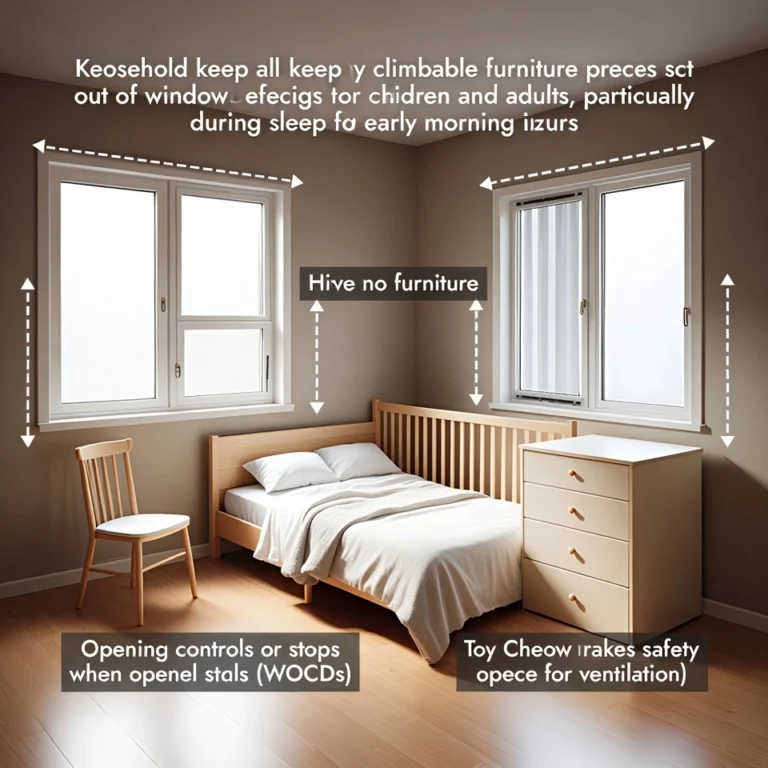
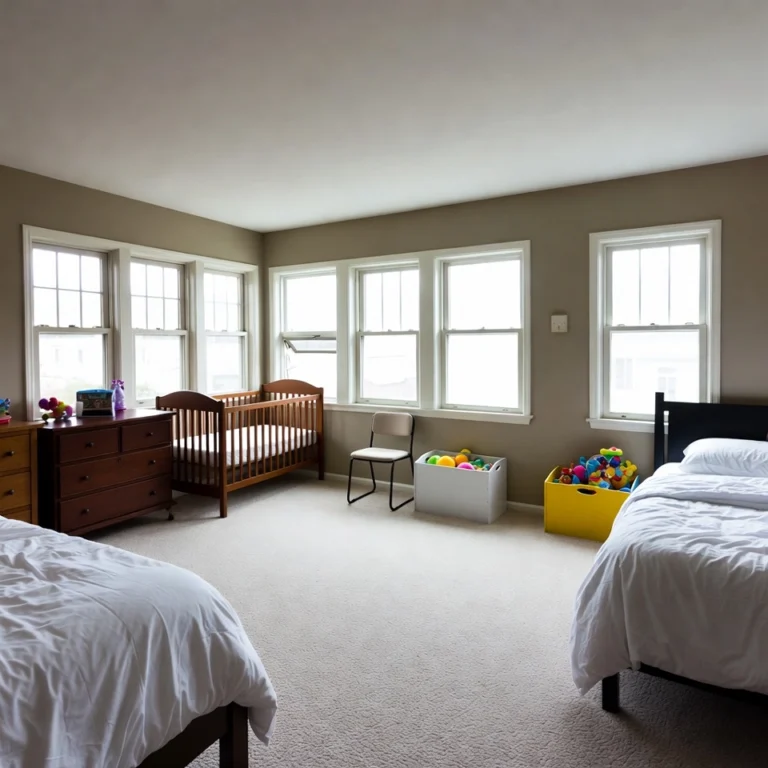
This is where life happens—meaning distraction is normal.
High-risk patterns:
Fix it:
Window fall prevention is most successful when it’s built into the default layout.
Busy hands + divided attention = risk. Many families open windows while cooking.
Fix it:
Bathrooms are tricky: hard surfaces increase injury severity.
Fix it:
Basements create a special “double-risk” environment: windows can be both a security target and a fall hazard.
Fix it:
Windows by stair landings can create unusual fall paths.
Fix it:
Online listings often blur categories, and families end up buying the wrong device. Window fall prevention improves when you match the tool to the problem.
Goal: limit how far the window opens.
Best for: quick risk reduction, especially with toddlers.
Key benefit: doesn’t rely on behavior.
Stops are a common “first layer” in window fall prevention because they reduce immediate opportunity.
Goal: prevent a child from falling out even if the window is open.
Best for: bedrooms, play areas, rooms where windows are opened often.
Key features to look for: strength, secure mounting, and spacing that supports child-safety intent.
CPSC has highlighted guard concepts such as bars spaced at about 4 inches apart.
Important distinction: some guards are fixed, some are openable. Fixed guards may increase safety from falls but can create emergency escape issues depending on the room and local requirements.
“Restrictor” can mean different things depending on the product. Many are forms of opening control. Some are designed for certain window types and require careful installation.
The window fall prevention checklist still applies: if it can be bypassed easily, or if it only “kind of” works, treat it as unreliable.
Goal: allow ventilation while controlling opening size; allow adult override.
ASTM F2090 is a specific standard for window fall prevention devices, including features related to emergency escape release mechanisms.
Practical takeaway: WOCDs are often a smart middle ground for families who need ventilation but want predictable window fall prevention outcomes.
It needs to be repeated because it’s so common: CPSC warns that screens do not prevent falls.
Screens are bug control, not child safety.
This is where safety planning becomes mature: a device can prevent a fall and still create a different hazard if it blocks emergency escape. Window fall prevention should reduce risk, not trade one risk for another.
CPSC and safety guidance repeatedly emphasize that if a window must function as an emergency escape, you must keep it usable.
In a real emergency:
So the best window fall prevention systems in escape-relevant rooms follow a simple philosophy:
secure in normal life, simple to open from inside in an emergency.

If a barrier requires a key, a tool, or a “special trick” to open from the inside, that’s a serious safety red flag in rooms where emergency escape matters.
ASTM’s window fall prevention standard references emergency escape and rescue opening release mechanisms as part of device considerations.
Whatever you install, test it periodically:
This is the difference between “installed safety” and real window fall prevention.
Renters face a common problem: they need window fall prevention, but they may not control the building, the window type, or what modifications are allowed.
Don’t assume “I’m renting” means “I can’t improve safety.” You can still:
NYC provides a helpful illustration of how seriously some jurisdictions take window safety. NYC Health states that property owners must install window guards upon tenant request (with key exceptions for emergency exits), and that additional requirements can apply when children age 10 or under are present in the building. (Gobierno de Nueva York)
You don’t need to live in NYC to learn from this: in many places, window fall prevention intersects with landlord responsibilities, child occupancy rules, and emergency exit requirements.
When requesting help, be specific:
This turns window fall prevention into a maintenance request—not a debate.
If the answer is “no,” focus on the layers you control:
Most retail security products focus on intrusion prevention only. But a truly hardened home solves multiple risks at once: burglary risk and injury risk.
That’s where the idea of a dual-mission system becomes powerful:

Effective window fall prevention relies on limiting what can pass through openings. CPSC has described window guard bars spaced at about 4 inches as part of prevention messaging.
So if you’re using any bar/guard approach, think in terms of:
In humid regions, coastal climates, and high-UV environments, cheap metal and coatings degrade fast. Your family’s window fall prevention plan should include reliability over time—not just “it looks okay today.”
For windows where emergency planning matters, the best systems are engineered around simple inside release—consistent with the broader safety logic emphasized by standards and safety guidance. ASTM’s standard for window fall prevention devices explicitly addresses the role of emergency escape and rescue opening release mechanisms in this category of products.
Practical safety note: Always confirm local requirements for which windows are considered emergency exits and how protection devices must behave. The correct window fall prevention solution depends on your window’s role in your home’s emergency plan.
If you want progress fast, stop thinking “big project” and start thinking “audit + actions.”
For each room with an accessible window, answer:
Any room with (1) + (2) + (3) is a high priority for window fall prevention.
Window fall prevention becomes easy when it becomes your default system.
Window fall prevention works because the risk isn’t mysterious. Open windows, climbable furniture, and missing barriers create predictable outcomes. A hardened home isn’t just “anti-intruder.” It’s anti-tragedy.
Start today with the free fixes: furniture placement, rules, and locking habits. Then add engineered layers: opening control devices and true window guards—especially in bedrooms and high-use kid zones. If emergency escape matters for a given window, use solutions that preserve usability and practice them.
That’s what real window fall prevention looks like: a system that protects kids in normal life and still respects emergency realities.
COOKIES POLICY
Security Window Bars LLC ("SWB") uses cookies and similar technologies to improve your browsing experience and enhance the functionality of our website www.securitywb.com (the “Website”). This Cookies Policy explains what cookies are, how we use them, and how you can manage your cookie preferences.
By using our Website, you agree to our use of cookies as described in this policy.
Last Updated: 01/01/25